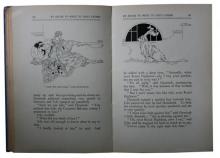
Birthday party, p.5
Birthday Party,
p.5


It was the engagement, I think, the sudden need for Aunt Julia and Ada to come to London for pre-nuptial shopping, which led to the suggestion that the two sisters should exchange houses for the last fortnight of August. So, Hilda being with a school-friend in Suffolk, Aunt Julia and Ada came to Sydenham. And Aunt Hester and Mary, pleasantly excited at the thought of the sea, came to Sandbeach.
They made the great change on the same day. Their trains crossed, as for a week past their letters had crossed; and this had made it necessary for each side to leave in a prominent place an elaboration of notes: on such matters, for example, as the best and quickest laundry in an emergency, the relative altitude of the Vicar’s liturgy, and what to do if, as sometimes happened, a flush of water was delayed. What interested Mary most was the presence of a key labelled ‘Hut 26’, and the information that, though undressing behind the boulders in the West Bay was now allowed to visitors, the residents naturally preferred to use the huts in the East Bay, and dear Mary would, of course, wish to do the same. But it was most important that the hut should always be kept locked. When the girls bathed, they buried the key in a hole in the sand while actually in the water. It was safer, as there were always prowlers about, and there were cases of clothes being actually stolen.
Mary loved swimming. She had, as a real swimmer should have, a blue one-piece which gave her the freedom of the water. Aunt Hester had tolerated, if she had not altogether approved, her niece’s appearance in this in the Sydenham Baths (Ladies’ Days); but for mixed bathing, in the very mixed society of a seaside resort, she considered it a little, just a little, unladylike. Faced by a slightly rebellious Mary with the pattern in Girl, Wife, and Mother of an attractive two-piece, in which each piece attended to its own business and made no attempt to meet the other half-way, she admitted sadly that she was old-fashioned, and Mary must do as she pleased. Mary kissed her, and said that she was an old darling. However, old darlings do not surrender so easily. When Mary, towel over shoulders, left Hut 26, Aunt Hester followed, camp-stool in hand, key in bag. Mary slipped off the towel and plunged into the sea. When she came, wet and shining, like Venus from the waves, and almost as revealed, Aunt Hester was at the water’s edge to throw the towel of invisibility over her, and hurry her back to sanctuary.
They made many nice friends on the beach. There was old Mrs Gosling, who had had children and operations in abundance, and who gave them much interesting information about both. Some of the grandchildren were almost ready to have their tonsils out; which may have explained her expressed hope that they would meet again in London in the winter. There were also the Amersham girls, who had a great fund of anecdote about the upper reaches of Society, which they were not unwilling to pass on. Mrs Manders, who came to Sandbeach every summer, could tell them of the changes in the amenities and tone of Sandbeach in the last forty years. There were many nice people about . . . and sometimes Mary wondered what Dorothy Lamour would have thought of them.
3
On Saturday they were going back to London. Packing—which always took Aunt Hester a long time, being planned in detail, as a general plans a campaign—would occupy most of Friday. To-day was the last free day, Mary’s last opportunity for a lovely swim in the lovely, lovely sea.
I am very sorry, dear,’ said Aunt Hester after breakfast, ‘but I shall not be able to come with you this morning. I have my girls to look after.’ She held up a bunch of letters, which had been sent on, a little unexpectedly, from the office. She had already opened one of them: from blue eyes (16), whose boy was taking some other girl to the next dance, and who naturally wanted to know if Life had anything else to offer. Aunt Hester was very sound on this, and would explain in the firmest but kindest way that suicide was altogether out of the question.
‘Oh, well, darling, I can go by myself.’
‘Of course, dear, but not, I think, to bathe. Just sit with old Mrs Gosling for a little; or take a look round the shops, or you could listen to the band with those nice Amersham girls.’
‘Very well, Aunt Hester,’ said Mary meekly.
But up in her room she stamped her foot and said that she would bathe, yes, she would. Only, of course, she mustn’t be seen leaving the house with a towel and bathing-dress . . .
She undressed. She put on the blue one-piece. She put a skirt and a hand-knitted jumper over it. Aunt Hester, like the American Board of Censors, didn’t approve of jumpers, but this one had been a present from Aunt Julia, and evidently intended in the first place for Ada, a bigger proposition altogether. It was a catholic jumper, which made no distinction between left and right, back and front; an outrage in orange which even Ada had rejected violently. To Mary this morning it was just a covering to get her down to Hut 26, and out into the sea. She would dry in the sun, slip on the skirt and jumper, and hurry back.
So off she went; and at the gate the golden Labrador, who had been hanging about wistfully for days, joined her.
Nobody ever knew whose dog he was; nobody but the Labrador, who knew he was Mary’s. Previously, when he had proposed to accompany them to the beach, and carry Mary’s towel for her, save her life if drowning, or render any other little service for his beloved which she asked of him, Aunt Hester had shooed him away. He had promptly sat down in the middle of the road and given them one look, of such unfathomable reproach that Mary could hardly bear it. ‘Couldn’t we take him, Aunt Hester?’ she would ask, and Aunt Hester would say, ‘We don’t know whose dog he is, dear. He hasn’t even a collar,’ as if this put him definitely among the submerged classes.
But the Labrador knew. To-day there was no one to shoo him away. Only the beloved was there . . . and the two of them went down together to the beach.
Of Mary’s swim, almost to France and back, we will say nothing. The Labrador went in a little way with her, assured himself that she was a real swimmer, and came back to the water’s edge to wait for her. They returned together to Hut 26.
‘Oh, dear!’ said Mary, ‘I forgot to bury the key!’ She opened the door, and went in. The Labrador, knowing his place, sat on guard outside.
And the skirt and jumper were not there!
It was no good looking for them; telling oneself that they had fallen off their hooks. Even in a well-furnished bedroom the orange jumper would have let its presence be known, however carelessly flung aside. Here concealment was impossible. One of those prowlers, while Mary was off Ushant, had prowled by, seen the key in the door, entered and taken what she could find. Luckily, to-day, only that hideous jumper and a very old skirt.
Well, that didn’t matter so much. What did matter was that she had to get back to Cragsyde, ten minutes’ walk up the hill. She couldn’t, she simply couldn’t, walk all that way in a wet bathing-dress! She didn’t need Aunt Hester here to tell her that no nice girl could. There was only one thing to do. Round two sides of the hut, as a sort of frieze (and very decorative, Aunt Hester had said when they first saw it) was pinned a broad gaily painted streamer, relic of that history-making Fête. Designed, presumably, by Tom Perry, and executed, undoubtedly, by Ada, it said in red letters on a yellow background: ‘don’t miss shrimpington hospital’s fun fair’, a pleasing way, when strung over the entrance into the Park, of calling attention to the Fête’s chief attraction. Here, anyhow, was something to drape round the upper half of the body, something to give her a little more the feeling of being dressed; however casually, in however holiday a spirit.
She draped it diagonally across her chest, over the right shoulder and under the left, and brought it round to the right shoulder again and pinned it; and she shifted it about until it was doing all that Aunt Hester would have liked it to do; and then she went out into the sun. In the bright sun, under the thoroughly approving eye of the Labrador, her self-consciousness left her. She felt a little Spanish, and really a little like Dorothy Lamour—say, a little like Dorothy Lamour at a bull-fight. Almost as if fully dressed, she walked along a singularly deserted beach, followed by the Labrador. Everybody, it seemed, had moved, or was moving, towards a platform by the bandstand. Wondering why, she began to follow them. As she got closer to them, a policeman noticed her, and at once realised the situation. He pushed his way out of the crowd, and came to her.
‘You’re only just in time, Miss,’ he said. ‘I’ll get you in round at the back.’ He took her arm, and, using his authority, made a passage for her. She supposed that the thief had been found, and that she was now to identify her property. She was helped on to the platform; yes, there were other girls there in bathing-dresses who had had their clothes stolen; yes, that’s what it was. Well, thank goodness, now Aunt Hester would never know.
‘Stand here, Miss, at the end,’ said the policeman.
So they stood there—from L to R. ‘Miss Torquay’, ‘Miss Weston-super-Mare’, ‘Miss Brighton’, ‘Miss Bridlinghampton’, ‘Miss Slowcombe-on-Sea’, ‘Miss Bognor Regis’, and ‘Miss Shrimpington’, with their titles on their chests, the finalists in the Bathing Beauties competition for the proud super-title of ‘Miss Southern Resort’.
Next to Miss Shrimpington sat the Labrador, the most beautiful of them all. Among the Judges was Mr Lionel Springe of C.Q.N—certainly the most unattractive.
4
C.Q.N., the world-famous Film Company, once Hollywood had heard of it, was the inspiration of Mr Finkelstein. Having had a classical education (until his father discovered that that was what he was having, and removed him to another school), he decided that it would be a pleasant conceit to call his child the Ciné-qua-non Film Company. As such it began its career; as the Cinequanon it disclosed itself as impossible of a standardised pronunciation. It also sounded un-British, an idea which Mr Finkelstein’s name should have dispelled. Reluctantly he surrendered his joke, but kept it in being as C.Q.N. The fact that nobody outside a few pioneers in the firm could tell you what the initials stood for was not to the Company’s disadvantage. The ‘Q’, one felt, was both intriguing and masterful; and, as it turned out, symbolic.
Mr Lionel Springe was talent-spotter for C.Q.N. He took his powerful field-glasses to a convenient recess in the cliffs and spotted talent. He had been spotting it all yesterday among the boulders in the West Bay. When the Mayor of Sandbeach was unable to fulfil his duties as one of the Judges, owing to a scene with the Mayoress at breakfast which was better described as urgent municipal business, hasty search was made for a substitute. It was known that Mr Lionel Springe of C.Q.N. was staying in the town; it was usually known that he was staying in a town, either through Mr Springe himself or the police; and he was immediately approached. Both for business and personal reasons he was delighted to accept.
Mary still didn’t quite know what was going on. Unpleasant people came and peered at her, and once or twice the Labrador growled warningly. After a little she was removed from the platform; partly because there was a complaint from ‘Miss Torquay’s’ end that the dog at the other end was getting too much attention; partly because somebody in authority had discovered that she ought not to be there at all. ‘Miss Shrimpington’, he remembered, had been eliminated in the semi-finals, and in any case there should, only have been six competitors. But though she and the Labrador left the stage, they had already been spotted. As she turned to go, Mr Springe said softly, ‘Wait until this is over. I must speak to you.’
No, it was not her pleasant little face which appealed to Mr Springe; not even the full charm of her figure, momentarily revealed when the pins came out, and the streamer dropped to the ground—to be picked up hastily and placed, as it should have been at first, over her shoulders, the lettering inwards. The others—Miss Bridlinghampton particularly—had twice what Mary had, everywhere, and a technique which made it look like three times. No; it was the Labrador.
Dogs, horses, fawns, elephants had all woken lately to find themselves famous film-stars: there seemed to be a sudden craze for them. C.Q.N., always in the van of progress, though nearly always on the tail-board, decided that a film about a faithful animal would be original and moving. At a recent conference the executive had been advised to ‘think up some ideas quick’. Mr Springe now had a quick idea. The Company had recently paid £10,000 for the film rights of a novel on the Black Prince, and half a dozen of the best authors in England were turning it into a scenario of the life of Bonnie Prince Charlie. If Bonnie Prince Charlie were followed everywhere in glorious technicolor by a golden Labrador, what a picture it would make! A moment’s doubt in Mr Springe’s mind as to whether Labradors would follow people up oak-trees was accompanied by another moment’s doubt as to whether it was Bonnie Prince Charlie he was thinking of, and the two of them dismissed. The six authors could work that out for themselves.
As soon as the Judges had come to their decision—and it is only fair to record that it went to Miss Bridlinghampton—Mr Springe made for Mary.
‘Now, Miss,’ he said, in his well-known imitation of a business man, ‘about that dog of yours—what d’you call it, by the way?’
‘It’s a golden Labrador.’
‘Yes, yes, I know that. I mean what’s its name?’
‘Well—er——’ began Mary uncomfortably.
‘Weller, eh? That’s good. The faithful servant, eh?’
Mary looked vague.
‘You’re a well-read girl, ain’t you? Know all about that fellow what’s-’is-name, who wrote the book of that film Pickwick Papers, eh? Well, now, I want you to come and see me this afternoon. Here’s my card. I’m at the Royal. And bring the dog. See? 3.30 sharp.’
Mary looked doubtful. Should a girl accept an invitation from a gentleman who had never been introduced? Aunt Hester would know.
‘Quite all right, Miss—er——’
‘Briggs.’
‘Quite all right, Miss Briggs. I’m a married man.’
This reassured Mary. Perhaps if she had known how very much married he was, she would not have been so reassured. If she had known that he had a date for that evening with Miss Bridlinghampton—well, that would have worked both ways. Most reassuring of all, perhaps, would have been the knowledge that as a man he felt no attraction to her, and as a talent-spotter no interest in her. She never knew this. She never knew that it was Weller whom he had so unerringly spotted.
‘All right,’ said Mary breathlessly. ‘I’ll come.’
5
Mary was still a little breathless when she found herself at the C.Q.N. Studios a few weeks later. It was Weller who had seen her through the whole business. Aunt Hester’s first reaction to the idea of taking somebody else’s valuable dog to London was not favourable. ‘Practically tantamount to stealing, dear Mary. Whose dog is it? All we can say with certainty is that it is not ours.’ Weller answered that one. He followed them to the station; he followed them into a third-class carriage; he retired under the seat. Nothing would get him out. ‘Very well,’ said Aunt Hester. ‘You will write to your Aunt Julia, saying that we have the dog, and that if anyone advertises for it——’
No one ever advertised for him, no one claimed him. Nobody ever knew where he came from. The suggestion was made, but did not meet with general acceptance, that he was Mr Gladstone, returned to earth in order to reorganise the Liberal Party. I think that this is unlikely. Anyhow, there he was; and it was he who convinced Aunt Hester that Mary was safe under his chaperonage, even in the wanton atmosphere of a film studio. Secretly she was not sorry to get a little inside knowledge of the Film World, a world in which her girls spent so much of their lives.
The difficulty, for Mary, of getting to the Studios was surmounted; the difficulty, for C.Q.N., of keeping her out of the picture was insoluble. Weller was prepared to bound over the heather with Bonnie Prince Charlie and Mary; pace, with Lord Nelson and Mary, the quarter-deck of the Victory; swim the Hellespont with both Byron and Leander, if Mary came too; but without Mary he would do nothing. Expert cutters and camera-men told the Director to leave it to them; Weller probably told Mary to leave it to him; in the end Weller always won. However cleverly they cut, there was a bit of Mary left over, or a bit of Weller missing. The six authors were told to think up some more ideas.
The idea finally accepted was a good one. Lightly tracing and retracing history, the Black Prince had ended up as Richard Cœur-de-Lion. You remember how Richard was imprisoned in a castle in France, and how somebody who Mr Springe always thought was Blondin sang beneath the walls of all the castles until he came to the right one? One of the executive in a dark-blue singlet, who normally pulled on a rope, suggested that Weller (and Mary) should take the place of Blondin, and that Weller should howl mournfully until he got an answering howl, or cry of recognition, from Richard. The suggestion was promptly elaborated. What about making Mary Margaret of Ongjew, come to save the man she had always loved; photographing her entirely from the back, or when she bent down to confide in Weller; and in the preliminary and subsequent love-scenes (and in constant interpolated close-ups, to remind one of what Margaret was looking like if one could only see her) letting the beautiful and popular Lorna Dooney stand in for Mary? But that is now ancient history. Everybody remembers Wella, the Lion Heart, and the notices which Weller, and in a lesser degree Lorna Dooney, received from the critics . . .
Everybody also remembers (with the exception, of course, of the Russians) that in 1939 England declared war on Hitler. This seemed a favourable moment to Mr Finkelstein and most of the executive to explore new openings for British markets in America. Mr Finkelstein had started to do this in a small way in September, 1938, but had decided, almost as soon as he landed in New York, that the moment was not quite ripe, and had returned as from the necessary reconnaissance. Now he had no doubts. All that was best of C.Q.N. hastened to Hollywood to amalgamate on what terms they could with P.K.Z., the terms naturally including C.Q.N.’s trump-card (as he now was) Weller.