

Medium rare, p.10
Medium Rare,
p.10
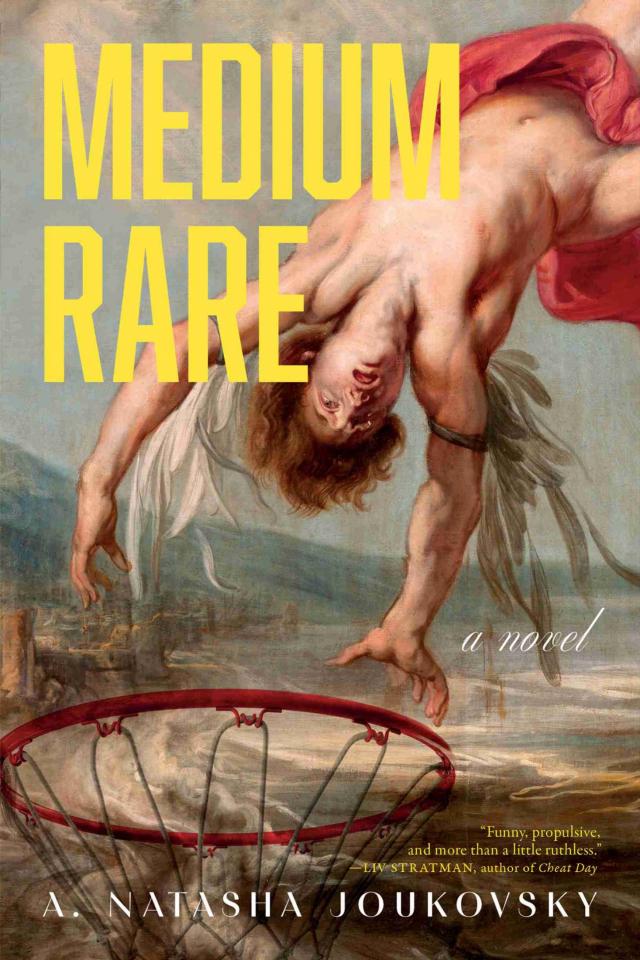


—You’re Raleigh Fayeton’s friend?
—Yes, I told the doctor, with no hesitation at all.
* * *
—
Preeclampsia is not understood well—I’ll give you one guess as to why—but it is thought to be an autoimmune reaction, marked by high blood pressure, swelling, and nausea. It is, almost, like an allergy to pregnancy itself, the only cure “depregnatization”—a little joke among specialists of maternal–fetal medicine for ailments alleviated solely by birth. Raleigh’s had caused an acute placental abruption—internal bleeding—which was why she’d been rushed to the OR for an emergency C-section. I couldn’t see her yet, the doctor explained, she was in recovery, still waking up. But she’d asked them prior to surgery to update me in Phil’s absence. They’d tried to reach him, unsuccessfully. If I was able to, I could tell him his wife was going to be all right. And she’d had a healthy baby. A healthy baby girl.
—I don’t want to downplay what they’ve been through, though, the doctor said. It’s good you got here so fast.
—It’s lucky, I said.
She nodded.
—Yes.
* * *
—
I tried Phil, then Miles, composing texts to both, overflowing with the kinds of words I’d needed earlier—preeclampsia, placental abruption, caesarean—as I walked to the hospital food court. Nothing was going through. I purchased an evangelical chicken sandwich and turned up the audio as Kyle Guy nailed a three to start the second half.
—…and Hunter’s fouled….
—…but he fouled Guy….
—…Diakite draws another foul….
It was back and forth on the floor, our lead hovering around seven. As few as four. As many as nine. I was entranced in the true sense of the word, time reduced to the shot clock, my food gone before I knew I was eating.
—Are you alright, ma’am? One of the chicken ladies asked me, with a tentative touch to the arm.
I’d seen Jerome find Guy in the corner, the beautiful arcing three, but I hadn’t realized I’d screamed. I smiled at the woman dementedly, which she somehow took as assurance. Still, I saw this as my sign to return to labor and delivery. Virginia was ahead by ten, with ten minutes left. Still up eight at five, back in the waiting room. Then Tech sinks a two. A three. All of a sudden: one possession. Jerome misses, and the Red Raiders get a layup—and one. Three minutes left. Fifty-nine all. Diakite makes a pair of free throws, and Tech matches them. A huge jumper from Hunter; Guy in the paint—but a fast, long-range three goes for them. At 1:08, a questionable possession call goes Texas Tech’s way. They show Phil and he’s lost any sense of possession himself. Flashing eyes, floating hair—his hat lost somewhere. A reckless madness, distraught of wit. Moon-struck. It’s dreadful to look at him. More dreadful still when Tech takes the lead with a layup. On the other end, ours bounces out. Twenty-two seconds. We have to foul.
They make the first.
They make the second.
For all the virtues of defense, patience, teamwork—sometimes, you need to score, and fast. That’s situational basketball. Sometimes, the situation calls for a star.
Jerome got the ball to him, down three, twelve seconds left. There in the right corner. De’Andre Hunter, open again. I saw him receive the ball, control it. I saw him set and leave the ground, the flick of his wrist as it broke contact with his upper hand. I saw the ball airborne, climbing, flying, at the height of its parabola—and then I saw only Phil’s wild, flashing eyes.
Except they weren’t Phil’s, they were mine. In the reflection of my blackened screen, because my phone had died.
—Motherfucker, I said aloud, rushing to reception. Excuse me—hi. Do you, by any chance, have an iPhone charger?
The nurse looked at me like I had two heads, shaking her own. I reassessed the room. There was a mounted television, playing a video demonstrating breastfeeding techniques and touting Georgetown as a “baby-friendly hospital”—a troubling phrase to me, with its implication that any hospital possibly wouldn’t be.
—Okay, well, do you think you could—just for, like, thirty seconds—put the game on that TV? It’s the national championship.
—The national championship of what?
—March Madness.
She looked at me with the wary pity reserved for the insane.
—It’s April.
Cruel!
I put my face in my hands, trying to think. Did I have time to go back to the car? I couldn’t—wouldn’t—risk it. There was no one else in the waiting room, no one to ask for a charger.
—Cassandra? Are you okay?
It was the doctor. I realized I’d started pacing like a lunatic.
—Mm? I said, smiling at her.
—Would you like to come back and see Raleigh?
She led me through a quiet hallway with numbered doors, a cross between hospital and hotel, past sixteen, eight, four, and two, to one. Raleigh was drowsy, but awake, propped up with a direct view into the little Lucite roller-bin where her daughter, wrapped tightly in a muslin ball, slept.
—Congratulations, Raleigh, I said.
—Thanks to you.
—She’s beautiful.
—She is.
For a moment, I reflexively fought against them, the tears. But why? Because I’d been taught, implicitly, they were a sign of weakness? To mistrust them? That they were incompatible with intellect? With irony? Lies. I let them fall, and took my friend’s hand, smiling maniacally.
—They still can’t reach Phil, she said.
—I know. I couldn’t either.
—Did we win, Cassandra? UVa, I mean.
—I don’t know. My phone died.
—Well, do you want to turn it on? she asked, pointing to the television behind me.
—We don’t have to—
—I want to turn it on, she said, smiling up at the gilded Jesuit crucifix hanging above her bed. If you don’t mind. Could you please?
I could, and I did—quietly, so as not to wake the baby. Hunter’s perfect, parabolic three had gone in. Not the most exciting team to watch, I thought, inflamed. What a load of Trojan horseshit. The championship game was going to overtime.
* * *
—Overtime in the national championship is brought to you by: Daedalus Cloud, says Jim. And I tell you what, that man right there, Phil Fayeton, is going to be riding mighty high on Daedalus Cloud if Virginia pulls this out.
—He’ll be on Daedalus Cloud nine! says Bill.
Virginia gets the ball, and Hunter’s fouled, makes his free throws, but Tech banks a quick three, then a bouncy jumper. A couple more free throws for Guy. Hunter drops the exact same right-corner triple he made to force overtime to retake the lead, up two; he’s burning hot. Two minutes left. A scorching block from Diakite. A defensive stand.
We slow it down, missing a shot, out of bounds in transition, but replay confirms it: UVa ball.
One minute now. Jerome’s fouled and delivers to go up two possessions.
Thirty seconds. Two more free ones from the Free Throw Guy himself.
Another two for Diakite.
Tech scores a quick layup, but ahead six with seventeen seconds? I wasn’t the only one who could see it.
A timeout, and Raleigh tried Phil. Straight to voicemail, but when I borrowed her phone to call Miles it rang as we inbounded, Jerome finding Braxton Key, who’d had a stellar game off the bench, for the lights-out dunk.
—Raleigh? Is everything okay? said Miles, yelling, but not rudely, just out of necessity.
—Hey, it’s me—she’s okay. Tell Phil—no wait, I have a better idea. Tell Sunny. Here’s what you need to tell Sunny.
* * *
I could see her discomfort after Hunter secured the final rebound; after the clock showed 0.0, the scoreboard Virginia 85 and Texas Tech 77; after the initial euphoria and streamers and white, snow-like confetti blanketed the April court; after Jim and Grant and Bill marveled at the redemption narrative, at the minting of the perfect-bracket billionaire. Not Raleigh’s discomfort—she was on a delectable mix of oxycodone and oxytocin. No. Sunny’s. For all of Sunny’s exquisite professionalism, which I’d relied on, I could see the traces of her personal entrapment as she told Phil, alongside all of America, that he’d achieved a feat of incomprehensible rarity and, with a wink, should get an invoice ready to send to Arun Patil.
—All this you know, Phil, said Sunny, but there’s something else you don’t. I learned minutes ago that during the game, you became a father. Mother and daughter are both doing well—yes, it’s a girl! Congratulations!
She paused to let Phil react, for the audience to, to maintain her own composure, folding narrative on narrative, like an onion mille-feuille, as she prepared for the pinnacle of her career, to deliver the signature, climactic line I’d incepted.
—And one final thing, Phil. Your wife, Raleigh? She already went ahead and named the baby. But I think you’ll agree it’s the perfect choice.
The photo I’d texted Miles—her teensy little profile, sandwiched between burrito and hat—filled first the Jumbotron, then half the hospital TV screen.
—Meet Virginia, said Sunny.
PART 2: POSTGAME SHOW
MAY
Hide yo kids hide yo wife, it’s Big Barry Wood with some Chocolate Rain sending David after the dentist. Send Charlie, too—he bit my finger—and the teens eating the Tide Pods. Yes, fame’s Gritty Evolution of Dance has Rickrolled us with questions, people: Rebecca Black and blue, or white and gold? Yanny or laurel? We’re all so William Hung up on it we’ve fallen into Harambe’s cage, Gorilla Glue in our hair. It can happen when you try Kombucha and make a funny face, or join the senior staff of the president of the United States. So easy to come by and so hard to orchestrate, fifteen minutes of fame. It’s pretty Scaramucci. And a dime a dozen, a cliché. So you’d be forgiven for adding Phil Fayeton, basketball bracketologist, to the list, maybe with a little pun on “fill.”
But Phil was different. He hadn’t sung or danced. He wasn’t particularly cute or cringe or controversial or (to my knowledge, anyway) giant-cocked. He wasn’t a superlative moron, either; he hadn’t vied for a Darwin Award. No. It was something else, a far more powerful gift, or at least the perception of one, flying Phil past fame’s inflection point, that elusive, magic line between what and who, distinct from absolute fame, whereby a figure—he often goes by the name genius—derives his power not from the value of his achievements, but from his being. From his very self. Everything that he touches, that touches him, turns to gold—especially money. And that was certainly a part of it, the money. The profit. The media frequently referred to Phil as a “billionaire,” though it wasn’t strictly true. Even after the funds cleared, the nature of Phil’s earnings was closer to those of lottery winners than titans of industry, foreclosing many of the latter’s tax-avoidance schemes. But his Midas touch was secondary, not the cause but an effect of the real prize.
I speak of prophesy. A gift to beware, I’m afraid. Among all forms of mistake, Eliot says, the most gratuitous. Not that you’ll heed our warnings. In this case: I don’t blame you. We can’t heed them ourselves. Soothsaying is too seductive, too existential. The moth-light of humanity, the quest that unites bracketologists and search-engineers, theoretical physicists and investment bankers, with their options and futures. Artists, too. Narrative artists above all, honestly, our every warning styling a self-transgressive act. Prophesy is the impetus and the outcome of genius and narrative, of narrative genius. The idea of the divine possession of the poet sprang from religious practice, the scholars tell us. It is an offshoot of the belief that the predictions and auguries of priestesses and prophetesses are fulfilled by—wait for it—“divine madness.”
Phil was famous thanks to basketball in March, in April. But it was prophesy that kept him in the spotlight, that drove the Madness into May(hem). Prophesy—and credibility. I envied him that. Phil had visibly predicted the future. Whether or not people cared about basketball, they cared about that. Because implicit in even the apparent gift of prophesy is not only profit and fame and genius, but the godlike affect of apotheosis—of immortality itself. This is at least partially an illusion. (Seeing the future is separate and distinct from the power to change it.) But it is a sticky, seductive one, which tends to blossom in optimistic minds at the height of spring. Phil basked in its rosy light, carefully tending to the garden of his fame—more carefully, I assure you, than to his newborn daughter. The insistence on coin-flip math, his crusade against luck, how he spoke of his family—his obdurate cognitive dissonance was all, though perhaps not consciously, calibrated to reinforce the twin themes of his personal brand: prediction and rarity. He was a rare medium.
—They’re calling him “Medium Rare,” said Jimmy Kimmel, he’s the man who filled out a perfect March Madness bracket this year, the only person who’s ever done it, predicting sixty-three consecutive games in what was a wild tournament won by the University of Virginia. Please give him a warm welcome: Phil Fayeton!
And he emerged, yet again, in his expensive, light-blue shirt. I saw now how much work it did for him, bringing out the blue in his eyes. It was a trick I recognized, straight from my personal arsenal.
Don’t get me wrong, Crewe helped, too. It was thanks to Crewe that Phil got to preen on Jimmy Kimmel in the first place, to lip sync on Jimmy Fallon; to talk pack-line defense with Seth Meyers and grains of sand with Stephen Colbert. He was on the cover of People magazine (with Raleigh and Virginia) and profiled in Rolling Stone. He was profiled everywhere, public interest in him insatiable, relentless. To Phil’s ambivalence and Raleigh’s postpartum horror, paparazzi began descending on their house in Arlington. Between Virginia’s arrival and Phil’s press circuit, they hadn’t had a chance to start looking at new “houses” yet (read: estates, plural), which Phil was firmly resolved to acquire. They were forced to hire a security detail, and every day that passed before Arun’s payment cleared privately deepened their cashflow challenge, until Phil fessed up to his new accountant, who helped secure a short-term low-interest loan.
I saw little of Phil during this period, aside from on television, but a great deal of Raleigh. He was on the road, in New York and—especially—Los Angeles. LA held particular appeal for him, not just for its narrative, Manifest-Destiny qualities; the Hollywood glamour and Kerouacian freedom and Crewe’s attentions, but also for its being the permanent residence of Sunny Sanders, with whom Phil had firmly eclipsed the realm of drunken indiscretion into that of a full-fledged affair.
I said nothing to Raleigh, much as it pained me. How could I? I knew it was true, but I had no proof. The higher truth was I saw no benefit to her in interfering. My collegiate warnings had already failed catastrophically. And where those had been wrapped in what seemed to me actionable revelation (easy enough, theoretically, to walk away from a noncommittal frat boy), their reincarnation would implicate the father of her child. Raleigh, meanwhile, was hyper-focused on the baby, and largely without the infrastructure of ultra-privileged parenthood you might expect. Between the surprise of Virginia’s early birth, Raleigh’s own extended recovery, the more modest plans they’d made prior to Phil’s windfall, and the startling upfront time and effort it generally takes to put reliable outsourcing in place, Raleigh needed an altogether different kind of help. She didn’t have a night nurse yet, and was exclusively breastfeeding anyway. Even when Phil was home, though he’d quit his job at the AASSS the day after the championship, he was pretty useless, especially in those wee hours new mothers—even well-supported ones—often come to dread. This was the treachery that weighed on Raleigh’s mind. I helped where I could. More than I’d ever helped any other friend, certainly.
Because something amazing had formed between us over the course of the tournament. I hesitate to use the word sisterhood. It’s too ironic; too firmly linked in my mind with the stupid gold pins and candles and expensive jeans, the songs and ceremonies and general pseudo-cultishness, like we were some kind of illuminati for social superiority. This had nothing to do with that. Kinship—or really partnership would be closer. The kind of intimacy that can usually, almost definitionally, only exist between two people, though Virginia was a part of it, too. I felt an extraordinary connection to her, akin to my bonds with Percy and Tate; the only child I’ve ever been drawn to like that, aside from my own.
* * *
—
I’ve mentioned my maternal instincts and lack thereof a few times, but sparingly up to this point: only to the degree it was strictly essential—which, unfortunately, a deeper foray has now become. I say “unfortunately” because the majority of novels about motherhood are aesthetic disasters, being frequently laced, as they are, with bitterness about the incompatibility between the author’s own childrearing and the creation of the very project in which they make this tension its subject. Blah, I get it, structural inequities. I’m deeply sympathetic—truly—but most people don’t want to read about structural inequities in their spare time. Never confuse guilt for desire, not to mention activism. About suffering they were never wrong, the old masters. But what they knew, what is now too often forgotten, is that for suffering to be worthy of art, truth is not enough. It also requires beauty. To serve an aesthetic purpose beyond the suffering itself.
I never confused practical maturation with artistic compromise, but I probably did confuse the desire for a child with that for a cat. I wanted to cuddle with something small and warm and alive, to look into big, round eyes, and was tricked by my biological clock into an insistence those eyes resemble my own. I’d only planned on having one, having grown up with too many siblings for my liking. But twins run in my family; I hadn’t been surprised. Another of the many reasons my preparation for motherhood’s responsibilities disproportionately involved the careful planning of their offloading—not to say luck wasn’t involved in my success. But this was why I’d pursued Miles and submitted to Georgetown and put up with Adrienne’s petty shit. My dislike for her probably sprang from her total integrality to the life I enjoy, if also her persistent presumption that I alone—and not her son—drink a little too much freedom on her tab.


