Still life, p.1
Still Life,
p.1
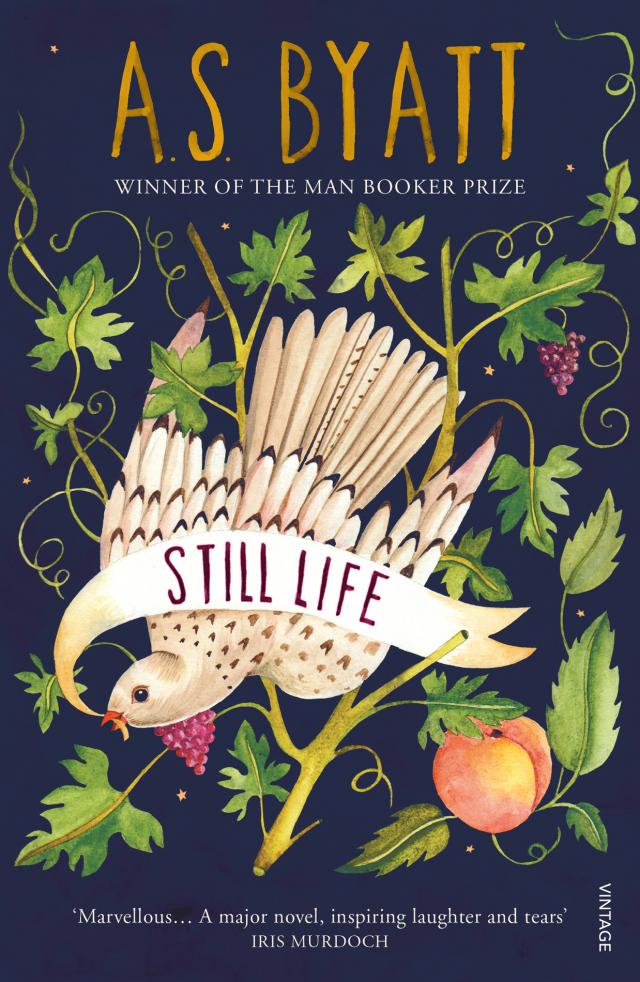


A.S. Byatt
* * *
Still Life
CONTENTS
Acknowledgements
Prologue Post-Impressionism: Royal Academy of Arts, London 1980
1 Ante-Natal: December 1953
2 At Home
3 Christmas
4 Midi
5 Mas Rose. Mas Cabestainh
6 Seascape
7 A Birth
8 A L’Eclat des Jeunes Gens en Fleurs, I
9 A L’Eclat des Jeunes Gens en Fleurs, II
10 Norms and Monsters, I
11 Norms and Monsters, II
12 Behold the Child
13 The Mummies
14 Figures of Speech
15 Wijnnobel
16 First Ideas
17 Field Studies
18 Hic Ille Raphael
19 Poetry-reading
20 Growing Things
21 A Tree, of Many One
22 Names
23 Comus
24 Two Men
25 Culture
26 History
27 Names of Grasses
28 The Yellow Chair
29 London
30 Unus Passerum
31 Daniel
32 Vanishings
33 Three Scenes
ABOUT THE AUTHOR
A.S. Byatt is a novelist, short-story writer and critic of international renown. Her novels include Possession (winner of the Booker Prize 1990), the Frederica Quartet and The Children’s Book, which was shortlisted for the Booker Prize and won the James Tait Black Memorial Prize for Fiction. She was appointed CBE in 1990 and DBE in 1999, and was awarded the Erasmus Prize 2016 for her ‘inspiring contribution to life writing’ and the Pak Kyongni Prize 2017. In 2018 she received the Hans Christian Andersen Literature Award.
ALSO BY A.S. BYATT
Fiction
The Virgin in the Garden
The Shadow of the Sun
The Game
Sugar and Other Stories
Possession: A Romance
Angels and Insects
The Matisse Stories
The Djinn in the Nightingale’s Eye
Babel Tower
Elementals
The Biographer’s Tale
A Whistling Woman
Little Black Book of Stories
The Children’s Book
Criticism
Degrees of Freedom: The Novels of Iris Murdoch
Unruly Times: Wordsworth and Coleridge in their Time
Passions of the Mind: Selected Writings
Imagining Characters (with Ignês Sodré)
On Histories and Stories: Selected Essays
Portraits in Fiction
Memory: An Anthology (ed. with Harriet Harvey Wood)
Peacock & Vine: Fortuny and Morris in Life and at Work
FOR JENNY FLOWERDEW
4 MAY 1936 – 11 OCTOBER 1978
Talis, inquiens, mihi videtur, rex, vita hominum praesens in terris, ad comparationem eius, quod nobis incertum est, temporis, quale cum te residente ad caenam cum ducibus ac ministris tuis tempore brumali… adveniens unus passerum domum citissime pervolaverit; qui cum per unum ostium ingrediens, mox per aliud exierit… Mox de hieme in hiemem regrediens, tuis oculis elabitur.
Bede, Historia Ecclesiastica Gentis Anglorum
‘Such,’ he said, ‘O King, seems to me the present life of men on earth, in comparison with that time which to us is uncertain, as if when on a winter’s night you sit feasting with your ealdormen and thegns – a single sparrow should fly swiftly into the hall, and coming in at one door, fly out through another. Soon, from winter going back into winter, it is lost to your eyes.’
Les mots nous présentent des choses une petite image claire et usuelle comme celles qu’on suspend aux murs des écoles pour donner aux enfants l’exemple de ce qu’est un établi, un oiseau, une fourmilière, choses conçues comme pareilles à toutes celles de même sorte.
Marcel Proust, Du côté de chez Swann.
J’essayais de trouver la beauté là où je ne m’étais jamais figuré qu’elle fût, dans les choses les plus usuelles, dans la vie profonde des « natures mortes».
Marcel Proust, A l’ombre des jeunes filles en fleurs.
Les substances mortes sont portées vers les corps vivants, disait Cuvier, pour y tenir une place, et y exercer une action déterminée par la nature des combinaisons où elles sont entrées, et pour s’en échapper un jour afin de rentrer sous les lois de la nature morte.
G. Cuvier, quoted by Michel Foucault, Les mots et les choses, p.289.
ACKNOWLEDGEMENTS
This book was written with the help of an Arts Council Bursary, for which I am very grateful. I am also grateful to Monica Dickens for a matter of plotting about which she knows. This novel could not have been written without the help of the London Library and Douglas Matthews, its Librarian. My publishers, Chatto & Windus, have been helpful and encouraging beyond the requirements of contract or courtesy. I am grateful to Will Vaughan and John House for talking to me about painting, to Jacquie Brown for typing accurately at unnatural speed, and to Michael Worton for some felicitous French and more particularly for aesthetic sense and general encouragement.
I am grateful to Thames & Hudson Ltd for permission to quote from The Complete Letters of Vincent van Gogh.
PROLOGUE
POST-IMPRESSIONISM: ROYAL ACADEMY OF ARTS, LONDON 1980
He signed the Friends’ Book in his elegant handwriting: Alexander Wedderburn, January 22nd, 1980.
She had said, peremptory as always, that he was to go straight to Room III, where ‘the miraculous stuff’ was to be found. Early. So here he was, a distinguished public man, also an artist of a kind, stepping obediently through Room I (French 1880s) and Room II (British 1880s and 1890s), on a lead grey morning, to the pale grey, classical, quiet place where the bright light shone and sang off pigment so that the phrase, miraculous Stuff, seemed merely accurate.
On one long wall hung a row of Van Goghs, including an Arles ‘Poets’ Garden’ he hadn’t seen before, but recognised, from small photographs, from charged descriptions in the painter’s letters. He sat down and saw a bifurcated path, simmering with gold heat round and under the rising, spreading blue-black-green down-pointing vanes of a great pine, still widening where the frame interrupted its soaring. Two decorous figures advanced, hand-in-hand, under its suspended thickness. And beyond, green green grass and geraniums like splashes of blood.
Alexander was not worried about whether Frederica would turn up. She was no longer in the habit of being late: her life had schooled her to temporal accuracy, perhaps to being considerate. He himself, at sixty-two, felt, not quite accurately, that he was now too old, too settled, to be put out, by her or by anyone else. He thought with warmth of her certain approach. There had been a pattern, an only too discernible repetition in the events and relationships of his life into which she had ruggedly refused to fit. She had been a nuisance, a threat, a torment and was now a friend. She had suggested that they look at Van Gogh together, setting up another form of repetition, deliberate, contrived and aesthetic. His play, The Yellow Chair, had first been presented in 1957; he did not like to think too closely about it, as he did not like to think too closely about any of his past work. He stared at the serenely impassioned garden made out of a whirl of yellow brushstrokes, a viridian impasto, a dense mass of furiously feathered lines of blue-green, isolated black pot hooks, the painfully clear orange-red spattering. He had had trouble finding an appropriate language for the painter’s obsession with the illuminated material world. He would have been lying if he had recorded only the more accessible drama of the painter’s electric quarrels with Gauguin in the Yellow House in Arles, the distant necessary brother who supplied paint and love, the severed ear delivered to the whore in the brothel, the asylum fears. At first he had thought that he could write a plain, exact verse with no figurative language, in which a yellow chair was the thing itself, a yellow chair, as a round gold apple was an apple or a sunflower a sunflower. Sometimes he still saw the brushstrokes, as it were, in this naked way, so that his earlier thoughts of this garden had to be undone, the idea of black wings to be stripped from the painted leafage, the vulgar idea of blood splashes washed off the notation of geraniums. But it couldn’t be done. Language was against him, for a start. Metaphor lay coiled in the name sunflower, which not only turned towards but resembled the sun, the source of light.
Van Gogh’s idea of things had also been against him. The yellow chair, besides being brushstrokes and pigment, besides being a yellow chair, was one of twelve bought for a company of artists who were to inhabit the Yellow House, the white walls of which should blaze with sunflowers as the windows of Gothic cathedrals blazed with coloured light. Not only metaphor: cultural motif, immanent religion, a faith and a church. One thing always linked to another thing. As the Poets’ Garden, a decoration for the bedroom of the ‘poet Gauguin’ was more than it seemed.
Arles, 1888.
Some time ago I read an article on Dante, Petrarch, Boccaccio and Botticelli. Good Lord! it did make an impression on me, reading the letters of those men.
And Petrarch lived quite near here in Avignon, and I am seeing the same cypresses and oleanders…
There is still a great deal of Greece all through the Tartarin and Daumier part of this queer country, where the good folks have the accent you know; there is a Venus of Arles just as there is a Venus of Lesbos, and one still feels the youth of it, in spite of all…
But isn’t it true, this gar
den has a fantastic character which makes you quite able to imagine the poets of the Renaissance strolling among these bushes and over the flowery grass?…
The youth of it, Alexander thought. I thought I was world-weary then. In July 1890, two years after writing this, Van Gogh had shot himself inefficiently in the groin, and had died slowly. In 1954 Alexander, a time-obsessed man, had read the centenary edition (1953) of the Letters. He had himself been rising thirty-seven and when The Yellow Chair was put on had passed that age, was older now than Van Gogh, as he had, in the 1940s, realised that he was older than Keats. He had felt, perhaps, briefly, the power of the survivor. What nonsense. The eternal youth of Provence. He thought of thick, fat, hot motorways carving up that land. He turned his attention to the timeless fields of wheat and olives.
She made a kind of progress up the Palladian marble stair. A painter stopped to kiss her: a journalist waved. John House, who had organised the exhibition, came almost leaping down the stairs accompanied by a smallish woman in a pine-green tent-like coat. He also kissed Frederica and introduced the woman, fumbling her name, as ‘a colleague’ and Frederica as ‘Frederica – you must forgive me, I never know what name you’re working under, women these days are so protean.’ Frederica did not attempt to ascertain the fumbled name, having given up interest in stray new people until it was clear that they were of real concern. She assumed wrongly that John House’s colleague was an art historian. The colleague looked at Frederica with an apparently absentminded scanning attention. John House spoke of the history of the gathering of the images, an emptiness here (Jacob wrestling the Angel), an unexpected illumination there. Frederica listened attentively; went on and signed the Visitors’ Book. Frederica Potter, Radio 3 Critics’ Forum. She negotiated a free catalogue. She made her leisurely way towards where she had told Alexander to be.
An old woman, armed with a Sound Guide, became quite excited and pulled at the arm of another. ‘Hey – look at that – Winston Churchill painted that, the…’ – carefully – ‘Cap d’Antibes.’
Frederica dipped round her to stare: Claude Monet: ‘Au Cap d’Antibes par vent de mistral’. A whirl of blue and rose, formless formed plungings of water and wind. ‘To paint,’ she remembered from Proust’s description of fictive Elstir, ‘that one does not see what one sees.’ To paint light and air between ourselves and objects. ‘I said, dear, Winston Churchill – .’ The second woman tugged free of the clutching fingers. ‘Not to be mentioned in the same breath with…’ she said, looking nervously from Frederica to painted signature. The arrested water shone and danced. In the catalogue John House quoted Monet’s description of the painted light around the snowy haystacks as an enveloping veil. He also quoted Mallarmé. ‘I think… that there should be only allusion… To name an object is to suppress three-quarters of the enjoyment of the poem, which is created by the gradual pleasure of apprehending it. To suggest it, that is the dream…’ It was not a view of things with which Frederica was entirely in sympathy: she liked naming names. But she looked briefly down, dazzled by the flowing skin of worked and delicate colour; the blue and rose tourbillons of the mistral on the sea, the prismatically sliced frosty nimbus round the mysterious squat stacks. She scribbled words, notes, in the margin of her catalogue.
Daniel bought a ticket, and paid for the hire of a catalogue, he wasn’t sure why. He had come, he believed, because he needed to discuss certain administrative problems with Frederica. He was aware that she believed he was in need of art. Under his arm he carried a folded newspaper with that day’s headline: PEACE MOTHER DIES. He was raw to bad news, more raw as he grew older, which was not perhaps quite what he had expected. He saw and did not see the paintings. There was a field of poppies and corn which reminded him only of small and large, faded and ghostly versions of Van Gogh’s ‘Harvest’ which he had seen repeated in endless hospital corridors, waiting rooms, school offices. He had seen these ample fields, as he had seen Cézanne’s geometric brown and green undergrowth in more than one mental hospital day room. Odd, he thought, considering that Van Gogh himself had died mad and despairing in such surroundings. Not serene, overexcited, these fields. Daniel’s patience with the nervously ill was not what it had been. Although he was fourteen years younger than Alexander, Daniel too was in the habit of thinking of himself as a survivor, a battered and grizzled survivor.
Alexander saw her coming towards him. A dozen or so schoolgirls were dutifully filling in xeroxed, hand-written, one-word-answerable questionnaires. Alexander, always a connoisseur of garments, realised that Frederica had changed her style, that the clothes the young creatures were wearing could be described as a parody of the clothes Frederica had worn at their age, and that Frederica’s new style was not unrelated to this shift. There she was in a conventional two-piece suit, fine dark wool, muted geometrical pattern in greens and unexpected straw browns, caught in at the waist – still very thin – to give the effect of a bustle, the skirt long and straight to the knee. She had ruffles (not swashbuckling) at the neck and the small velvet hat could, but did not, support a veil. The pale red hair was in a figure of eight chignon in her neck, reminiscent of one of Toulouse-Lautrec’s fine-drawn café habituées. Fifties and postimpressionist, thought Alexander, connecting. She came up and kissed him. He remarked on the parody-young. She took the point eagerly.
‘My dear, I know. Pencil skirts and batwing sweaters and spiky stilettos, tottering with their hard little behinds sticking out, and all that red lipstick. I remember when I thought lipstick had gone forever, a dream of painted excess, as I thought paper taffeta had gone forever, in Cambridge, when we all took to glazed cotton. Do you remember?’
‘Of course.’
‘Do you remember the eclectic Sixties parodies – when we went to the National Portrait Gallery – everything, from swamis to major-generals and major-domos too. These are such a serious and uniform parody. More and more of the same. More of me.’
‘Lèse-majesté. And you? You have reverted to type?’
‘Oh, I’m in my element. I understand the Fifties. I couldn’t do the Forties bit at all, padded shoulders and crêpy things, ugh, and page-boys – I think it must have been purely Oedipal, those were my parents’ things, dammit, what I was getting away from. This is my scene.’
‘So it is.’
‘And now I have money.’
‘In our new austerity, you have money.’
‘In our new austerity, I am old enough to have money.’ They saw Daniel advancing.
‘Daniel doesn’t change,’ said Alexander.
‘Sometimes I wish he did,’ said Frederica.
Daniel did not change. He wore the same black clothes – baggy corduroys, heavy sweater, working-man’s jacket – that he had worn through the Sixties and Seventies. Like many hirsute men he had thinned a little on top where once his black fur had been extravagant, but he had a plentiful and prickling black beard, and his body was still compact and very heavy. He looked, in this setting, a little like some painter. He saluted Frederica and Alexander with his rolled newspaper and said that it was cold outside. Frederica kissed him too, reflecting that he was dressed like a man who smelled dirty, but in fact didn’t. Alexander smelled, still, of Old Spice and a sort of agreeable toastiness. His smooth brown hair was as thick as ever but shot now with needles of glittering silver.
‘We must talk,’ said Daniel.
‘First you must look at the pictures. Take time off.’
‘I keep trying. I went to the King’s Carol Service.’
‘Good for you.’ Frederica glanced shrewdly at him. ‘Now, look at the pictures.’
Gauguin’s ‘Man with the Axe’. ‘One for you,’ said Frederica to Alexander, still skimming the necessary accompanying print. ‘Androgynous. John House says. No, Gauguin said. Do you think?’
Alexander considered the decorative gold body, itself a repetition of a body on the Parthenon frieze. He saw a blue loincloth, flat breasts, purple sea with coral tracings lying flatly on it. He was unmoved, though the colours were rich and strange. He told Frederica he preferred his androgynes to be more obscured, more veiled, more suggested, and directed her attention to ‘Still-Life, Fête Gloanec 1888’ in which various inanimate objects, two ripe pears, a dense bunch of flowers, swam across a bright red table-top rimmed with a black ellipse. The picture was signed ‘Madeleine Bernard’, and Alexander told Frederica that Gauguin had flirted seriously with that young woman, had characterised her, as was fashionable at the time, as having the desirable, unattainable androgynous perfection, complete sensuality combined with unattainable self-sufficiency. Frederica informed him from the catalogue that the vegetation was supposed to be a jocular portrait by Gauguin of Madeleine, the pears her breasts, the dense flowers her hair. ‘You could read it another way,’ said Alexander, interested now, ‘you could read the pears as androgynous in themselves, as partly male.’ ‘And the hair as other hair,’ said Frederica loudly, scandalising a few bystanders, amusing a few more. ‘You like to work for your images, don’t you, Alexander?’ It’s age,’ said Alexander, peaceably, untruthfully. They were beginning to attract a penumbra of gallery-goers, as though they were offering a guided tour.