Medusas ankles, p.19
Medusa's Ankles,
p.19


Some brave men went out to prospect but were forced back by clouds of scalding steam and showers of burning grit. Two friends, bold hunters both, went out and never returned.
One day a woman in her garden said: “It is almost as though it was not landslides but creatures, great worms with fat heads creeping down on us. Great fat, nodding bald heads, with knobs and spouts and whelks and whorls on them, and nasty hot wet eyes in great caverns in their muddy flesh, that glint blood-red, twelve eyes, can you see them, and twelve hairy nostrils on blunt snouts made of grey mud.” And after conversations and comparisons and pointings and descriptions they could all see them, and they were just as she said, six fat, lolling, loathsome heads, trailing heavy bodies as long as the road from their village to the next, trailing them with difficulty, even with pain, it seemed, but unrelenting and deadly slow.
When they were nearer—and the slowness of their progress was dreamlike, unreal—their great jaws could be seen, jaws wide as whales and armed with a scythelike horny or flinty edge like a terrible beak, with which they excavated and swallowed a layer of the earth and whatever was on it—bushes, fences, haystacks, fruit trees, a couple of goats, a black and white cow, a duck pond and the life in it. They sucked and scythed, with a soughing noise, and they spat out fine ash, or dribbled it from the lips of the terrible jaws, and it settled on everything. As they approached, the cloud of ash came before them, and settled on everything in the houses and gardens, coated the windows, filmed the wells. It stank, the ash, it was unspeakably foul. At first they grumbled and dusted, and then they gave up dusting, for it was no use, and began to be afraid. It was all so slow that there was a period of unreal, half-titillating fear, before the real, sick, paralysing fear took hold, which was when the creatures were close enough for men and women to see their eyes, which were rimmed with a gummy discharge, like melting rubber, and their tongues of flame. The tongues of flame were nothing like the brave red banners of painted dragons in churches, and nothing like the flaming swords of archangels. They were molten and lolling, covered with a leathery transparent skin thick with crimson warts and taste buds glowing like coals, the size of cabbages, slavering with some sulphurous glue and stinking of despair and endless decay that would never be clean again in the whole life of the world. Their bodies were repulsive, as they humped and slithered and crushed, slow and grey and indiscriminate. Their faces were too big to be seen as faces—only identified in parts, successively. But the stench was the worst thing, and the stench induced fear, then panic, then a fatalistic tremor of paralysis, like rabbits before stoats, or mice before vipers.
The villagers discussed for far too long the chances of the village being destroyed. They discussed also expedients for diverting or damaging the worms, but these were futile, and came to nothing. They discussed also the line of the creatures’ advance; whether it crossed the village, or whether it might be projected to pass by it on one side or another. Afterwards it might have been easy to agree that it was always clear that the village stood squarely in the path of that terrible descent, but hope misleads, and inertia misleads, and it is hard to imagine the vanishing of what has seemed as stable as stone. So the villagers left it very late to make a plan to evacuate their village, and in the end left hurriedly and messily, running here and there in the stink and smoke of that bad breath, snatching up their belongings, putting them down and snatching up others, seething like an ants’ nest. They ran into the forest with sacks of corn and cooking pots, with featherbeds and sides of bacon, completely bewildered by the presence of the loathsome creatures. It was not clear that the worms exactly saw the human beings. The human beings were not on their scale, as small creatures that inhabit our scalps, or burrow in the salad leaves we eat are not visible to us, and we take no account of them.
The villagers’ life in the forest became monotonous, boring even, since boredom is possible for human beings in patches of tedium between exertion and terror. They were very cold, especially at night, they were hungry and their stomachs were constantly queasy, both with fear and with their ramshackle diet. They knew they were beyond the perimeter of the worms’ breath, and yet they smelled its foul odour, in their dreams, in the curl of smoke from their camp-fires, in rotting leaves. They had watchers posted, who were placed to be able to see in the distance the outline of the village, who saw the line of gross heads advancing imperceptibly, who saw bursts of sudden flame and spurts of dense smoke that must have been the kindling of houses. They were watching the destruction of their world, and yet they felt a kind of ennui which was part of all the other distress they felt. You might ask—where were the knights, where were the warriors who would at least ride out and try to put an arrow or a bullet through those drooling eyes. There was talk of this round the campfires, but no heroes sprang up, and it is probable that this was wise, that the things were invulnerable to the pinprick of human weapons. The elders said it was best to let things go by, for those huge bodies would be almost as noisome dead as alive in the village midst. The old women said that old tales told that dragons’ breath paralysed the will, but when they were asked for practical advice, now, they had none to offer. You could want to kill yourself, Eva found out, because you were sleeping on a tree-root, on the hard ground, which pressed into your flesh and became an excruciating pain, boring in both senses.
* * *
—
Harry and Jack finally went with some other young men, out in the direction of the village, to see from close quarters the nature and extent of the devastation. They found they were walking towards a whole wall of evil-smelling smoke and flame, extending across acres of pastureland and cornfield, behind which the great craglike protuberances of the heads could be seen, further apart now, moving on like the heads of water at the mouth of a flooding delta. Jack said to Harry that this fanning out of the paths left little chance that anything in the village might be left standing, and Harry replied distractedly that there were figures of some sort moving in the smoke, and then said that they were the pigs, running here and there, squealing. A pig shot out of the smoke, panting and squeaking, and Harry called out, “Boris!” and began to run after his pig, which snorted wildly and charged back into the darkness, followed by Harry, and Jack saw pig and human in sooty silhouette before he heard a monstrous sucking sound, and an exhalation of hot vapours and thick, choking fiery breath which sent him staggering and fainting back. When he came to, his skin was thick with adhesive ash and he could hear, it seemed to him, the liquids boiling and burning in the worm’s belly.
For a moment he thought he would simply lie there, in the path of that jaw, and be scooped up with the cornfield and the hedgerow. Then he found he had decided to roll away, and little by little, rolling, crawling and scrambling, he put patches of space between himself and the worm. He lay for several hours, then, winded and sick, under a thornbush, before picking himself painfully up, and returning to the camp in the forest. He hoped that Harry too would return, but was not surprised, not really surprised, when he did not.
* * *
—
And so it dragged on, for weeks and months, with the air full of ash and falling cinders, with their clothes and flesh permeated by that terrible smell, until little by little the long loathsome bodies dragged past, across the fields and the meadows, leaving behind those same furrows of rocky surface, scooped clean of life and growth. And from a hilly point they saw the creatures, side by side, cross the sandy shore of the lake, and without changing pace or hesitating, advance across the shallows, as though driven by mechanical necessity, or by some organic need like the periodic return of toads or turtles to a watery world to breed. And the great heads dipped to meet the lake surface, and where they met it, it boiled, and steamed and spat like a great cauldron. And then the heads went under the surface, which still boiled, puckered and bubbling, as the slow lengths of the long bodies humped and slithered, day after day, over the sand and down through the water to the depths, until finally only blunt, ugly butts could be seen, under the shallows, and then one day, as uncertainly as their coming had been established, it became clear that their going was over, that the worms had plunged into, through, under the lake, leaving only the harsh marks of their bodies’ weight and burning breath in the soil, the rock, the vegetable world crushed and withered.
* * *
—
When the villagers returned to look on their village from a distance, the devastation seemed uniform: the houses flattened, the trees uprooted, the earth scored, channelled, ashy, and smoking. They wandered in the ruins, turning over bricks and boards, some people finding, as some people always will, lost treasures and trivia in the ashes, a coin, half a book, a dented cooking pot. And some people who had vanished in the early chaos returned, with singed eyebrows or seared faces, and others did not. Jack and Eva came back together, and for a moment could not work out in what direction to look for the ruins of what had been their house. And then, coming round a heap of fallen rubble, they saw it there, untouched. One of the dragon troughs passed at a distance, parallel to the garden fence, but the fence stood, and inside the fence the garden, the veranda, the doors and windows were as they had always been, apart from the drifting ash. And Jack lifted the stone under which the key was always kept, and there was the key, where it had always been. And Jack and Eva went into the house, and there were tables and chairs, fireplace and bookcase, and Eva’s loom, standing in the window, at the back of the house, where you looked out on the slopes and then up at the peaks of the mountains. And there was a heavy humping sound against the back door, which Jack opened. And when he opened it, there was Boris the pig, hanging his head a little, and giving off an odour of roast pork, with not a bristle on his charred rind, but with pleasure and recognition in his deep-set little eyes.
When they saw that the pig had by some miracle, or kindness of luck, escaped the dragon breath and the fiery tongues, they hoped, of course, that Harry too would return. They hoped he would return for days and months, and against their reasonable judgment, for years. But he did not.
Eva dusted her rug, which was lightly filmed with ash, since it was at the back of the house, and the windows were well made. She saw the colours—red, blue, yellow, black—as though she had never seen colour before, and yet with disturbed pleasure at their familiarity. An archaeologist, finding this room, and this rug on this loom in it, say two thousand years later, might have felt intense excitement that these things were improbably intact, and intense curiosity about the workmanship, and even about the daily life that could be partly imagined around the found artefacts. Eva felt such amazement now, about her own work, the stubborn persistence of wood and wool and bone shuttle, or the unfinished tree with its squatting pheasants and fat pomegranates. She felt inwardly moved and shaken, also, by this form of her own past, and the past of her mother and grandmother, and by the traces of her moments of flowing competence, and of her periods of bunching, tension, anxiety, fumbling. Jack too felt delight and amazement, walking repeatedly across the house from the windows which opened on smouldering devastation to those from which you could see the unchanging mountains. Both embraced Boris, restored and rescued, feeling his wet snout and warm flanks. Such wonder, such amazement, are the opposite, the exact opposite, of boredom, and many people only know them after fear and loss. Once known, I believe, they cannot be completely forgotten; they cast flashes and floods of paradisal light in odd places and at odd times.
* * *
—
The villagers rebuilt their village, and the rescued things in the rescued house stood amongst new houses in whose gardens new flowers and vegetables sprouted, and new saplings were planted. The people began to tell tales about the coming of the worms down the mountain, and the tales too were the opposite of boredom. They made ash and bad breath, crushing and swallowing, interesting, exciting, almost beautiful. Some things they made into tales, and some things they did not speak. Jack told of Harry’s impetuous bravery, rushing into the billowing smoke to save his pig, and nobody told the day-to-day misery of the slowly diminishing hope of his return. The resourcefulness and restoration of the pig were celebrated, but not his inevitable fate, in these hard days. And these tales, made from those people’s wonder at their own survival, became, in time, charms against boredom for their children and grandchildren, riddling hints of the true relations between peace and beauty and terror.
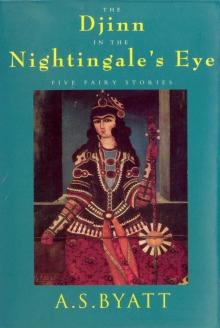
THE DJINN IN THE NIGHTINGALE’S EYE
Once upon a time, when men and women hurtled through the air on metal wings, when they wore webbed feet and walked on the bottom of the sea, learning the speech of whales and the songs of the dolphins, when pearly-fleshed and jewelled apparitions of Texan herdsmen and houris shimmered in the dusk on Nicaraguan hillsides, when folk in Norway and Tasmania in dead of winter could dream of fresh strawberries, dates, guavas, and passion fruits and find them spread next morning on their tables, there was a woman who was largely irrelevant, and therefore happy.
Her business was storytelling, but she was no ingenious queen in fear of the shroud brought in with the dawn, nor was she a naquibolmalek to usher a shah through the gates of sleep, nor an ashik, a lover-minstrel singing songs of Mehmet the Conqueror and the sack of Byzantium, nor yet a holy dervish in short skin trousers and skin skullcap, brandishing axe or club and making its shadow terrible. She was no meddah, telling incredible tales in the Ottoman court or the coffeehouses by the market. She was merely a narratologist, a being of secondary order, whose days were spent hunched in great libraries scrying, interpreting, decoding the fairy tales of childhood and the vodka posters of the grown-up world, the unending romances of golden coffee drinkers, and the impeded couplings of doctors and nurses, dukes and poor maidens, horsewomen and musicians. Sometimes also, she flew. In her impoverished youth she had supposed that scholarship was dry, dusty and static, but now she knew better. Two or three times a year she flew to strange cities, to China, Mexico, and Japan, to Transylvania, Bogotá, and the South Seas, where narratologists gathered like starlings, parliaments of wise fowls, telling stories about stories.
At the time when my story begins the green sea was black, sleek as the skins of killer whales, and the sluggish waves were on fire, with dancing flames and a great curtain of stinking smoke. The empty deserts were seeded with skulls, and with iron canisters, containing death. Pestilence crept invisibly from dune to dune. In those days men and women, including narratologists, were afraid to fly east, and their gatherings were diminished. Nevertheless our narratologist, whose name was Gillian Perholt, found herself in the air, between London and Ankara. Who can tell if she travelled because she was English and stolid and could not quite imagine being blasted out of the sky, or because, although she was indeed an imaginative being, and felt an appropriate measure of fear, she could not resist the idea of the journey above the clouds, above the minarets of Istanbul, and the lure of seeing the Golden Horn, the Bosphorus, and the shores of Europe and Asia face to face? Flying is statistically safer than any other travel, Gillian Perholt told herself, and surely at this time, only slightly less safe, statistically only a little less.
* * *
—
She had a phrase for the subtle pleasures of solitary air travel. She spoke it to herself like a charm as the great silver craft detached itself from its umbilical tube at Heathrow, waddled like an albatross across the tarmac and went up, up, through grey curtains of English rain, a carpet of woolly iron-grey English cloud, a world of swirling vapour, trailing its long limbs and scarves past her tiny porthole, in the blue and gold world that was always there, above the grey, always. “Floating redundant” she said to herself, sipping champagne, nibbling salted almonds, whilst all round her spread the fields of heaven, white and rippling, glistening and gleaming, rosy and blue in the shadows, touched by the sun with steady brightness. “Floating redundant,” she murmured blissfully as the vessel banked and turned and a disembodied male voice spoke in the cabin, announcing that there was a veil of water vapour over France but that that would burn off, and then they would see the Alps, when the time came. “Burn off” was a powerful term, she thought, rhetorically interesting, for water does not burn and yet the sun’s heat reduces this water to nothing; I am in the midst of fierce forces. I am nearer the sun than any woman of my kind, any ancestress of mine, can ever have dreamed of being, I can look in his direction and stay steadily here, floating redundant.
The phrase was, of course, not her own; she was, as I have said, a being of a secondary order. The phrase was John Milton’s, plucked from the air, or the circumambient language, at the height of his powers, to describe the beauty of the primordial coils of the insinuating serpent in the Paradise garden. Gillian Perholt remembered the very day these words had first coiled into shape and risen in beauty from the page, and struck at her, unsuspecting as Eve. There she was, sixteen years old, a golden-haired white virgin with vague blue eyes (she pictured herself so) and there on the ink-stained desk in the dust was the battered emerald-green book, ink-stained too, and secondhand, scribbled across and across by dutiful or impatient female fingers, and everywhere was a smell, still drily pungent, of hot ink and linoleum and dust if not ashes, and there he was, the creature, insolent and lovely before her.