

The certainties, p.17
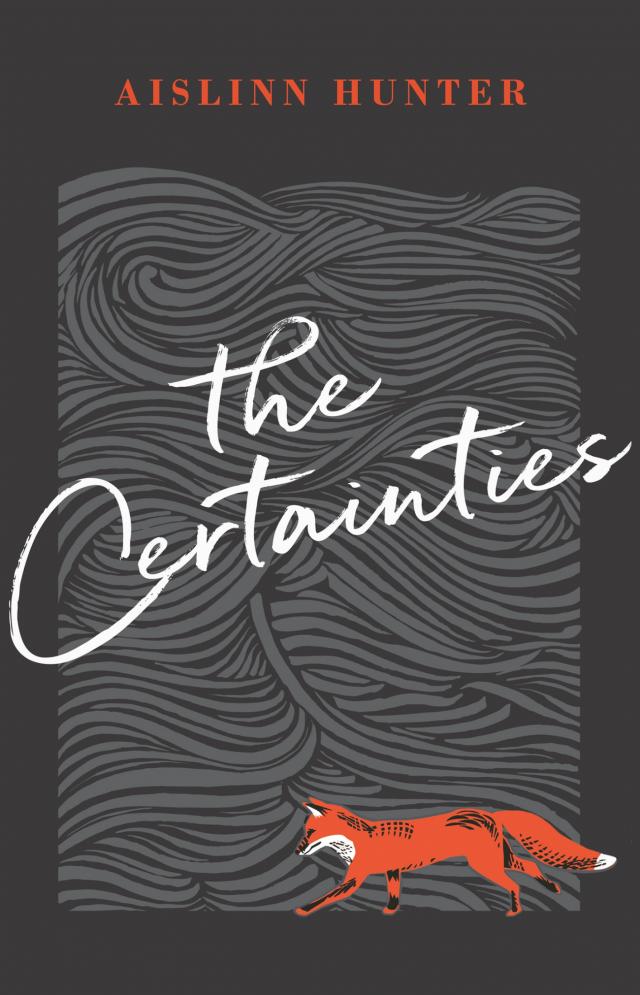
The Certainties,
p.17


ia’s ears are ringing. The builder rolls over beside her in the early morning light, drops his right arm over her ribcage and squeezes. After a minute his breath falls back into the measured sound of sleep.
Undressing him last night, Pia had asked again, ‘Why did you stop being a doctor?’ And at last he had answered her. ‘I was in a camp.’ She wasn’t sure what he meant by that, so she said, ‘And?’ ‘And?’ he’d repeated, mildly annoyed. He was naked, his body in front of her and his body in profile in the mirror. The room was quiet, except for the hum in her head. ‘Well,’ he said, ‘people died there, for one. A lot of people…’ And then he looked at his hands.
AT DAWN, THE GROOM IS down on the beach, and this surprises Pia. He’s wearing good clothes: a sweater, trousers rolled up to the knees, the wrong footwear. He’s moving sluggishly, and Pia intuits that he took the night shift. The beach is still dotted with lanterns. More clothes have washed up, along with parts of the wheelhouse. A dozen life vests have been lined up near the cliff wall.
Pia hands out tea to the silent group; the small talk from the day before is gone. The six on the beach—the barman, the widow’s son, Pia, the builder, the groom, and the farmer, whose dog is trotting the tide line—keep their focus on the sea. Pia thinks of the poet her mother loved—the one who wrote about grief: how few of the angels were singing, how few dogs were barking, about shutting a balcony door so as not to hear the sobbing. Here, she thinks, the balcony door is the sea.
IN THE LAST RECORDING Pia’s mother made, she enters a house of dissidents in hiding. She describes where she is and what exactly is happening: ‘We are being led into the house under escort…’ ‘…there are ten people huddled in the dark of a kitchen…’ ‘…there’s a sense among those gathered that the government will be overthrown…’ She does not speak as a citizen whose government might fall; she does not speak as someone who will be detained and tortured under a new regime, under excuses for cruelty. She doesn’t see her own death in front of her. She isn’t even angry.
Now, Pia stands by the sea, thinking about how she has the ability to move her mother’s interviews around in her mind: she can play them back and forth in and out of order, take the flower of history and turn it into a seed. She thinks of the philosopher who wrote about mirrors: Mirrors can only record what can be seen. They ask for nothing and give back exactly what they receive. She watches the builder, standing at the tide line with binoculars. After a few minutes, he comes jogging back up the beach. Before he reaches her, she remembers standing in front of the mirror on the landing in the hotel—her mother’s face present in her own, and some other form unveiling itself through the hum of the night’s wine. She closes her eyes tight and only the sound of the sea remains. She compares the surf rolling and lightly crashing to the way the sea in the village where she grew up poured over and through the pebbles in the bay, dice the sea was shaking.
THE FIRST BODY TO COME IN is a man’s. This is followed by a woman’s, then a boy’s. They come bobbing toward the shore, and the barman and the widow’s son drag the adults up from the tide line. The boy is so light he can be lifted in the builder’s arms.
The bodies are laid out on the sand. They’re veined and bloated, the skin waterlogged and lifted away from the bones. They’ve come in without clothes so that you can see every violence. It’s almost impossible to look: the vulnerability of their nakedness, the gasp of shock on the man’s face, the woman’s swollen legs, the boy’s front teeth, broken.
‘Imagine—’ the groom says, his eyes welling. And he turns away.
STANDING BESIDE THE SEA’S FROTH, its opaque blue, Pia thinks that the philosopher who wrote about mirrors and glassy surfaces is wrong: this sea has no reflection…even the word ‘sea’ fails. This sea doesn’t resemble the sea of the village in the country where she grew up. Even to name a body of water seems insufficient in this instant—an instant where a woman’s dark and tangled hair slicks to the side of her face, a face so decimated that the word ‘face’ is inadequate, too.
The islanders lift the woman’s body into one of the heavy black bags. They set her down gently and zip up the front so that she disappears. They do this with the boy, and again with the man. The barman takes his binoculars and goes back to the shore. The builder and the widow’s son move up and down the beach, laying out more bags. Soon there is a line of thirty across the sand.
ON HER WAY BACK TO THE HOTEL, Pia passes the widow’s house. The widow is standing in her large picture window, her hair set in tidy white curls, her cardigan buttoned up properly. She raises her hand to wave at Pia but her expression remains neutral, as if she isn’t sure whether Pia is real or a figment moving through one of her own dissembling dreams.
The desk clerk at the hotel asks Pia what’s happening down on the beach, and Pia requests a pad of paper and a pen. She can hear her mother saying, ‘and on the third morning…’ and ‘these events come at a time when…’
In the bar, the bride and her father silently play a game of cards.
PIA RETURNS TO THE BEACH, again almost slipping down the embankment. She makes it to the skirt of rocks and stops to gather her breath. She’s tired now, and her vision is blurry. She touches the bump on her head. Still, she begins to work. She unzips the body bag of the man who came in first. She writes down his exact description: how tall he is, the length of his hair, the shape of his eyes, how his toes are long and almost uniform in length. She touches him everywhere—she lifts his arm, rolls him over, and in turning him she feels the heft of him and thinks about how he was once alive and woke up in a bed and rolled his body toward the sun. There is a scar on his hand: a thin line of white skin. She writes this down, draws its likeness. She is trying to write a message to the future, to someone who might need these notes, who might read this description and say, This was my brother, or This was my uncle, or This was my friend.
THE MAN AND THE WOMAN are wearing simple wedding rings. He has one brown shoe tied tightly to his bloated foot. His beard is matted. She is wearing a delicate silver bracelet. The boy has dark hair, and a birthmark on his left calf the size of a thumbprint. Pia draws its location and shape in her book.
Farther down the beach, more locals arrive. They stand on the rocks, waiting. The woman from the grocer’s has binoculars, and the fisherman has put on hip waders. He’s carrying a hook on a long pole and he walks with it out into the froth. The dog is still doing his work along the tide line, his tongue hanging out the side of his mouth. The builder walks into the waves until he’s up to his waist, and then he grabs at something—a grey mass—and wades back to the shore with it.
PIA MAKES HERSELF REMEMBER this: When Pia’s mother left her at the fountain in the plaza long ago, when her mother went off with a man who bundled her into his car, when her mother disappeared, Pia managed to find her way home on her own. She got up from under the blearing leaves after hours and hours of waiting and she started to run. She ran and ran, past the pastel faces of the houses and the wrought-iron balconies, the hanging laundry, the white cat with his back arched and the men and women sitting patiently on benches under the drooping trees. She ran as fast as she could, and a part of her knew where she was going even as she felt lost and alone.
THE SUN COMES UP. Pia is standing on the sand, her head heavy with exhaustion. She squints out at the water, says over and over: Stay awake. A part of her is here and a part of her sees this catastrophe as if it is far away—as if it’s something her mother might have covered, or a report she’s glanced at in the morning paper before finishing her coffee and heading out the door. But there’s a slop of seaweed next to her feet, and her hands are freezing.
Suddenly, in the distance, people are moving. There’s a surge of energy on the beach. Pia’s breath hitches and she feels her chest lift in a sudden inhalation. Then stillness. And then again—a gasp and ragged breath.
* * *
—
Out past the harbour, past the twin points of the headland, a ship steams south.
No: Out past the harbour—a rescue boat.
* * *
—
Pia closes her eyes. Stay here, she thinks, stay here.
She forces her eyes open. The bodies are coming in.
* * *
—
Look.
ACKNOWLEDGEMENTS
This book would not have been possible without the love and support of my late husband, Glenn Hunter. Even as he was dying he encouraged me to keep writing it. In his last weeks he was still helping with factual, historical and worldly knowledge—as he has done with every book I’ve ever written.
Thanks to Claudia Casper, who saw me through the dark times and who always affirmed the value of literary work. To Kerry Ohana, who keeps me on this earth. To my mother and sister for showing up time and time again. To Helen and Tony, Jill and Derek, Jade and Brigette, Sue, James, Anne, Sam and Jen, Leslie, Carissa, Maureen, Betsy, Tom and Kalissa, Miranda, Sibeal and Peter, Sue and Bruce, and Doug and Liz, who stood with us and witnessed. To my brother, Lee, and Leitha, in the US, and to Rochelle and Pat in St. John’s, and Angela in the UK for light and love from a distance. To my former writing students who showed up with grace and kindness and plants. To Glenn’s family—Deanna, Laurie and Rob—for the gift of your care and in honour of your grief.
To Joel Thomas Hynes, Anosh Irani and Helen Humphreys for friendship and solidarity in the trenches. To Shaun O’Mara, who graciously stepped up and answered the sorts of technical questions Glenn would have answered, and who gifted me with understanding and love. To Cooper, Juniper and Clara, who sustain me and bring me joy every day.
I’m grateful to the Canada Council for their support of this work, and to Kwantlen Polytechnic University for a research grant that enabled me to spend time in Portbou. The Canadian Forces Artist Program provided me with an invaluable opportunity to think and learn about bearing witness with Canadian and NATO forces during a mission in 2018.
The Dermot Healy epigraph at the start of the book is from his poem ‘The Quick Slow Boat’ in The Travels of Sorrow (The Gallery Press, 2015) reproduced by kind permission of the author’s estate c/o The Gallery Press. The Federico García Lorca epigraph is from his poem ‘Narcissus.’
I’m full of gratitude for the wonderful team at Knopf Canada and at Penguin Random House, especially Kristin Cochrane, Anne Collins, Rick Meier, Kelly Hill, and Sharon Klein. Thanks to Suzanne Brandreth and the team at Cooke International for championing my work in the world.
While this book is a work of fiction, aspects of it were inspired by the life and death of Walter Benjamin (1892–1940), whose alleged suicide in Portbou, Spain, informed a portion of this fiction’s plot. Benjamin was a great thinker and his work and words are a stunning legacy. In 1918, Malcolm MacNeill, a police officer on the island of Islay, filled a journal with descriptions of the dead after a tragic shipwreck. His journals and act of witness also inspired this novel.
Last, thank you to Lynn Henry—a brilliant editor and remarkable friend. Every project we work on together makes me a better thinker, a stronger writer and a more expansive human being. Your compassion during the writing and revising of this novel made the book possible.
AISLINN HUNTER is an award-winning novelist and poet and the author of seven highly acclaimed books including the novel The World Before Us, which was a New York Times Editor’s Choice, a Guardian and NPR “Book of the Year,” and winner of the Ethel Wilson Fiction Prize. Her work has been adapted into music, dance, art, and film forms—including a feature film based on her novel Stay, which premiered at the Toronto International Film Festival. Hunter holds degrees in Creative Writing, Art History, Writing and Cultural Politics, and English Literature. In 2018 she served as a Canadian War Artist working with Canadian and NATO forces. She teaches creative writing and lives in Vancouver, BC.
Aislinn Hunter, The Certainties


