House arrest, p.1
House Arrest,
p.1
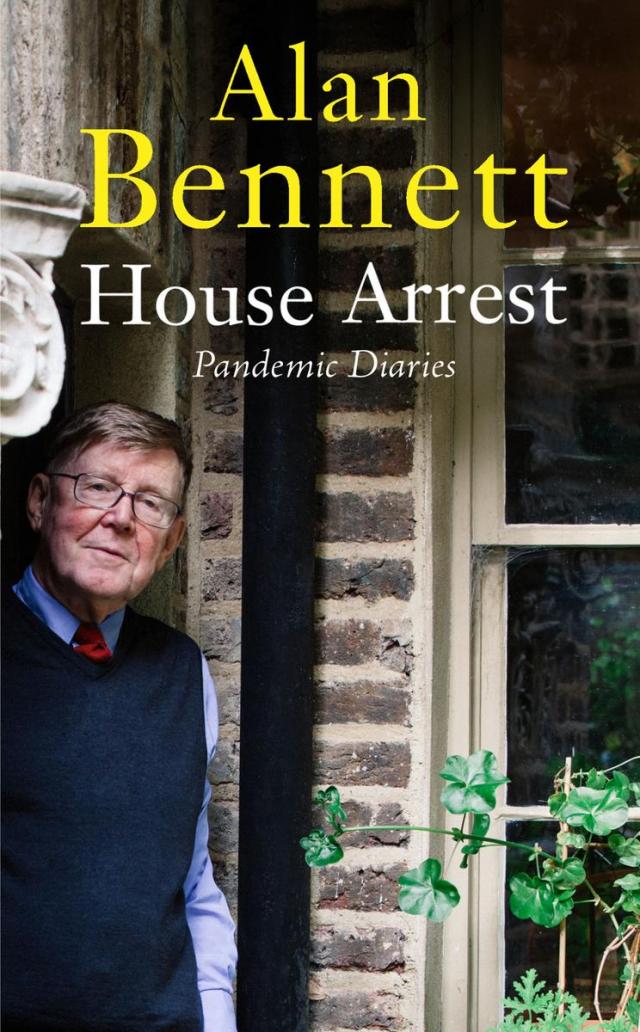


HOUSE ARREST
ALAN BENNETT
Contents
Title Page
Epigraph
The Journey Home
By the Same Author
Copyright
HOUSE ARREST
PANDEMIC DIARIES
But any writer would say that, though the sales and plaudits come not with doing it but having done it, the useful medal to have would be one bestowed, as it were, on the field of battle, hung round your neck in recognition of yet another fruitless morning spent at the typewriter or after a week or even months spent staring out of the window.
– from Staring out of the Window Alan Bennett, 2001
24 February Last week Rupert and his whole magazine were thrown into confusion when for no apparent reason the management enquired how many of the team could work from home. This was taken to be the prelude to some sort of shedding of staff. Today it transpires it’s less inimical than this, but rather a precaution. The coronavirus in Italy has meant the Milan office has had to close, the enquiry in case a similar situation should arise in London. This is thought to be unlikely.
1 March Thanks to arthritis I’m now much less mobile than I was. Gone are the days when I could jump on my bike to pop down to the shops, so static semi-isolation is scarcely a hardship or even a disruption of my routine. Himself no slouch when it came to work, George Steiner once asked a Soviet dissident how he got through so much. ‘House arrest, Steiner. House arrest.’ Alas, so far as work is concerned, I haven’t yet noticed much difference.
The only medical scourge I’ve had any experience of is TB, or consumption as it was called then. The Sherwoods, a family that lived next door to us in Armley, Leeds, in the 1940s lost their youngest son to TB, which then infected his father, who also died. Unsurprisingly, this left my mother perpetually anxious lest we catch it. Mrs Sherwood was a good cook and often invited my brother and me to sample her dishes, which we were strictly forbidden to do. On one occasion, though, I succumbed (Yorkshire pudding) and foolishly saying so at home it was as if I’d signed my own death warrant.
TB was to blame for other more bizarre prohibitions. We were never allowed to wear open-necked shirts, for instance, lest the cold ‘go to your chest’. Sharing a bottle of pop with other boys was another death trap, as was not wearing a vest or drinking unaired water.
TB was pretty well eradicated or controlled long before my mother’s death, but she never ceased to think of it as the killer it had been in her youth. Always one to diddle her hands under the tap, she would have found the precautions against the coronavirus only common sense.
4 March HMQ pictured in the paper at an investiture wearing gloves, presumably as a precaution against coronavirus. But not just gloves; these are almost gauntlets. I hope they’re not the thin end of a precautionary wedge, lest Her Majesty end up swathed in protective get-up such as is worn at the average crime scene.
Jeremy Musson the architectural historian writes to me for any thoughts I might have about George Bernard Shaw, who has an anniversary coming up and with some refurbishment projected at his house at Ayot St Lawrence.
I talk to him on the phone, saying that I’ve always wished I’d written Pygmalion, not to mention My Fair Lady, but without being able to offer much more. I used to read Shaw a good deal (or at least take him out of Headingley Library) when I was sixteen – the russet-brown bindings of the texts often figuring in my borrowings. I suppose, thinking about it, that I did absorb the notion that plays were a form of action, they were meant to do things, solve problems or flag them up and this I say to J. Musson. What I see I have in common is that I always enjoy writing the introductions more than writing the plays themselves. But whereas Shaw plainly thought his prefaces were on a par with the text, my introductions are more in the way of gossip, explaining why I’ve written the play and the circumstances that have generated it. I don’t think they are ‘a contribution’ as the Shavian prefaces are.
14 March As an over-seventy, I am officially exhorted to remain isolated and indoors which is to say that my usual going-on now has governmental endorsement.
18 March The York Theatre Royal’s tour of The Habit of Art, the play about Auden and Britten that did well last year and was due to be revived for a festival in New York, has had to be cancelled. I write to the cast apologising and saying that one person who would not be washing his hands every five minutes is W. H. Auden.
20 March With Rupert now working from home my life is much easier, as I get regular cups of tea and a lovely hot lunch.
24 March A rare plane passes.
Rupert is upstairs on a Zoom call with his office who, like him, are now all at home.
Photo in the Guardian of a home-made sign at the entrance to Malham village telling or rather entreating the hordes of tourists to go home. In our village twenty miles or so away the car park is full and the place far busier than on a normal Sunday. So far from social distancing some of the visitors practically link arms. Still, it makes a change from brawling over toilet rolls.
26 March Around six Nick Hytner rings, highly excited. Piers Wenger (BBC’s Director of Drama) has just rung him saying that though current restrictions make mounting any TV programmes difficult, he thinks it may be possible to do a new version of the Talking Heads monologues from 1988. Nick is ringing me (needlessly) for my permission. He comes round later and we thrash out some of the details in a conversation with him standing on the other side of the street. (‘Was this how King Lear started, do you think?’)
And now R. comes with a cup of coffee and a ginger biscuit, which is what John Dawson of Bleak Bank Farm gives the vet.
10 April, Good Friday We have agreed that the cast and crew in the Talking Heads remount should do so for a token fee, with any profits to be given to the NHS. I’m somewhat staggered to find that this amounts to a million pounds, possibly more. It’s no skin off my nose, as I never expected the programmes to be repeated, but the financial sacrifice for some of the cast and crew will not just be notional. Astonishing though it is, this gesture passes without notice.
Good Friday, when this year Pontius Pilate is not the only one washing his hands.
14 April I give some basic notes about Talking Heads to all the directors, who are on a Zoom call. Some of the precedents from the first production are particularly inappropriate. The first director was Stuart Burge, who did Thora Hird’s A Cream Cracker under the Settee and my A Chip in the Sugar. His method in rehearsal was to station himself a foot or so in front of one’s face, simulating the camera and remaining there throughout. To begin with this was unnerving, particularly for Thora who had never had to accommodate herself to such rigorous technique. But when after a few days Stuart moved to the other side of the room, we had got so used to him that both of us felt withdrawal symptoms. Today such proximity is out of the question, so I’m not sure my experiences are much help. I tell them if they have any queries about the scripts they are to ring and ask me but they’re free to make small cuts – adjustments – so long as they don’t touch the jokes.
16 April A card from Tom King with news of the tattoo of me that he had put on his arm (pictured in the Diary published in the London Review of Books of 3 January 2019): ‘The tattoo remains popular, though bizarrely one person thought it was of Henry Kissinger. It also makes for an amusing conversation during intercourse.’ This suggests the intercourse might be less than fervent, my name in itself something of a detumescent.
18 April Nick H. rings having had the first reading of the monologues he is producing, including a new one, The Shrine, about a woman whose husband is killed in a motorbike accident. At one point she talks about the sandwiches she used to make for him, ‘wenged in a hedge somewhere’. Neither Monica Dolan nor Nick, who is directing it, have come across ‘wenged’, and I think it may be one of my dad’s invented words. It meant – at least for him – to chuck. When my parents moved to the village, they were puzzled that they kept finding turds on the lawn. Then one day Dad was in the garden and a turd came flying through the air from next door, where the old lady had a dog. With uncharacteristic boldness Dad wenged it back (and it never happened again), but wenged remained in the family vocabulary.
23 April On St George’s Day (and Shakespeare’s birthday) the milk is sour, so no early morning tea and no breakfast until R. goes to the post office. I lie rather prematurely on the sofa at 11 a.m. – un-breakfasted and longing for a cup of tea – and of course not a soul about. I finish my umpteenth rereading of Andrew Barrow’s The Tap Dancer, which, with Nancy Mitford’s The Pursuit of Love, must be my favourite novel and one I wish I’d written.
Junk shops used to take us to out-of-the-way places – to Kirkby Stephen and Mrs Hill’s kitchen shop, for instance, or Brampton, where there were a couple of shops. Back in the sixties, the same quest took me all over Islington and Camden Town, and when I had learnt to drive it was junk shops that took me around Yorkshire. Lures they were in the sixties, junk shops. Since when, of course, the scope of junk has widened with shops scarce and car boot sales not a draw in the same way.
28 April The most one can hope from a reader is that he or she should think: ‘Here is somebody who knows what it is like to be me.’ It’s not what E. M. Forster meant by ‘only connect’, but it’s what I mean.
These days ‘only connect’ means bumping elbows.
7 May Some time in the afternoon Alex Jennings and Lesley Moors call by and we have a socially distanced chat on the doorstep, me sitting on a stool, Rupert standing behind me. They bring me a birthd
ay present (as yet unopened), having just taken something similar to Nick Hytner, whose birthday is today. Mine is on Saturday and Alex’s the day after, which is perhaps why we all get on so well (all Taureans, some would say). Nick rings later with a progress report on T. H. He is full of praise for the helpfulness of the EastEnders technicians, on the set of which at Elstree the monologues are being filmed.
Harriet Walter is doing Soldiering On and asked Nick H. how it was I ‘did posh so well’. Short of a ready explanation he said (somewhat desperately) he thought it was because I had been a friend of Debo D. There is some truth in this in the sense that my awareness of upper-class tropes comes not from Debo but her sister Nancy, whose Pursuit of Love I have known ever since I first discovered it in Majority 1931–1952 – the omnibus edition of Hamish Hamilton publications, read when I was at Oxford. ‘Too many memoirs’ would be another explanation (and ‘some Evelyn Waugh’).
8 May Today the displaced May Bank Holiday to mark the 75th anniversary of VE Day. London Live TV has a ‘War Week’, with a good deal about how the nation stood together 1939–45, but which can’t help sounding ironic in the dawning realisation of how inadequately the government has managed the response to the virus.
9 May Faultless weather yesterday and today reveals (with crowds on Primrose Hill) how the lockdown is coming apart.
11 May Boris Johnson’s address to the nation in the evening pretty pointless. ‘Stay alert’ meaning nothing. He’s such a poor orator and speaker generally, one almost feels sorry for him, with the plainness of Keir Starmer a relief.
R. bought me for my birthday The Stonemason: A History of Building Britain by Andrew Ziminski, an account of a life spent patching up ancient and even prehistoric buildings, particularly in Wiltshire. It’s also a history of ancient building methods and materials, particularly sarsen stones, and at one point the author painstakingly constructs a menhir of his own using the same tools and methods as his Neolithic predecessors. It’s a book about landscape as much as about what our ancestors made of it and brings the past well into the present – my only regret is that it’s very much centred on Wiltshire and the South East. I suppose that though Ilkley and thereabouts is strewn with Bronze Age remains, in our bit of Yorkshire further north, they’re pretty thin on the ground.
A few years ago we acquired our own menhir from a brick dump in Accrington where we had gone looking for flagstones for the kitchen floor. It was a substantial granite post, half of an ancient gate with the cast-iron hinge still embedded in the side. It stands majestically at the end of the garden – an orphan now, in that the village is in the heart of overwhelmingly limestone Craven. Not quite an erratic.
I met a stonemason once, appropriately in an historic monument, the Pantheon in Rome; he must have been alone among the crowds of tourists looking at the structure with an eye as to how it had been done. Rupert was looking at it as a classical interior. I feel I was hardly looking at all, I was just thankful to be able to sit down, and my neighbour was the mason and his father to whom I talked.
12 May Yesterday afternoon Charles Walker from United Agents rings to ask if I knew (which I didn’t) that Tony Cash has died. Tony and I were both in the same class on the arts side at Leeds Modern, even at one point sharing a desk. I think from Scarborough originally, his father a chef. His younger brother Bernard, who was also in the school, died young, in his twenties. Both were very musical, keen on jazz, Tony a clarinettist and a friend of Alan Cooper of The Temperance Seven. More outgoing than me, who at that time was very Conservative, Tony was on the left, may even have claimed to be a Communist – certainly not Christian, which I claimed to be. He hated school uniform since he was already a young man and wouldn’t wear a school cap, sporting a modish corduroy number. He was one of the half-dozen of us who applied for Oxford and Cambridge in 1951 and he got in at St Edmund Hall. Doing National Service in the navy, he was in a different branch of the Russian Course from me and served as a coder in Germany. Though I knew him at Oxford, we next came across one another in TV where he worked for Melvyn Bragg. It was thanks to Tony I did the Poetry in Motion programmes, which I’m grateful for. He was talkative, enthusiastic and always appreciative. Dying in the middle of the coronavirus pandemic he is unlikely to have a memorial service which he deserves or even a funeral. I can see his boyhood cap now – it was like a slipper.
I also remember him at one of the evenings we had playing records at the St Michael’s Youth Club in Headingley, when he and Alan Cooper were in hysterics at the conclusion of Beethoven’s Fifth because Beethoven didn’t seem to know how to end it – a difficulty that a few years later occurred to Dudley Moore and which he put to great effect in Beyond the Fringe.
15 May I’ve never been that fond of my hands. Now, much washed as we are told, they scarcely bear looking at: shiny, veinous and as transparent as an anatomical illustration. Far from the matt, solid, sensible instruments one has always hankered after. More ‘artistic’, I suppose. An old lady’s hands, lying idle in a lap somewhere.
17 May Remember lying on my bed in the University Arms at Cambridge the afternoon of the day Beyond the Fringe opened in May 1961 listening to the knocking and scraping of the workmen titivating the colleges, never thinking I would remember this afternoon all my life.
30 May Someone writes to me apropos my piece on Hardy in Six Poets, recounting the story of Hardy getting down on his hands and knees in the middle of a flock of sheep and pretending to eat the grass in order to see what it was like to be a sheep. To the person’s surprise they behaved exactly as they did in the story, gathering round to watch. A second go though was met with utter indifference.
1 June Coming to the end of English Pastoral, James Rebanks’s second volume. It’s harder to read than The Shepherd’s Life, with the central section about the onset of factory farming not easy to take. Thankfully, though, in his own life at any rate the tide turns and Rebanks regains his grip on traditional farming and with it offers some hope, without it being ‘fine writing’ as so much pastoral writing is. What it is, though it’s self-serving to say so, is a commentary on the last speech from Forty Years On: ‘Were we closer to the ground as children or is the grass emptier now?’
3 June George Fenton rings. Asks where I am.
‘On the sofa.’
‘Position normal?’
20 June When from 1944 to ’45 we lived in Guildford, we often ate (had to eat, the truth of it) in the British Restaurant there. This was a government canteen with pretty basic self-service school-dinner-type food. As a child, I found eating in public a delicate area, and I was always embarrassed when my parents patronised the place, though it was presumably all they could afford. It didn’t take much to embarrass me, but I was still at primary school, whereas my brother was at Guildford Grammar School, then as now quite a posh school, so with more reason to be self-conscious than me. Guildford was not short on cafés, the nicest (and in no way embarrassing) the Corona down the High Street, with a revolving drum of coffee beans in the window and an intoxicating aroma. Another was the Good Oven, where the scones were a particular favourite. In Leeds there would always have been the dietary supplement of fish and chips, and even in Guildford there were fish and chip shops. But they used oil, not the beef dripping on which we’d been brought up, and to us oil smelled disgusting and was yet another score on which ‘down South’ proved a disappointment.
10 July Isolation, such as it is, is beginning to rob me of speech. I had to call the optician today to explain how I’d broken the strut of my glasses, and I found myself so much at a loss Rupert had to take over. He didn’t find this at all strange. I do.
17 July I have watched the recordings of the Talking Heads monologues, but because of social distancing I’ve not been able to attend rehearsals or meet the performers or the directors. I send them thank-you notes and good wishes, and today comes a lovely card from Martin Freeman, whom I don’t know, but who is so good about the monologue he did (A Chip in the Sugar) that I want to write back and thank him, thus making it like an extract from A Lady of Letters, a thank-you letter for a thank-you letter. I’m so pleased with it, I carry Martin’s card about with me in my pocket like a hand warmer.