

The sons of el rey, p.2
The Sons of El Rey,
p.2


He smiles at me and reaches for the telephone, its ring rude and shrill. “East LA Hospice and Palliative Care. This is Randy.”
Every day I bring Abuelo the same bottle of chocolate Yoo-hoo, his favorite drink. I set it down on the side table near his bed and adjust the blinds so that the room isn’t so dark and morose, so he could know the sun’s out, that he’s still alive, still with us. His eyes mostly remain closed, though every now and again they flutter open, and he peers around, his look both amazed and terrified, like he’s seeing the world for the first time. There’s so much about Abuelo Ernesto that remains a mystery, obscured by secrets and time, a long life lived decades before I was even a thought. I reach out, hold his weathered hand, his fingers twisted as dried grapewood branches. My grandfather doesn’t respond, though. He’s too far out of reach now.
Even my dad doesn’t know for sure why my grandparents left Mexico right before he was born, why they landed in LA with nothing but a few boxes of clothes and pictures, having driven all the way from the capital in Abuelo’s shiny Impala with its gold rims, the spokes glinting like a queen’s crown. He asked my grandmother once when he was a kid why they came here, but she got all quiet and serious.
“I think something bad happened to them,” he told me. “Something that made them so sad.”
He and Tía Mercy knew not to ask about their lives in that other country, the one they only knew about through photos and old magazine clippings of Abuelo’s escapades as a luchador. This is how it is for most of us with parents or grandparents who leave the poverty and political upheaval behind. We try to tease information out of them, try understanding what could motivate them to risk everything to come here. So often our questions about why and when and who are answered by more questions: Why not? Who knows when? A smuggler helped us, I guess? Or vague replies that only heighten the mystery even more: It was terrible there. Be grateful that you live here. If you only knew what we went through.
Imagine trying to sift through endless fragments of your history. Imagine not knowing what year your grandfather was born, where your grandmother went to school. Imagine knowing you have family somewhere in Mexico or Guatemala that you’ll probably never meet. In elementary school, my teacher gave each student in our fourth-grade class a sheet of paper with a drawing of a tree. Next to each branch was a blank spot. You’re going to fill out your own family tree, she explained.
Someone asked why.
“So that we could know who we are and where we come from,” she replied.
Someone else asked why.
“Knowing where we come from helps us understand ourselves better.”
I knew a lot about my maternal grandparents, Steve and Patricia Mata, my mother’s mom and dad. Grandma Patty baked me birthday cakes and decorated these with squiggly drawings of fire trucks and plastic action figures of Spider-man or Superman, and they’d sometimes fall over and get frosting stuck to their outfits. Grandpa Steve worked in an insurance office and read books about war and political sabotage. He had a library, and I wasn’t allowed to go in there. Ever.
“That man has never seen a day of hard labor in his life,” Abuelo once said to my father. “You can tell by his hands. No calluses.”
They were never Abuelo and Abuela. They were always Grandpa Steve and Grandma Patty.
Grandma Patty’s parents fled Mexico in the 1930s and immigrated to Southern California. Her father drank himself to death, leaving his wife to raise all seven kids, including Grandma Patty, by herself.
My mother was the awkward middle child who had dreams of becoming a nurse after she read a biography about Florence Nightingale. Back in the mid-1990s, her life took a different turn when she met my father. Around that time, there was a crazy guy going around assaulting young girls, and my mother and her friends from community college heard about the self-defense classes being offered at Abuelo’s gym.
“I was exaggerating some that day,” she confessed. “I was more interested in getting close to your father than anything. I’d seen him once before when I stopped in. He was cute, and I wanted him to ask me out.”
They fell in love. She made him mixtapes of all her favorite songs recorded from the radio. She kept these in a cardboard shoebox, and sometimes I’d play them, laugh at the cheesy music and silly lyrics.
My mother’s older brother, Uncle Danny, had been a “wild child,” Grandma Patty told me. Very unconventional. He listened to punk rock in high school, sported a mohawk, and wore safety pins pierced through his earlobes. Tío Danny lived in a trailer in northeast Utah, near the Uintah and Ouray Reservation. He sent me birthday cards that carried the scent of patchouli oil. Those cards came every year without fail. The brown envelopes, his neat writing. Inside he’d include pencil sketches of flowers, hawks in flight, a pack of coyotes perched atop a boulder. Sometimes he’d send these little booklets with writing that looked as though it had been printed using an old typewriter.
They were handmade, the thin pages stapled or tied together with twine, full of the strange paranormal accounts of the region and of a place called Skinwalker Ranch. Some of the booklets included illustrations of objects in the sky or shadowy humanlike figures lurking behind thickets of trees. He’d write in the margins, Julian, I saw one of these, followed by the date of the alleged encounter. My mom’s younger sister, Aunt Cathy, was a born-again Christian who liked to post news stories about conspiracy theories and Covid-19 signaling the second coming of Jesus Christ to my social media feeds. She’d leave comments, too: Repent, mijo. The Lord loves you and will forgive you. Let HIM into your heart!
I had to add her to my list of blocked profiles.
I could say with certainty that, of all the relatives, none had more of a direct impact on my life than Abuelo Ernesto. Without his decision to get up and go, to leave it all behind and start up again, I wouldn’t be here to tell you this.
The only times I ever got close to livestock were the trips we took as a kid to the Los Angeles County Fair in Pomona. There are pictures of me petting sheep, sitting on top of a donkey, and feeding stalks of grass to a goat. Abuelo went with us a couple of times, and when we got to the section with the pigs, he used to tell me about the different breeds. The golden red ones called Duroc were used to make lard, he’d explain. Then there were the Hampshires with their black-and-white coats and ears that always stuck straight up. This made them very alert and good at grazing. Hampshires were the most common in the United States and raised for their meat. His favorites were the ones called Yorkshire pigs, because their meat was lean and the sows of this breed produced many piglets.
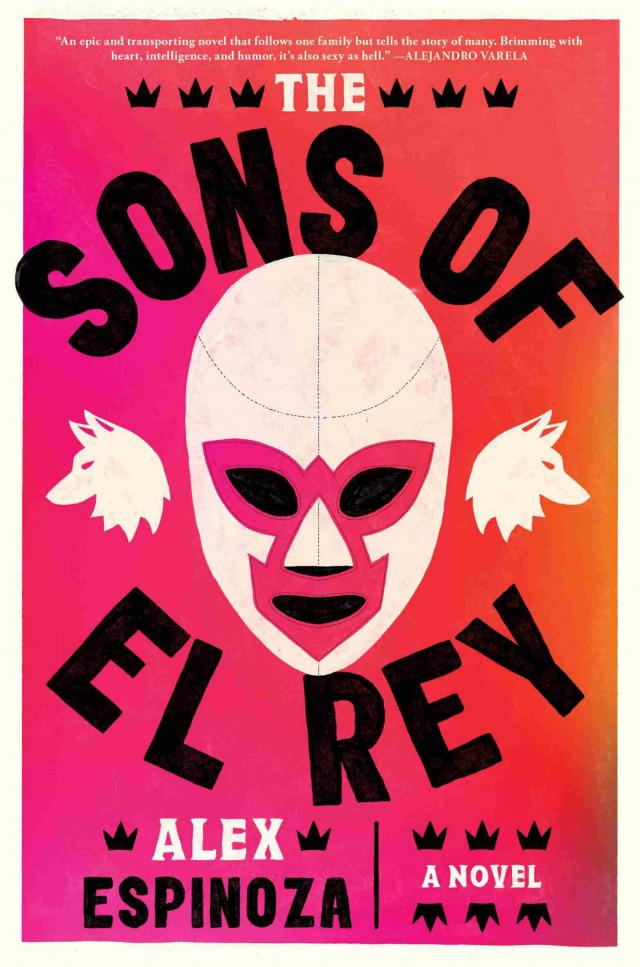
From pig farmer to luchador. When I was younger, he loved to show off his old clippings, the posters advertising his fights, Polaroids of him standing in the middle of a crowded bar, arms extended out, muscles oiled and flexed, surrounded by women with puffy hair and too much makeup. He wore his mask like a second skin, braided around the back of his skull by a series of thick laces. The gold borders outlining his eyes and mouth were thick, defined, and even though he was one of the good guys, the thing always made him look sinister to me.
In some of the pictures, there’s my grandmother Elena in her polyester jackets with wide collars, her hair in a beehive bun, fake eyelashes fuzzy as moth wings. She’s holding a wooden spoon up to Abuelo’s mouth, and he stands beside her in a brown-and-orange checkered shirt, chains hanging from his thick neck, his lucha mask over his face because, like all luchadores, he kept his identity a secret from his fans.
She’s smiling, but there’s something faraway about her expression. In some of the images, though, when he embraces her, it’s like there’s something between them, an unseen barrier.
Abuelo Ernesto is all grins under his mask.
But if I looked long enough, my abuela Elena’s face would speak to me, would tell me, I’m lost. How do I find my way out?
I try to stay here in this moment with him, because he’s slipping from us one breath at a time. A nurse comes in and tells me I need to step out of the room for a while.
“We have to suction him,” she explains. “You can come back in about an hour.”
It’s not a pleasant thing to experience, the gurgling sound of junk being pulled from his lungs.
“Yeah, I should head out anyway,” I reply, grabbing the warm bottle of chocolate milk and shoving it in my pocket.
I make my way towards the front entrance of the hospice. An old man in a hospital gown speckled with red stars sits in a wheelchair near the double doors. He lifts a finger as I pass, pointing to the bottle of chocolate milk.
“Yoo-hoo.” He sings it. “Yoo-hoo. Yoo-hoo. Yoo-hoo.” He grins, the inside of his mouth all gums, pink and slick.
I lean over and place the bottle in his lap and don’t take off my mask until I’m inside my car, away from the specters and memories tugging and tugging at me.
Tomorrow, I think. We have tomorrow. For now.
Elena Vega
What he said isn’t the truth. I wasn’t Ernesto’s only real love. But here’s what is true: I wasn’t all that content living in La Peña. Sure, we had our little house with its shiny metal roof and its sturdy brick walls painted bluer than the sky. We had two small rooms. There was a bed with a soft mattress and pillows and warm quilts. The house was on a large plot of land that once belonged to his father. Wide green fields. Soil rich in minerals. There was even a little brook that ran a few feet behind the barn. How I loved the trickle of water skidding over the slick silver rocks.
Each morning, after he’d leave to tend the pigs, I’d boil water and sit out back, smoke a cigarette and sip my coffee and watch the cornstalks sway in the breeze. We had chickens, and they grew fat and healthy, and they laid eggs and I fed these to him, swimming in red salsa. We had money. Not a lot, but enough, first for the refrigerator and then the television. We placed it on top of an old wooden drum. He fiddled with the dials and the antenna, until the fuzzy picture cleared and, just like that, the world entered my house. I had my comadres. On Saturdays, we went shopping in the markets, bought lipstick and false eyelashes, ate lunch, drank beers and gossiped. There was church on Sunday, eating toasted peanuts on metal park benches in the zocalo, strolling under shaded porticos.
But I knew of a bigger world, one with more shine, more luster, thanks to our television and all those Buenhogar magazines I would thumb through at the newsstands scattered along the broken and narrow sidewalks of our town. The glossy photos showed blond-haired gabachas modeling pleated miniskirts and leather boots. There were advertisements for shampoo, perfume, cigarettes (Her lips love Regal Slims!), and makeup.
I loved our town. Don’t get me wrong. But I also found myself yearning for something more. That’s part of the reason why I followed them. I could just hear our daughter Mercy’s reaction: A man shouldn’t control your destiny. You don’t have to go where he goes, do what he says. You are your own person. He left me no other choice; I’d do whatever it took to preserve my family because he had his eyes elsewhere. He expected me to agree to stay behind and wait, but I had my own plans. I wasn’t some pendeja from the campo. I knew things, even back then.
I had something to prove too.
El Rey Coyote
Let’s get one thing straight, ¡cabrones y cabronas! I’m not like her, the wife. She’s a ghost. I’m something more, something ancient, powerful. Both the old man and not. I extend beyond life and past death. I am a force of nature not to be toyed with.
But this isn’t about me. It’s about them. And about what they did to that poor man, their friend. They betrayed him and their entire country, turning their backs on us after everything we gave them. Cowards. Too ashamed to admit what they set in motion. Too embarrassed to face the ruin they caused. They ran away, tried shedding that former life, tried burying it. But the lies, the deceit, the mierda, it ALWAYS has a way of resurfacing.
¡Eso es la verdad!
ERNESTO VEGA
Why does he bring that bottle of chocolate milk each time he visits? It’s like a taunt, a sad reminder that I can’t drink anymore because I got a giant fucking tube sticking out of my throat. Hijo de la chingada. Screw the chocolate milk. I need a shot of tequila.
It might sound like I’m not taking this whole dying business seriously even as the nurse jabs the thin tube into the hole and then turns the machine over my head on to slurp all that green fluid out of my lungs. Who knew my body was still capable of producing so much? Rest assured that I know this is serious. There’s a sadness that extends beyond the basic definition of that word, too. It’s something transcendent, like the lamentations of monks and saints, a mourning that cuts right through flesh and bone and straight to the soul. When one is so close to departing, no grand thoughts fill the mind. Instead, it’s the madness of insignificant things you focus on. Like the nurse’s freckled arms, the scent of coffee on her breath, the sound of a child whining out in the hallway.
But I can barely feel anything even though I know that I’m still inside this body. These arms and legs. These bones. Brittle and weakening. These ears can still hear. And there are my eyes. Still my eyes. Clouded over, shadowed edges, the dim silhouettes of my family when they stop by, but these eyes still see. Like wearing a pair of sunglasses at dusk. Overhead, there are fluorescent yellow tubes encased in plastic. The darkness beyond my bed intensifies, circles closer, and it’s as though I’m being stalked by a vicious animal, an unseen predator. And the mind. This mind. My mind. It still holds on to memories. Are they the last to go? Rattling around like seeds inside the hollowed-out rind of a cantaloupe.
Then I see it, hovering at the foot of my bed. It comes into focus. The figure of a man. He’s dressed in my boots, the tights I wore, my flowing cape with its fur collar. A silver glow speckled with flecks of gold encircles him. It’s me. Another version of me, and everything about him is normal. He has two arms and two legs, a torso, broad shoulders, a fleshy neck. It’s my own body, up and about, swirling over me. There’s his head, my head, but it’s as bald as a newborn’s. There are my two ears. There’s my chin, scoured with scars. But my eyes, my mouth, my nose? They’re missing. There’s only skin, pulled tight like elastic, over the whole of my non-face.
—Are you going to take me away? I ask.
—No, he replies.
—Then why are you here?
—To remind you.
—Of what?
—¡Ya sabes, cobarde!
—Stop, I insist. Please leave. I’m trying to die.
The nurse is wrapping up the suction tubes. Can she see him? I try asking, but gravity seizes my tongue. It’s nothing but a dry, swollen thing rolling around in my mouth. Nothing works anymore. Then, just above her right shoulder as she leans over to adjust the IV drip, coiling it under my blanket, I notice something penetrate the haze around her. First there is a pattern I remember. Blue with tiny yellow flowers. Her dress. The one we buried her in. Elena, my dead wife, materializes before me. Transparent at first, she slowly takes form until she’s solid, standing so close to the bed that I can feel the heat from her body pass through my dying skin, reviving the blood still inside my frail veins.
—Ernesto? She looks at me, puzzled. Where are you? Who is this woman?
—I’m dying, I reply. They’ve brought me here.
—Who did?
—Alfredo and his wife, la Grace. Our mija, Mercedes. Our grandson; you died before you could meet him.
—Do I look dead now? She lifts both arms above her head, making fists with her hands.
—No. You look alive. It’s amazing.
—You can’t go yet. You must talk. Keep thinking. Keep remembering.
—But I can’t. It’s impossible. So much has vanished.
—It’s still there. I’ll help you find it.
—But what if I don’t want to? I can’t face the truth.
—You must, she implores. You simply must.
And then there it is. A thought. A memory’s left behind, the residue of a life once lived, like patterns on the side of a mountain that mark the remnants of extinct oceans. My friend. A boy I once knew and cared for very much. There he remains in the folds of my brain, refusing to be forgotten.
* * *
There was music playing inside the cantina that day. Then a voice said hello; Julián Tamez circled the room, greeting everyone. He reached into the pockets of his bell-bottoms and pulled out a wad of pesos, told the bartender to get everyone in the room whatever they wanted.
“Mira este.” Israel Navarette, another hog farmer, turned to me, chuckling, as Julián went from table to table, slapping each man on the back. “Regresa muy catrín.”
He flashed a ring at us. Around his neck he wore a heavy gold chain with a large crucifix. Some of the men mumbled and nodded. We gathered around Julián, drinking cold Victorias, and he told us all about his life in the capital. There were skyscrapers, he went on. Rascacielos, they called them, tall buildings that touched the clouds. There were wide avenues and plazas and fine restaurants that you could get to by using the new metro subway lines connecting the city. He talked about Chapultepec Park, about museums that housed the artifacts of our ancestors. He talked about fancy cars and houses so big that everyone in our entire pueblo could live inside of one and there’d still be more than enough room. Many of the men stumbled home by the time he finished, but I remained, mesmerized by his tales. It was a Sunday. Elena was out with her friends. I had the whole day to myself.
“Ernesto,” he said, cupping his hand over my left shoulder. “The last time I saw you we were still silly boys pretending to be men.” He whistled through his teeth. “Híjole.”
I shook my head. “It’s good to see you again, old friend.”
We sipped our beers, and he asked me what I did for a living.
“I raise hogs. On what’s left of my father’s ranch. He died. So did my mother.”


