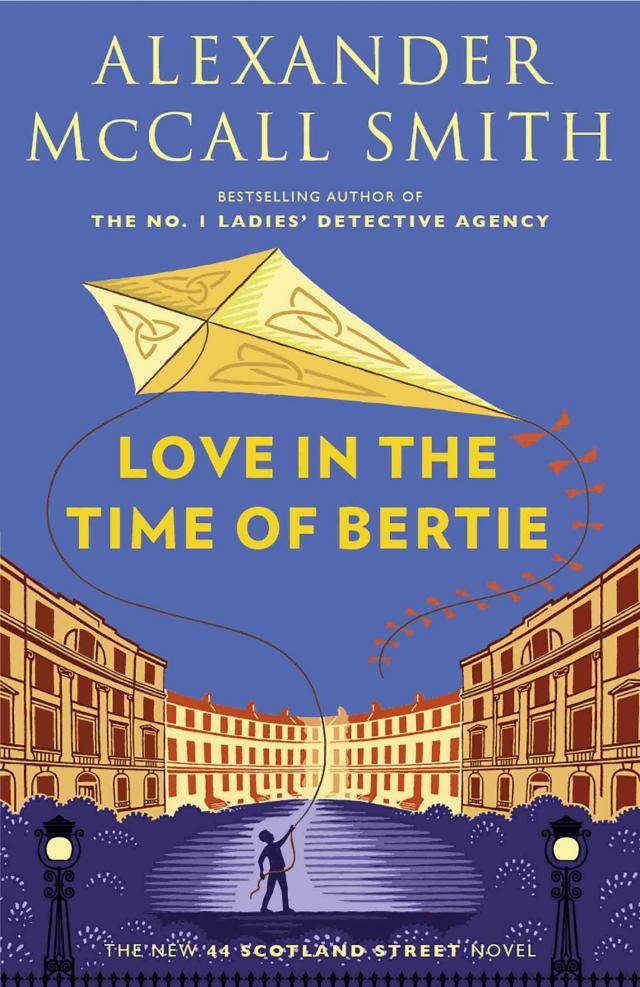
Love in the time of bert.., p.1
Love in the Time of Bertie,
p.1


Praise for Alexander McCall Smith’s
44 SCOTLAND STREET SERIES
“McCall Smith…is a pro, and he delivers sharp observation, gentle satire…as well as the expected romantic complications…. [Readers will] relish McCall Smith’s depiction of this place…and enjoy his tolerant, good-humored company.”
—The New York Times Book Review
“Contain[s] a healthy helping of McCall Smith’s patented charm…just about perfect.”
—St. Louis Post-Dispatch
“Packed with charming characters, piercing perceptions and shrewd yet gentle humor.”
—Chicago Sun-Times
“The most genial of writers and most gentle of satirists…. [The] characters are great fun…. McCall Smith treats them with affection.”
—Rocky Mountain News
“Powerfully addicting fiction…. Delightful…. [A] graceful and always amusing depiction of the pleasures and problems of everyday life.”
—Entertainment Weekly
Alexander McCall Smith
LOVE IN THE TIME OF BERTIE
Alexander McCall Smith is the author of the No. 1 Ladies’ Detective Agency novels and a number of other series and stand-alone books. His works have been translated into more than forty languages and have been bestsellers throughout the world. He lives in Scotland.
alexandermccallsmith.com
books by alexander mccall smith
in the 44 scotland street series
44 Scotland Street
Espresso Tales
Love Over Scotland
The World According to Bertie
The Unbearable Lightness of Scones
The Importance of Being Seven
Bertie Plays the Blues
Sunshine on Scotland Street
Bertie’s Guide to Life and Mothers
The Revolving Door of Life
The Bertie Project
A Time of Love and Tartan
The Peppermint Tea Chronicles
A Promise of Ankles
Love in the Time of Bertie
in the no. 1 ladies’ detective agency series
The No. 1 Ladies’ Detective Agency
Tears of the Giraffe
Morality for Beautiful Girls
The Kalahari Typing School for Men
The Full Cupboard of Life
In the Company of Cheerful Ladies
Blue Shoes and Happiness
The Good Husband of Zebra Drive
The Miracle at Speedy Motors
Tea Time for the Traditionally Built
The Double-Comfort Safari Club
The Saturday Big Tent Wedding Party
The Limpopo Academy of Private Detection
The Minor Adjustment Beauty Salon
The Handsome Man’s De Luxe Café
The Woman Who Walked in Sunshine
Precious and Grace
The House of Unexpected Sisters
The Colors of All the Cattle
To the Land of Long Lost Friends
How to Raise an Elephant
The Joy and Light Bus Company
for young readers
The Great Cake Mystery
The Mystery of Meerkat Hill
The Mystery of the Missing Lion
in the isabel dalhousie series
The Sunday Philosophy Club
Friends, Lovers, Chocolate
The Right Attitude to Rain
The Careful Use of Compliments
The Comforts of a Muddy Saturday
The Lost Art of Gratitude
The Charming Quirks of Others
The Forgotten Affairs of Youth
The Perils of Morning Coffee (eBook only)
The Uncommon Appeal of Clouds
The Novel Habits of Happiness
At the Reunion Buffet (eBook only)
Sweet, Thoughtful Valentine (eBook only)
A Distant View of Everything
The Quiet Side of Passion
The Geometry of Holding Hands
in the detective varg series
The Department of Sensitive Crimes
The Talented Mr. Varg
The Man with the Silver Saab
in the paul stuart series
My Italian Bulldozer
The Second-Worst Restaurant in France
in the corduroy mansions series
Corduroy Mansions
The Dog Who Came in from the Cold
A Conspiracy of Friends
in the portuguese irregular verbs series
Portuguese Irregular Verbs
The Finer Points of Sausage Dogs
At the Villa of Reduced Circumstances
Unusual Uses for Olive Oil
Your Inner Hedgehog
other works
La’s Orchestra Saves the World
The Girl Who Married a Lion and Other Tales from Africa
Trains and Lovers
The Forever Girl
Fatty O’Leary’s Dinner Party (eBook only)
Emma: A Modern Retelling
Chance Developments
The Good Pilot Peter Woodhouse
Pianos and Flowers
Tiny Tales
The Pavilion in the Clouds (eBook only)
VINTAGE CANADA EDITION, 2022
Copyright © 2021 Alexander McCall Smith
Author illustration © Iain McIntosh
Cover illustration © Iain McIntosh
All rights reserved under International and Pan-American Copyright Conventions. No part of this book may be reproduced in any form or by any electronic or mechanical means, including information storage and retrieval systems, without permission in writing from the publisher, except by a reviewer, who may quote brief passages in a review.
Published by Vintage Canada, a division of Penguin Random House Canada Limited, Toronto, in 2022 and simultaneously in the United States of America by Anchor Books, a division of Penguin Random House LLC, New York. Originally published in hardcover in Great Britain by Polygon Books, an imprint of Birlinn Ltd., Edinburgh, in 2021. Distributed in Canada by Penguin Random House Canada Limited, Toronto.
Vintage Canada and colophon are registered trademarks of Penguin Random House Canada Limited.
www.penguinrandomhouse.ca
This is a work of fiction. Names, characters, places, and incidents either are the product of the author’s imagination or are used fictitiously. Any resemblance to actual persons, living or dead, events, or locales is entirely coincidental.
This book is excerpted from a series that originally appeared in The Scotsman newspaper.
Library and Archives Canada Cataloguing in Publication
Title: Love in the time of Bertie / Alexander McCall Smith.
Names: McCall Smith, Alexander, 1948- author.
Series: McCall Smith, Alexander, 1948- 44 Scotland Street series ; 15.
Description: Series statement: A 44 Scotland Street novel ; 15
Identifiers: Canadiana (print) 20210320826 | Canadiana (ebook) 20210320834 | ISBN 9781039004016 (softcover) | ISBN 9781039004023 (EPUB)
Subjects: LCGFT: Humorous fiction. | LCGFT: Domestic fiction.
Classification: LCC PR6063.C326 L68 2022 | DDC 823/.914—dc23
Image credits: © Iain McIntosh
ep_prh_6.0_139332125_c0_r0
Contents
Cover
About the Author
Books by Alexander Mccall Smith
Title Page
Copyright
Dedication
Belgian Shoes
Galileo, Orthodoxy, Dinner
The Terraces of Purgatory
Debtors and Creditors
Being Aeneas
Blue Remembered Hills
The Holy Family Boxing Club
Students Eat Anything
An Orcadian Spell
Scotsmen Can Skip
Fat Bob
The Story of Mags
Great Lass, Big Quads
The Wolf Man Again
Dear Little Argonaut
Aberdeen Beckons (or Threatens)
The Coolest Boy by Far
An Incident in Crieff
The Money Rolls In
Torquil at the Door
Aunts and Spies
Oedipus, the Minotaur, Guilt
Torquil and Domenica Converse
Agrippina and Nero
Bertie’s Fate
Stuart Goes Out
Sister Maria-Fiore dei Fiori’s Secret
Bruce Prepares
The Merits of the Double-Upper
What Tam Didn’t Do
Garlic Naan
Harry and Josephine
Sleeping Rough
Bertie’s Outing
Bertie’s Farewell to Ranald
Retro’s In
Bruce Snubbed
In the Elephant House
The Omnipresence
of Hierarchy
Poppadoms and Theology
Given Lodging
Bruce Reflects, and Conducts
Against All Medical Odds
“You are troubled in your soul”
The Road to Aberdeen
My Ordeal, by Bertie
Edinburgh Past; Glasgow Future
Sister Maria-Fiore Confides
A Martini Is Planned
Post Martinis Omnia Animalia…
Room Issues
Elspeth Reflects
We’re All of Us Lost
At Doddie’s Hoose
Ranald Leaves a Note
Thank You for Having Me
Bless You
A Thursday Meeting
Pluscarden Abbey
Ca’ the Yowes
How the Cyclops Felt
Let the Games Begin
A Hammer Hurled
Love, Simpliciter
This book is for my good friend, Alistair Kerr
1
Belgian Shoes
Angus Lordie, portrait painter, citizen of Edinburgh, husband of Domenica Macdonald and owner (custodian, perhaps, according to modern sensibilities) of Cyril, the only dog in Scotland to have a gold tooth; that Angus Lordie stood in a room of his flat at 44 Scotland Street, wondering what to wear.
All the clothing he possessed was either hanging from a number of wooden hangers or was neatly folded and stacked away in a series of drawers within a large wardrobe, called in the second-hand trade, brown furniture. Nobody, apparently, wanted brown furniture any longer, as it was considered too cumbersome, not to say too dull, for contemporary tastes. If the Scottish diet had become Mediterranean, then Scottish furniture had become Scandinavian – light and minimalist, consigned to its owners in flat boxes and requiring to be assembled before use – and then reassembled, once the instruction booklet had been read. This was the very opposite of Angus Lordie’s wardrobe, as gloriously over-engineered, in its way, as the Forth Railway Bridge, and of similar vintage.
This wardrobe consisted of a series of drawers in which Angus kept what he called his accoutrements: his shirts and socks, handkerchiefs, ties, vests and so on, while jackets and trousers were hung from a railing on the opposite side. His kilt, along with his sporran, hose, kilt pin and sgian dubh, were also in one of the drawers, protected, ineffectively, by moth-repelling balls of cedar.
He had two suits – a dark one that had been made for him twenty-two years ago and that was described by Domenica as his kirk suit, and a three-piece, tweedy outfit that Domenica had disparagingly labelled his bookie’s suit. Neither of these descriptions was entirely helpful: the kirk suit was well-made and discreet, rather than Calvinist; the bookie’s suit was not in the least bit flashy, being made of Harris tweed and designed to withstand Hebridean weather – the horizontal rain and Atlantic gusts that beset the West of Scotland, and the North, South, and East for that matter. There was nothing wrong with these suits, although Angus seldom wore them. Suits, he thought, might be going the way of men’s hats and ties – both of which were now seen only infrequently on any man under forty. This was a matter of regret, Angus felt, even if he himself was doing nothing to stem that particular tide of fashion.
Alongside the suits were hung four jackets, all of them in frequent use. Two of these were linen, and formed the core of his summer garb, while the others were of an unidentified fabric that Angus referred to as one hundred per cent un-natural. They were comfortable enough, though, and went with virtually anything, but particularly with the crushed strawberry corduroy trousers by which Angus signalled his status as a resident of the Georgian New Town, as a member of the Scottish Arts Club, and as a man of artistic bent. If these trousers raised eyebrows amongst the ranks of the staid, then Angus did not care in the slightest. There was no fixed ordinance stipulating that men should wear sober trousers: fund managers, lawyers and accountants could dress in grey and black if they wished – he, as an artist, preferred something livelier.
On the floor of the wardrobe was the shoe rack on which Angus kept shoes other than those in regular use. His regular shoes – described by Domenica as his daily boots – were a pair of brown brogues made by the Northampton shoe-maker, Joseph Cheaney. English shoes, Angus maintained, were second to none. They may not be as elegant as Italian footwear, but Italian shoes would never stand the rigours of Scottish conditions. English shoes were made to last; they were modest, often understated, and they were, above all else, honest shoes. That quality of honesty was difficult to define – in shoes at least – but one knew it when one encountered it. That was why English shoes were still sought after when everything else, as far as Angus could see, was being made in distant, unspecified workshops. Designed in X and made in Y…Angus had never fallen for that particular attempt to sugar the pill of local deindustrialisation and the deskilling that went with it.
The English shoes of which he was proudest were a pair of black brogues, made of soft and supple leather, and bought by his father from the London firm of John Lobb. Lobb made shoes to measure, and while Angus could not afford the expense of bespoke shoes – the price tag ran effortlessly into thousands – his father, a Perthshire sheep farmer, had been able to do so after a particularly good season at the Lanark stock sales. His prize Scottish Blackface tup, Walter of Glenartney, renowned for his noble bearing, his fine Roman nose, and his contempt for lesser sheep, had broken all sales records and had provided him with the funds to order a pair of Lobb shoes.
By great good fortune, Angus and his father had near-identical feet, and when Angus left school, his father passed his shoes on to him. Angus accepted the gift with a degree of concealed embarrassment: at the age of eighteen, when one is busy shaking off parental influence, who wants a pair of bespoke Lobb shoes? At the Edinburgh College of Art at the time, shoes were being worn, of course, but these shoes were concepts or statements, rather than shoes simpliciter. So Angus relegated the Lobb brogues to a cupboard and wore, instead, a pair of Hush Puppies of tobacco-coloured suede, threaded with red laces – a touch that met with the wholehearted approval of his fellow students. “Radical,” they said – high praise in those innocent days.
At a crucial stage in life – somewhere in one’s mid-thirties – the merits of well-made shoes dawn on one, and that was what happened to Angus. He wore the shoes to his father’s funeral, and as he and farming neighbours carried him to his final rest, a tear fell from Angus’s eye onto the cap of one of the shoes. Not every man, he thought, will live to see such a thing: his tears falling onto a shoe into which he had, both metaphorically and otherwise, stepped.
Alongside the Lobb shoes, in as complete a contrast as could be imagined, was a pair of Belgian shoes, those light-weight, indoor shoes that are made only in Belgium and are completely unsuitable for active use. Angus had been given these by Domenica, whose eye had been caught by them on a trip to London.
“You can’t wear them out of doors,” she said, as she pre-sented him with them. “The Belgians, it would seem, don’t get out much.”
Angus smiled. “How drôle,” he said.
Domenica accepted the compliment with an inclination of her head. “Belgium is a bit of a mystery to me,” she said. “I don’t feel I’ve ever really grasped it, if you see what I mean.”[*]