The enigma of garlic, p.1
The Enigma of Garlic,
p.1
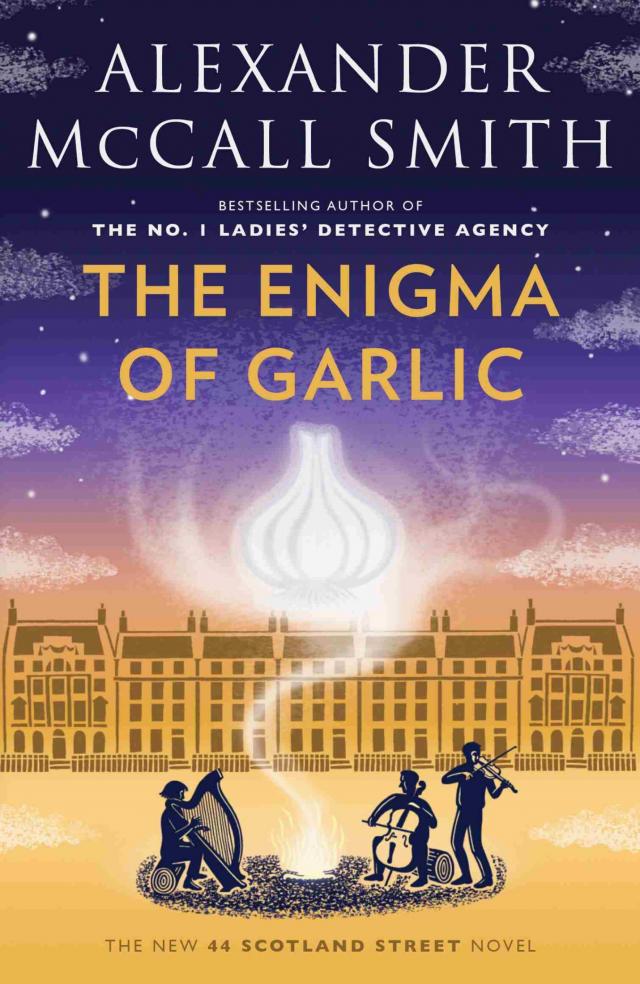


Praise for Alexander McCall Smith’s
44 SCOTLAND STREET SERIES
“It is McCall Smith’s particular genius to be able to look on the brighter side of life, and he’s seldom done so more enjoyably.”
—The Scotsman
“Alexander McCall Smith once again proves himself a wry but gentle chronicler of humanity and its foibles.”
—Miami Herald
“McCall Smith…is a pro, and he delivers sharp observation, gentle satire…as well as the expected romantic complications.…[Readers will] relish McCall Smith’s depiction of this place…and enjoy his tolerant, good-humored company.”
—The New York Times Book Review
“Contain[s] a healthy helping of McCall Smith’s patented charm…just about perfect.”
—St. Louis Post-Dispatch
“The most genial of writers and most gentle of satirists.…[The] characters are great fun.…McCall Smith treats them with affection.”
—Rocky Mountain News
“Powerfully addicting fiction.…Delightful.…[A] graceful and always amusing depiction of the pleasures and problems of everyday life.”
—Entertainment Weekly
Alexander McCall Smith
THE ENIGMA OF GARLIC
Alexander McCall Smith is the author of the No. 1 Ladies’ Detective Agency novels and a number of other series and stand-alone books. His works have been translated into more than forty languages and have been bestsellers throughout the world. He lives in Scotland.
alexandermccallsmith.com
BOOKS BY ALEXANDER MCCALL SMITH
IN THE 44 SCOTLAND STREET SERIES
44 Scotland Street
Espresso Tales
Love Over Scotland
The World According to Bertie
The Unbearable Lightness of Scones
The Importance of Being Seven
Bertie Plays the Blues
Sunshine on Scotland Street
Bertie’s Guide to Life and Mothers
The Revolving Door of Life
The Bertie Project
A Time of Love and Tartan
The Peppermint Tea Chronicles
A Promise of Ankles
Love in the Time of Bertie
IN THE NO. 1 LADIES’ DETECTIVE AGENCY SERIES
The No. 1 Ladies’ Detective Agency
Tears of the Giraffe
Morality for Beautiful Girls
The Kalahari Typing School for Men
The Full Cupboard of Life
In the Company of Cheerful Ladies
Blue Shoes and Happiness
The Good Husband of Zebra Drive
The Miracle at Speedy Motors
Tea Time for the Traditionally Built
The Double Comfort Safari Club
The Saturday Big Tent Wedding Party
The Limpopo Academy of Private Detection
The Minor Adjustment Beauty Salon
The Handsome Man’s De Luxe Café
The Woman Who Walked in Sunshine
Precious and Grace
The House of Unexpected Sisters
The Colors of All the Cattle
To the Land of Long Lost Friends
How to Raise an Elephant
The Joy and Light Bus Company
A Song of Comfortable Chairs
FOR YOUNG READERS
The Great Cake Mystery
The Mystery of Meerkat Hill
The Mystery of the Missing Lion
IN THE ISABEL DALHOUSIE SERIES
The Sunday Philosophy Club
Friends, Lovers, Chocolate
The Right Attitude to Rain
The Careful Use of Compliments
The Comforts of a Muddy Saturday
The Lost Art of Gratitude
The Charming Quirks of Others
The Forgotten Affairs of Youth
The Perils of Morning Coffee (eBook only)
The Uncommon Appeal of Clouds
The Novel Habits of Happiness
At the Reunion Buffet (eBook only)
Sweet, Thoughtful Valentine (eBook only)
A Distant View of Everything
The Quiet Side of Passion
The Geometry of Holding Hands
The Sweet Remnants of Summer
IN THE DETECTIVE VARG SERIES
The Department of Sensitive Crimes
The Talented Mr. Varg
The Man with the Silver Saab
The Strange Case of the Moderate Extremists (eBook only)
IN THE PAUL STUART SERIES
My Italian Bulldozer
The Second-Worst Restaurant in France
IN THE CORDUROY MANSIONS SERIES
Corduroy Mansions
The Dog Who Came in from the Cold
A Conspiracy of Friends
IN THE PORTUGUESE IRREGULAR VERBS SERIES
Portuguese Irregular Verbs
The Finer Points of Sausage Dogs
At the Villa of Reduced Circumstances
Unusual Uses for Olive Oil
Your Inner Hedgehog
OTHER WORKS
La’s Orchestra Saves the World
The Girl Who Married a Lion and Other Tales from Africa
Trains and Lovers
The Forever Girl
Fatty O’Leary’s Dinner Party (eBook only)
Emma: A Modern Retelling
Chance Developments
The Good Pilot Peter Woodhouse
Pianos and Flowers
Tiny Tales
The Pavilion in the Clouds (eBook only)
In a Time of Distance
AN ANCHOR BOOKS ORIGINAL 2023
Copyright © 2022 by Alexander McCall Smith
All rights reserved. Published in the United States by Anchor Books, a division of Penguin Random House LLC, New York. Originally published in hardcover in Great Britain by Polygon Books, an imprint of Birlinn Ltd., Edinburgh, in 2022.
Anchor Books and colophon are registered trademarks of Penguin Random House LLC.
This is a work of fiction. Names, characters, places, and incidents either are the product of the author’s imagination or are used fictitiously. Any resemblance to actual persons, living or dead, events, or locales is entirely coincidental.
This book is excerpted from a series that originally appeared in The Scotsman newspaper.
Cataloging-in-Publication Data is available at the Library of Congress.
Trade Paperback ISBN 9780593685198
Ebook ISBN 9780593685204
Cover illustration by Iain McIntosh
Author illustration © Iain McIntosh
anchorbooks.com
a_prh_6.0_143301906_c0_r1
Contents
Cover
About the Author
Books by Alexander McCall Smith
Title Page
Copyright
Dedication
1: Cooking for Men
2: Dutchitude
3: Domenica Thinks About Time
4: Stuart Is Unactivated
5: Stereotypes, Bullfighting, Danger
6: A Strawberry-blonde Experience
7: Borthy Arrives
8: Changed, Changed Utterly
9: Wedding Plans
10: At the Mansfield Traquair Centre
11: A Modernist Poet
12: Angry Penguins
13: Minor Disagreements, Germs, Promises
14: The Reel of the Fifty-First
15: The Perfect Bacon Roll
16: ‘The lightning is all about me’
17: The Pronunciation of Gullane (Again)
18: Energy Fields; Low Amperages
19: Kitchen Confidential
20: Lunch with a Dental Hygienist
21: Airbag Issues
22: Babar, Apollo, Contrition
23: Matthew Answers Elspeth’s Phone
24: Canine ESP
25: The Whiff of Battle
26: A Damascene Moment
27: St Senga of Dunfermline
28: Dr Livingstone Expounds
29: Capgras et al.
30: A Swiss Army Knife
31: Vitamin D Deficiency
32: Transparency
33: Fungus Issues
34: Signed in Green Ink
35: No Point in Girning
36: At Valvona & Crolla
37: Ossian, and So On
38: Seriously Cold
39: The Consequences of Frostbite
40: Early Rising
41: An Astonishing Act by Bruce
42: The Entity
43: Down in Leith
44: Very Uxorious
45: The Road to Carlops
46: Olive Takes Command
47: Vigils
48: Rust on Garlic
49: Lion-tamers, Change, Truth
50: Waterfalls, Scotland, Everything
51: Vitamin D: A National Issue
&nb
sp; 52: Angus Makes a List
53: In the Pentlands
54: Swallows and House Martins
55: The Talented Mr Borthwick
56: At The Chaumer
57: Sumptuary Laws
58: Glasgow Is Our Only Hope
_143301906_
This book is for Anna Marshall
1
Cooking for Men
Domenica Macdonald, anthropologist, resident of Edinburgh, observer of humanity and believer in the old-fashioned and increasingly rare virtue of tolerance, looked out of her window onto the cobbled street below and wondered what to cook for dinner. It was not a question on which she would spend much time – nor was it one with which she engaged emotionally. Domenica was a competent enough cook, but she had never been able to develop much enthusiasm for time-consuming recipes or for the cults surrounding some of the better-known chefs. She was aware of the prominent culinary names of the age, of those described as celebrity chefs, but took no real interest in them or in their doings, other than to be disappointed, in some cases at least, by their rude behaviour. The people who worked in kitchens had not signed up for the Foreign Legion – an organisation in which recruits could hardly complain if they were shouted at; kitchen staff should not have to put up with being sworn at and threatened in their workplace. The fact that you can make a tasty sauce is no ground for thinking you have the right to belittle those who help you make it. There was no excuse for impoliteness, Domenica would like to remind them: politeness cost nothing, did not smell, and there was always enough of it to go round.
Domenica did almost all the cooking in her household. Although her husband, Angus Lordie, a portrait painter of some distinction, did not belong to that generation of men who were completely incapable in the kitchen, his repertoire was nonetheless somewhat limited. In his bachelor days, Angus had relied on a small number of dishes that he prepared for himself and that he was able to make without reference to any recipe book. These included a pasta dish (spaghetti aglio e olio); Macsween’s haggis, served with mashed potatoes, neeps and peas; and kedgeree made with Arbroath smokies. The ingredients of these concoctions were few in number. Spaghetti aglio e olio, as the name suggested, required only spaghetti, garlic and olive oil. You cooked the spaghetti in another readily available ingredient – water – and then you placed it in heated olive oil to which you had added copious quantities of chopped garlic. That was all, and yet the name – aglio e olio – was so poetic, so full of Italian promise.
Haggis was perhaps even simpler. You obtained your haggis and you put it in the oven, wrapped in foil. Then you took it out and punctured the skin, having boiled the vegetables in advance. That, again, was all that you had to do, and all this could easily be accomplished, Angus thought, by mere men, possessed of no further culinary skills than those elucidated in a small and well-thumbed book that somebody had once given him entitled Cooking for Men.
It was not an unhealthy or unpalatable diet but it was with some relief that, after their marriage, Angus fell into the habit of allowing Domenica to prepare their evening meal. He was aware, though, that there were potential objections to this arrangement, and that the days when men could sit back and rely on being uncomplainingly cooked for by women were over. It was the duty of men to pull their weight domestically, and Angus fully accepted that. It was just that between the recognition of a duty and its fulfilment there was often something of a gap. We all want to be good, he told himself; we all want to do the right thing; but it’s not always easy. St Augustine had had something to say about that, he thought.
“I must get myself organised,” he said to Domenica. “I must do more in the kitchen. I really must. I enjoy cooking, you know.”
Domenica smiled. One had to encourage men in their inchoate schemes of self-improvement. “Yes,” she said. “That’s a very good idea, Angus. The kitchen, you may have noticed, is over there.”
But somehow Angus had never managed to put this vague intention into practice, and the task of cooking was shouldered by Domenica, just as it is by so many wives whose husbands express an intention to sharpen their culinary skills but somehow never get round to it.
Now, as she looked down on Scotland Street, Domenica decided that they would that evening have tomato soup out of a can, followed by scrambled eggs served on toast. This was plain fare – nursery food, as Angus sometimes called it – but it had the merit of a preparation time of five minutes, at the most. Angus would like it and for her part she had more pressing concerns than those of the kitchen. Domenica was currently working on a scholarly paper, An ethno-linguistic analysis of a Scottish sub-dialect: conjectures and possibilities. The paper itself was already written and accepted, in principle, for publication in a reputable scholarly journal. The journal editors, though, had passed on to Domenica various proposals for change made by the peer reviewers to whom the paper had been submitted, and these would need to be attended to.
Reviewers could be irritating; while some of them were helpful and approved publication without change, others seemed to feel it necessary to suggest amendments, even where none were strictly necessary. Domenica was convinced that this sometimes happened simply because reviewers felt that they had to do something to justify their involvement in the whole process. It was a familiar story in so many fields of activity. If you appointed a bureaucrat, for example, then you must expect the bureaucrat to create rules and think of reasons for not doing things. That is what bureaucrats do. If you bought a dog, then you must expect him to bark. That is what dogs do.
It was a matter of regret, Domenica thought, that people felt the need to do things. There were many situations, she felt, where inaction would be a perfectly good policy, where things could be left where they were without any attempt at improvement. The adage that what was not broken should not be fixed was derided as folk wisdom, and yet it was, Domenica thought, profoundly true. There was nothing wrong with inaction, in spite of the widespread belief that everything had constantly to be adjusted and rearranged. Things might be left exactly where they were, unaltered by interference. After all, there was no essential merit in change, in spite of the belief that disaster would follow unless all our arrangements were constantly revisited and reorganised.
Domenica had recently come across a biography of Calvin Coolidge, the American president who served so unobtrusively between 1923 and 1929. It was Coolidge of whom Dorothy Parker, when told of his death, asked, “How can they tell?” Dorothy Parker was extremely witty, but in this case her amusing observation obscured the fact that Coolidge, who was undoubtedly dull, was also a fairly successful president – for the very reason that he did nothing, and said even less. That would not be possible today, of course. People had to do things, and would not rest until they had done them.
Domenica turned round from her window and caught her husband’s eye. “I’ll cook dinner this evening, Angus,” she said. “Nothing fancy.”
“Thank you,” he said, looking slightly guilty.
2
Dutchitude
The paper on which Domenica had been working, and to which she would return after she and Angus had consumed their dinner of tomato soup and scrambled eggs on toast, represented the first fruits of a significant piece of research. Unlike the fieldwork she had previously done in her anthropological career, which involved travelling to distant and exotic places, Domenica’s latest project was one that took her no further than the slopes of the Pentland Hills on Edinburgh’s southern boundary. That is not to say that it was without risk: there had been several difficult moments in Fairmilehead and even in Morningside itself, the epicentre of Edinburgh respectability, but by and large there were none of the dangers that she had faced on her earlier forays into Papua New Guinea and the Malacca Straits.
Domenica’s career had closely followed the cursus honorum of the academic anthropologist. An undergraduate degree had been followed by research for a PhD and that, in due course, led to a postdoctoral fellowship. The PhD was completed under the supervision of the distinguished social anthropologist, Professor Lance Studebaker, an authority on the use of linguistic evidence in support of anthropological conclusions. Studebaker came from a cosmopolitan background. His father had been an American air force colonel who spent some years as air attaché in the American Embassy in Sri Lanka. It was while he was in Colombo that he met Anna-Marie van Vonk, the daughter of a prominent member of the Burgher community. The Burghers were people mostly of Dutch or Portuguese origin who had lived in Ceylon, as it once was, and Sri Lanka, as it became, for generations. Most of them had intermarried with the Sinhalese and become very much part of the patchwork of peoples who made up Sri Lankan society. The van Vonks were tea merchants and had their own small tea garden not far from Galle. Anna-Marie, the eldest of three daughters, was a bird painter whose works had attracted an international following; her delicate watercolours of the island’s birds were displayed in museums all over the world and had been published, too, in a handsome, privately printed book. Lance was born in Colombo, but was taken back to the United States at the age of four. He was educated at Phillips Exeter Academy and then at Princeton, where his interest in anthropology was first aroused. Because of his family connection with the country, it is perhaps not surprising that he should have chosen to do postgraduate research into an aspect of his mother’s country, concentrating on the sense of Dutch identity experienced by the Burgher community. To this concept he gave a name – Dutchitude – a nod in the direction of Léopold Sédar Senghor’s influential work on identity.