The ball of snow, p.13
THE BALL OF SNOW,
p.13


“Have pity on me, pardon mo, good Mullah Nour!” said Sédek.
“Have you ever pitied the lot of the poor man whom you saw dying of hunger? Would you have felt any remorse if you had killed me? No; for you are a miserable wretch. You coin every letter of the Koran into money, and in your own interests and for your own profit you sow dissension in families. I recognized you; I knew what sort of a man you were, and I did not touch you when you passed along here on your way to Derbend. You did not see me; you did not meet me; you did not know me; yet you insulted me. Well, now you will not be lying when you say that I have robbed you. Mullah Sédek, give me your money!”
Mullah Sédek sent up shriek after shriek, he shed great tears; but he was entrapped, he had to submit. One after another, he cast his poor roubles into the sack held out to him by Mullah Nour, squeezing each coin before letting it go, as if a coating of silver might cling to his hands.
Finally, he reached the last piece.
“That is all,” said he.
“You would swear to a lie on the edge of the grave!” cried Mullah Nour. “Look here, Sédek, unless you wish to become more intimately acquainted with my poniard, count better. You still have money; you have gold in the inside pocket of your tchouska. I know how much, and I can tell you, — fifteen hundred roubles. Is n’t that it?”
Great was the lamentation of Sédek, but he was forced to yield up his very last piece of gold.
Mullah Nour had spoken the truth, he knew the amount.
Mullah Nour then conducted Sédek to the much desired bank, and made him there dismount from his horse.
Mullah Sédek believed himself at quits with the bandit, but he was deceived.
“Now, that is not all,” said the latter; “you have hindered the marriage of Iskander Beg, and you must mend what you have marred. You have a bottle of ink in your girdle; write to Hadji Festahli that you have received on the way a letter from your brother, in which he tells you that his son does not wish to marry, and has gone on a pilgrimage to Mecca; or say that he is dead, if you like. The deuce! you ought not to be put to it for a lie! Only, arrange it so that Iskander can wed his promised bride. Otherwise, I shall see to marrying you to the houris, Mullah Sédek!”
“Never!” cried Mullah Sédek, “never! No, no, no, I will not do it! You have taken all I had; be content with what you have robbed me of.”
“Ah! is it so?” said Mullah Nour.
He clapped his hands three times, and, at the third, a dozen bandits appeared, as if they had issued from the rocks.
“The worthy Mullah Sédek wishes to write,” said Mullah Nour; “second him, my friends, in the laudable intention.”
In a twinkling, Mullah Sédek, if such was indeed his desire, had nothing left to wish for. One bandit detached his ink-bottle, another dipped his pen in the ink, a third handed him paper, and last of all, a fourth, bracing his hands against his knees, and lowering his shoulders, offered his back for a desk.
Three times Mullah Sédek began to write, but, whether from errors or unwillingness, three times he broke off., “Well?” demanded Mullah Nour, his voice but the more threatening for appearing to be perfectly calm.
“The ink is bad, and my head is so bothered that I can think of no words.”
“Then write with your blood and think with your papak,” said Mullah Nour, with an emphasizing flash of the terrible kandjiar; “but write very quickly! If not, I will put such a point between your two eyebrows that the devil alone can tell which letter of the alphabet you resemble.”
Mullah Sédek saw that his hesitation had gone its length, and he finally made up his mind to write.
“Set your seal now,” said Mullah Nour, when the letter was finished.
Mullah Sédek obeyed.
“There! now give it to me,” demanded Mullah Nour; “I will see to posting it.”
He took the letter, read it, assured himself that it was what he desired, thrust it into his pocket, and then, tossing to Mullah Sédek all that had been taken from him, he said, —
“There is your gold and silver, Sédek; take it back, not a kopeck is missing. And now which of us two is miser or thief? Answer. However, it is not a gift, but a payment. You have blackened my name at Derbend, you must regild it at Schumaka, and that in open mosque. Go, then, and know that if you do not carry out my orders, my ball will find you, however well hidden you may be. I have convinced you that I know everything; I will prove to you that I can do everything.”
Mullah Sédek pledged himself to all that the bandit exacted, took possession of his money very joyfully, restored it to his pockets, after first assuring himself that his pockets contained no holes, and, remounting his horse, he set off at full gallop.
Two days later, Mullah Sédek scandalized the people of Schumaka by a discourse in which he eulogized Mullah Nour, comparing him to a lion that bore the heart of a dove in his breast.
CHAPTER XIV.
CONCLUSION.
PROBABLY the letter written to Festahli by his friend, Mullah Sédek, left the former not a ray of hope for the union on which he had counted; for, one evening after the letter had reached his address, music and songs were heard in the streets of Derbend.
Kassime was being escorted to the home of her betrothed husband, Iskander.
All Derbend followed her; shouts and acclamations rent the air on every side, and from every house-top innumerable guns discharged their fires, like brilliant rockets.
The whole town seemed ablaze, rejoicing in Iskander’s happiness.
Iskander Beg, on hearing the noise and music, had twenty times drawn near to his door, and every time custom forbade his opening it.
Finally, at the twenty-first time, when the procession was almost at his threshold, as he half-opened his door and shyly put out his head, a horseman extended his hand, saying, —
“Iskander, may Allah grant you all the happiness that I wish you!”
And the same instant he wheeled his horse away, that he might not be caught in the midst of the crowd.
But, just as the horse turned, he found himself face to face with Yussef, who, naturally, was the best man at Iskander’s wedding.
Yussef Beg recognized the horseman, and could not restrain an exclamation of terror.
“Mullah Nour!” he cried.
That name, as one can well understand, threw the fête into great confusion.
The cry “Mullah Nour! Mullah Nour!” re-echoed on all sides.
“This way! that way! catch him! hold him fast!” howled the ten thousand voices together.
But Mullah Nour shot away like a flash of lightning.
All the young men who were on horseback in the bride’s train dashed off in pursuit of the bandit.
Mullah Nour flew through the streets of Derbend, and all they saw of him in the dark was the shower of sparks from his horse’s hoofs.
But as the city gates were closed Mullah Nour could not get out.
By the glare of shots fired at him along his course, they saw that he was headed toward the sea.
He would there find himself caught between the ramparts and the water.
One instant the bandit paused; the sea was high. They saw the leaping waves and tossing foam; they heard their roar.
“He is caught! he is ours! Death to Mullah Nour!” shouted his pursuers.
But Mullah four’s whip whistled like the wind, flashed like the lightning, and from the rock where he had an instant paused, at one leap his horse plunged into the sea.
His pursuers drew rein as the waters of the Caspian Sea washed their horses’ flanks.
They strained their eyes, screening them with their hands, in an effort to pierce the gloom.
“He is lost! drowned! dead!” they shouted at last.
A formidable peal of laughter answered their shouts, and a hurrah sent up from a dozen throats was heard in the direction of a little island uprising about a quarter of a verst from Derbend, which announced to the disappointed pursuers that not only had Mullah Nour escaped, but that he was even surrounded by his comrades.
In Iskander’s house the doors are closely shut. All is very quiet within; a faint whispering can scarcely be heard.
Gayety seeks the crowd; happiness loves silence and solitude.
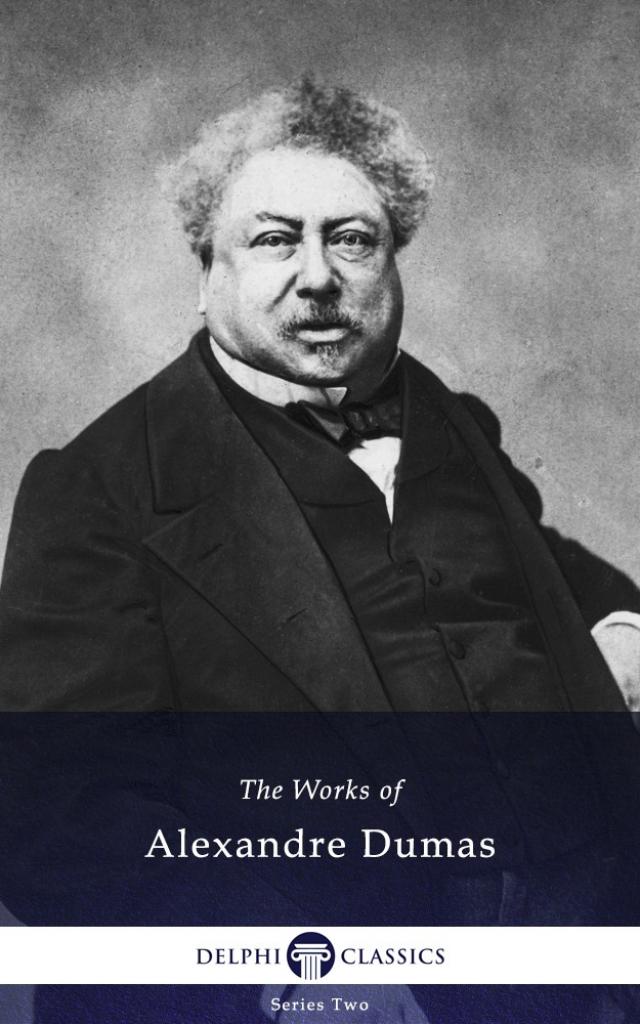
Alexandre Dumas, THE BALL OF SNOW


__english_preview.jpg)