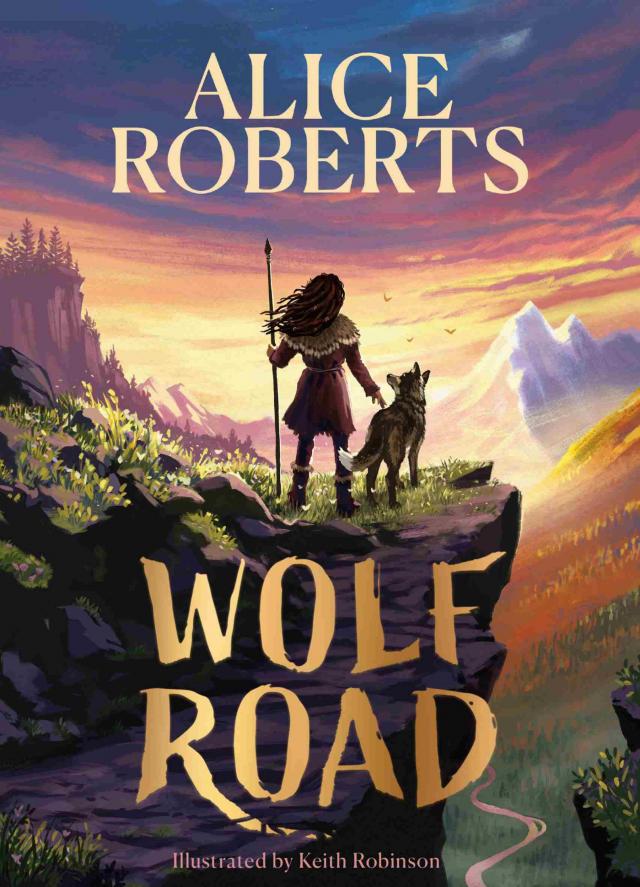
Wolf road, p.7
Wolf Road,
p.7


She shook herself out of her reverie, realizing she’d come to a stop. Looking down the valley she was just in time to see Maatu with three-winters-old Vinta on his shoulders disappearing among the larches up ahead, just where the sides of the gorge pushed in.
She was suddenly gripped with fear – she didn’t want to be left so far behind. Not today, not with that potential threat lurking in the hills. She grabbed the hide reins of her pulk and forged ahead, intent on catching up, ignoring the squelching in her boots. She regretted being so grumpy with Maatu.
I AM strong. I can do this.
But just as Tuuli summoned up this inner strength, Lupa – always close by her side – pricked up her ears and then flattened them against her head, pulling her lips back into a silent snarl. And then she was off, tearing up the bank into the taiga.
‘Lupa!’ yelled Tuuli. ‘Lupa! Come back!’
She stood still, breathing heavily, her eyes darting along the larches where the wolf had disappeared into the wood. She held her breath and listened, but she couldn’t hear anything. She called out to the wolf twice more, but there was no sign of her. Tuuli was faced with a choice. Should she press on, and try to catch up with the others – or should she abandon her pulk here and go after Lupa in the woods?
Tuuli pressed her hands against the sides of her head, feeling tears pricking her eyes. She didn’t feel so strong now. Perhaps she’d been foolish to think that she could keep a wild wolf, even for one moon. Of course the call of the wilderness would always be too strong for a creature like that.
In the end, Tuuli’s own survival instinct won through. She turned away from the woods, focused on the narrowing valley and the river, grabbed the reins again, and made a start. Perhaps she will come back, thought Tuuli. If she wants to find me, she should be able to follow my scent. She kept glancing to her left at the larches, just in case.
As she reached the narrowest part of the gorge, Tuuli called out her kestrel-cry, twice. Her voice pierced the air, bird-like. She thought she heard a swan call out in reply – Jutsa, if she wasn’t mistaken. But then she heard a raven, too – Garan’s voice.
She looked around her. Just beyond the corner here, the cliffs would pull back, she remembered, and then she should be able to see them all. She was fighting her way through a thicket of dwarf willow which reached right down the bank – specially designed, it seemed, to snag her pulk at every step. She moved down, closer to the river’s edge, where she hoped to pull the sled more easily over the large, wet stones. But this was an outside bend – the bank was steep. The river, engorged with meltwater, surged beneath her. Tuuli’s wet reindeer boots had absolutely no grip and suddenly, she slipped. She plunged down into the icy cold water up to her thighs and gasped with the shock of sudden immersion.
She’d somehow managed to stay upright, but as she moved her right foot out to keep her balance, she slipped off a submerged rock and felt her ankle twist under her with a sudden stab of pain. She let go of her spear, and it was swiftly carried off by the surging water. Tuuli was really panicking now, up to her waist in the torrent. She threw herself against the bank, grabbing at the willows straggling down to the water. They cut her hands as she reached for a hold. Her pulk, which had been resting on one edge on the bank above and behind her, suddenly overbalanced, and tipped into the river. Now upside-down, it pushed past her in the rushing water. It was being dragged away from the bank – and Tuuli was attached to it by the hide reins, tied to her waist. She was being tugged away too, and as the brittle twigs of the dwarf willows shattered in her grip, she scrabbled to get a better hold.
She had to act quickly. Her life was in danger from the raw, elemental power of the river. If she let go of the willow, she’d be pulled out – and under. She wouldn’t stand a chance. But if she could get a good anchor with just one hand, she could free the other… and grab the sharp flint knife tucked inside her coat. Holding on tight with her right hand, she pushed her left hand down to feel for the roots of the willow – stronger and tougher than the branches and twigs. She rammed her fingers deep into the mass of roots, feeling the rough bark and sharp stones in the earth tearing at her flesh. Getting a good grip, she pulled her right hand away, feeling inside the flap of her coat for the flint… panicking for a moment – was it there? She felt it, grabbed it, pulled it out, and in two swift, deft strokes cut through the thongs tying the pulk to her waist. It rushed away from her, still upside-down, travelling fast on the snowmelt current. Right out into the middle of the river, carrying all her possessions with it: her share of hides for the tents, her summer clothes, her hide boots, pieces of antler; the bit of tusk ivory that she’d been going to carve into an amulet for Aski. Her pieces of birch bark and packets of pine resin. And her carefully wrapped parcels of dried reindeer meat, fermented willow, sweet horse-foot and groundsel. And all her spare darts, her harpoon, her half-made stone points. Everything. Apart from the two darts that were still – somehow – strapped to her back.
Tuuli pulled herself out of the water, onto the bank. She was bleeding, her hands covered in scarlet gashes. As she dragged her body up onto the springy, stunted willows, one of her reindeer boots came off, lost to the river like all her other belongings.
But she was alive. She’d narrowly avoided being swept away. She lay on the springy bed of willow, with her face buried in her arms, gasping for breath. And in that moment, she felt a sharp pang of resentment towards her parents, especially her mother, for leaving her behind. And Lupa was gone, too.
Face down, nose pressed into the sodden reindeer fur of her coat, she began to sob. She could taste the salt of her tears. She was frozen to the bone. So, so cold. But she knew she couldn’t afford to give in, give up. Somehow, she had to get back to the rest of her tribe. Taking a deep breath, she lifted her head off her arms.
As she opened her eyes, the next sob became a gasp.
Because he was right there.
Sitting in front of her.
Looking right at her.
THE LONE WOLF
Terror was flowing into and over Tuuli. Through her fingertips, down to her toes. It was like being plunged into the icy river all over again.
Gasping, she pulled herself up to a kneeling position. It was hard to do without falling into the springy willow, and she winced in agony at the pain in her ankle. She felt as though she’d been punched in the pit of her belly.
She froze, holding her breath. All she could think was that he was going to kill her.
Should I throw myself back in the river? That’s my only chance of getting away from him…
Which was the greater threat? Tuuli glanced over her shoulder at the turbulent water rushing past behind her. The noise of the river filled her ears, crowding her thoughts. She’d be gone in a flash, swept downstream like her pulk. Catching up with the rest of her tribe – probably as a corpse.
She could feel her heart pounding. She had to make a decision. It could be her last.
The boy still hadn’t moved.
He was sitting cross-legged on the cushion of willow, only a few arm-lengths away, hands resting on his knees. He was watching her with narrowed eyes. Staring at her.
She looked right at him through still-rising panic, trying to read his face.
What’s he going to do?
And while she fixed him with her stare, Tuuli was taking in just how odd-looking this boy was. His skin wasn’t dark brown like hers – like everyone she’d ever seen. When she’d glimpsed him in the woods, she hadn’t been able to see how pale he was. His hair was light, too. Not dark like her own, but honey-brown. Just like her hair, his was rubbed into thick tangles, pulled back from his face. She couldn’t see how long it was. He was staring back at her – and his deep-set eyes looked blue. As blue as a clear sky. She’d never seen eyes that colour – except in babies.
They’d been staring at each other for what seemed like an age, even though it was just a few moments. Why didn’t he make a move? Tuuli had been delivered from the freezing grasp of the river, straight into the jaws of a lone wolf. She glanced over her shoulder again at the raging river, then back at him. When she clenched her right fist, the sharp edge of her flint knife cut into the skin. She’d almost forgotten she still had it.
If she reached for one of the darts from her sling, he might make his move and attack her. The flint knife, though, gave her a chance. He doesn’t know I have it.
With the idea of jumping back in the river firmly behind her, she still knew she had very little chance of walking away from this safely, with her battered and bruised limbs and her twisted ankle.
But she had to try. And if he made a move – if he launched himself at her – she would slash up at his neck with her flint.
Tuuli rose slowly to her feet – difficult in the springy, bushy willow of the riverbank – and gasped again, at the lancing pain in her ankle. She moved her right hand, clutching the blade behind her back, and stepped forward.
Then suddenly, like sun bursting from behind a cloud, the boy smiled.
She froze again, thunderstruck.
The smile widened into a huge, toothy grin, taking over his face. His eyes, under those heavy brows, creased up merrily. Was he laughing at her?
Tuuli stared at the boy, frowning. She looked at him even more closely. He looked a bit older than her, in his teens. His skin colour was different, and his face was also unusual – his features large, somehow exaggerated.
Just then, he moved towards her a fraction, shifting his weight and coming up onto his knees. Startled, she jerked backwards, caught her painful ankle and fell into a sitting position. She thrust her hands down to steady herself and grimaced as sharp willow twigs pricked and dragged at the raw cuts on her palms and fingers.
He approached her cautiously, still smiling, eyebrows raised in a friendly way.
Tuuli shrank back, but now she was dangerously near the rushing water. As he came closer she looked into his face and detected no aggression there.
And then he spoke.
‘Come,’ he said.
The word sounded strange. Like he wasn’t used to it. Like he’d heard it once and now tried to repeat it. Some of the other tribes they met across the seasons spoke with accents, with dialects that made familiar words seem unfamiliar. But this boy spoke a single, simple word as if it were something quite foreign and difficult. Still, it was impossible to misunderstand, when at the same time he was beckoning her away from the river.
‘Come,’ he said again, holding his hand out to her. She kept her right hand behind her, gripping the flint knife. Taking a deep breath, she reached out to him with her left. And he pulled her up to standing.
Then he helped her clamber and hobble over the thicket of willow until they were higher up on the bank and the willow gave way to sparse larches. Heart thumping and legs trembling, she needed to sit down again. He held her hand and supported her as she sat down, but as soon as she was settled, she pushed him away.
‘Who are you?’ she hissed at him.
The boy crouched down next to her. He was wearing a basic tunic made of deer-skin, crudely sewn up at the sides. He had a broad hide thong tied around his chest, under his arms, and a short, wooden spear was tucked under this strap at his back. A single fox-tooth hung from a cord around his neck. He was wearing what looked like fur boots, but on closer inspection, Tuuli saw that these weren’t properly sewn. They looked like rough pieces of fur just tied onto his feet with sinews.
She found herself staring at those tied-on boots. They were so odd. He must come from a faraway tribe. In the dappled sunlight striking down between the bare larch branches, he looked like a magical being from a dream.
‘Friend,’ he replied to her, after a pause, clearly but with his odd accent.
He was staring at her, and frowning a little under those impressive brows, as though the word was difficult to recall. He reached out and touched her right ankle. She flinched and pulled her foot back – too quickly – wincing in pain again.
He was looking at her intensely – it made her feel uncomfortable. But he didn’t seem threatening.
‘Friend,’ he said again, simply. And once more, he reached towards her bruised ankle. This time, Tuuli extended her foot and let him inspect it. He touched it gently, feeling the swollen contours. Then he sat back on his haunches and took his spear out. Tuuli recoiled nervously, but he laid it on the ground. Then he untied the hide strap from around his chest. It was a long strip – it had passed twice round his body. Cradling her damaged ankle, he began to wrap the hide around it. He pulled and stretched the strip of skin as he wound it, passing it down under her foot and then back up and around her ankle. His hands moved deftly and precisely. He’d left the beginning of the strip sticking out, so there was something to tie the end of it to when he’d finished winding. Tuuli wriggled her toes; her ankle felt secure.
He looked up at her and smiled again. This time, she returned the smile, shyly.
‘Are you on your own?’ she asked him.
He looked at her quizzically. She wasn’t sure he’d understood.
‘Where are your people? Your tribe?’ she asked.
He looked like he was concentrating very hard, and now a flicker of understanding rearranged his features.
‘And-ar,’ he said, speaking very slowly, as though he was grasping for the word in his mind.
It was Tuuli’s turn to look confused. Was this the name of his tribe? She’d never heard of them, which meant they must come from a very long way away. She was intrigued to meet someone who seemed so different from everyone she’d ever met. But was he on his own – a lone wolf, albeit a friendly one? Or was his tribe in the area? Perhaps they wouldn’t be as friendly.
There’d been no real fighting between tribes in her lifetime, as the Swans got on well with the four or five other tribes they knew and saw often, in the land around the rivers and between the mountains and the dunes. Territories overlapped, and they would meet up with these others at Spring and Summer Camp. There was usually enough food to go round – they weren’t competing with each other. In fact, when one tribe was in trouble, they could usually count on help from neighbours. There were arguments on occasion, of course, and this could drive hunters to leave one tribe and join another – sometimes just temporarily, at other times for good. Occasionally a talo split up completely, or fused with another. Physical violence was rare, though. But if there was a completely new tribe around the river valley, what might happen?
Tuuli wanted to know more about the stranger, but it was clearly going to be difficult to extract any information from him. There was one thing she really wanted to know, though.
‘What is your name?’ she asked, enunciating the words slowly. ‘I am Tuuli. Too-lee,’ she said, tapping her right hand on her breastbone.
He looked at her like he understood what she was saying. Then he got up.
‘And-ar,’ he said again. ‘Andar.’
Tuuli frowned at him. He stood backlit by the sun now. And again, for a moment, he looked more like a magical spirit than a human. She squinted at him.
‘Is that your name? Or your tribe’s name? Your talo’s name?’ she asked.
It was too complicated. There was such a frustrating gulf of language between them.
‘Andar,’ he said again, this time laying a hand on his own chest.
‘Tuuli… Andar?’ asked Tuuli, gesturing at herself and then at him.
He nodded and laughed, musical and infectious. She found herself laughing too. Then he moved next to her and offered her a hand, which she needed. She let him help pull her up to standing. She gingerly tried placing weight on the bandaged ankle. It hurt – a lot – but it was just about bearable.
‘I need to go… that way,’ she said, gasping at the pain, and indicated the way, downriver. Then she realized she was pointing with her flint knife.
Andar took a step back, looking surprised.
‘Oh,’ said Tuuli, laughing. ‘Well, you scared me.’
Andar narrowed his eyes at her, and she tucked the knife away in the fold of her jacket.
He helped her walk along for a few paces. Every time she stepped onto her right foot, she gasped. They went on like this a little way, with him trying to support her. Then she gave up trying to walk on the damaged ankle and leaned on him, hopping along on her left foot. They went on like that a bit further. Then he stopped, turning around to confront her. He had his spear in one hand and she was suddenly nervous again – had she badly miscalculated?
He saw her reaction and grinned, placing his spear on the ground. Then he crouched down, beckoned to her and reached around and patted his back with his left hand. She knew what he meant. He wasn’t threatening her; he was offering to carry her on his back. She shifted her weight, wincing as a sharp pain in her ankle prompted her decision. Her heart was thumping. Was it foolish to trust him? In the end, she had no real choice – she just had to believe that he was, as he had said, a friend.
She climbed onto his back, putting her arms around his shoulders. He reached his arms under her thighs, shifted her weight a little higher up on his back, and then stood up, one foot then the other. He could bear her weight easily, it seemed. Then he set off up the bank and into the taiga where the ground was soft and wet underfoot. He moved surely and quickly. She was certain he’d have to stop for breath soon, to put her down and rest. But he kept going. And although they’d headed up into the hills, she knew he was taking her in the right direction, over the high ground towards the sun, now sinking lower in the sky. Towards her family, towards Spring Camp.
He carried her in this way through the forest. In just a day, it seemed that spring had really begun. The willows were adorned with their tiny furs; the larches were just starting to sprout green, and to push out their salmon-pink flowers. There were still patches of snow on the ground, but the forest floor was bright with mosses and lichens.