The kings pleasure, p.1
The King's Pleasure,
p.1


The King’s Pleasure is a work of fiction. All incidents and dialogue, and all characters with the exception of some well-known historical figures, are products of the author’s imagination and are not to be construed as real. Where real-life historical persons appear, the situations, incidents, and dialogues concerning those persons are entirely fictional and are not intended to depict actual events or to change the entirely fictional nature of the work. In all other respects, any resemblance to persons living or dead is entirely coincidental.
Copyright © 2023 by Alison Weir
All rights reserved.
Published in the United States by Ballantine Books, an imprint of Random House, a division of Penguin Random House LLC, New York.
Ballantine is a registered trademark and the colophon is a trademark of Penguin Random House LLC.
Published in the United Kingdom as Henry VIII: The Heart and the Crown by Headline Review, an imprint of Headline Publishing Group.
Library of Congress Cataloging-in-Publication Data
Names: Weir, Alison, author.
Title: The king’s pleasure: a novel of Henry VIII / Alison Weir.
Description: New York: Ballantine Books, 2023.
Identifiers: LCCN 2023004984 (print) | LCCN 2023004985 (ebook) | ISBN 9780593355060 (hardcover; acid-free paper) | ISBN 9780593355077 (ebook)
Subjects: LCSH: Henry VIII, King of England, 1491-1547—Fiction. | Great Britain—History—Henry VIII, 1509-1547—Fiction. | LCGFT: Biographical fiction. | Historical fiction.
Classification: LCC PR6123.E36 K56 2023 (print) | LCC PR6123.E36 (ebook) | DDC 823/.92—dc23/eng/20230203
LC record available at https://lccn.loc.gov/2023004984
LC ebook record available at https://lccn.loc.gov/2023004985
Ebook ISBN 9780593355077
randomhousebooks.com
Book design by Virginia Norey, adapted for ebook
Crown ornament: dartlab/stock.adobe.com
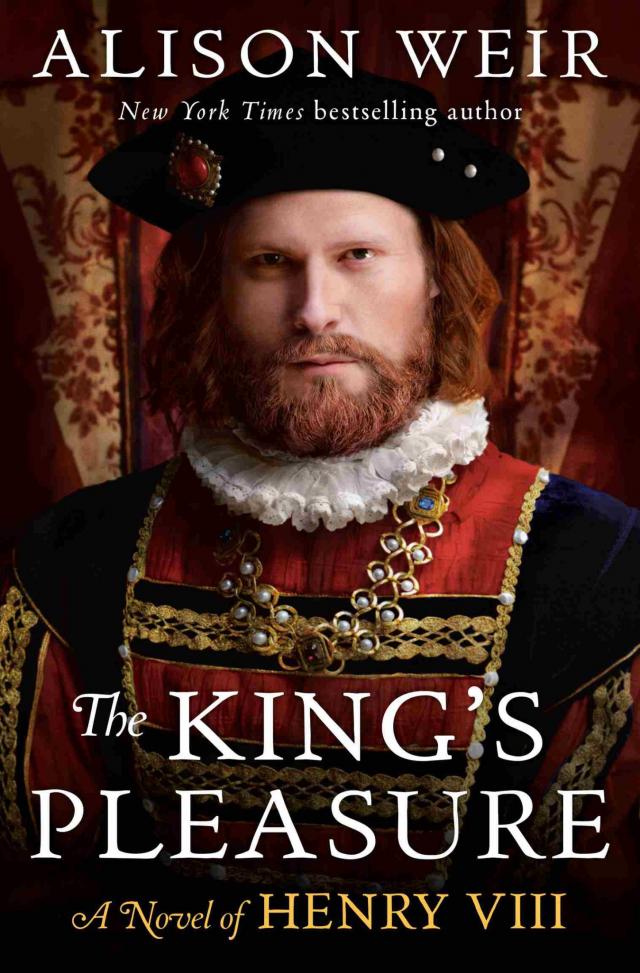
Cover design: Victoria Allen
Cover photo-illustration: Alan Ayers, based on original photographs by Jeff Cottenden and VaDrobotBO (Depositphotos)
ep_prh_6.1_143667513_c0_r0
Contents
Cover
Title Page
Copyright
The English Royal House, 1503
The English Royal House, 1547
Prologue
Part One: Spring
Chapter 1
Chapter 2
Part Two: Summer
Chapter 3
Chapter 4
Chapter 5
Chapter 6
Chapter 7
Chapter 8
Chapter 9
Chapter 10
Chapter 11
Chapter 12
Chapter 13
Chapter 14
Chapter 15
Chapter 16
Chapter 17
Chapter 18
Chapter 19
Chapter 20
Chapter 21
Chapter 22
Chapter 23
Part Three: Autumn
Chapter 24
Chapter 25
Chapter 26
Chapter 27
Chapter 28
Chapter 29
Chapter 30
Chapter 31
Chapter 32
Chapter 33
Chapter 34
Part Four: Winter
Chapter 35
Chapter 36
Chapter 37
Chapter 38
Dedication
Author’s Note
By Alison Weir
About the Author
_143667513_
Prologue
Whoever leads an auspicious life here and governs the commonwealth rightly, as my most noble father did, who promoted all piety and banished all ignorance, has a most certain way to Heaven.
—King Henry VIII
He was dying; he knew it. No one had dared tell him, and why would they, when to predict the King’s death was treason? But he could feel it in his bones, in the bulk of his failing body—not so bulky now, since his flesh was hanging on him. He had not wanted food these past few days.
He tried to shift in the vast bed, but even that was beyond him. How much longer must he suffer this purgatory, he, who had ever shied from illness and death? He groaned aloud, but there was no one to hear him, only Will Somers, who was dozing in the chair by the fire. The diamond panes in the mullioned windows were rattling in the winds battering Whitehall Palace. Outside, the Thames might be freezing over.
He shivered, and not just from the chill in the room. It would not be long before he stood before the God he had so often invoked as his ally, and with whom he must soon make his peace. He had ever striven to be a virtuous man and keep the Commandments, but he had not been a good man. He saw that now, as the Day of Judgment approached ever nearer. It would be a long reckoning.
He wished that Kate was here beside him, but she was at Greenwich, where he had sent her, not wishing her to witness his final decline.
At least his councillors—vicious, quarrelsome, contentious knaves, all of them—had left him in peace for a space. This morning, he had roused himself sufficiently to discuss affairs of state with them, until the strength drained from him and they had gone away, bowing and whispering. They were like cats, poised to pounce. As soon as he was dead, they would seize power in the name of his son, and then God help England! But he had done what he could to safeguard the boy’s future. A rogue tear trickled down his cheek at the thought of his precious, beloved jewel, bereft and orphaned.
It was growing dark now. How the years had flown. He had not always been a prisoner of this unwieldy, diseased body. He had been a golden youth; he had known glory upon glory. The world had celebrated him. He had thought himself immortal. How God makes fools of Men…
Not so long ago, it seemed, he had been young and full of hope, burgeoning with life and promise. And then tragedy had struck. Even now, remembering prodded the wound to which time had brought insensibility. From a distance of forty-four years, he could recall, as if it was yesterday, the soft velvet of his mother’s counterpane, damp and spoiled beneath his cheek…
Chapter 1
1503
He had cried for hours. Mother, his dearest Mother, was dead. It had been the most hateful, dreadful news, broken to him by Mrs. Luke, his old nurse. Not, thankfully, by Father, who was too broken by his own grief. Harry could not have coped with witnessing the King’s distress. He had enough to bear. He had wept and wept on Mrs. Luke’s broad bosom, and now, aware that great boys of eleven were not supposed to give way to womanish tears, he struggled to compose himself and went to find his sisters, who were sitting desolately on the rug before the fire in Mother’s bedchamber. He stared in horror at the bed, which had already been hung and draped with the black velvet of mourning. Mother would never sleep here again; he would never more hear her sweet voice, feel her gentle arms around him, her golden boy. How truly she had loved him; how desperately sad to think of the empty years ahead without her. He could not damp down the great swell of sorrow that was rising within him. He sank to his knees by the bed and buried his head in his hands.
He had loved her, revered her, adored her. Through her, he was the heir to the rightful royal line of England. She had been everything a queen should be: beautiful, kind, fruitful, charitable, open-handed, and devout. She had taught him his first prayers and his first letters, soothed his childish ills, and been a fount of wise advice and comfort. And now she was gone. He could not bear it.
His grandmother, the Lady Margaret, found him and lifted him up. Framed by her widow’s wimple and black gable hood, her thin face was sad and drawn.
“Harry, you must rejoice that your dear mother is with God and be happy for her.”
“How can I?” he burst out. “I need her! How can God be so cruel as to take her from me?”
“Hush, child! You must not question God’s will.” She sat on the bed and drew him to her, as Mary, not quite seven and the beauty of the family, climbed on her lap and sat there, her lower lip trembling, and Margaret, thirteen years old and normally willful and imperious, knelt at her feet, looking lost.
“Your lady mother is now in Heaven, looking down on you all and praying for you,” Grandmother told them. “She would not want you to be sad. And she is with Arthur.” Even now, Harry felt the old familiar, resentful jealousy of his brother rising in him. Whatever Arthur had had, Harry had coveted, and when Arthur had died last year, at the tender age of fifteen, Harry had suddenly had it all. He was now the Prince of Wales and heir to the throne, and he was betrothed to his brother’s enchanting Spanish widow. One day, he would be the King of England and Katherine of Aragon would be his Queen. But now, Arthur, in Heaven, had stolen one final march on him and was enjoying the greatest thing of all: their mother’s presence.
“Why did she have to die?” Mary asked.
“God ca
lled her,” the Lady Margaret said.
“She died because she got childbed fever after having our sister Catherine,” Margaret elaborated.
“Would that Catherine had never been born,” Harry muttered.
“Never say that, Harry!” Grandmother chided, hugging him. “She is an innocent, poor, motherless babe, and I fear that she herself is not long for this world.”
Harry wept again, as the reality of his loss sank in. He was motherless, too. He leaned his head on the old woman’s thin shoulder and howled.
* * *
—
Two days later, the Lady Margaret being of the opinion that lessons would help to take Harry’s mind off his loss, he was back at his desk at Eltham Palace, laboring under the waspish eye of his tutor, Master Skelton. Learned herself, Grandmother had always taken an active interest in the welfare and tutoring of her sweet children, as she called him and his sisters, and Mother and Father had always said they should be grateful for that, since she was a generous patron of scholars and the University of Cambridge. Like Mother, she loved books, and both women had inspired in Harry a passion for learning. It was a great source of enjoyment, a journey of discovery for a young mind avid for new information, and he had always been an apt and able pupil.
Three years ago, Lord Mountjoy, a scholar whom Father had appointed to mentor Harry, had arranged for a young lawyer called Thomas More to bring the celebrated Dutch humanist Erasmus to Eltham Palace. Harry and his younger siblings had received them in the magnificent great hall built by their grandfather Edward IV, and he and Erasmus had conversed in an oriel window.
Harry had long revered Erasmus as a hero; even before he met the great man, he had read his books and been inspired by his understanding of the literature of the ancients and his studies of the Greek New Testament. He had been taught about the rediscovery of the classical works of ancient Greece and Rome, and knew that those who studied this “new learning” were called humanists. He had been honored when Erasmus invited him to correspond with him in Latin, and elated when the great scholar praised his letters and said how impressed he had been to learn that they were all his own work. I see you like to emulate my style, Erasmus had written after the Eltham meeting. You have the seeds of genius in you. You reach for the stars, and you could bring to perfection whichever task you undertake. Harry had thrilled to his words.
Now, bent over a beautifully bound manuscript of Homer’s Odyssey, he was finding it hard to concentrate, for his thoughts kept straying to his great loss. He was always an active child, and schoolwork could not distract him from his grief. He needed to be outside, running or riding or fighting with his friend Charles Brandon and the other boys seated at the adjacent desks, who seemed as fidgety as he was.
When he had been very young, there had been talk that he was to become a churchman. Fortunately, Father had changed his mind, for Harry had no inclination for the religious life. He wanted to fight battles and triumph at tournaments, woo beautiful ladies and perform feats of daring to win their love. Both his parents, especially Mother, had instilled in him a passion for chivalry, and he wanted to be the new King Arthur. That role had been intended for his brother, who was to have ushered in the second golden age of Camelot, but Harry knew that he himself was far better suited to the task than Arthur would ever have been. Arthur had been skinny and sickly; Harry was bursting with health and energy. He was Lord Warden of the Cinque Ports, Constable of Dover Castle, Lord Lieutenant of Ireland, a Knight of the Garter and a Knight of the Bath; prior to becoming Prince of Wales, he had been Duke of York. He could not wait to feel the weight of the crown on his brow.
For now, however, he was relegated to the schoolroom.
“And what is so interesting outside the window?” barked Master Skelton, catching him daydreaming. “To your books, Lord Harry! England has the right to expect much from a king who has been nourished on philosophy and the Nine Muses!”
“Yes, sir,” Harry muttered, failing as usual, for the life of him, to see why Erasmus had called crabby old Skelton—Skelinton, as he himself privately thought of him—an “incomparable light and ornament of British letters.” More like the feared and hated scourge of his father’s unsuspecting courtiers, whom the tutor targeted with derisory and contemptuous satires. It was not only Harry who had felt the lash of his tongue. Father had been angered by Skelton’s barbs and had even clapped him in jail for a short spell last year. Since then, Skelinton had tempered his criticisms and spoken of leaving court and taking up a rectorship in Norfolk. Harry had been gleeful to hear that, then realized he would miss him. He had his master’s measure and knew how far he could push him. Better the devil you knew.
He caught Charles Brandon grinning at him across the room. Seven years his senior, Brandon had been chosen as one of his companions after Arthur’s death. He was the son of Sir William Brandon, who had been Father’s standard-bearer at the Battle of Bosworth, but had been cut down by the Usurper, Richard III. Had Sir William not been guarding him, Father himself would have died. In gratitude, a few years after the victory that had won him the throne, Father had placed young Charles in Arthur’s household and later made him a page. He was a boisterous boy, none too bright, but his love of jousting, chivalry, and pageantry meant he and Harry had become inseparable.
Brandon hated Skelinton, who was often exasperated with him, but the tutor had Harry’s interests at heart. Two years ago, he had written a book, The Mirror of a Prince, in which, with other improving advice, he had exhorted Harry to choose a good wife and prize her always. As if Harry would not do that! Ladies were to be worshipped and treated with reverence.
Trying not to laugh at Brandon’s funny faces, he turned his eyes to the printed page before him, thinking of Katherine. His heart had been hers ever since he had welcomed her to London sixteen months earlier and escorted her to the altar in St. Paul’s Cathedral, where she was married to Arthur. He had been captivated by her fair prettiness, her long red-gold hair, her dignity and graciousness. Five and a half years his senior, dignified, and serious, she seemed like a princess out of a legend and would surely be another perfect queen like his mother. How jealous he had been of Arthur. He had known even then that he himself would make her a far better and lustier husband. And now Katherine was to be his; in just over two years’ time, when he reached fourteen, they would be married. He needed no advice from Master Skelton about prizing her.
The thought of his mother made him pause in distress. It was too painful to revisit his grief, but the sense of loss threatened to overwhelm him.
“Lord Harry, you have not turned the page this past quarter-hour,” the tutor rapped.
“How can you expect me to work when I cannot stop grieving for my lady mother?” Harry retorted plaintively, keeping his head down so that Skelinton could not see the tears in his eyes.
His master’s craggy face softened. “All right, my lord Prince, I understand. Maybe it would do you good to get out in the fresh air and practice your archery skills.”
“Yes, it would!” Harry cried, leaping up, desperate for a distraction.
“Be gone then. I will tell Master Dewes to come this afternoon, instead of this morning.”
“Thank you,” Harry breathed, hastening away. He liked Master Dewes, who taught him French, Latin, and Italian, languages being a subject at which he excelled. At least that was one thing in which he pleased his father. But first, the great outdoors beckoned. After a few contests with his friends, he would ride and then practice at the quintain, and play tennis if there was time before lessons resumed. He loved nothing more than sport. Thankfully, Father had ordered that he be given instruction in all the exercises meet for a prince—horsemanship, skill with the longbow, fencing, jousting, wrestling, and swordsmanship. And he excelled at them all!