The dark issue 83, p.1
The Dark Issue 83,
p.1
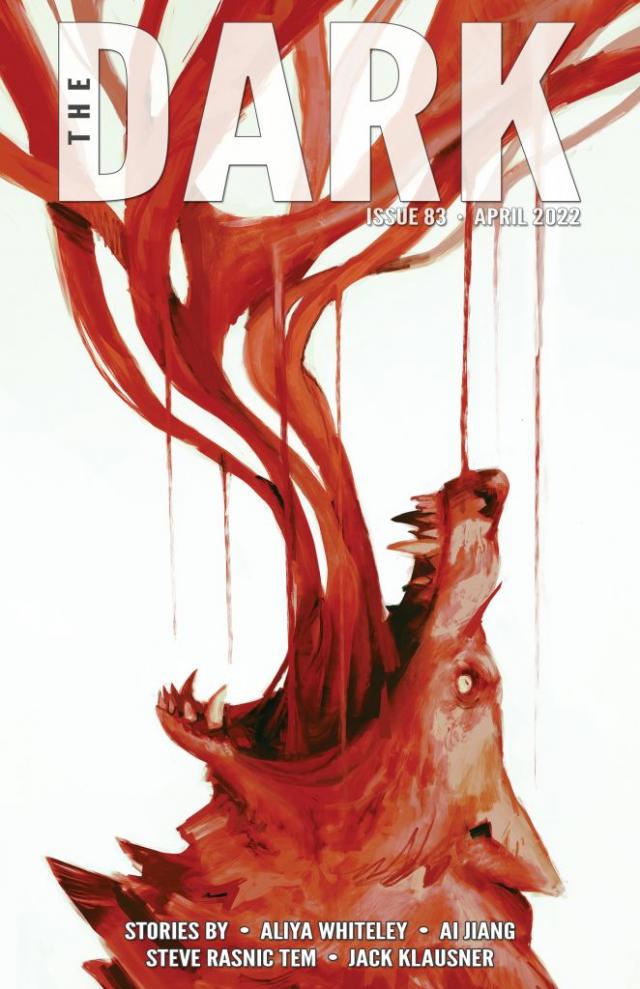


THE DARK
Issue 83 • April 2022
“Knotlings” by Aliya Whiteley
“Black Wings” by Steve Rasnic Tem
“Xiǎo Èmó—Little Demon” by Ai Jiang
“In Farrow” by Jack Klausner
Cover Art: “Wolf Cry” by Jonathan Wesslund
ISSN 2332-4392.
Edited by Sean Wallace.
Cover design by Garry Nurrish.
Copyright © 2022 by Prime Books.
www.thedarkmagazine.com
Knotlings
by Aliya Whiteley
There came a day, six years into my marriage, when my husband was hit by a van. It skidded on black ice in a car park, and crushed him against a post.
He did not suffer, they told me later, in the hospital.
Sure, I said. He wasn’t really the type. My son Aaron and I went on without him.
Aaron made an expression of surprise, of discomfort. It bent his beautiful mouth out of shape. He leaned forward, his hands clamped over his stomach. It was early morning; he was on his way out the door, to school. I froze, on the bottom stair in the hallway. I went to him, took him back inside the house, and hugged him tight. I knew what was causing it: a feeling I had lived with since my own first release, thirty years ago.
I had dreaded the moment, hoping he had escaped my condition, but when it came I felt relief. He was not like his father after all. He was suffering, and to suffer well, one must live a long time.
I let him feel the pain for a few days before I attempted to explain what it was. I knew he would need to go through the sensations to get to the point where he was willing to listen. He came to me late in the evening of the third day and described the symptoms so well, choosing his words with a precision that made me proud.
“—squeezing, inside, like a beat, like a light winking on and off, but also burning. A strong, hot light. And a tearing feeling too, as if my guts are twisting. I thought it might go away—”
“It won’t,” I told him. He was beside me on the sofa. I took care not to make direct eye contact for more than a few seconds. He hated intensity. I was the same, at fifteen.
“You know what it is, then?”
I explained it, as best as I could.
“Seriously?” he said, but he did not laugh at me, or push the idea away. “And you’ve got the same thing?”
“Had it since I was your age.”
“Why?” he said. I couldn’t answer. Who knows why? I told him what I hold true to this day: we are alone in illness, whether we share its existence with others or not. If there are textbooks and societies, answers and alleviations, I don’t want to know of them. I went through a phase of thinking otherwise. The doctor did not believe me and I could not demonstrate my symptoms on cue. I came to my own solutions through exploration, and through luck.
Sometimes things that look as if they came into this world whole, planned and executed all at once, are in fact made over years of trial and error. So it was with my shed. I never set out to have a site purely for releasing. I was only looking, at first, for a large garden, overgrown, to which I could go and crouch, give way to the pain. Aaron’s father saw no reason for me to stay out there without protection in all weathers, so he bought a small shed and left it empty for me. As the frequency intensified, into my late twenties, I started to collect egg boxes and glue them to the walls, to keep the sounds I made from escaping. Then paint, all colours, splashed wherever I felt while waiting for the release to come. The painting seemed to help, a little.
The box I used—with the snap-shut lid—I’ve had since the beginning. It was left over from Christmas, had once housed fancy iced biscuits. I grabbed it the first time I released, standing in my parents’ kitchen in the early hours of the morning, alone and scared, trying to be so quiet. It’s been my receptacle of choice ever since.
But the key to it all is the garden. When we first viewed the house, looking to buy, I took one look at the overgrown expanse backing on to a wide, unkempt field that merged into a wood, thick trees keeping out the light, and knew it was what I needed. I won’t ever move, no matter what happens. Let them come. I’m staying put.
The morning after Aaron shared his condition with me, I took him down to my shed.
I’d like to think that the things I told him that day have stuck with him, were meaningful. Resonant, in the way advice is meant to be. I saw him tilt his head and stare at the eggboxed walls, the mad painting of swirls, of splotches. The floor had a heavy rug upon it, taken from my parents’ house after my father died and my mother was moved into a warden-controlled flat. It was a dirty pale green. My box was at the back of the room, on the edge of the rug.
I said, “Bend forward a little, brace yourself, try to keep your legs relaxed if you can. Be ready for pressure. Breathe, okay? Don’t be afraid. Just breathe. And don’t worry about making sounds. The eggboxes keep the sound in. That’s why they’re there. Even if there was anyone outside, they couldn’t hear a thing.”
“You sure?” he said, his voice slow, thick.
“One hundred per cent. Years of experience talking here. When it comes, reach up and grab it. Then throw it into the box.”
“It hurts.”
“Let it build. Wait.”
“How long?”
“You’ll feel it.”
We stood side by side. He retched, and I put one hand on his lower back, but he tensed against the pressure so I withdrew it.
“It hurts,” he said again, with urgency, and I said, “Shout.”
He opened his mouth, and his sound was strong and deep immediately—not a tentative beginning, not like my own. I had given him confidence, somehow. He poured out his pain, his chin jutting, his stance firm: louder, louder. His chest heaved, he tightened his thighs, pushed his feet down into the rug, and it came out of him, pouring from his eyes, nose, mouth. Dark red strands of it, waving, a wild mess, dangling from his face.
“Take it,” I said, “Tie it.”
He put up his hands, made fists. He had it, the whole thing, first time out. He was a natural. A quick movement, and it was knotted, once, then he jerked it away, threw it into the box. It slipped through the air in a downward arc and hit the box hard. It rattled, and I moved quickly, with an accuracy born of experience, to slam the lid shut.
“Well done,” I said.
The box shifted a little, as if a weight inside it had tipped, and all was silent.
We took it out to the overgrown land at the back of the garden. I carried the box. Aaron kept pace, a few steps behind me. It reminded me of the time his mouse had died, a white one with pink eyes that I hadn’t cared for, but he had once been devoted to—in the way that a child can love anything, immediately and with abandon. No thought for the future. We had buried it in a similar way to this, putting that papery corpse into a container, walking it down to a spot to rest. Not here, in the back garden, but out the front, by the small plum tree, with a view of the street. I told him the mouse would prefer the view there. I wondered if Aaron was thinking of it too: of how such moments form the landscape of growing up, creating the cracks that widen behind us, forcing us to leave childhood in the past.
In the wild back quarter, before the tangle of ivy over the maples, I knelt. Aaron stayed back. I glanced over my shoulder. How tall he looked, standing there above me, his face blank. I saw nothing I knew in him. “You’ll do it next time,” I said. I turned my attention back to the box, released the lid, tilted it forward.
Out came the knotling.
It wasn’t a slow or confused one. It was speedy to sense freedom, even in its new state. It zipped from the box, straight into the grass; I saw no more than a flash of red, and heard a rustling as it pushed in deep and headed for the treeline. It would have been easy to mistake it for an animal, the small, burrowing kind, frightened of humans, hiding for survival. I knew better.
I explained as much to Aaron later. It was the advert break during his favourite game show, and I’d got us some ice cream as a celebration for his rite of passage. After all, he would not be able to share it with anyone else, and have them believe him.
“They’re not really alive,” I explained.
“But it ran away.”
“They all do different things, but they’re not . . . they don’t breathe. Try not to think of them as alive.” I didn’t tell him about the ones I’d kept, experimented upon. I wanted him to think me above any behaviour that could be mistaken for cruelty. Besides, I had been kind to the knotlings for years since that brief time, even though they weren’t living creatures. I felt better that way.
We talked a little more. We understood each other better than ever, I think. Then the adverts ended so we returned our attention to the game show. Aaron liked questions he could attempt to answer: solid, acceptable knowledge.
There’s no set rhythm to the building of a knotling.
A spurt of strong emotion might lead to one that comes suddenly: a crisis, adrenalin, anger, sadness. Even happiness. I had a wonderful day once, a day when I woke up and the weight of my responsibilities as a parent, an only source of love and comfort for a small boy, did not crash down upon me. It was a Sunday, and on a whim we took the train to some stop on the coast, a small town. Aaron and I walked around, hand in hand, and ate ice cream on an iron bench overlooking a calm sea. It was not a warm day, and there wasn’t much to recommend the town. We saw a few people who did not return our smiles. They looked busy, on their way to jobs, or shops, perhaps. We joked about how seriou
s they were, then ran along a stretch of pebbled beach, and caught the train home again. I don’t remember anything else, and can’t recall the name of the place. Aaron slept on the train, his head in my lap. I had thought the days of such things were past us, that he was too old for it.
I put him to bed, then went down to my shed and let it all out. The knotling was a chunky one, strong; it filled the box and pounded on the lid. After I released it, it turned on me and threw itself against my ankle. I kicked it into the long grass.
I did not monitor Aaron’s releases. I let him get on with it, wanted him to feel privacy when it came to his own body. I think, now, that was a mistake. But there are many mistakes made in parenting and it’s ridiculous to pick one, to say—there. That’s the one that took him from me.
After the first months, I asked him to find his own box. I thought of it as a rite of passage, I suppose. Or perhaps the truth is that I felt an attachment to that old biscuit box, and I wanted to keep it to myself. The request was not meant to push Aaron away, but I did notice he became more secretive in nature, once he had made his choice. It was a plastic lunchbox he’d loved when he was in primary school, with a cartoon of The Transformers on the front, from the old animated series. I hadn’t realised he’d kept it somewhere until it appeared in the room. Strange, the things children decide to keep. He put it in the shed, next to mine.
A few days after his fifteenth birthday it disappeared.
I asked him where it had gone.
“I’ve found my own place for it,” he said.
“Really? You can use the shed. It’s the best place for it. It’s no problem.”
“I know. But I’ve found a good spot of my own and –”
“In the house?”
He recoiled. “No, not in the house! Yuck.”
“Okay. I mean—I just don’t like the idea of them in the house.”
“Close by, all right? Don’t sweat.” He went out to mow the patch of lawn that we kept in order. I watched him from the kitchen window. He manoeuvred the mower carefully around the gravel path that led down to the shed. He mowed precisely level with the door, and left the grass beyond wild. It was a hot, wet summer and the woods were in a glorious, energetic tangle. We were lucky to still have it, intact, unchanged. I didn’t know who owned the land there, and I’ve never tried to find out. I never wanted to draw attention to it.
Soon after that, my own releases began to wane.
It wasn’t that I felt less, or experienced less emotions, I would say. It was only that they rarely swelled up to the point where a knotling came. The ones I created were smaller, too. Weaker. They sat quietly in the box and slunk away when released, barely stirring the grass.
Aaron wanted to study history. His main interest lay in conflicts of the immediate past, such as the world wars, Vietnam, Iraq and Afghanistan. I came to realise how much we defined our memories by the damage we had done—to each other, to the world. I think Aaron saw it differently. He pictured them all as a continuous line of events, one leading to another on the path to achieving some sort of perfection. Peace. It was all connected, to him. One thing inevitably led to another.
I took him to university in our trusty old banger of a car, and worked extra hours to pay for a private room in the hall of residence. I requested one at the end of the row, and it was tiny. Once all his possessions were inside we could barely stand side by side within it, but it was a corner room with a good view, on the top floor, and I hoped he wouldn’t be overheard. “Will you be okay?” I asked, doubtfully. I was prepared to take him home again, if he asked.
“It’s good,” he said. “I have stuff to put up on the walls.”
“Eggboxes?” I said, confused.
“Posters, mum.”
“That won’t block out—”
“Because I like them,” he said, with a smile. “You should get going. Beat the traffic.”
I sensed impatience in him. “Are you feeling it now?”
“Feeling what?”
He’d tell me nothing in this mood, and I’d learned there were moments in which the only option was to give in gracefully. I hugged him goodbye and left him in that corner room. I drove for about half an hour, then realised I had missed the turn to the motorway. Instead I veered off along smaller and smaller roads, unknown to me, towards green spaces, open fields. The sky changed colour, the sun fading; the tall hedges cast longer shadows. I swerved into a layby, ran to a nearby copse of trees, and crouched down. I let it all out of me—the longest one I’d created in years. I knotted it many times, twisting its struggling form, feeling it squirm, resist. Then I threw it, as far as I could, and ran back to the car.
I got home late that evening. Aaron had left me a message on the answerphone.
Just to let you know I’m fine,” he had said, to the dark house. “Don’t worry, Mum, Okay? Don’t worry.”
That was the last time I made a knotling. The urge never came to me again in the same way. Sometimes I felt a stirring, a hint of familiar pain, and I would swallow down a glass of cold water, or take some deep breaths, and it would pass.
Here’s the oddest thing—I missed it.
Not the process, the ache in the stomach, the building to a climax, but the lassitude that came afterward, as if I had run a marathon and then been lowered into a hot scented bath. I realised every knotling had been an achievement, of sorts.
I wished myself young again more than once, and I missed Aaron. Mourned him, in a way, even though he phoned regularly and his voice held affection for me. But I could tell he had compartmentalised me, shifted me to one side. He sounded well, and happy. He was not suffering at all.
Maybe he wasn’t like me. Maybe he was more like his father. That thought kept me awake at night. I crawled slowly toward Christmas, and when I went up in the car to collect him I found a different man waiting for me.
He was taller and thinner, and less serious. There was a river of laughter running through his voice that I hadn’t heard before, and he wore his hair long, his fringe in his eyes. He peered out at me with fresh curiosity, and charm.
“You need a haircut,” I said, on the way back. His presence in the passenger seat was, at least, familiar, and the tee shirt he wore. Even in December, he never seemed to feel the cold. “Are you eating enough? You don’t look like you’re getting enough to it. You remembered that breakfast is part of the eating plan I paid for, right?”
“I have a fry up every morning,” he said. “And afters every night.”
“Ice cream?”
“Mountains of it. It’s all good, I promise. The food’s great. We’re down there every night. Marget calls us her pack of starving wolves.”
“Who’s Marget?”
“She works at the canteen.”
It was a glimpse into his other life. I tried to picture Marget, and the pack of wolves he ran with.
We fell back into an easy routine, watching game shows and chatting about the things he was interested in during the adverts. He had many new ideas he was keen to tell me, mostly to do with modern history and how he felt the world worked. He was very sure that people could find ways to make things better for everyone, if only they looked hard enough. I asked questions, sometimes, and that patient tone he had begun to adopt with me crept into his voice a lot, but he never snapped, never put me down for not understanding.
I didn’t raise the subject of releasing until the new year.
Aware that the best of the holiday was behind us, feeling time slip away, I gave up searching for the perfect moment. I simply said to him, over breakfast, “Have you made a lot of knotlings?”
He frowned. “Yep,” he said, then chewed another mouthful of cereal.
I tried a different tack. “Do you release them somewhere close to the hall?”
“Mum, I’ve got it covered.”
“You’ve found a good place, then.”
He put down his spoon. “Listen, it turns out you don’t need to—”
“Need to what?”
“Knot them.”
“You’ve been letting them go without knotting them?” I couldn’t make sense of it. “How do you get them in the box?”
“Come upstairs for a minute,” he said. I followed him to his room, and stood in the doorway as he crouched to retrieve a box from under his bed. It was not his old lunchbox, but a new one—larger, made of metal, like one of those burn boxes that people use for important documents.