Lucky us, p.20
Lucky Us,
p.20


“You know me,” he said. “I know you.”
YOU KNOW ME.
I don’t think the best beginning is loneliness or the memory of a man making you laugh while your sister is kissing his wife in the backyard or the strong feeling that if you do not leap now, unprepared and inept as you are, onto this buckling train, you may be sorry, but I don’t think it’s the worst.
Gus took my hand at the kitchen table and came forward to kiss me. I put my saucer over my teacup to keep it warm and Gus laughed. He did kiss me, not on the lips, but below my ear.
“Everyone’s asleep?” he asked.
“I hope so.”
We went up to my attic room and lay down on my bed.
“No one’s seen me without my clothes for a long time,” he said. “It ain’t pretty.”
I never wanted anything the way I wanted to see Gus without his clothes on and then to have him see me.
“Oh,” I said, “please let me.”
It was the end of winter and we were in layers. I put his sports jacket on the little wooden chair in the corner and then I came back to the bed. He kept his eyes on the ceiling.
“Look at me,” I said. “I’m so glad to be seeing you.”
“I hope so, kiddo,” he said, and he closed his eyes.
The white shirt and all of its buttons, the undershirt, the belt, the pants, and then I was down to his boxers and shoes and socks, in which I’m pretty sure no man looks his best. I untied his black shoes and pulled off his socks. I had seen my father like this, and Danny. I had seen pictures of Michelangelo’s David. Gus looked nothing like that.
“Getting cold here,” Gus said.
I put my mouth on his smooth chest. He tasted like coffee. I kissed him from one shoulder to the other and down the dark line of his belly and I stopped, to gather my thoughts. I said his name.
Gus opened his eyes. He leaned up on one elbow and took off my clothes, one piece at a time, until I had on nothing but my underpants and socks. He kissed my breasts. Sorry for last time, he said. He kissed me through my underpants. I didn’t take my socks off until the middle of the night. Everything surprised me and nothing frightened me.
Gus talked and I listened. He told me about the long march to Trutzhain and the Gypsy man he’d walked with and the people they had had to leave behind. I fell asleep and woke up, reaching for him. He was still talking, about a crippled boy on the ship that took him to Germany and about Greta and her two little girls. Anna and Carolyn.
We heard Danny’s door creak open and we heard him pee into the toilet bowl. His footsteps stopped at the bottom of the stairs to my room and then I heard him get back into bed and leave his door open.
Gus got up and put on his boxers. He looked silvery and beautiful in the moonlight, released from his usual boxer’s stance. His bad leg looked slim and elegant, like it balanced him. Gus smiled and reached for his glasses.
“I’ll be right back,” he said. “Wish me luck.”
I fell asleep and woke up to Gus laughing.
“I met Danny,” Gus said. “He could use some help with math, he thinks you should get out more, and we agreed that a bright moon, like tonight, makes it hard to sleep. I said that I had always found that a couple of cookies and a glass of milk helped. So we tried that. Also, you’re low on cookies.”
He lay down beside me, on the side of the bed I never slept on, and he lay on his back and sighed. He pulled me onto him. He talked about people in Pforzheim, about a man with no legs who got around in a cart, until I fell asleep again, my hand in his hair, his hand on my hip. I woke up at dawn and saw that he was crying in his sleep. I wiped his face with my hand and he curled around me, still sleeping, not an inch between us.
IN THE MORNING, WE tiptoed out of my room, absurdly, as if in my little house, another person wouldn’t be noticed. Danny was dressed and sitting at the kitchen table. He stood up when Gus walked in the room.
“Good to see you again,” Gus said. He stuck out his hand and Danny shook it.
“Do you want some breakfast?” Danny said. “Eva makes good pancakes.”
Danny poured Gus a glass of orange juice. He acted as host and butler for all of breakfast. It was as if my father had entered Danny’s body and soul. He poured coffee. He made remarks about the weather. He filled the sugar bowl and brought it to the table. Discreetly, he folded a napkin next to Gus’s elbow and set a teaspoon on it. When Gus lifted the little bottle of syrup to pour on the pancakes, Danny put his hand on Gus’s arm.
“Do you want that warmed?” he said, and cast an eye at me, as if to say, Hop to.
After breakfast, Gus washed and Danny dried. I said that I had some errands to run, and if Danny was not the nice boy that he was, and hadn’t absorbed the Acton rule of good manners in the face of all, and if he didn’t on top of that, love me, he would have said, Who’s stopping you, lady?
Gus left his horrible apartment and moved in, with a suitcase and a box of books. He fixed the front step and fussed over Francisco’s car until it purred and Francisco shook his hand. Gus slept on the couch for two weeks, in a gesture of something more benign than hypocrisy, but not much. Finally, Francisco and Danny sat us down on the second Sunday night and suggested that the following Friday would be a good day for us all to have our hair cut and our shoes polished and go to Town Hall, which we did.
Letter from Eva
220 Old Tree Lane
Great Neck
New York
April 2, 1949
Dear Iris,
Come home.
Your sister,
Eva
Telegram from Iris
TO: EVA ACTON
220 OLD TREE LANE
GREAT NECK, NEW YORK
MAY 2, 1949
ARRIVING SEVEN PM. BOAC LAGUARDIA AIRPORT.
CRYING ALREADY.
THERE IS A BLACK-AND-WHITE PHOTOGRAPH, WITH WHITE SCALLOPED edges, in my red leatherette photo album, in Iris’s padded white leather one that has IR monogrammed in the corner, and in a silver-plate frame that Danny took with him to college: five people on a wide, striped picnic blanket unrolled over thick green grass, at the edge of the beach in Steppingstone Park. A fat, handsome old man, dark, with beautiful silver hair curling over the collar of his loose white shirt, smiles warmly. He lifts up a beer bottle, toasting the camera. A younger—but not young—man raises his bottle. You can see the condensation on it. The sun shines against his horn-rimmed glasses and you can’t see the man’s eyes. His smile is wide and a little watchful. A boy who might be eleven or twelve lies on the grass, on his stomach, under the arc of beer bottles. His horn-rimmed glasses are a little big for his face. He looks right into the camera, his smile almost covered by his hands, his elbows buried in the grass. His round, bare feet stick up behind him, and on one foot, someone has placed a blue-and-white Brooklyn Dodgers baseball cap. The two women in the photograph lean in from opposite edges, making a canopy over the group. The taller woman kneels, in light-colored slacks and a pale, sheer, sleeveless blouse. You can see the edges of her lace bra underneath. Her dark hair is piled up and she wears long, glittering earrings. She smiles and you can see her white teeth. She dangles her sunglasses from the fingers of one upturned hand, as if she’s just been told to take them off. In her other hand, she lifts a silver thermos in the air, toward the center, and the long tails of the scarf around her neck billow out behind her.
The other woman also kneels, arching over the group sitting beneath her on the blanket. She wears dungarees rolled above her ankles and a white blouse and you can see her bare feet on the blanket. Her dark hair is in a ponytail and her glasses shine on the top of her head. A pair of loafers is on the grass beside her. Her right arm is outstretched, her hand almost touches the other woman’s. Her left hand rests on the boy’s back and the man with the glasses’ hand is on top of hers.
You can count four sailboats in the water behind them and there is a gull’s wing in the upper right corner of the photograph. The sun is directly overhead, behind great sheets of cloud, and the light falls evenly on them, on the picnic basket almost hidden behind the old man, on the one gull approaching a ball of waxed paper, on the listing boathouse, on the smooth pale sand, on small whitecaps breaking in the distance, on everything we see.
AUTHOR’S NOTE
This is a work of fiction, from beginning to end. To the best of my ability, I have worked from the particulars and facts of geography, chronology, and customs of the time. I have also moved things and people, adjusted and reconfigured both, when it suited the story.
For my sister, Ellen
ACKNOWLEDGMENTS
My editor, Kate Medina, continues to be one of the luckiest breaks of my life, writing and otherwise. My agent, Jennifer Rudolph Walsh, is, always, a generous and serious reader, a gifted, relentless advocate and excellent company. My dear friend, Phyllis Wender, has always given me great support and continues to do so.
I want to thank the MacDowell Colony, at which I made any number of wrong turns, and a few right ones. I also thank Wesleyan University’s Olin Library and its resourceful and exceptional librarians.
I also wish to thank my very dear friend, and twin, Jack O’Brien, and his Imaginary Farms, which have given me safe haven, comfort, and more joy than one can imagine, while sitting at a table, in a barn, facing a wall.
I am very lucky in my friends and family, all of whom know lots of things I don’t: Dr. Sydney Spiesel helped me with all medical questions, and infallibly; Jane Stern, divine interpreter of road food and the tarot, was generous with her time and talent; my niece Karina Lubell and her husband, Romain Mareuil, are responsible for any good use I have made of idiomatic French and are in no way responsible for my gaffes; scholar and novelist LaShonda Barnett provided expert and creative research as I was getting this book under way and she also provided the soundtrack for much of the writing.
My reading family, Kay Ariel, Bob Bledsoe, Alexander Moon, Caitlin Moon Sorenson, and Sarah Moon, all read with care and kindness and well-crafted criticism. Michael Cunningham gave me a much-needed boost and, as he does, Richard McCann helped me through the last, dark hour.
I must thank my dear cousin Harold Bloom, whose brilliance shines a light on all writers, past and present, and who helped me, with tea and wit, to find a better way to put almost anything.
Jennifer Ferri is the best. Period.
Finally, I thank my husband, Brian Ameche, for giving me everything I have ever hoped for.
By Amy Bloom
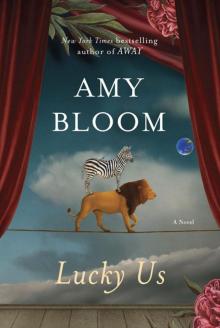
Lucky Us
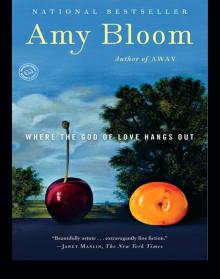
Where the God of Love Hangs Out
Away
Normal
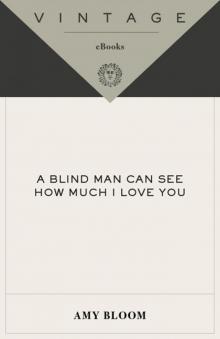
A Blind Man Can See How Much I Love You
Love Invents Us
Come to Me
ABOUT THE AUTHOR
AMY BLOOM is the author of Come to Me, a National Book Award finalist; A Blind Man Can See How Much I Love You, nominated for the National Book Critics Circle Award; Love Invents Us; Normal; Away, a New York Times bestseller; and Where the God of Love Hangs Out. Her stories have appeared in The Best American Short Stories, O. Henry Prize Short Stories, The Scribner Anthology of Contemporary Short Fiction, and many other anthologies here and abroad. She has written for The New Yorker, The New York Times Magazine, The Atlantic Monthly, Vogue, Slate, and Salon, among other publications, and has won a National Magazine Award. She teaches creative writing at Wesleyan University.
www.amybloom.com
Facebook.com/AmyBloomBooks
@AmyBloomBooks
Amy Bloom is available for select readings and lectures. To inquire about a possible appearance, please contact the Random House Speakers Bureau at 212-572-2013 or rhspeakers@randomhouse.com.
Amy Bloom, Lucky Us