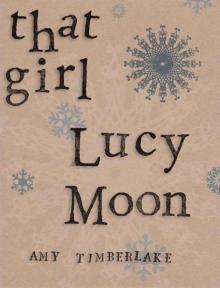
That girl lucy moon, p.20
That Girl Lucy Moon,
p.20


Lucy sighed. As predicted, Miss Wiggins wasn't going to admit to anything, though Lucy felt slightly vindicated by whatever she had seen on Miss Wiggins's face. Still, it was time to let it go. She'd never know. The only thing Lucy did know was that she didn't completely trust Miss Wiggins.
Lucy nodded at the hole in the fence. "I didn't have anything to do with that, you know. I would never do something like that!" Miss Wiggins wasn't the only one with principles.
Miss Wiggins's eyes trailed to the hole. "No," she said. "That was the work of Miss Eugenie Sovil and friends."
Lucy's mind spun. The Big Six cut the fence? They were the junior-high "girl gang"? The fashion-enhanced wonder-waifs of the third floor?
"Whoa," said Lucy.
"Lucy, is it against your belief system to converse normally? It seems you prefer confronting people with your wild accusations—in their own backyards, for heaven's sake."
"I was only asking some questions," Lucy said.
Miss Wiggins ignored her comment. "I take a lot of pride in this town. I do things that benefit everyone. I want you to understand that."
"I care, too," said Lucy. She balled one of her braids in her fist.
"I know," said Miss Wiggins. "And you're about as persistent as a biting fly."
"You've got to have everything your own way," Lucy shot back.
That was when Miss Wiggins chuckled a little. After a beat, she said: "Funny, I would've said the same of you."
There was a pause, and the two of them stared at each other for a long moment.
Miss Wiggins tucked her scarf in around her neck. "Good-bye for now, Lucy Moon."
And then Miss Wiggins turned and strode over the lip of the hill, toward her blue house.
Miss Wiggins is wearing work boots, thought Lucy.
On her way back down the hill, Lucy stopped at the giant sugar maple. She put her hands on its bark, feeling the furrows under her mittens. She listened to the wind, and then turned and leaned against the tree. She stared out down the long hill, finding the sketchy outline of Turtle Rock through all the snow.
The Big Six cut the fence? It was about time Lucy stopped thinking that their heads were filled with cotton candy. Miss Wiggins wore work boots? And that conversation . . . yeah, there were ways that Miss Wiggins and Lucy were alike. (But also very different, too, thought Lucy defensively.) No one seemed to be who Lucy thought they were.
It was too much! With a rush of emotion, Lucy desperately wanted to have the sense that she knew somebody, like you knew grape jelly. You read the label—"grape jelly"—and that was enough to know that it tasted great on bread, time and time again. Would it be so bad to wish for people to be as dependable?
And shouldn't moms be more dependable than anyone? Lucy didn't even know who her mom was anymore.
At this point, all she wanted was for her mom to apologize in a way that felt like an apology. She didn't want to hear, "I'm sorry, but the opportunities have been once in a lifetime." Or, "I'm sorry, but I've had it bad, can't you understand?" Confessions and explanations were only meant to show Lucy that she hadn't considered what was going on with her mom, that in essence, Lucy was a shallow and insensitive daughter — the kind of daughter that forced mothers to apologize when they'd done nothing all that wrong. Lucy didn't buy that! "I am sorry," was what Lucy wanted to hear. Lucy wanted her mom to admit that she had done Lucy a wrong.
Huh, thought Lucy. She guessed Miss Wiggins's apology wasn't the one she wanted to hear today—not really.
Lucy snorted. Well, no matter what she wanted, she'd bet she wasn't going to get an apology from her mom anytime soon. She'd be lucky if her mom made it home by summer. Heck, her mom might never come home.
It was as if the thought had simply been waiting backstage, and now it was making its appearance. Lucy hadn't thought it once. She hadn't wanted to think it. She'd just been trying to ignore her mom's existence all this time.
If Christmas, her dad, Lucy, couldn't bring her mom home, nothing would.
Nothing.
Lucy slipped down the side of the maple tree and started to cry—great, loud barks of cries.
Slowly, through her tears, Lucy began to understand one thing: if the choice was between an apology and her mom driving circles around the great state of Minnesota forever . . . well, she'd take her mom back on almost any terms.
"Just come home," she whispered into the snow.
Lucy thought then of Amos Zebulon's wife, Rippling Water, and the song Rippling Water felt around and through this sugar maple, from somewhere else, somewhere larger. The song had passed through Rippling Water "as if . . .”— and Lucy found she had memorized this
part—". . . she were water for the song to wade in." Lucy closed her eyes and imagined her body being water, and for a moment or two, she thought she felt the thrum of song. Lucy envisioned her words carried along in the song, and realized, with a start, that she was praying.
It was either a lifetime or one long minute later when Lucy opened her eyes. The snow fell, fell, fell. Her breath puffed and unraveled. Her nose was numb. Her butt was cold.
Her mom might not come home.
The realization made everything seem dull. It was like seeing in shades of gray instead of color, or feeling the smoothness of plastic sheeting everywhere, on everything.
Still, Lucy stood up and brushed the snow off her pants. She straightened her knit hat. She cupped her hands in front of her face and blew into them to warm her nose.
Then she told herself the truth: without her mom, Lucy had survived the worst school year she could remember. She had friends (Zoë especially), and with friends, a person could be stronger than when all alone. Her dad had turned out to be pretty dang heroic in his efforts to help her, and he never gave up. Her dad wouldn't give up on her. She knew this now. And Mrs. Rossignol and Ms. Kortum cared about her. Plus, it seemed like Sam might be her boyfriend (if she hadn't screwed it up by stomping on his foot). Lucy's face grew hot.
Okay? Lucy told herself. You are not alone.
It was a good thing people weren't grape jelly, because grape jelly couldn't surprise you in a good way, either— like her dad had.
And, Lucy thought, this hill—the one we fought for— is free!
At first, Lucy forced herself to spin around, winging her arms out with an image of Zoë in her mind. But the first surge of dizziness made her smile, so she spun a little more. And pretty soon, Lucy lifted her face to the sky and spun as fast as she could, until she fell and found herself rolling down the hill. When she stopped, somewhere near the bottom of Wiggins Hill, Lucy laughed. "Ha!"
* * *
Thirty minutes later, Lucy turned left onto Fifth Street and spotted her red house. She knew she was in for it. She was late coming home, she was outside in a snowstorm, and who knew how her dad would respond to the news that so many kids had joined the protest. Still, she felt content with the sort of weariness and relief that a good cry leaves behind. Lucy noticed that the porch light had been left on for her, and smiled.
There were two cars in the driveway: one was the station wagon, and the other was an unknown minivan with what turned out to be Florida plates. Well, so be it, thought Lucy. She was headed toward a lecture from her dad, and she was too tired to care if someone else got to enjoy the show. She just wanted to be home.
Lucy walked up the sidewalk and through the front door. The screen door banged shut behind her.
"Lucy?" called her dad.
Then a woman appeared.
Was it... ?
As Lucy's eyes adjusted to the indoor light, she saw it was.
Her mom's face seemed all angles and hollows. She wore a thick, blue-and-burgundy sweater that Lucy had never seen, and her hair now hit her shoulders. She held out Lucy's green-and-yellow hat. "Looking for this?" she asked.
Confused, Lucy took the hat out of her mom's hands and stared at it. "How . . . ?" she started. It was the second time today the hat had been returned to her. And by the last person Lucy expected.
"Zoë and Sam came by," her mom said. "They said you dropped it in Lookout Park. They want you to call them."
Lucy looked up then, saw her mom's gray eyes, and that's what started it.
Lucy set the green-and-yellow hat on the kitchen counter and rounded on her mom. "What are you doing here?"
"Lucy!" said her dad sharply. Lucy had forgotten he was even present. But there he was, towering behind her mom, suddenly very apparent.
"No, Don." Lucy's mom held her dad back with one arm. Then she spoke softly to Lucy. "I wanted to surprise you for Easter." She sounded sad, as if it hadn't worked out like she hoped.
"Well, I don't need you anymore," said Lucy. "If you're not a mom, I'm not a daughter."
Lucy was happy to see her mom pale at these words.
The anger was red hot and slashing. Later, Lucy was ashamed of the violence she'd witnessed in herself, especially after praying on Wiggins Hill, but right now, it felt like scratching something that had itched for months. Lucy wanted her mom to feel what she had felt, every knifelike bit of it. Lucy continued: "You left me! You said it was all about photography, but in the end it was all about escaping Dad and me. You ran away! You don't even know how bad this year was for me, do you? I wanted to run away, too, but I didn't. I stayed here and worked it out."
Lucy turned her back to her mom. Her mom touched her shoulder, and Lucy whipped around. "Didn't you hear me?" Lucy said. "I worked it out without you. I don't need you. Go away."
But then something Lucy hadn't foreseen happened. Her mom reached out and pulled Lucy into her arms.
Lucy's body revolted. "Don't touch me!" she said.
Her mom held on. "I'm not letting my daughter go," she said. "I made that mistake once."
The words mixed with the familiar scent of outside air on her mom's sweater, and Lucy felt her head bump her mom's shoulder, like it always did when they hugged, and she started to cry. Lucy hated herself for being naked, soft, and pink, because she wanted to be cold and impenetrable, like steel, to show her mom that she had grown strong, like a skyscraper—all alone, all by herself. Still, Lucy couldn't stop crying.
Oh, did she miss her mom. She did.
And that's when Lucy heard these words whispered in her hair: "What I did was wrong, Lucy. I'm sorry. I am so, so sorry."
The words were simple, unembellished with excuses, and Lucy knew the words were true.
It was enough for a beginning.
* * *
Before even an hour had passed, news about the Easter Sunday protest was on North Country Radio, WBRR. Ken and Julie interrupted programming to give "eyewitness accounts" (callers who'd phoned in), "news updates" (confirmations from "insider sources"), and a special "Biography of a Rebel" (Ken's epic poem about Lucy Moon, in rhyme that clunked along like a car over potholes). Of course, Ken and Julie tried to get both Lucy Moon and Miss Wiggins on the phone. Eventually, Miss Wiggins called them, the producer patching her through immediately, interrupting a Theremin version of "Here Comes Peter Cottontail."
"I asked you to stop calling me," came the voice over the air. "Now get back to that fiddle-faddle music of yours. Poetry certainly isn't your strength!"
"Yes, ma'am," said Ken. The Theremin started up with a blurt.
As the days passed, the excitement died down. But for a few folks in Turtle Rock, something else replaced it—a thoughtful pondering of the story of Wiggins Hill and Lucy Moon. These folks thought about Lucy Moon while they waited for the microwave to heat up a little leftover hot dish, or while they stood on the front porch watching for their ride. Mostly, they thought about themselves. What would they fight for? Was there something they believed in that strongly? Did they have it in them?
Maybe the changes that happened had to do with that musing. And maybe they didn't. It was hard to tell. But Sam Shipman's mom began inviting people over to her house to read Shakespeare, with the idea of starting a theater troupe that would perform in open spaces, without sets or fancy lights, and Zoë and Edna told her that they'd make the costumes. Ms. Kortum pushed for a marker on the sight of Amos Zebulon's house at the edge of Turtle Rock Lake. Lucy's dad got more involved with the local Audubon group. And Mrs. Rossignol added Chocolate Sauerkraut Cake to her display case, simply because she loved it. Surprise of all surprises, other people liked it, too.
For cutting the Wiggins Hill fence, Kendra, Brenda, Didi, Gillian, Chantel, and the Genie found themselves in a summer of community service at the senior center. They declared the senior center drab, and wore fluorescent-green T-shirts declaring YOU'RE OLD! BE BOLD!
And one day an advertisement appeared in the Turtle Rock Times: "Toboggans made to order! Take the entire family sledding in one sitting!" Sam Shipman stared at the name above the phone number. "Harold Sovil," it read. Could he be related to Eugenie Sovil? He thought about the night he and Lisa were arrested way back on October 3rd, and the mystery toboggan rider with the black hair. "No way!" he whispered. But it had to be! He couldn't wait to tell Lucy. Then Sam Shipman checked the balance in his bank account and decided to spend it all on his own toboggan.
At the junior high, things continued on, except that some students began to question. Questions turned out to be a bigger thing than most of them realized.
ACKNOWLEDGMENTS
Without others, this book wouldn't exist. Though I cannot mention everyone (the list would go on and on), I would like to publicly acknowledge the following: The Anderson Center for Interdisciplinary Studies in Red Wing, Minnesota; my colleagues at the Virginia Commission for the Arts; Nikki Grimes; my friends from the Illinois chapter of the Society of Children's Book Writers and Illustrators; Steve Malk; Donna Bray; my family; and of course, my husband, Phil. I couldn't have done this without your help, encouragement, and support. I thank God for each of you.
Don’t you hate it when a book ends?
Yeah, me too.
What to do… what to do…
Got it. There’s another feisty heroine in my next book, One Came Home (subtitled “A sister lost. A body found. The truth buried.”) available January 2013 from Alfred A. Knopf Books for Young Readers.
You could read it. It’s available as an ebook too.
And there’s a discussion guide and author interview for That Girl Lucy Moon available for download at amytimberlake.com.
Maybe I’ll see you on my site? Cool.
Happy Reading!
Amy
Amy Timberlake lives in Chicago, but grew up in a small town in Wisconsin. She remains convinced that the best stories take place in the Midwest. Her most recent book is One Came Home which will be published by Knopf Books for Young Readers in 2013. (The subtitle reads: “A sister lost. A body found. The truth buried.”) She is the author of That Girl Lucy Moon (a Book Sense Pick) and The Dirty Cowboy (winner of SCBWI’s Golden Kite Award and a finalist for the Western Writers of America Golden Spur Award).
For more information about That Girl Lucy Moon, One Came Home or The Dirty Cowboy —or perhaps to simply say “hello”—go to her website, amytimberlake.com.
Praise for That Girl Lucy Moon:
Awards:
A Fall 2006 Book Sense Pick
A New York Public Library Book for Reading and Sharing
Friends of American Writers Literary Award Winner
2007 Bank Street College of Education Best Children’s Books of the Year
2007 Amelia Bloomer Book
"This year’s must read book."
Elizabeth Bird (Fuse #8 Production, School Library Journal)
"Lucy Moon is one of the most original characters I've come across in a long, long time."
Nikki Grimes, award-winning author of Dark Sons and Bronx Masquerade
"A wonderful coming-of-age story for young girls that deals with issues such as fitting in when going from elementary school to junior high."
BookSense
"Lucy's a winning character, whose native fierceness and sudden uncertainty will resonate with readers."
Kirkus Reviews
"This book will have readers cheering as Lucy Moon grows in her commitment to activism."
The Bulletin of the Center for Children's Books
Copyright © 2006 by Amy Timberlake
All rights reserved. No part of this book may be reproduced or transmitted in any form or by any means, electronic or mechanical, including photocopying, recording, or by any information storage and retrieval system, without written permission from the author. For information contact the author through her website: amytimberlake.com
First edition printed by Hyperion Books for Children (New York) in 2006.
First Kindle ebook edition: 2012
ISBN: 978-0-9847575-1-0
Amy Timberlake, That Girl Lucy Moon