When did i get like this.., p.21
When Did I Get Like This?,
p.21


My own favorite Sandra Boynton book is But Not the Hippopotamus, the tale of a young semiaquatic mammal who is not keeping pace with her animal companions:
A cat and two rats
Are trying on hats.
But not the hippopotamus.
A moose and a goose
Together have juice.
But not the hippopotamus.
The hippopotamus watches all these gay activities peeking from behind a tree, or from the corner table where she sits alone, or through the window of a haberdashery (literally, on the outside looking in). The other animals aren’t excluding her intentionally; they don’t even know she’s there, which is ironic, because she is certainly the largest animal in the book. The hippo’s face is a perfect, childish blank of huge-eyed concern. She desperately wants to be included in all the fun but is just not sure how to make her move. All the other animals run past the hippopotamus, out for a group jog in their new hats, while she gazes after them longingly. But just when they all appear to have left the hippo behind, Boynton throws us a curveball:
But then the pack
Comes scurrying back
Saying, Hey! Come join the lot of us!
And she just doesn’t know:
Should she stay? Should she go?
Caught up in her indecision, the hippo’s front hooves hover near her face in a way I find nearly heartbreaking. Turn the page, though, and she runs after her friends, suddenly weightless, absolutely free, calling,
But YES the hippopotamus!
I always find it thrilling when the hippopotamus casts off her uncertainty and runs off to play. It is when she feels free to join in on the fun that she comes alive and looks, finally, happy. I want that joyful ending for the little hippo, because I know well what it is like to hang back. I too will hide behind a tree if I fear I cannot do something perfectly.
Every Friday of second grade, I told my mother I had a stomachache in a vain attempt to miss gym class, taught by the dreaded Mrs. Backus, a gravelly-voiced, deeply tanned senior citizen with no patience for the hesitant. I hated the ignominy of sides-choosing, in which I was inevitably second-to-last, ahead only of the boy who still wet his pants. I hated the queasy feeling I got when Mrs. Backus got out the red kickball and announced we were, once again, playing Kill the Guy. I hated standing at the free-point line to miss another basket with everyone watching. I hated the pressure of performing something I would never be any good at.
Now that I’m an adult, I continue to be terrified of any arena where my meager athletic skills might be exposed, such as a family reunion softball game. I have no idea how to exist in that world. I am still not sure on which hand one wears a baseball mitt. And I will probably never learn, since if I can’t immediately be good at something I hang back and watch instead. My hesitation extends beyond sports, however. Even if it’s just a pack of preschool moms meeting up for a coffee, even if I really want to participate, I still wait to be asked. While the moms of other toddlers chat easily at the playground, trading phone numbers as we all stand around, I want to say, “Can Maggie and I come over tomorrow too? See, she’s my third, I am lazy, and she has no friends.” We’re all grown-ups; what are they going to say, no? That should be easy for me to say by now. But I say nothing.
This is how I am. But I wish I were not. When I read But Not the Hippopotamus, I always root for the hippo to overcome her shyness. I want my kids to understand that they do not have to miss out on their own lives, stuck in their own moments of self-doubt.
Each July, the kids and I leave the city and move a hundred miles away until Labor Day. It is the escape valve that makes life in New York City feel possible. When we are out here, the kids can lie in the grass and pick dandelions and enjoy a slower pace of life. On Saturday mornings, David and I take the kids to the local baseball field for a pickup game. This is no hyper-organized Little League but a very gentle and encouraging game, where the kids are on one eternal batting team and a couple of dads do the pitching and fielding. The dads time their plays carefully so that no one is ever tagged out, and everyone at bat gets to swing until they hit. Maggie and I sit in the grass and watch as David and the boys dash to the far side of the fence with their gloves. I like to imagine, watching them, that things might have turned out differently for me if I went to a game like this when I was their age.
Even so, Seamus will usually take only a few half-assed turns at bat before walking around the fence to sit on my lap in the grass. Last week, he rolled his eyes back until the whites showed, so that he would not cry. “I not vewy good at baseball,” he whispered.
“But you are, honey! You hit the ball so many times!” I cooed, smoothing his hair. It didn’t work. He was done for the day. As someone whom sports always made cry, I let him stay there in my lap, even though David was a little annoyed. But my son’s disappointment killed me, because for someone who was not quite five, he was doing just fine. It was only his own diffidence that was keeping Seamus from cracking the ball as confidently as he did in our own backyard. All he needed to do was go back out there, and have fun, and not give a rat’s ass whether he was any good or not. But I could not explain how to do that.
My other two children are not like me in this way. Maggie runs at life full speed and hugs it about the knees. As soon as she is old enough to take the field—and probably well before—she will be right out there, slugging with the big kids. Connor, too, is able to embrace new opportunities eagerly. This summer, he attended a new day camp and got on a school bus by himself for the very first time. Since his first day of camp was two weeks after the other kids had started, I fretted that all alliances would have been made already, permanently excluding him. “How do you feel?” I asked him as we stood at the end of the driveway.
“A little nervous. ’Cause it’s my first day. But I’ll be okay,” he answered calmly, boarding the school bus without a tear or a look back. “My son doesn’t know anyone,” I told the bus driver, sotto voce. “Please make sure he finds his way.” The bus driver nodded with a slight roll of the eyes; he had evidently seen mothers like me before. He knew that Connor would be fine. So did Connor. I, however, was not so sure, and is it not a mother’s prerogative to hover?
When I dropped Seamus off at his younger, gentler day camp that same morning (no school bus yet for him), I leaned on the college-aged counselors. You have to engage him in activities with his peers, I told them. Otherwise he will just sit there. I wanted them to understand: Seamus needed help to get past his innate bashfulness to where the other children were. The counselors looked at Seamus, then at me, a little confused, since he seemed perfectly happy in the corner doing a puzzle and humming to himself. They were not as invested as I was in seeing Seamus run outside with the other children, laughing and shouting. I was the only one worried about what he will miss this summer if he stays inside, waiting for someone to ask him if he wouldn’t like a turn on the swings.
But my children have to negotiate their camp experiences for themselves. That is the point of going. Their mother is supposed to be absent, just as there is no mother hippopotamus present in the pages of Boynton’s book to nudge her little hippo along. Maybe there is nothing the mama hippo could say or do that would really help, anyway. The little hippopotamus has to come out from behind the tree herself, and Seamus will have to learn on his own to say “hello” back to that nice little boy who wants to play with him. But even if Seamus finds the nerve to join the pack, I will still be lurking behind that tree, watching, biting my fingernails.
It occurs to me that this hovering in the background, worrying, not knowing what I’m supposed to do, is how I feel—as a mother—most of the time. I watch my children as they venture away from me, praying that their lives will be easy and carefree. But I cannot fret away the inevitable bumps in their roads, and my presence cannot really change, at those times, whether they are going to feel like the little hippopotamus or not.
But the background is where a mother belongs, in bad and good times both. I am supposed to be the responsible adult at all times, standing back and watching the fun, ready to interrupt if things get too silly or dangerous. Mothers can’t take part in the merrymaking because they are too busy enabling it behind the scenes. I used to think my mother never wore a bathing suit in the summer because she just didn’t like swimming, or something. Now I see that it’s because she never got around to putting it on. On a summer Saturday afternoon, David and the kids go jump in the pool after lunch. “I’ll be right there!” I yell after them. But by the time I clean up the kitchen, and throw a load of clothes in the dryer, and go out to the pool, and pick up the towels thrown around, and then go back to the kitchen to get drinks for everyone, and then distribute the juice boxes, everyone is out of the pool, and I will have missed the fun again.
David does not have to be the juice box manager or bedtime clock watcher. His main job, when he is with the kids, is to be Good-Time Charlie, and to push the boundaries of what our children think they can do. If I say, “Be careful on those monkey bars,” David is next to me saying, “Let me see how high you can climb.” This past winter, David took Connor skiing a couple of times. (I have never skied in my life.) David told Seamus he would be old enough to go along with them next year. “Maybe Mommy will come too,” David said, winking at me. “You and Mommy can learn to ski together.” Since this would be an acceptable excuse for a grown woman to be on the bunny slope, I agreed I would give it a shot. Then Natasha Richardson’s tragic death, the result of a seemingly minor bump on the head during a ski lesson, occurred just a week later. “Well, that’s it,” I told David. “Two little boys without a mother? You’ll never get me on skis now.” He, choosing his arguments like any good husband does, has not pushed me any further. But when he heads out to the slope with our boys next winter—and even Maggie, in a few more years—and I stay home, what will that cost? What will Maggie learn from watching her mother always sitting on the sidelines? What will I miss while I wait for them all to return safely to the bottom of the mountain?
But Not the Hippopotamus does not really end with the hippo’s joining in the fun. There is an afterword of sorts, one that I have always found a bit thorny. As the hippopotamus runs off to play, she shouts,
But YES the hippopotamus!
And then, looking after her forlornly, is another uncertain young mammal:
But not the armadillo.
The armadillo, drawn with shaky lines, is fraught with uncertainty. (The hippopotamus had it easy compared to him.) The book ends without telling us whether the armadillo ever gets to join in, and I have always been sort of dissatisfied with this ending. Why didn’t Boynton end on a high note, with the hippo’s moment of triumph? Maybe Boynton wants to remind her young readers that there will always be someone watching from the sidelines, feeling excluded, feeling shy. Or perhaps that armadillo is there for mothers like me, to remind us that feeling left out is normal. That our children can feel that way and still be okay. That they might need to feel that way at some point, and then overcome it on their own, in order to grow up at all.
My children are still very young. As they grow, parenting will be more and more about letting go, about helping them learn to help themselves. My worrying about what lies in their futures will not, alone, prevent bad things from happening. Planning ahead of time for every possible consequence may just mean that I miss the thing that is really happening right now. There may be times when it is all right to risk imperfection, even failure, and just join in, before my children no longer want my participation at all. Being the hippopotamus, always in the background, is on its face good mothering, but that is not the mother I really want to be.
My youngest brother is visiting us this week. He is a generation younger than I am, still in college, the liminal space between carefree childhood and responsible adulthood. My kids regard him, rightly, as “a little bit big and a little bit little.” He was splashing in the pool with the kids yesterday, and I went outside to say that it was time to get out so they could begin their evening bath/dinner/story/bedtime routine. “Aren’t you coming in?” my brother says, holding Maggie as she splashes, not realizing I had barely been in the pool all summer. “Come on in, Mom!” Connor yells, his goggles making him look like a mad scientist. “Yeah, Mom!” Seamus hollers. “It’s weawy nice in here!” And even though I just blow-dried my hair that morning, even though I should be back in the house starting dinner, even though I know the cold will be bracing, I cannonball in the deep end.
Acknowledgments
I am very grateful to all of the following people:
Tracy Fisher, the agent whose insight, expertise, and unswerving belief in me improved this book immeasurably (and to her assistant, Elizabeth Reed);
Laurie Chittenden, the editor whose enthusiasm and wisdom were daily gifts, and who made my first book a much easier labor than my first child;
Brian Liebman, who was the first person to suggest that there was a book here, and who was instrumental in making it happen;
Mollie Wilson, who was peppered with drafts and almost-daily editorial questions, and is the best “first reader” a sister could have;
Julie Kramer, Heather Brudz, AJ Murphy, and Isabel Rose, who also read early versions of this book and provided much-needed encouragement during the writing process;
Everyone at HarperCollins—Liate Stehlik, Peggy Hageman, Shelby Meizlik and Seale Ballenger, Kimberly Chocolaad, Lynn Grady, and Jean Marie Kelly, Mike Brennan and all the wonderful salespeople, Dale Rohrbaugh, Mary Schuck, Mary Ann Petyak, and Aja Pollock;
Gretchen Koss and Meghan Walker at Tandem Literary, who worked tirelessly on behalf of this book and made it fun;
The “Mums Who Write,” for the been-there-done-that advice and subtitle inspiration;
Linda Davis, Shelly Holassie, Sarah Kennedy, Katie Knick, Michael Wilson, YaYa and Poppy, and Nana and Pop—the babysitting village without whom I could never have written at all;
Heather Brudz, Cece Heraty, and Nicole Smallwood, who generously allowed me to include their “when did I get like this?” moments along with my own.
Most of all, I am grateful to the four reasons I get out of bed every morning: Connor, Seamus, Maggie, and David. Thank you for loving me enough to share me with this book for almost a year. Now: let’s go play.
About the Author
AMY WILSON is the creator of Mother Load, a one-woman show that has been touring the United States since 2007. Amy is a contributing editor to Parenting magazine and has also written for babytalk, Babble.com, and CNN.com. As an actress, Amy has performed on and off Broadway, on numerous sitcoms, and in films. But her favorite productions are her three young children, whom she raises with her husband in New York City. This is her first book.
WWW.AMYWILSON.COM
Visit www.AuthorTracker.com for exclusive information on your favorite HarperCollins author.
Credits
Jacket design by Mary Schuck
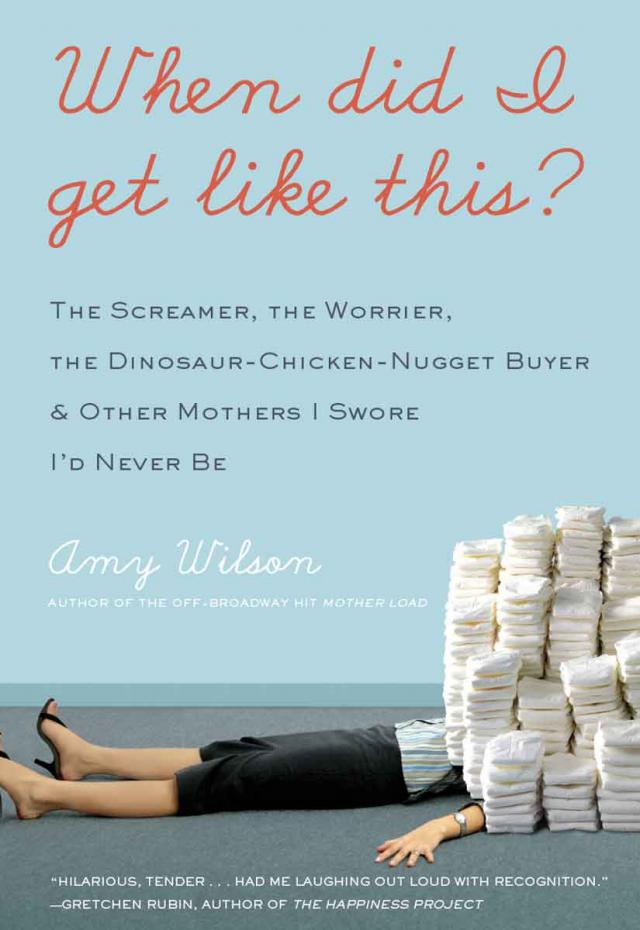
Jacket photographs: Stack of Diapers © by EG Project/Getty Images; Office Worker © by Loungepark/Getty Images
Copyright
The names and identifying characteristics of some of the individuals throughout this book have been changed to protect their privacy. Any resemblance to actual persons, living or dead, is purely coincidental.
Chart in Chapter Sixteen: From Your Four-Year-Old by Louise Bates Ames, Ph.D., and Frances L. Ilg, M.D., copyright © 1976 by The Gesell Institute of Child Development, Frances L. Ilg, and Louise Bates Ames. Used by permission of Dell Publishing, a division of Random House, Inc.
Chapter Twenty-One: Reprinted with the permission of Little Simon, an imprint of Simon & Schuster Children’s Publishing Division from But Not The Hippopotamus by Sandra Boynton. Copyright © 1982, 1995 by Sandra Boynton.
WHEN DID I GET LIKE THIS?. Copyright © 2010 by Amy Wilson. All rights reserved under International and Pan-American Copyright Conventions. By payment of the required fees, you have been granted the non-exclusive, non-transferable right to access and read the text of this e-book on-screen. No part of this text may be reproduced, transmitted, down-loaded, decompiled, reverse engineered, or stored in or introduced into any information storage and retrieval system, in any form or by any means, whether electronic or mechanical, now known or hereinafter invented, without the express written permission of HarperCollins e-books.
Library of Congress Cataloging-in-Publication Data has been applied for.
EPub Edition © March 2010 ISBN: 978-0-06-198801-1
10 9 8 7 6 5 4 3 2 1
About the Publisher
Australia
HarperCollins Publishers (Australia) Pty. Ltd.
25 Ryde Road (PO Box 321)
Pymble, NSW 2073, Australia
http://www.harpercollinsebooks.com.au
Canada
HarperCollins Publishers Ltd.
55 Avenue Road, Suite 2900
Toronto, ON, M5R, 3L2, Canada
http://www.harpercollinsebooks.ca