The kingdom of sand, p.23
The Kingdom of Sand,
p.23



The store’s website describes Walgreens as “a chain store with health and beauty aids, and mini-mart basics”—the latter, I assume, being the two aisles of groceries, most of it processed food—things designed for a long shelf life. But it doesn’t go into the personal lives or habits of its employees, or even provide their names. So I have no idea what their schedules are, where they live, how far they commute, or whether or not they are moved around among different Walgreens in the area. The fellow with Bette Davis eyes is so young I presume he has chosen work over college, or is doing this part-time. Most of the clerks at Walgreens are women of various ages, but he is just starting out in life. His expression, it seems to me, has been growing increasingly despondent as Christmas nears, in contrast to the pharmacist, who remains his usual equable self. “Will you be open on Christmas Eve?” I want to ask when I walk in. But that’s a creepy question—way too lonely—though that’s the Christmas Eve I’d really like. To be the only customer in the store, just the cashier, the pharmacist, and me, alone with the sunglasses and vitamin pills and greeting cards and candy bars and toothpaste and shampoo, if only for fifteen minutes, would be the perfect Christmas Eve.
Because Walgreens stays open till ten, like the CVS across the street, they are the only businesses in this town one can visit at night. Not even the gas station is open—since the owner was caught scamming money off the sale of lottery tickets, which is why there are yellow plastic bags wrapped around all the nozzles of the gas tanks. Sometimes a band is practicing behind vertical blinds in the music store, and I stop and listen to the song they’re trying to learn, most often one by Creedence Clearwater Revival, or I pause at the decorating shop next door that has a Christmas display in the window whose colors are white and blue, testifying to the taste of the woman who owns it. Christmas interiors belong mostly to women; it’s men who put up the outdoor lights—those old sexual roles on which many have shipwrecked.
Because Walgreens is open till ten in a town that has otherwise gone to bed, the pleasure in going there is the one I used to feel when visiting after-hours clubs in lower Manhattan in the seventies, though at nine forty-five Walgreens is almost always empty. Why go that late? Because the later the hour, the less chance that I will have to compete for the clerk’s attention with other customers. There probably won’t be any customers. What I don’t want is to find myself standing in line at the checkout with a bunch of other shoppers who preoccupy the boy with Bette Davis eyes so that he’s all business when I present my item; or worse, I am palmed off on one of the women who work the other register down by cosmetics, when she sees the crunch of customers and waves the end of the line over to her counter.
Last year, I should mention, something terrible happened at the drugstore: the employees began to say “Welcome to Walgreens!” whenever I walked in. The first time this happened I stopped and asked the boy with Bette Davis eyes if he’d been ordered to do this, and when he said yes, I shook my head in commiseration. It seemed obviously an idea that someone in a marketing meeting at headquarters had come up with, and indeed it proved to be so disliked by the employees that after a short while it became a custom more honored in the breach than the observance. But it allowed me to express, the first time it happened, a sense of solidarity with the boy with Bette Davis eyes, to take his part, to show I saw it from his perspective, though he never mentioned it again, and after a while it ceased to provide a topic of conversation for us during checkout. Checkout is never a guarantee of intimacy anyway. Once while standing in line I saw him laughing with some customers his age at the register, whereupon my fantasy that he was attracted to older men crumbled to smithereens, and when it came time to pay for my candy bar I could think of nothing to say.
I suspect he merely associates me at this point in time with Lindt’s Dark Chocolate 70%, Intense Orange, or Black Currant, the three candy bars I buy after a careful reading of the calorie counts and ingredients. Lindt candy bars are twenty cents cheaper at Walgreens than at the grocery store, and there is more of a variety of other brands; beneath the Lindts are candy bars from Ghirardelli, Godiva, and even Green & Black’s, my favorite, though the latter are the most expensive. When the Lindts are on sale I hand the boy with Bette Davis eyes my blue Walgreens discount card with a strange feeling of satisfaction, as if enrolling in their program makes us comrades. I never ask for a bag, because of the Pacific Garbage Patch; I walk home with the candy bar in my pocket, and the illusion that the boy with Bette Davis eyes would say yes if some night I came in my car and he needed a ride home and I offered him one, though I have no idea where he lives. The web page for Walgreens includes photographs and short biographies of the pharmacists but not of the clerks, and as for the pharmacists, only the first name and the first initial of their last name are given, so that they sound like characters in a nineteenth-century Austrian novel that opens with: “One summer day in the town of ——— Stephen L. arrived in an old landau pulled by two bays belonging to the prefect of…” I assume the reason they conceal the last name is privacy, but what is gained by giving us the first initial of their surname? It doesn’t matter. Stephen, the pharmacist who looks like Edgar Allan Poe, went to the University of Illinois, I read, and has been working for Walgreens for eleven years. The other pharmacist, whom I’ve seen only once, has been there two years and graduated from a pharmacy school in the Appalachians. The boy with Bette Davis eyes is not on the web page; his post is too insignificant. But it doesn’t matter. The main thing I’d like to know about him is not something that would be online. Years ago while taking my nightly walk I was picked up by a battered queen who pulled off the side of the road in his old Volkswagen and flashed his headlights several times before I realized what that meant. He turned out to be a male nurse living in a cottage on the other side of the lake who burst my bubble by telling me that he often waited till closing at the grocery store and offered the bag boys rides home and had sex with them. The idea has always stayed in my mind, but I no more have the courage to suggest this to the boy with Bette Davis eyes than I have to tell my sister that I’m not coming to her house this Christmas. Maybe that’s why the idea of spending the feast alone in this little town seems to me so erotic: just the three of us, the pharmacist, the boy with Bette Davis eyes, and me on Christmas Eve. Surely I’d experience a degree of despair, loneliness, and self-loathing unsurpassed at any other time. The lighted houses, the Christmas windows at the five-and-dime, the empty street, would be more expressive of the original story of the Nativity than anything I could experience in a house filled with people in the suburbs of a city up north.
I don’t want to go to an airport and get on the road, I tell myself; I want to stay home and feel the anniversary of the birth of Christ get closer and closer as I watch the boy with Bette Davis eyes grow more and more despondent, and the voice in which he says “Welcome to Walgreens!” become less and less audible, especially to someone like myself with hearing loss.
I know my sister insists I come because she can’t stand the idea of my being alone at Christmas, and bless her heart for that; her house, her table, are always so beautiful at Christmas I am glad I’ve gone. But I long to explain to her that single people get used to being alone, that it becomes normal for them, that it’s the deviation from that condition that’s painful. On the other hand, if I do stay here, won’t Walgreens surely be closed on Christmas Eve? It’s unlikely they would keep it open for the likes of vampires like myself, and they’ll certainly be closed on Christmas Day, and even if they were open I wouldn’t have the nerve to make an appearance in the store at that time. I would hide from public view the closer it got to Christmas, too embarrassed to go out, not even daring to venture to the mailbox on the street to get the trickle of Christmas cards I receive each year, Christmas cards I no longer send anymore unless somebody sends me one. But still I feel that by going north I am missing some exquisite mixing of loneliness and lust. No matter. I will never know. I don’t have the nerve to say that I’m not coming.
Before I leave, however, in preparation for my trip and the exposure to all those people in the airport, I must get my shot for this season’s flu; it would be foolish to take an airplane ride in the middle of winter without having had one. I know I can take it at any time, on any day of the week, but I am also aware that the flu shot is my only chance to be with Edgar Allan Poe, so I must time my visit right. Of course, after the source of all my guilt and anxieties, The New York Times, advises me that it is a good idea to get the flu shot as early as possible, since the flu season in Australia (a harbinger of ours) has been especially bad this year, that adds a certain urgency to things. So for the past few weeks I have been going to Walgreens at various times in the hope that Edgar Allan Poe will be working when I get there. The problem is I don’t know his schedule, so it’s always a gamble. The first time I stopped in on a Saturday night the pharmacy was closed—it closes at six on weekends, I learned, at nine on the weeknights. The second time, on a weeknight, the Appalachian pharmacist was on duty, so I turned around and left. I didn’t know my favorite pharmacist’s hours but I did know what I wanted: the quiet, empty store that I usually find half an hour before closing. So I started walking up to Walgreens around eight-thirty in hopes that I would find no other customers with whom I’d have to share his attention—something that can be quite in demand when there’s a line of cars outside his window, for the pharmacist, like the teller at the bank, has to work both sides: indoors and out.
One gets a flu shot, after all, only once a year, so I couldn’t waste this opportunity—which is why whenever I go, I enter the store, accept with as much grace as I can muster the “Welcome to Walgreens!” from the cashier, whoever it is, and walk directly to the back of the store, past the cosmetics and the sunglasses, to see if he’s on duty. When he is, I know we will share the sort of badinage, the intimacy that is possible only when you are the only customer and the store is deathly quiet. And that is why when he’s not, even though I know the earlier you get your flu shot the better, I turn on my heel and walk right out of the store without even purchasing a candy bar, unless it’s on sale at two for five dollars.
Whatever happens, the houses whose invisible occupants put on these wonderful shows of white or colored light soothe my spirit on the way back home. The people who have put up these lovely displays may be no more cognizant of the pleasure they give me than I am able to express my feelings about Christmas to my sister, the pharmacist, or the boy with Bette Davis eyes, but that doesn’t change the fact that their efforts fill me with a sentimental warmth. It’s Christmas, so most of us are walking around with feelings that can’t be expressed; but as I walk along I know I have something to look forward to—my flu shot—which will be the case every year until the pharmacist’s assigned, God forbid, somewhere else, or I kick the bucket. If all goes well at some point before I leave for Christmas we will be sitting in the little portable enclosure between the diabetic socks and the vitamins, making ironic comments on what we are there to do. Meanwhile life is pleasant. I have moved the tall Edwardian lamp with the fringed shade that Earl gave me onto the enclosed porch, where it has transformed the room into the loveliest part of the house, especially when I go out into the yard and look back at it, as if it’s somebody else’s home. One must be grateful for what one has. So if, when I get back to my street, Santa is lying not only flat on his back but completely deflated, and the little animals in his retinue have been reduced to crumpled heaps of dirty plastic under a tree on which someone has posted a sign urging passersby to “Get on the Trump Train,” I can still take pleasure from my neighbor’s fire flickering in the darkness under the live oaks, and the fact that the night is cold and the sky cloudless and clear, because, as Bette so wisely urged her beau, “Oh, Jerry, don’t let’s ask for the moon. We have the stars.” Tomorrow I may even drive to the beach—something I haven’t done in years. That’s how you know you’ve been in Florida too long—you no longer go to the beach.
Also by Andrew Holleran
FICTION
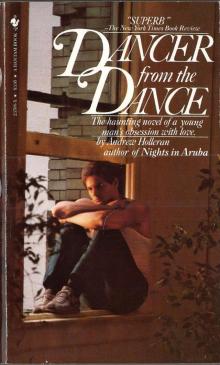
Dancer from the Dance
Nights in Aruba
The Beauty of Men
In September, the Light Changes
Grief
NONFICTION
Ground Zero (reissued as Chronicle of a Plague, Revisited)
A Note About the Author
Andrew Holleran’s first novel, Dancer from the Dance, was published in 1978. He is also the author of the novels Nights in Aruba and The Beauty of Men; a book of essays, Ground Zero (reissued as Chronicle of a Plague, Revisited); a collection of short stories, In September, the Light Changes; and a novella, Grief. You can sign up for email updates here.
Thank you for buying this
Farrar, Straus and Giroux ebook.
To receive special offers, bonus content,
and info on new releases and other great reads,
sign up for our newsletters.
Or visit us online at
us.macmillan.com/newslettersignup
For email updates on the author, click here.
CONTENTS
Title Page
Copyright Notice
Epigraph
The Dirty Hat
The Endless Cantaloupe
The Kingdom of Sand
Hurricane Weather
Two Loves Have I at Walgreens
Also by Andrew Holleran
A Note About the Author
Copyright
Farrar, Straus and Giroux
120 Broadway, New York 10271
Copyright © 2022 by Andrew Holleran
All rights reserved
First edition, 2022
Ebook ISBN: 978-0-374-60097-6
Our ebooks may be purchased in bulk for promotional, educational, or business use. Please contact the Macmillan Corporate and Premium Sales Department at 1-800-221-7945, extension 5442, or by email at MacmillanSpecialMarkets@macmillan.com.
www.fsgbooks.com
www.twitter.com/fsgbooks • www.facebook.com/fsgbooks
Andrew Holleran, The Kingdom of Sand