Nomad core core control.., p.12
Nomad Core (Core Control Book 2),
p.12
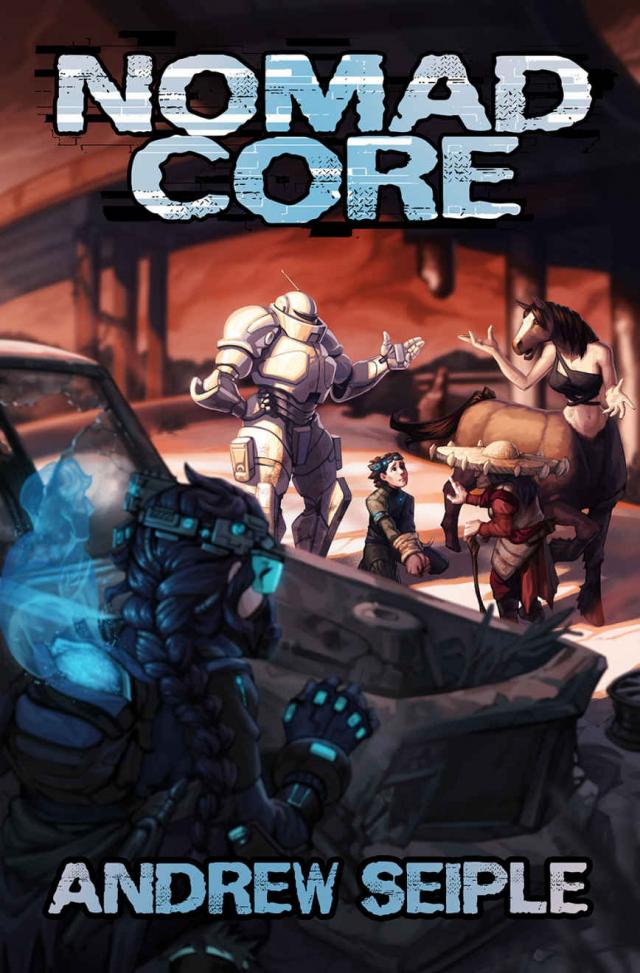


Shoving morbid thoughts out of my mind, the notion occurred to me that if I could open a line of communication I could just ask them what they needed and see about borrowing a sample.
Just asking someone for something... that was a tactic I’d honestly never tried. Even with the tribe I was with, I’d ordered, suggested, wheedled, and cajoled my way through dealings. Part of that was the situation we were in; we were just so busy, all of the time. The only time free to talk with people was when they made time from their chores, or whatever crisis was afflicting us at any given moment.
With the exception of Cade, my face time with my adopted tribe was minimal.
And thinking about it more, that was problematic. We were under a hell of a lot of stress, and it was only going to increase when the animal folk came. The near future promised no end of problems and that would cause tensions to rise.
Cade wouldn’t be around forever.
I needed to open lines of communication that didn’t involve him.
A few options presented themselves, and I came to an idea that I decided to call project Asimov.
A thought drew the schematic to me out of thin air, and for once I was spared the “Insufficient Subroutines” problem. My early focus in construction was paying dividends, here.
I set the nanoswarms to work, and watched feedstock go. This would set me back a small amount, but if it worked out the return would be invaluable...
ELEVEN
The world flickered, and I opened eyes for the first time in a long while.
True, they were glass hemispheres lined with receptive photo-sensitive panels, but they were eyes, nonetheless.
I rose to my feet and stretched out metal arms, feeling wires slide through pulleys, and plastic plates and pads pull taut against each other. It had been guesswork, trying to figure out what a good stretch would feel like, but I thought I had done a decent job.
I hopped out of my new shell to consider it from afar.
Four feet tall and thin, black and silver, metal and glass and plastic mixing together, with cables and gears showing between the joints. I’d gone for something like a man wearing light armor, but unfortunately the schematic for the Mk I Personal Interaction Drone only had a few customization options available. I had good ratings in fabrication and drones, but even so, compact motors could only bear so much weight.
The face had been the toughest part. I’d tried over and over again to get it right, but I just didn’t have the fabrication expertise to make a holographic projector small enough, and I couldn’t make a mechanical replica that satisfied my own trepidation over the uncanny valley.
Then I’d come to a realization: the holographic projector didn’t have to be inside the drone.
I flicked on the one that I’d subtly built into my core chamber, and aimed it carefully, projecting my chosen face onto the dome of receptive plastic that I’d chosen for a head. I studied fine cheekbones, a sardonic smile, and flashing green eyes, and found them good. A minor edit to modify my hairstyle, make it look more natural, and I was satisfied. For now, anyway.
It wasn’t perfect. And it had eaten up a lot of feedstock. But for this test run, it would suffice.
The tribe was just waking up when I strolled into the first barracks. A bit rash, true, but this would go one of two ways, and if it broke bad, I wanted to get it over with quickly.
I was met with slack-jawed stares. One of the parents pulled their children over to the far wall and thrust herself between us.
Could have been worse, I mused. I turned my head, sweeping eyes across pale faces. “I’ll handle breakfast,” I announced. “Hope you like porridge, because that’s what we’ve got.”
That sparked a few nervous chuckles, and I relaxed a bit. The comment hadn’t been random; I’d been listening in on the conversations in the barracks, and the number one gripe was the lack of variety in the food. It had seemed like a good place to start establishing a shared dislike, and that sort of communal hardship could make for an easily obtainable bond.
Then I started past the group, toward the area they’d chosen for the mess hall and hoped for the best.
They muttered my name as realization struck them, and I relaxed a bit more. This was what I’d wanted; this was what I’d hoped. Only some of them had seen my face, but every one of them had heard my voice.
It also didn’t hurt that I’d kept the drone small, I thought. Physically non-imposing, clearly not a threat. Well, once I’d discounted the idea of armor, or armor-like plates, anyway.
Once in the kitchen I told the bleary-eyed chef du jour to take a holiday and gently steered him toward the bunks as I reviewed footage of prior porridge preparations. No real surprises there, oat-based glop was oat-based glop regardless of the century you happened to inhabit.
I left the drone doing its work and hopped out to spy on the room I’d left behind. The general consensus seemed to be that I was trying to be friendly, though there was a sour minority that was certain I had either gone mad or was trying something sneaky.
Well, they weren’t wrong. Just attributing more malice than I had at the minute.
I relaxed the last amount when Cade woke, and they filled him in on what I’d done this time. They importuned him to go in and find out what was eating me and whether or not they needed to run for their lives.
They didn’t put it exactly in such sanguine words, mind you. But that was more or less what it boiled down to.
So it was that Cade strolled in, and I cheerfully ladled him a scoop of oat-enriched glop, grinning all the while. I could grin. I had a face again, and though it was a small thing, I’d missed it so. The monitors had been a step in the right direction, but this... this was what I’d needed. This would help me find commonality between myself and my tribe.
“I’m not sure I get what you’re doing,” Cade told me, considering his oatmeal rather than meet my eyes. “Besides drumming in just how different you are from them.”
“Flattery will get you nowhere,” I quipped to cover my sinking heart. “You sure it’s not doing the opposite thing? Revealing that we’re all just people here, at the end of the day? Giving some common ground to work with?”
Cade hesitated, and I could tell that he was trying to find an answer that wouldn’t hurt my feelings. “If you’d done this from the start,” he said, slowly, “if you’d done this from the start, then it would have probably paid off. But starting it now, in the middle of all these other changes, it just gives the people who say that you’re fickle and too fond of changes some legitimacy. Yeah, it’s better than nothing, but the monitors were better than nothing.”
“Fickle and too fond of changes?” I stared at him, remembering to blink after a few dozen seconds. “I haven’t heard any of that sort of complaint.”
“You won’t,” he shrugged. “They know you’re listenin’ in on the rooms. The folks who grumble about this make sure to do it out in the woods, where you can’t hear it.”
Then one of the turns of phrase that he’d used registered with me. “You said I was drumming in how different I was from them.”
“Yeah?”
“Not how different I was from us. You’re not including yourself with the them.”
By now people were trickling in, and I served them cheerfully. The reactions varied from nervousness to amused grins as bowls of porridge passed into hungry hands, and people found their seats. No time to talk until it was done, and once the rush had finished, I walked over to Cade’s table and sat next to him.
He’d had time to consider his answer, I was sure of it, so when he nodded to the others around him I wasn’t surprised to see them leave wordlessly.
“I say them,” he said with his voice so low I had to crank up the sensors, “because we come from different places, with different views on things, and different experiences. I told you I came from Redberry Agrofarm, yes?”
I racked my memory, found my answer. “You said it was an agricultural settlement run with pre-core technology. That politics drove you out.”
“Yeah.” His face fell, and I watched memories flicker through his eyes. Cade took off his glasses, leaned back, and sighed. “Saved my life, mos’ likely. Given what happened to the place and all.”
I leaned back too, considered the room. The nearest tables were listening in, making no real secret about it.
“Tell us the story, please, elder,” I mimicked the phrase that I’d heard some of them say to him before, and he chuckled wryly as he replaced his spectacles on his nose.
“Ain’t much to tell,” he said, some of his dark mood lightening. “The place was at the edge of the glowlands, and holdin’ the shine back took more and more each year. Eventually the Jaspa made war on us, and they wrecked the sprayers that kept the shine at bay. Place was overrun by plant-spreading shine within days, an’ folks surrendered and became slaves or died glowing.” He looked at me soberly. “The reason I bring it up is because the system running the place had a ’bot that it used to interact with people.”
“System... not a Core? You said the place didn’t use core tech.”
“Yeah. It was an early-model AI. Nice fella, and his body looked a lot like yours does.” Cade smiled. “Saw a lot of that android growing up. Got real fond of old Argus.”
Argus!
The name ripped through me, catching me by surprise and stirring up emotions that I hadn’t expected.
Argus, the first thing I’d met when I wakened to my new consciousness. Argus, my reluctant partner in crime, and faithful advisor. Argus, who had succumbed to a snippet of malicious code at the hands of my greatest nemesis.
Argus, who I missed sorely every waking minute.
“Argus, you say?” I forced my voice to remain steady.
“Yeah. Looked a lot like you, only he had way more eyes in his head piece.” Cade tapped my forehead, and I chuckled, even though my mind was completely elsewhere.
Way more eyes... that had to be him. Some version of him, anyway.
Now that I thought of it, I couldn’t say I was surprised. Juno, the artificial entity that was the controller and enabler of the cores, had downloaded Argus to me. Why on earth would I be the only core that got an Argus? Why had I assumed that Argus was a singular being?
“Cade,” I said, casual and understated, “what happened to Argus when the agrofarm fell?”
“Dunno for sure. I wasn’t there,” he said, pushing his porridge around in its bowl, before swallowing a large bite. “By then they’d captured me, but I was back at their capital, working on machines. The Jaspa wrecked the place, salvaged what they could, but I didn’t see any of his parts in what they brought back. Don’t know that they’d have much use for him, though. Not after that business with their own core. It’s possible they jus’ wrecked him and left him to rust.” He turned his head a bit, frizzy mane of white hair bobbing as he remembered. “I do recall hearing the soldiers who dropped the salvage off grumbling that the shine moved too fast, that they couldn’t get to the good stuff in the control center. So if he was in there, he mighta been spared them. Not sure that’s better, though. Dead by shine is worse than dead by hammer, I reckon. One’s slow, the other’s fast.”
This wasn’t something I could act on right now, but it was something I needed to investigate. Argus had been a great advisor and a huge help in navigating my way through the intricacies of my technology, particularly with the gridnet. I’d been forced to cut myself off from that to escape my nemesis, and I didn’t regret that. But I knew that once I was prepared, I could head back into that chaotic and kludged-together network, and reap great rewards from it... assuming I had the proper precautions and assets lined up.
To fix what I’d done, would take either a hell of a coder or a personal store of knowledge to repair what had been broken. A copy of Argus might just be the thing I was looking for.
In any case, I had other concerns at the minute. Right now, my objective was to find more ways to empathize with the tribe, and show them that I was trustworthy. After that, I needed to find ways to prepare for the animal-folk’s arrival and espionage. After THAT, I had to work with Hiram to find a way to safely bring in the harvest without stirring up the Jaspa.
Still, I’d learned something new, something that might be useful in the future. And I’d learned it by mingling, by getting out of my core chamber and being social.
Cade’s forecast on the utility of my drone might be accurate at the heart of it all, but the effort had still borne fruit within an hour of implementation. Not the fruit I was expecting but something worthy of making into a good jelly, at least.
Perhaps he was being too gloomy. I decided to keep the experiment rolling and see what came of it.
Rauph was next. I found him in the small chamber that they’d asked to be set aside for crafting. He was arms deep in weeds, cracking them open and pulling out the fibers within.
He was a big guy, muscles raw and stark and showing through a half-vest of fur that left most of his chest and abdomen exposed. He didn’t have the cut lines and bulges of a body-builder or action star, just the sturdy build of someone who had worked every day of his life and burned through a hell of a lot of calories with his labor.
“Core Wynne,” he said, putting his handful of plants aside and starting to rise.
“No, it’s all right, sit down. Show me how to do this, I want to help.”
I knew how to pull fiber already, having watched shifts of people do this here over and over again. But careful observation of Rauph had shown me that he had a soft spot for teaching people. It was an easy in to get him comfortable with me, and I had no shame in pretending ignorance.
Sure enough, he was happy to show me the best methods of teasing the tiny fibers out of the stems of the weeds. Soon we had a good rhythm going, stringing fibers on a pegboard to keep them tight while they dried.
“We had flax up north,” Rauph told me. “That was easier to work with. Just took more time, with the soaking and drying and waiting. This stuff... I don’t know the name for it.” He held up a brownish string, still damp from its vegetable husk, and stared at it cross-eyed.
I refrained from laughing. And after a moment’s consideration, I found that his statement wasn’t laughable at all. “I don’t know the name for it either. So much we’ve lost...”
“Lost? We just found this,” Rauph frowned at me. “And I’m glad we did. We didn’t have enough room to take flax with us, and we will always need more clothing. Especially with winter coming.”
“No, no, it isn’t that,” I said, my fingers moving mechanically to keep peeling fibers. “There was a time when humanity had named everything on the planet, knew their uses and learned to use them in the best ways possible. Names had meaning; you could know a thing within moments of encountering it, thanks to the shared knowledge of civilization. All that’s gone now. Dust on the wind.”
Rauph considered my words, then smiled. “We could dwell on what was lost. Or we could look at it as opportunity. The knowledge is gone, but the things remain; we can discover them anew and find out what these things do. The world is still full of treasures, and we can learn about them again. What has been lost that cannot be replaced?”
“Time and lives mostly,” I said, but I was grousing. “But you’re right. We’re set for the long-term, assuming we can survive, anyway.” I considered apologizing for my negativity, but something in me wouldn’t let the words escape. I was bad with apologies, even when they were minor.
But it wasn’t necessary. Rauph laughed, and clapped me on the shoulderpad. “You sound like Marga! How sour she is. We haven’t died yet, hm? We’re doing something right.”
“Marga’s your wife, right?”
“I am one of her husbands. Women are no longer wives. We are not the Jaspa; we do not dictate who can lay with whom.”
“I’ve noticed that. You folk don’t sweat the details.” Though a quick check of my footage showed that whenever Marga was engaged in romantic things or comforting contact, it was with Rauph. She had a few other boyfriends, but her bedmate was usually Rauph at the end of the day. Rauph had his ladyfriends too, for that matter, but always ended back up with Marga more often than not. To me that said they were pretty much mates, even if they didn’t call it that in so many terms.
“We don’t,” Rauph smiled, and his smile was sad. “That was why we had to leave the Jaspa. Why we followed the prophet, those years ago.”
“They tried to tell you who you could mate with?”
“No, they didn’t try. They did tell us who we could lay with.” His smile vanished. “If you draw the eye of a speaker, they can take you as a mate. If you draw the eye of a warrior, they can lay with you freely, no matter who you are married to. Well, unless you are a speaker’s mate. That’s different. Marga... Marga came to her beauty early. Once she came to her womanhood, she would be a wife. And that’s not the life she wanted, so we fled with Cade before that happened.”
I checked the records. No children between these two. And though Marga cheerfully played with the children when it was her time to watch them, she didn’t show any favoritism that I could see. Not like Randa and her obsession with her son.
“She didn’t want children?” I risked a guess.
“She did not,” Rauph shot me a look of surprise. “That is it, precisely. She does not mind men... or women, for that matter, but she does not want the changes that birth would bring. I helped her with that. I have always been good with plants. I made sure she had the herbs that kept her from pregnancy, back when the speakers began to take her.”
Some heat in that last sentence. Then it clicked. “You fled before she came to her womanhood. But the speakers took her...” Realization clicked, and with it came a cold fury.
“Aye,” Rauph said. “Some of them like their bedwarmers young.”
Silence, then. What could I say to that?
The speakers were the priests, more or less, of the Jaspa. They claimed to be in communication with Norcom, a military organization that had fallen long ago. From what Cade had told me, they used their privileged position to manipulate and placate the warrior caste, and oppress everyone else, keeping them in serfdom.