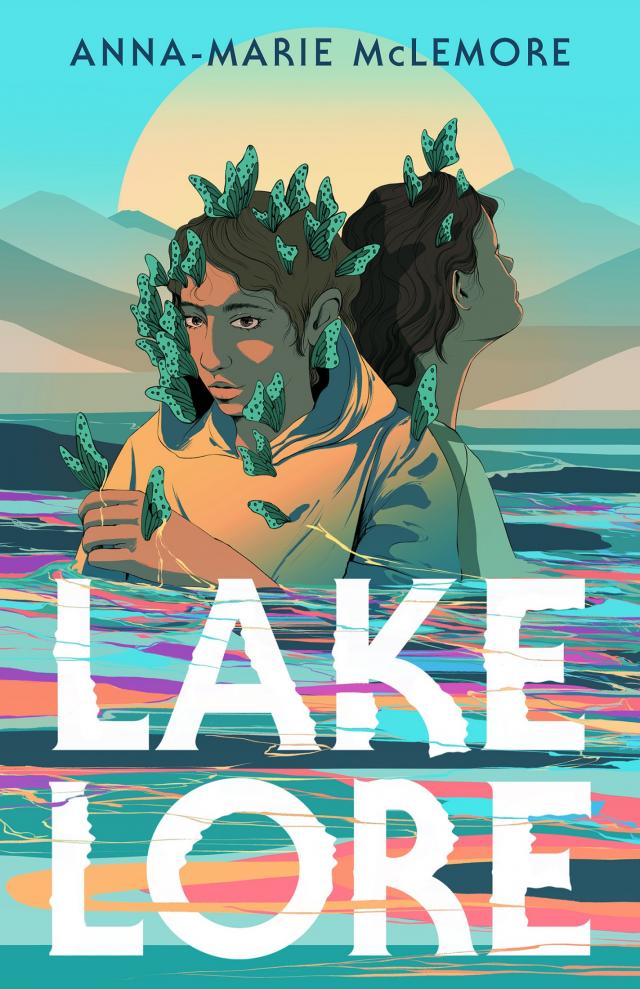
Lakelore, p.7
Lakelore,
p.7


BASTIÁN
“Lore,” I say again. Even though I can’t understand the name they’re saying above the rushing water, I can hear it enough to know it’s not mine.
Lore clutches the edges of the desk they’re on, pupils wide enough to take up most of their irises.
“It’s me, okay?” I say.
Lore stares at me. I think I hear the beginning of a name, my name this time. But the motion of what looks like a wall coming at us stops us both.
I grab Lore’s arm and pull them with me before a cabinet crushes us against the desk. We get out of the way just as the cabinet slams into it, wooden panels rattling.
With that noise, Lore flinches, clicking back into right now.
The rising water has turned the ground floor of where the Garcias live into an obstacle course. The mess of half-finished furniture, some upright, some upended, knocks together, pieces bouncing off one another. Knots of waterweed grab at chair legs and the corners of tables. Stray blotches of paint light up like they’re under ultraviolet.
I bang into the hard corner of something, a low piece of furniture that probably has a fancy name, but I don’t know it. As pain spreads through my shin, I push it away hard enough to shift its path, and the water carries it toward the wall.
Lore pulls me toward the door, getting us out of the way of a cluster of chairs. They bob along on a stand of kelp that shifts colors under the water.
We follow the rush of the current out onto the sidewalk. The foam on the dark water flashes orange as wild poppies.
We run into the middle of the street, and the water thins out enough that it doesn’t go past our ankles. Water thyme and star grass float past us. Pieces catch on our shoes.
“Are you okay?” I ask.
Lore looks around. Their wet hair gathers into pieces and falls into their face.
“I made a mistake,” they say. “I screwed everything up.”
“Hey.” Lore still hasn’t let go of me, so I don’t let go either. I slide my hands under their elbows, trying to get them to look at me. “This wasn’t your fault. None of this is your fault.”
But Lore’s not hearing me. They watch the pieces of water thyme gather around our feet.
“Do you do hugs?” I ask.
Lore looks up with a laugh, like I caught them off guard. “What?”
“I don’t know if you do hugs, so I’m asking.” I didn’t expect this to be funny, but Lore’s still laughing, so I’ll take it.
“Sure,” Lore says.
I’m not a natural hugger, not like most of my family is. When I was little and people tried to hug me without asking, it was sometimes the thing that pushed me from agitated into overstimulated. Hugs I didn’t want made me hide in the cabinets under sinks, in garages, in the back seat of the car our neighbor always forgot to lock, anywhere I thought no one would find me.
But the longer we stay like this, the more we figure out how our bodies fit together, the more I relax into it. My arms cross Lore’s back. Lore’s palms spread out over my shoulder blades. Lore’s forehead rests against my shoulder.
Lore lifts a piece of star grass out of my hair, the strand of thin leaves dotted with tiny yellow flowers. Then I’m laughing with them, and I figure that’s when we’ll pull apart. We’ll take this off-ramp to end the hug.
But Lore doesn’t pull back. I don’t either. Even though water and lake plants are winding around where we stand, even though the hems of our jeans are deeper blue from the water soaking them, I don’t want to. Even though we’re both looking over each other’s shoulders for any sign of a seiche, I want this.
For one of the few times I can remember, I not only stay still, I want to.
LORE
When it’s over, and the world goes back, things almost look normal. The folding chairs we’re working on for the wedding aren’t tangled together. The cabinets aren’t warped and waterlogged. The desk hasn’t splintered into pieces.
But something’s off.
Everything’s in a slightly different place than before.
I shift them, so slowly that they barely grind against the floor. I try to get them as close to where they were without waking up my parents. In the morning, my parents may blink at each of them, wondering if a credenza sidled up to a bookshelf when no one was looking. But I’ll just keep working, like I don’t even notice. If they ask about it, I’ll laugh. What, you think the furniture’s throwing wild parties while we sleep?
I hear the faint edges of a voice from upstairs. I swear under my breath, wondering which of my parents I just woke up. In a minute one of them will be on the stairs with a bleary expression and an unfiltered, What the hell are you doing, Lore? It’s three in the morning.
The sound thickens and sharpens.
The pitch of it crawls along my neck, and it resolves into a high, taunting laugh.
My hands grip the dresser, palms clammy against the wood.
I stay still, my breath rasping in my throat. I shut my eyes tight.
The laugh shimmers along the walls, like the sound is swallowing me. It’s still quiet, as though whoever is laughing is holding a hand over their mouth to muffle the sound. But it feels so close I’m wearing it. It’s coating my skin.
I stay still. I clench my teeth and fold my tongue against my soft palate.
The laugh fades.
I take a gasping breath in, knowing what I need to do.
I have to tell Bastián.
BASTIÁN
“What do you want?” I stand at the edge of the world under the lake. I hate how exasperated my voice is. I sound like I’m trying to reason with a temperamental cat who has already decided I am beneath her.
The weather in my brain is drying out. Any rain or mist is evaporating.
“Do you want me to make you new friends?” I ask. “Is that it?”
As though I don’t make enough alebrijes, every time I have one of my bad days, every time I make a mistake I can’t stop thinking about.
The horses and axolotls glide toward me and then hover. I flinch and back up. But then I realize they’re not trying to rush toward the surface.
They’re trying to get me to come to them.
“No,” I say. “I’m not coming down there.”
I step back. I’m not going near these living versions of my worst days.
“I can’t,” I say. “And you know that.”
LORE
“I’m worried,” Bastián’s mother—the one who told me to call her Ava—says when she answers the front door.
All I get out is “uh…” before she keeps going.
“They’re in a rabbit hole,” she says. “Hiperconcentración. You get them out of the house and into daylight, I’ll give you whatever you want. Do you smoke? What brand?”
“I don’t smoke,” I say.
“Good.” Her face turns intense and forbidding. “That was a trick question. You shouldn’t smoke. Never start.”
I step back and respond with an encore, “Uh…”
“They’ve been in that room for years,” she says. “Years. Planets have been demoted in less time.”
Ava Silvano should go up against my mother in the sport of exaggeration. Will you turn this down, it’s five thousand degrees in here.
Bastián has not been in that room for years; they were at work earlier today. I know because I thought about stopping into the copy-print place on the way home but couldn’t think of a good excuse by the time I got close enough that they might see me. I saw them, a flash of their hair and their shirt, before I ran back around the corner. Like the coward I am.
“Go.” Ava points down the hall. “See if you can get them out and into the living world.”
I do what I’m told. On principle and from experience, I don’t argue with Mexican mothers.
When Bastián sees me in the doorway to their room, how fast they stand up from their desk chair almost makes me laugh, like they’re in an old movie, rising for the entrance of someone important. “I thought you were coming over at”—Bastián checks the clock—“oh.”
“Yeah,” I say. “Sorry, your mom said you were in here. Well, more accurately, she said you were in hyperfocus.”
Bastián laughs at that, but seems a little on edge. They look around their room, self-conscious as though there were dirty clothes and snack wrappers everywhere. But nothing’s especially out of place. There’s a jacket on the dresser. A stack of books on the floor that look like they just came from the library or are about to get returned. Their bed’s made in only the most half-assed way, but no one I know except my mom whole-ass makes their bed every day, complete with redoing the corners.
A breeze through the open window rustles a corkboard full of postcards. They’re packed in, overlapping like fish scales, and they’re all some kind of art. A pink shell by Georgia O’Keeffe. A photo of a miniaturized room, complete with tiny furniture. Edmonia Lewis’s sculpture of Cleopatra.
“I like your collection,” I say.
“Yeah.” Bastián clears their throat. What am I doing that’s making them so nervous? “Those are from my brother. We send them back and forth.”
“You and your brother are pen pals?” I ask. “That’s adorable.”
“My brother’s fifteen years older than me,” Bastián says. “Most of my memories of him growing up are after he moved out.”
I track Bastián’s eyes twitching around the room. Did last night make things irreparably, universally weird?
As I watch where Bastián’s looking, I notice the small details of their room I missed. I count seven alarm clocks and timers, some shaped like cubes, others like a tomato or a cat. All the clocks are ahead of the kitchen clock I just saw, either by a few minutes or almost twenty, but none of them say exactly the same time as any other one. Index cards are taped to light switches and the edges of the dresser and tacked to more squares of corkboard. I can’t tell what they say, though. The handwriting on them, each a short phrase, maybe a sentence, is looping and artistic but unintelligible to me. The same dyslexia that gives me messy handwriting makes it harder for me to understand other people’s handwriting.
They notice me noticing, and tamped-down horror crosses their face. So I set my focus on one thing they’re not looking at nervously, the paints and paper and brushes on their desk. Alebrijes crowd the space in front of them.
“Did you really make all those?” I ask.
Bastián hesitates before saying, “Yeah,” under their breath.
“They’re incredible,” I say. An orange rabbit wears a shell of sea urchin’s spines. A raccoon has tiny plastic jewels for eyes. A brush soaked with ultramarine paint rests next to a fox with a jellyfish tail.
Bastián still looks uncomfortable.
“Do you want me to leave?” I ask.
“No,” Bastián says, and they say it fast enough that I’m pretty sure they mean it.
The air through the window comes in stronger, lifting the index cards like leaves.
I still can’t read most of them, but the breeze tilting up toward the light lets me read some.
Drink water.
Take meds.
Slow down.
Breathe.
Write it down.
Do one thing at a time.
Breathe again.
If you don’t write it down, it doesn’t exist.
Where are your keys?
Don’t forget your water bottle.
No, really, you’re on T now. Don’t forget your water bottle.
That’s when I get it.
Bastián doesn’t think their room is a mess.
Bastián didn’t want me to see the index cards. For whatever reason, their room has dozens of these, each reminding them about something. And the reason could be anything. It could be things they’ve told me show up in a brain like mine. Trouble with working memory. Processing and retrieval problems. Possible detail in support of this theory: There’s some kind of filled-out form in the middle of Bastián’s floor, which makes me wonder if Bastián does the same trick I do, placing things I need to take with me so they’re literally in my way. My choices are either to remember to bring it or trip over it, so I do this with anything important that isn’t breakable or a potentially hazardous obstacle.
I want to ask. Of course I want to ask. But it’s none of my business. And even if it was, how would I ask? Hey, random question, but did you grow up thinking there was maybe something weird about your own brain? Or that your brain was doing things the wrong way? That you were doing things the wrong way?
Even in my head, it sounds like a bad infomercial. It comes with a flourish of harp sounds. There’s an Amanda the Learning Specialist for that.
I look around for something else to comment on.
Next to their bed, a jar of blue-violet water holds a layer of sparkles at the bottom. The sun lights it up like a fish tank.
“That’s shiny,” I say. “What is it?”
“It’s a glitter jar.” Bastián grabs it and puts it in my hands. “You have to shake it up.”
That seems to relax them a little. They don’t even seem to notice that the paint on their hands just left strokes of color on the glitter jar.
So this subject is safe. I make a mental note.
I watch the green and coral sparkles spin through the water.
As I turn the jar over, I notice more color on the bookshelf. The pack of alebrijes isn’t just on the desk. The alebrijes have spilled onto the shelves, each either half-painted or all the way finished. They’ve overrun the windowsill, crowding next to paints and brushes and coils of wire. Alebrijes sit on top of newspaper on Bastián’s dresser. A tortoise with owl’s wings. A purple cat with a peacock’s tail. A coyote with a hummingbird’s markings and fins behind the ears.
Their coats all shine like they’re just painted, no films of dust on any of them. No wonder the window’s open. I’m so used to the smell of paint and varnish and other nonpolar solvents that I barely notice them, but when the breeze turns, I catch the subtle sharpness of acrylic paint.
I’m now seeing what Ava saw.
In the least alarmed voice I have, I ask, “What are you doing?”
“I missed something.” Bastián paces between the desk and the bed, which isn’t a lot of space, so it gives the effect of them knocking between the walls of a pinball machine. “I had to have missed something. There’s something I was supposed to send down there that I didn’t, and now it’s pulling everything else up here, and I can’t figure out what it is.”
So I’m not the only one who sometimes feels like I’m fighting my own brain.
The pinch of last night comes back. Sending those ribbons of paint into the dark made me think I was doing the right thing. But I made the world under the lake volatile and dangerous. It came above the surface and threw my worst memories back at me. It didn’t accept them like it did with Bastián.
“I don’t think you’re the problem,” I say.
Bastián picks up another wire frame from the desk. “What do you mean?”
“I think there’s something wrong where my family’s living,” I say.
Bastián’s fingers leave paint smudges on the wire skeleton. “What kind of wrong?”
“Like something in those rooms isn’t happy,” I say. “Like the rooms or the walls themselves aren’t happy.”
Bastián stares at me.
“Every time the world under the lake comes above the surface,” I say, “I hear something.”
“What kind of something?” I say.
I anticipate how flimsy this will sound. “A laugh. One that feels like it’s right next to me but also like it’s coming from far away. Like I’m hearing it through water. I don’t think it’s one of my neighbors, and I keep hearing it, especially when the world under the lake shows up. So I’m starting to wonder if there’s some kind of connection.”
Bastián’s eyes fall shut.
“You think I sound ridiculous,” I say.
“No,” Bastián says. “It’s not that. It’s that Abril’s going to be insufferable. Come on.”
“Where are we going?” I ask.
Bastián goes toward the door. “To ask someone who might know something.”
BASTIÁN
“Proceed with caution.” I lead Lore over the contours of the rocks.
“Where are we?” Lore asks.
“Somewhere we’re not exactly supposed to be,” I say.
A sliver of water catches the sun.
“I thought you wanted me to stay away from the lake,” Lore says.
“Yeah,” I say. “Because that plan’s working.”
We go over the crest of the rocks, the floor of the bight veined with old roots.
The rocks shift, and Lore loses their footing.
“Careful.” I hold out my hand. Lore only grabs it for a second before they’re steady again, but when I see their fingers on my forearm, I realize how much paint is still on me. Green and orange and blue cross the brown of my skin. One habit I haven’t broken is doing a rushed, shoddy job washing off paint. It takes forever under the tap, and my patience thins out faster than the acrylic.
Lore surveys the bight in front of us, the swing sets, climbing bars, the worn-wood playhouse with a ladder and slide.
They look back at the wall of rocks we just climbed over.
“Weird place for a playground,” Lore says.
“It’s kind of not a playground anymore,” I say. “It was, but after the last big storm all those rocks crashed in, so it’s not kid safe at the moment.”
I only have to wait a few seconds for my friends to come out of the playhouse.
Sloan stands at the open side. He has on one of the graphic T-shirts he wears so much the design is pilling off.
“That’s not even one of the options,” he’s saying to Vivienne.
“I don’t care.” Vivienne sits on the edge of one slide. “I want her wardrobe.”
“You’re basing this on costume design?” Sloan asks.
“Hey,” Maddie says. “It’s one of the great art forms of cinema. Without it, the visual cohesion of a film doesn’t work.”