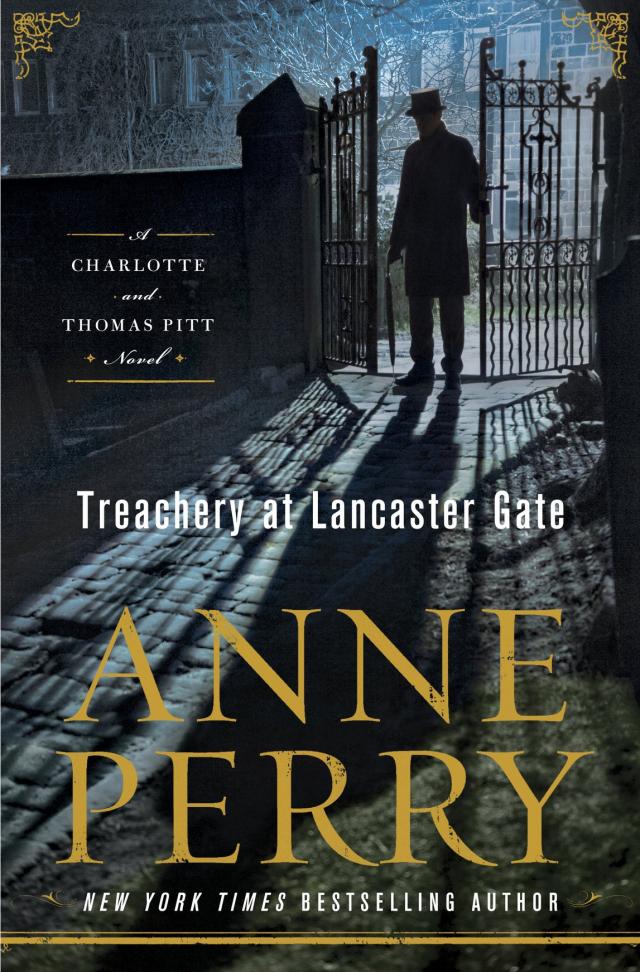
Treachery at lancaster g.., p.28
Treachery at Lancaster Gate,
p.28


Charlotte, Vespasia, and Jack walked the short distance to the nearest public house seeking a good, hot meal. They did so in silence, wrapped up against the wind. Vespasia did not mention whether she had been to such an establishment before, but she looked around curiously only once. They all had more pressing weights on their minds than the chatter of the other diners, many of whom had also come from one of the nearby courts or offices.
They spoke briefly of Tellman, and his slow but steady recovery. Vespasia particularly asked after Gracie, and Charlotte smiled for the first time that day as she recounted how Gracie was completely in control and Tellman was for once doing exactly as she told him.
“Perhaps he at last realizes how much she loves him?” Vespasia suggested.
“I think so,” Charlotte agreed. “And he is allowing himself to admit that his family means more to him than anything else.”
Vespasia smiled back, and resumed eating a kind of meal to which she was totally unaccustomed.
—
ABERCORN BEGAN THE AFTERNOON’S testimony by calling Constable Yarcombe. He was better recovered than Bossiney, but he still walked a trifle out of balance for having less than half an arm on one side. He also told of being lured to the house in Lancaster Gate, of how they all were prepared to find a major drug deal in progress, confident that the informer who had previously been so reliable would be so again.
He described the house much the way Bossiney had, but carefully using different words, as if they had not compared notes. Again it was enough to convey that he knew the place, but the account was not swamped in enough detail that any of it could be contradicted.
He spoke of the explosion with some distress, both for his colleagues who were killed and for the searing pain he had felt. When Abercorn asked him, he spoke highly of Ednam.
“Yes, sir, ’e were a fine man. Knew ’im for years, I did. Very brave, ’e were. Very fair. It were a terrible thing that ’e died of ’is injuries. Mind, the pain of it, there were days I wished I ’ad.”
There was an audible murmur of sympathy around the gallery. Charlotte saw one of the jurors muttering something, and then looking up at Alexander, who sat white-faced and stiff. But he was no stranger to pain. He had lived with it since his own accident, and would for the rest of his life. But of course the jury did not know that—and was it relevant to anything? Narraway had not pleaded insanity for Alexander. Why not? Surely the opium he had been prescribed, and then became addicted to, could have driven him mad? And madness was about the only defense for this.
Charlotte wondered what on earth Narraway was doing, and whether Thomas had any idea at all how appallingly this was going. It could hardly be worse.
But when Yarcombe came to the end of his evidence, and Narraway could have done something, again he declined to ask him anything at all.
The ripple of amazement around the court was tinged with anger, even contempt.
And contempt was written clearly on Abercorn’s aggressive face. He looked across once to where Cecily Duncannon sat and there was victory already in his eyes.
Charlotte wished she could somehow hurt him, take some weapon and hit him so hard with it that the pleasure in him would vanish forever. She knew that was ridiculous and childish. It was not really he who was at fault. He was only doing what he was supposed to. But she hated him for enjoying it. And he was! Staring at him, at the shine on his face, she was certain of it. This was a victory against Godfrey Duncannon, because Alexander was his son and he had what should have been Abercorn’s. Godfrey had abandoned Abercorn’s mother for Cecily, and left her to the pain of difficult birth and no one to support her. Perhaps, like Alexander, she too had turned to opium or some other drug. Where would that have left Abercorn as a child?
She turned her attention back to the trial. Abercorn could do nothing now except proceed. If Narraway had hoped to knock his confidence by behaving so extraordinarily, he was not succeeding.
Abercorn called the senior fireman who had attended the blaze after the explosion. His account was exact, harrowing, but with the expert detail that held the attention of everyone in the court. There was a horrible fascination in the power of fire to cause all-consuming destruction. Here, safely in the courtroom, the fear created a frisson of excitement.
Abercorn thanked the fireman and turned to Narraway.
Narraway rose to his feet. “Thank you, my lord,” he said to the judge. “I cannot think of anything this witness has left out, or indeed of anything that could be interpreted other than as he has done.”
“You’ve nothing to ask?” the judge said incredulously.
“Nothing, my lord, thank you.”
The jurors looked at one another, puzzled, even disconcerted.
There was a murmuring in the body of the court.
Charlotte turned to Vespasia, and then wished that she had not. The concern in her eyes was unmistakable. Charlotte reached out and put her hand gently on Vespasia’s and felt her fingers tighten in response.
Abercorn spent the rest of the afternoon calling one expert witness after another. Most moving were the doctors, especially the one who described the pain of those who had survived. The police surgeon described the causes of death of Newman and Hobbs. He also stated that Ednam’s injuries were the primary cause of his death, although it occurred a little later.
Again Narraway had nothing to say.
“Surely, Lord Narraway, you have some purpose here?” the judge said in complete exasperation. “You are hardly giving your client any kind of defense at all! Are you hoping for a mistrial, sir? You cannot claim incompetence. You are perfectly capable of mounting some sort of defense, or I would not have permitted you to undertake it. Do you wish to be replaced?”
“No, thank you, my lord,” Narraway said a little stiffly, as if his neck ached and his throat were dry. “I have not questioned the witnesses so far because I do not believe their evidence is in error or in any way incomplete. I will have questions later. I do not believe it is in my client’s interest to waste the court’s time over issues that are not in doubt.”
“Very well. But you had better begin soon, or I shall be obliged to find a more…competent counsel for Mr. Duncannon.”
“I am engaged, my lord,” Narraway said with a sudden flare of passion. “Believe me, I am!”
Charlotte gripped Vespasia’s hand harder, and found her eyes filling with tears of relief.
—
PITT KNEW IT WAS inevitable that Abercorn should call him as a main witness against Alexander Duncannon. He had spent a good deal of time with Narraway and knew what he had planned, as well as both the chances and the risks. He was not surprised when, the day after he finished with the other expert testimony, Abercorn called him in for a final discussion before putting him on the stand.
At seven o’clock in the morning Pitt was very reluctantly having breakfast with Abercorn at his home. It was a large, elegant house off Woburn Square. This was an excellent neighborhood, quiet and exclusive, wealthy long enough to wear it with ease.
Abercorn ate well. The sideboard held silver dishes of scrambled eggs, sausages, bacon, mushrooms, deviled kidneys, and kippers. There were racks of fresh toast, and there was butter and several kinds of marmalade. Graceful silver pots held tea and hot water, matching the silver cruet sets and the monogrammed knives, forks, and napkin rings.
Abercorn himself was dressed in a suit obviously tailored for him and a quality of shirt Pitt would have felt was extravagant for himself, with a family to support, but he admired it nonetheless. He did wonder why Abercorn had not married yet, or if perhaps he had, and tragedy of some sort had robbed him of his wife and the possibility of children.
In a brief visit to Abercorn’s study the last time he was here, in earlier preparation, Pitt had noticed the portrait of an elderly woman, dressed in the fashion of some thirty years earlier. And in spite of the ravages of pain, her features bore a noticeable resemblance to Abercorn’s. Pitt had assumed it was his mother.
“Sorry for calling you out so early,” Abercorn said almost as soon as the food was served and they began to eat. “But this is crucial. I think we already have the jury completely. It has all gone perfectly so far.”
Pitt knew this from Charlotte, but he intended to make no mention of that.
Abercorn took another large mouthful of deviled kidneys. He had separated them on his plate—a generous helping. They were apparently a favorite and he meant to indulge himself. Pitt wondered how long he had had his wealth. There was something in him, almost indefinable, a relish, that made Pitt aware that Abercorn was not born to such plenty. He still savored it, just enough to see.
“Narraway did absolutely nothing,” Abercorn went on. “I thought at first that he would be a dangerous opponent, but the more I watch him, the more I am coming to believe that he is totally out of his depth. I don’t know why he took the case on at all…” He hesitated, watching Pitt closely.
Pitt did not reply. He sat waiting as if he expected Abercorn to explain.
“You know the man!” Abercorn said impatiently. “Is he really empty, a paper tiger?”
Pitt was conscious that he must judge his reply exactly, not only his choice of words but the precise facial expression that accompanied them.
“He’s made mistakes,” he began. “Misjudgments. But then so has everyone. Sometimes it’s not the errors you make but how you recover from them that mark the difference between failure and success.”
“I don’t intend to give him the opportunity to recover,” Abercorn said tersely. “So far he’s said nothing. Why do you suppose that is?”
Pitt smiled to rob the reply of any suggestion of sarcasm. “Possibly you’ve made no mistakes he could exploit? The evidence of the actual crime seems very clear cut.”
“Indeed, it is,” Abercorn agreed. “But I expected him to say something.” He frowned. “How long is it since he actually practiced law?”
“I didn’t know he ever had, until he told me a couple of weeks ago,” Pitt admitted. “And I didn’t ask him. I gathered it was a very long time ago.”
“I looked.” Abercorn nodded. “I found no trace of his ever appearing in court at all. But he is certainly qualified. Why on earth does he want to defend Duncannon? Do you know?”
It was the first question to which Pitt had to answer with a direct lie. He disliked doing it, but he had no choice.
“I imagine it could have something to do with Godfrey Duncannon. The government is very keen that the contract should be accomplished successfully.”
A shadow crossed Abercorn’s face and then was gone. “I agree that the timing is appalling, and I dislike doing the opposition’s job for them. But the attack on our police force is even more serious than this contract. They are our first line of defense against anarchy and the total chaos of civil disorder.
“The whole of Europe is in civil disorder and within the next ten or fifteen years, at the outside, we will be in chaos if we do not gain some control. Socialism is rising in Russia, Germany, France. The Balkans are on the brink of war. Who is to hold onto order, if not us?”
Pitt did not answer. Everything Abercorn said was true.
“We must not, cannot let down those who rely on us,” Abercorn went on. “Three men are dead and two more fearfully injured. Bossiney was a fine witness. His disfigurement made a lasting impression on the jury. They’ll have nightmares about that for a long time. I’ll have that face in my dreams for years.” He winced, for a moment not making any attempt to hide his emotion.
Pitt felt a moment’s complete unity with him. Bossiney would carry that for the rest of his life. Whatever he had done in complicity with Ednam, it was a monstrous punishment. But it did not justify the crime of hanging Lezant, nor did it assuage Alexander’s pain.
“What is it you wished to discuss?” he asked.
Abercorn brought his attention back to the present. “Ah…yes. Just details. Attitude perhaps more than facts. They seem to be clear enough.” He looked at Pitt earnestly. “I know exactly what I am going to ask you. You are my main witness, beyond the facts already established. Narraway has to cross-question you, or he has done nothing at all. I want to make sure he cannot rattle you. He must know you well. He was your superior for several years.” He left the remark in the air between them, forcing Pitt to respond.
“I believe I know what you mean,” Pitt said slowly. “But if you are plain, then there can be no misunderstanding. We have already gone over the evidence. I shall be precise in answering your questions.”
“And brief,” Abercorn added, still watching Pitt closely. “Don’t offer anything I haven’t asked for.”
At another time Pitt might have smiled. He had given evidence more times than Abercorn had even been in a courtroom. But there was nothing easy, final, or to be taken for granted in this.
“I won’t,” he promised. He must be careful. He did not like Abercorn, and yet his dislike of him was baseless and probably unfair. His loyalty to Narraway was deep, and his loyalty to what he believed to be right was even deeper. He knew exactly what Narraway meant to do—at least he thought he did. Narraway had been very careful not to tell him in so many words.
Abercorn stared at him, weighing, measuring, and judging. Pitt had a strong sense of the man’s power and his acute understanding of others that had brought him from obscurity, poverty even, to a place where he was rich and very widely respected. He was almost certainly headed for the next step up the ladder to a political career of some distinction.
If Abercorn won this case it would be seen as a victory in the crusade for the ordinary man, the policeman on the beat who protected people’s houses, families, even their lives, against crime and disorder. A place in Parliament, even in government, was not unlikely, for Josiah Abercorn, to be a springboard for government office, even, eventually, a ministry, such as the Home Office, with all its power to change the law and life of the nation. It would be foolish to take him lightly.
Pitt had at last learned not to fill other men’s silences with words he would rather not say. He ate his breakfast, without enjoyment.
“Narraway must have some plan,” Abercorn said at last. “You know the man. More to the point, he knows you! Is he going to try to trip you? What does he imagine he can do that Godfrey Duncannon has allowed him to represent the family? I have a powerful feeling that there is something I don’t know! What is it, Pitt?”
Pitt was startled. “What makes you think that?” He was playing for time, studying Abercorn’s face, the tension in his body as he sought to probe Pitt’s thoughts. Was this what the meeting was really about? “How well do you know Alexander Duncannon?” he asked. It was a thought that had only just occurred to him, and probably it was irrelevant.
Abercorn’s expression was extraordinary: a mixture of a terrible humor, bitter and deep; a satisfaction as if tasting something delicate, determined not to gulp it; and a pain that was almost overwhelming.
“Alexander?” Abercorn said with his eyebrows raised. “Our paths have seldom crossed. Why do you ask?”
Pitt shrugged, aware now that they were playing a complicated game with no rules to it. “Looking for what it could be that we don’t know,” he answered.
“Why did Godfrey allow Narraway to do this?” Abercorn held his fork in the air, the next mouthful for once ignored.
“Perhaps it was Alexander’s decision?” Pitt suggested, knowing that it was.
“Why? Cardew was to be his lawyer. He would have been excellent. He would at least have put up a battle.”
“But would he have won?” Pitt asked.
Abercorn pursed his lips doubtfully. “Insanity, perhaps. Narraway hasn’t even put it forward. God knows why. It’s all there is.”
“Perhaps he doesn’t think it would work?”
“Nothing’s going to work!” Abercorn said with a sudden rush of emotion. His big broad hand was clenched on his knife, his face was flushed with a wave of color. “He’s guilty!”
“Yes, he is,” Pitt agreed. He felt as if the room stifled him. He thought of Alexander bent double with pain, the sweat pouring off his face, his shirt soaked with it. He wanted justice for Lezant. He would die for it. He was going to die anyway. The opium would see to that.
Could Narraway bring about that justice?
There was something Pitt had missed, some connection. He racked his brain, but the pieces still did not fit, not quite.
WHEN THE TRIAL RESUMED, Pitt took the stand immediately. He climbed the steps, faced the court, and swore to his name, rank, and occupation. He was aware of Alexander in the dock, white-faced and motionless. He knew that Cecily would be in the front seats of the gallery, with Emily beside her, somewhere that Alexander could see her.
Pitt glanced at Charlotte once; she was sitting with Vespasia. Then he turned all his concentration on Abercorn as he stepped forward and began what was intended to be his cornerstone of the prosecution.
“My lord,” Abercorn addressed the judge, “I shall not ask Commander Pitt more than necessary about the terrible carnage he saw when he arrived at Lancaster Gate on the day of the bombing. We already know exactly what happened from the two victims who survived that atrocity. Nothing could be more immediate or more accurate than their accounts. We have heard from the firemen, from the ambulance men, and from the hospital doctors. We need no more retelling of the horror and the pain.”
He gestured toward Pitt on the stand. “What I will ask Commander Pitt to tell you is how he investigated the crime, how he put together all the evidence and came to the inevitable and terrible conclusion that Alexander Duncannon was responsible for it. He, and he alone, did this thing. I have no doubt whatever that you will reach the same conclusion.” He gave a very slight bow, a tiny gesture of courtesy, and then he looked up directly at Pitt.
“This must have been extraordinarily distressing for you, Commander,” he began, his voice filled with sympathy. “You will have seen many disasters, many crimes, but these men whose shattered corpses you found were fellow police officers! Men exactly as you were yourself only a few years ago.”