A christmas deliverance, p.8
A Christmas Deliverance,
p.8


He had been introduced to the minister, who was wearing what Scuff first thought was a long black dress, except that it wasn’t a dress, it was a cassock! When the minister asked Scuff his name, Scuff couldn’t say…because he didn’t know. He didn’t have a proper name!
It was Hester who answered. “This is Will Monk,” she said. But then, if she were his mother, and his father was head of the Thames River Police, it was his name by right, not like he had borrowed it.
He still thought of himself as Scuff, but that was just a name to call him by, for anyone who knew him well. To others, he was Will Monk, and one day he would be Dr. Monk. Hester would really be proud of him then! Even Monk himself would like that.
He answered the sergeant. “I’m Will Monk.”
The sergeant thought about that for a moment or two, and then wrote something in his notebook. After telling the constable to pay attention, they both left the clinic. But just before the constable walked onto the street, he turned round and gave Scuff a smile. A real one. Not just to put on the show.
It was then that Scuff realized that the man had linked him to William Monk, his father, the head of Thames River Police.
Scuff smiled back at him.
* * *
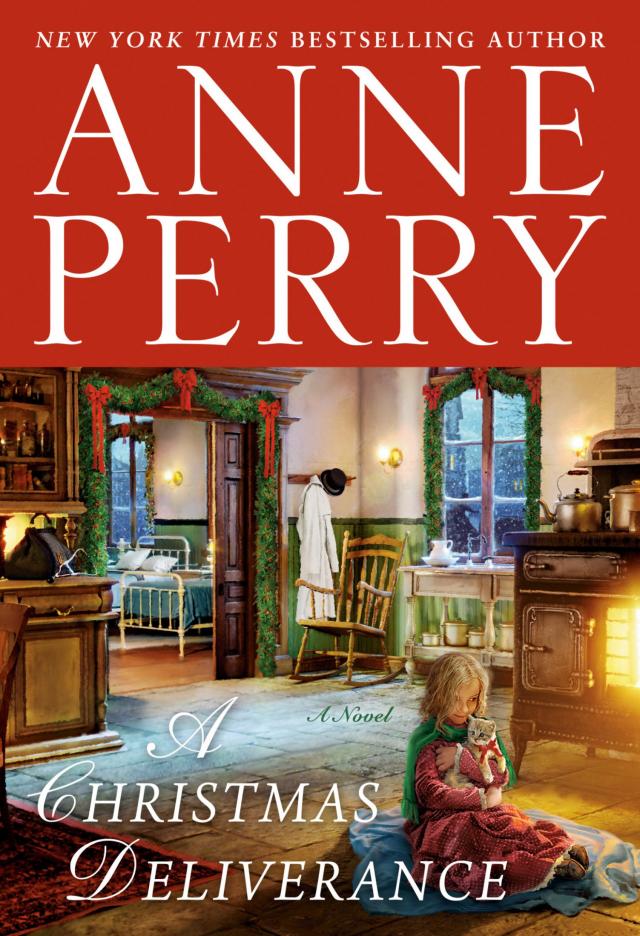
Scuff was putting away newly washed pots and pans when he heard a noise. He turned to see who was there. Crowe had told him of Mattie, the little girl from a few days ago. This must be her. And this time she was not alone. She held in her arms, rather too tightly, a calico and white cat, very small. A kitten, in fact.
“I brung you a present,” she said, looking up at Scuff. She unfastened the kitten’s claws from her sleeve and held it out.
For a moment, Scuff froze. “It’s very little,” he stated.
“She’ll grow,” Mattie replied. “Her name is Rosie. She’ll catch mices for you, and rats.”
What on earth could he say? The little creature, barely weeks old, was wriggling and likely to fall. He took it from her and held it in his arms. It fastened its needle-like claws into his woolen sweater. When he put his hand around the kitten to make sure he had hold of her, she started to purr. Her whole body was vibrating, and her blue eyes were closed in pleasure.
“Rosie,” he repeated. He didn’t want a cat. He had no time to look after a baby animal.
“She likes you,” Mattie said with a shy smile.
“Are you sure it’s a she?” he asked. Not that it mattered, but it was something to say while he thought about the best way to handle this.
“Always are, when they’re this color,” said Mattie. “She’ll grow up to be a good mouser!”
He had no idea if that was true, but it sounded reasonable. He swallowed hard. Here was this child, with no apparent family, giving him probably the most precious thing she had—her friend, a tiny cat who was as alone and as dependent as she was. Without thinking, he stroked the soft little head. It would need milk every day! And what else? Meat? It was far too small to catch any mouse at all, let alone one that was big enough to feed it.
Mattie watched him, her eyes full of trust, but slowly her expression changed. Scuff was certain she was realizing that perhaps he didn’t see the kitten as the same precious thing that she did.
“You have to come here and feed her for me.” Scuff heard his own voice and could barely believe it. What was he doing?
“I can do that!” she said, her face shining with hope again. “I’ll look after her all the time.”
He felt the heat rising up his face. “We’ll find a place for her to sleep. Are you sure she won’t run away?”
“No, she won’t,” Mattie said with certainty. “Not if you feed her.” She looked at him curiously. She was a child of the streets, he could see it in her eyes, hear it in her voice. He should recognize it! He had been about her age when he first spent a night on the riverbank, cold, hungry, and alone.
“If I get some milk now, will you feed her for me?” he asked.
Mattie nodded vigorously. She clearly wanted to say something more, but it seemed as if she dared not.
Scuff knew that there would never be any way he could go back on this now. Crowe would be furious. And yet, while he thought this, he could quite clearly hear himself say, “Mattie, you’ll have to stay here, or at least come very often. Would your mother allow you to do that?”
Mattie gave a tiny shrug. “She won’t know. She’s gone.”
“Where are you staying?” he asked, then immediately wondered if this was a mistake. He plunged on, looking at her as her eyes brimmed with tears. She had offered him her companion, this kitten, another hungry and lonely child! “Then do you think you could stay here? If I found a place for you near the stove, and a blanket? Then Rosie could sleep there, too?” He waited, as if it were really a question that she alone could answer. He wanted to kick himself for not having offered this sooner. Another lesson learned about making decisions.
Her eyes widened. “I think I could do that. It will be good…for Rosie.”
“Yes, it would,” he answered. “And then I wouldn’t worry about her. If you really mean that she’s mine. You could help me for a little while anyway, if you don’t mind.”
“I don’t mind.” she said solemnly, then gave him a sweet smile. She put up her arms to take the kitten from him. “Have you got any milk?” she asked.
While he fetched milk and a little dish, he put to the back of his mind every possible explanation he could make to Crowe as to why there was no milk left, and possibly only one egg. And why there was a very small girl, still with her own milk teeth, asleep on the floor beside the kitchen stove, and a very small cat, also with milk teeth that were sharp like a row of pins.
“Once she’s fed, we’ll change those bandages of yours,” Scuff told the girl. She nodded in agreement without looking away from the small creature.
* * *
It was late afternoon and Crowe had learned all he could about Hollister, and the fire that had changed his fortunes and those of Silas Dolan, as well as having taken the life of Maddock, the night watchman. He knew he could no longer avoid learning the truth as to why there had been no prosecution. The insurance company had apparently paid out in full, and both Hollister and Dolan were better off than they had been before. Again, he wondered if the Thames River Police—and more specifically, William Monk—had given up on the case. Perhaps Monk and his team were biding their time, and working at it from some other angle. But it had gone on so long.
Crowe did not want to inquire further with those people he knew. He had already been given a good picture of the blaze itself from a fireman whose family he had once helped.
“No suspicions?” he had asked the man.
The fireman had given him a wide-eyed stare.
“Because I have some,” Crowe said.
“Warehouses don’t set ablaze all by themselves,” said the man. “At least, not often. But it can happen. You take flour, what you make bread with, and it can go off like a bomb; burn down half the street, did you know that?”
“But they weren’t storing flour, were they?” Crowe pressed.
“No, there was silks, wool, and furs.”
“And did they go off like bombs?” Crowe tried to keep the sarcasm out of his voice.
“I ain’t saying it was arson,” the man replied. “Saying that could get me into real trouble.” He leaned closer to Crowe. “But I won’t say as it wasn’t.”
“And if I could read your thoughts?”
The fireman grinned broadly. “You’d say a fine mess, and that they got away clean. But you can’t read my thoughts, now, can you!”
“And the night watchman?” Crowe asked bitterly. “What about poor Maddock?”
“Quick death, likely.”
“Burning?” Crowe said incredulously. “That’s hardly quick.”
“Reckon he were probably dead before it started. Professional job, maybe? No matter, I hope he were dead before the fire started. Terrible way to die,” he added.
Crowe knew that, as a fireman, he had seen his share of deaths by burning.
“Terrible,” the man repeated. “But in these parts, best keep yer mouth shut and stay outa trouble.”
“What about the River Police?” Crowe asked. “They’d not have been so easy to fool.”
“Don’t know. But again, Doc, I can’t take ideas to the police if I got no proof. And if I can’t prove it, I best not say it. Big man, your Mr. Silas Dolan. Got a lot of people working for ’im.”
“But the River Police thought it might be arson?” Crowe asked.
“Who knows what they thought?” The fireman shrugged. “They got different fish to fry. And they got to watch their step, as there’s people who got friends in the right places. And Silas Dolan’s got some nasty friends. Sometimes a clever man might use one of them friends to catch another, if you see what I mean. But it could take time.”
Crowe had seen what he meant, possibly very clearly. Not all police were like Monk, who was not only head of the Thames River Police, but Scuff’s adoptive father and friend. He was a clever man, one not to cross, but he was also a man of convictions, not a political climber, and never someone who could be bought with money, or frightened with threats.
Crowe had been putting off the thought of going to Monk, but perhaps now was the time to concede. This time of evening, Monk might still be in his office at Wapping, in the old docks area. Perhaps Crowe stood the best chance of catching him now. Or Monk could have left and would be halfway home. He lived on the south bank, up the hill from the Greenwich ferry. It was not the time of year when anyone spent longer away from home than they had to, especially with Christmas only days away.
Crowe started walking, the resolution forming in his mind. He was near enough, half a mile, so he headed for the police station. What he didn’t want was to make the situation for Ellie even worse. One error, one piece of information that would open the arson case again, and Monk would be compelled to follow it up. As far as Crowe knew, Monk always followed the law, however it affected people. He was not a man to turn a blind eye to anything, except temporarily, and for a reason.
When Crowe found himself standing on the wharf steps leading up to the police station, he could wait no longer. He knew the station would be open all night.
The waterside streets were cold enough up the river, but that was far short of the penetrating chill on the open water. Oilskins were appropriate. He pulled his coat around him, came to the top of the steps, turned the handle, and went in. The warmth of the air wrapped around him like a blanket: soft, almost suffocating.
“Yes, sir?” a constable asked him. The man was not in uniform, and yet his air of confidence said that he belonged here.
Crowe smiled. “My name is Crowe,” he began.
“I know who you are, sir. Nothing wrong with Scuff, I hope?” Now there was anxiety in the man’s voice, in his eyes.
“He’s fine. In fact, he’s managing the clinic while I come here. I need Mr. Monk’s help.”
“Yes, sir. As luck has it, you’re catching him before he goes home.” He turned and walked quickly to one of the doors leading off the main room. He disappeared, then after a matter of seconds, came back. “This way, sir.” He showed Crowe to the office, and left discreetly, closing the door behind him.
Monk was sitting behind his desk. He rose to his feet. He did not ask how Scuff was, but the inquiry was in his keen face. He was a dark, lean man with strong facial bones and steady gray eyes. The touches of white at his temples suited him.
“Scuff is fine,” Crowe said, having no time for word games, even for the sake of good manners. Medicine required courtesy, but also speed. “He learns well. I’ve come about something else, another patient. I think she’s in trouble now.”
Monk looked surprised, but he pointed to the chair for Crowe to sit down.
“I don’t know what you can tell me.” Crowe was forestalling the expected refusal on the grounds that Monk could not discuss cases with civilians. Crowe understood that. He had his own laws of confidence. “Some things are public knowledge. That fire just under a year ago, when Albert Hollister’s warehouse was burned to the ground. Fortune in wool, silk, and furs destroyed.”
“We looked into the insurance claims,” Monk said. “And yes, before you ask, they were paid. But how does that concern any patient of yours now?”
“It doesn’t,” Crowe agreed. It was comfortable and warm in here, but he could not allow himself to relax. “But the watchman was burned to death.”
Suddenly, Monk was absolutely still, but he said nothing.
“Actually, I don’t know whether he was burned to death,” Crowe amended, “or if he was mercifully killed before the fire got hold.”
Crowe was digging a hole for himself. The possibility of murder had never been explored, he was quite sure. And to bring it up now might give Monk the idea that Crowe didn’t trust him to do his job.
“Why do you think that?” Monk asked, his face absolutely unreadable.
It was too late to turn back, so he plunged ahead. “Did you consider that the fire might not have been accidental? That it was arson?”
“Of course!” declared Monk. “But we found no proof. And believe me, we looked.”
“Would you see it, if it had been skilled enough?” Crowe did not want to be insulting, but there was no purpose in tiptoeing around the bush.
“That question is its own answer,” Monk pointed out. “Are you asking if it was arson so skillfully committed that we couldn’t prove it? That question is…I don’t know how many cases we thought were accidental and turned out to be arson. It certainly happens.”
“I don’t care about the others, if there are any. You didn’t charge anyone in this case. Which tells me that you believed it was accidental. But could it have been arson? The knowledge of that fact would be a powerful weapon with which to blackmail someone.”
Monk sat for quite a few seconds, moments ticking by, before he answered, and then it was another question. “And do you believe it was arson? I can’t say for sure that it wasn’t, only that if it was, it was done by a very clever man and we missed the signs. Why do you want to know, and after all this time?”
“Because I think someone is being blackmailed about it, and I need to know the truth, if I can, before I do anything.”
Monk did not ask what he was intending to do, nor did he warn Crowe off any action. “Blackmailed for starting the fire?” he asked instead.
“I don’t know,” Crowe answered. “But if it truly was an accident, and that is what the police believe, then there would have to have been the kind of proof that convinced you of it.”
Monk looked at Crowe for a long time before he finally spoke. “What I believe—and this is off the record, agreed?”
Crowe nodded. “Yes, of course.”
Again, a long pause, as if Monk was weighing the wisdom of speaking, or if revealing his thoughts might be unprofessional. Finally, as if having made a decision, he nodded and then spoke. “I suspected that Silas Dolan was behind it, but I couldn’t prove it.” Before Crowe could respond, he said, “Don’t make an enemy of him. He’s a hard and clever man, and no one’s beaten him yet. And Albert Hollister has more sense than to try. Is that what you wanted me to say?”
“No,” Crowe said very softly. “But it is what I was afraid you would say.”
Monk drew in breath, and then let it out again. “Be careful, Crowe. You are important to a lot of people. They believe in you, they come to you for help. They trusted you even before you were fully qualified. They paid you with money they didn’t have, and they respect you. If you lose that, you won’t get it back. And men like Dolan know how to destroy reputations.”
Crowe had no answer to these comments. He knew that Monk was right. Their lives were wildly different, but there was something in their natures that was alike. If someone they cared about was in danger, they would fight for them to the end.
“Is it your belief that Hollister and Dolan are responsible for the fire, and very likely the death of the watchman?” Crowe asked.
Something in Monk’s face hardened. “Again, off the record: yes, but it’s only my opinion. I can’t do anything more about it, or believe me, I would.” His face was set hard. “And for heaven’s sake, Crowe, don’t go crusading. Silas Dolan is not only clever, he’s dangerous.”
Crowe gave a tight smile, then rose slowly to his feet. He turned at the doorway and faced Monk. “Life isn’t so tidy, and you know that. Not much point saving my patient’s life, only to see her sold into a marriage, and to a monster.”
He went out the door, through the anteroom, and then opened the outside door to the wharf and walked back into the cold, dark night.
So, now he knew: Monk had not forgotten, nor had he given up. But he needed solid proof before he could consider reopening the case and making any charges. The question remained: Was the arsonist also the murderer? Was whoever had lit the fire also guilty of Maddock’s death?
Crowe was certain that Monk shared his desire to identify the man who had ordered the arson, but if Crowe sprang a trap before he had foolproof evidence, the wrong man might get arrested, and the guilty would remain free, escaping permanently. The gallows were final, and no judge was likely to go back on a verdict he could not undo.
Crowe could well imagine Monk unintentionally making enemies he could not afford, if he were to continue successfully in his job. And that included pursuing a case that nearly everyone considered solved and closed.
Like a lot of things, it was far more complicated than it looked. Crowe knew that it was too early to point a finger. And the last thing he wanted was to sully the reputation of an innocent man. When this happened—and he knew very well that it did—the damage was too often irreversible.