Mission eradicate obsidi.., p.19
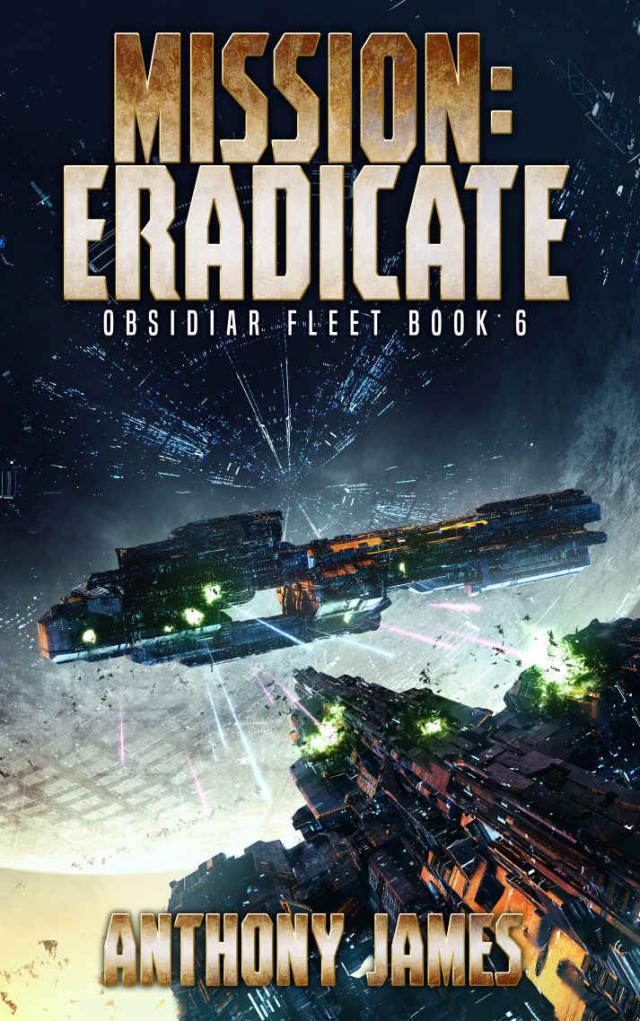
Mission: Eradicate (Obsidiar Fleet Book 6),
p.19


“We’re shielded and our stealth modules are active,” said Quinn. “The Rusor-Nilfar has activated its own shields and stealth.”
“Leaving the MHL Atlas looking like a juicy, sitting duck,” said Hawkins.
“The Aranol isn’t here,” said Pointer. “There probably isn’t a single person in the entire fleet that isn’t crapping themselves, but it doesn’t look like the Vraxar are going to be rushed.”
“I’m disappointed,” said Hawkins.
“Did you really think it would be early?” asked Quinn.
“Maybe. Not really.”
“That’s enough idle talk,” said Blake. “We’re here to do a job.”
“Yes, sir.”
“Here’s Felspar,” said Pointer. “We’re half a million klicks away from the ninth planet.”
“It’s a big old place to be so far from its sun,” added Cruz. “We’re seven-point-three billion miles from the expected zone of engagement.”
Felspar was cold and empty – a grey, imperfect sphere which nevertheless held beauty of a kind. It was rugged and its five-billion-year-old surface would never see a visit from anything living. The sun, Rangel-3, showed as a bright pinprick of light upon a carpet of sheer black and when he looked upon it, Blake couldn’t imagine a lonelier vista than this one.
With the Fulminator connected to the local network, the tactical screen was constantly updated with the positions of the individual spaceships in the Alliance Fleet. There were a lot of ships and a lot of area to cover. Most of the biggest guns were close in to Rangel-3, in anticipation of the Aranol’s arrival.
“Three of the ships carrying Obsidiar bombs are in orbit about the sun,” said Blake. “Rangel-3 has a twenty-five million klick diameter. It’s not going to survive if all three go off close by.”
“I’ve got Admiral Talley on the comms, sir.”
“Bring him through.”
“Good to see you, Captain Blake,” said Talley. “Is there anything you need to know?”
“No, sir. I have been well briefed.”
Talley laughed. “As much as it’s possible to be briefed.”
“We’re going to hang back here and watch as the Alliance Fleet destroys the Aranol, sir.”
“There will be no hesitation this time. Ix-Gastiol took us by surprise and we’ve learned from our mistakes. As soon as the enemy arrives, we will give it hell.”
“Is there a chance we might destroy some of our own fleet if our bomb carriers get the timing wrong on the short-range transits?”
It was obviously a question which had come up before.
“This is war, Captain. You know as well as anyone that we can’t predict every outcome. We’ve done our best to mitigate – we have pre-arranged attack formations which are intended to ensure our spaceships don’t get caught in the detonations. It will have to be enough.”
There was nothing more to be said and Talley closed the channel.
“This is going to be a real shitstorm, isn’t it?” said Hawkins.
“Did you expect a round of gentleman’s fisticuffs, Lieutenant?”
“No, sir, I expected to kick the Vraxar in their cold, shrivelled balls and fly off home to collect my medal.”
Blake laughed. “I like that.”
With the Aranol not yet due, Blake found himself looking at the clock on the bulkhead more often than was healthy. It was tempting to order it switched off, yet it was too fascinating to watch the minutes erode.
“One hour to go,” said Quinn. “How accurate is the modelling prediction?”
“To within three minutes, apparently.”
Whoever in the Space Corps had gone over the fission modelling prediction, they’d forgotten to carry the two when doing their sums.
“There’s something wrong,” said Quinn. “I’m reading signs of an inbound vessel.”
“We have nothing due, Lieutenant.” Even as he spoke the words, Blake knew he was wasting his breath.
“This is something else, sir.”
“The Aranol.”
Given the enormity of such a conclusion, Quinn spent a couple of seconds making absolutely certain. “The fission cloud matches the data Lieutenant Dunbar gathered at Jonli, sir. They’re trying to mask their size.”
The Aranol was far too massive to conceal its path through lightspeed and its signature appeared midway between the fourth and fifth planets.
“Everyone ready!” shouted Blake. “Lieutenants Cruz, Pointer, make sure the rest of the fleet is aware!”
The crew of the Rusor-Nilfar were definitely aware and they began feeding power into their particle disruptor. The members of the Alliance Fleet were only a second behind and they began loading their cores for short-range transits.
The Aranol emerged from ultra-high lightspeed and the rupture it made through the fabric of space continued spilling positrons into the vacuum as the fissure slowly healed. The Vraxar planetship remained motionless for a few seconds, as though it was taking in its surroundings. Then, one of its bay doors opened and warships emerged, one after the other.
The Aranol was in no mood to run.
Chapter Twenty-One
At its heart, the approach was a simple one: attack until one side was defeated. The officers in charge had devised a strategy involving staggered SRTs in order to minimise the effectiveness of an area stasis weapon such as Ix-Gastiol had employed so devastatingly in the past.
The Hadron Stars of Home, accompanied by the Galactics Fearsome and Brick Wall, alongside the Ghast Oblivions Rawklond, and Lunfak-Z activated their short-range transits to bring them within twenty thousand kilometres of the Aranol.
The Stars of Home deployed bomb No. 000045, Tears of the Dead, on a short timer. The Rawklond activated its stasis nullifier, just as the Aranol emitted a vast wave of energy that filled a sphere a million kilometres across. The stasis wave failed to shut down the Alliance Fleet warships, which launched a wave of several thousand missiles and two dozen particle beams, directed at the Aranol.
With reactions far beyond that of the best human captain, the synchronised battle computers of the five warships triggered a second series of SRTs, but not before the Brick Wall took a thundering strike from a gauss slug launched from a turret on the Aranol. The heavy cruiser – known more familiarly by those who served onboard as the Brick Shithouse - shrugged off the blow. Its fission engine fired and it emerged with the other four, several million kilometres away.
The wave of missiles required four seconds to reach the enemy shields, which was not sufficient. The Tears of the Dead detonated with 130% of its expected efficiency. The sphere of dark Obsidiar energy flooded in all directions, until it reached a diameter just shy of 700,000 kilometres. Two Vraxar Neutralisers, one huge battleship and three cruisers which had already emerged from the planetship’s bays were utterly obliterated, reducing them to atoms.
On the bridge of the Fulminator, the crew watched the grainy sensor feed, to see what the outcome would be.
“We will cry no longer,” said Blake, remembering the words from the bomb’s nameplate.
The dark sphere vanished – one moment it was the largest feature in the solar system after Rangel-3, the next it was gone as though it had never existed.
“Shit,” said Quinn. “Not enough! I don’t think that bothered them one bit.”
The Aranol hadn’t moved, nor did it show indication that it was damaged. Suddenly, two huge explosions appeared on the shell of its energy shield. Against the dark metal of its hull, the blasts were hard to see and Pointer worked hard to clean up the image.
“Shots from the Earth’s Fury and the Earth’s Vengeance,” said Blake. “Their projectiles have a few seconds’ travel time.”
“And a long reload,” said Hawkins.
Another wave of Alliance Fleet warships initiated their SRTs. This second group was larger than the first and it swarmed around the perimeter of the Aranol’s shields. There were several bay doors open on the planetship and Vraxar spaceships raced away, firing their particle beams into the allied ships.
It was getting busy and Blake tried to identify which of the attacking Space Corps vessels had an Obsidiar bomb onboard. There wasn’t one.
“Good planning,” he said. “We don’t know what the Aranol is keeping in reserve and our ships are trying to lure it into using whatever unknown weapons its equipped with.”
A second stasis pulse swept outwards and again there was a Ghast warship close enough to block the effect. There was a short, punishing exchange of blows. Several thousand missiles struck the Aranol, leaving much of its shield speckled with plasma light. In return, the Vraxar ship unloaded with dozens of its immense gauss turrets. Two Galactics and a Ghast Cadaveron were punched into lumps of crushed Gallenium.
“They’re staying too long,” said Blake.
He needn’t have worried. The Alliance Fleet warships jumped away, emerging in random locations designed to make it harder for the Aranol to hit them with an area-effect weapon. Two more Obsidiar projectiles thundered into the planetship, creating splashes of darkness a hundred kilometres across. Against the Aranol, the explosions appeared tiny.
“Something’s coming,” said Quinn. “They’re charging up a weapon.”
“The fleet is aware,” said Pointer. “They will act with caution.”
“It’s not the right thing to do,” said Blake. “We’ve got to push the bastards.”
At one time, Admiral Talley had been known as a prudent officer. A safe pair of hands. Blake had met the man on a few occasions and concluded that there was now a streak of the impetuous in Talley. And so it turned out.
“There goes the third wave,” said Cruz.
The Maximilian and the Stars of Home appeared near to the Aranol, in the midst of eighty more heavily-armed warships. The stasis pulse engulfed them, once more countered by the nullifier from the Oblivion Rawklond. The Lunfak-Z scattered its payload of two thousand incendiary bombs, whilst the other ships spewed missiles and shock drones.
Blake watched it unfold. The area surrounding the Aranol was suddenly aflame with the fires of the Lunfak-Z’s incendiaries. A million streaks of white from the Ghast Vule cannons and Space Corps Bulwarks traced lines in all directions.
The Vraxar ships engaged and Blake saw at least fifteen of their V-shaped battleships. The Maximilian vanished inside a cloud of high explosives and he held his breath until he saw it burst free at maximum velocity, its overcharged particle beams cutting through the Aranol’s shields and igniting the metal beneath.
“Holy crap,” said Hawkins.
The brutality of the contest was appalling to behold. Any vestiges of Talley’s caution had been washed away by his experiences near planet Roban at the start of the war. He kept his spaceships in range for as long as he dared. The Aranol punished the Alliance Fleet with its gauss turrets, destroying eight and forcing another nine to SRT out of the fray. Only the heaviest ships had strong enough energy shields to resist a single blow.
Although the Aranol’s guns had a formidable impact, they were comparatively sparse in overall numbers. As the seconds went by, Blake started to believe the planetship was more of a defensive platform, designed to shelter the Vraxar fleet in safety and take them from place to place.
He was wrong.
A message flashed up on Blake’s tactical screen, one amongst a thousand other updates.
> FINALITY DEPLOYED. ACTIVATING SYNCHRONISED RANDOMISED SRT.
“000046. The end is nothing more than a new beginning.”
The Obsidiar bomb exploded at precisely the same moment as the Aranol fired. Finality achieved 2300% of its expected blast radius and the explosive sphere reached a peak diameter of eleven million kilometres. Dozens of Vraxar spaceships were unmade, along with the Imposition class ES Never Say Die, whose captain gambled with the timings and lost.
A thick beam lanced out from the midst of the Obsidiar explosion and struck the fourth planet – Tunde – where the Earth’s Fury was based. For a few moments, it appeared as if nothing happened. Then, Blake noticed the outline of the planet wavering as if it were seen through a fine mist. With horror, he realised the Vraxar weapon had caused the entire planet to disintegrate and, gradually, it began to separate as it drifted on its orbit around Rangel-3.
The blast from the Finality bomb receded.
“The bastards are still there!” said Cruz. “What will it take to finish them?”
Blake studied the feed, trying hard to discover any sign that the planetship had suffered damage, or that its shields were failing. Visually, there was no change.
“Lieutenant Quinn, are they even struggling?” he asked. “Can you obtain readings that give us some kind of clue about whether we’re hurting them at all?”
“There hasn’t been a flicker, sir, except for the build-up before they fired at Tunde. I’d say…” Quinn hesitated, causing Blake to face him.
“What is it?”
“Sir, we’ve been operating on the basis that we gave the Aranol a fright when we hit it with the Sorrow bomb. What if it isn’t frightened? What if its behaviour is nothing more than a result of the madness we are sure it is possessed by?”
“I think I could believe anything, Lieutenant. Why do you say it now?”
“I don’t believe we can harm it with Obsidiar bombs, sir. The Aranol could be made from solid Obsidiar, able to withstand a thousand bombs, but it would still need to draw on that power for its shields. There should be a fluctuation – something to indicate it’s been attacked.”
“What if our instruments simply can’t measure the change? It could have different shield technology to our own.”
“That isn’t how it works, sir. To maintain a shield requires a source of energy. If there’s a source of energy, our sensors can read it, even if they don’t know exactly what is producing the energy.”
The fervour in Quinn’s voice made Blake start to believe the words.
“Do you believe this is already lost?”
“Sir, I do not believe we should stop trying.”
“What about a refined Obsidiar bomb?” asked Blake. “Maybe it’s time we tried out what’s in the hold of the MHL Atlas.”
Quinn faltered. “I don’t know, sir. I’m just an engine man. I have no idea what they’ve done to the base product in order to refine it into Obsidiar-Teronium.”
While they talked, the combat resumed. The Alliance Fleet changed tactics and used their SRTs to attack in waves of fifty. They jumped towards the Aranol, unleashed their missiles, incendiaries and particle beams, before jumping away to safety. Each wave lost three or four of its numbers to a combination of gauss turrets and beam attacks from the newest Vraxar spaceships to leave their bays inside the Aranol.
Blake counted the enemy ships.
“They’re only letting out thirty at a time,” he said. “And then they stop.”
“The Aranol isn’t as reckless as we thought,” said Hawkins. “It knows our Obsidiar bombs can finish off any number of its fleet and it doesn’t want to lose more than it needs to.”
“In a battle of attrition, we’re going to come out on the losing side,” said Blake.
He tried hard to predict the flows of the engagement. The Aranol couldn’t be immune to Obsidiar bombs – surely it couldn’t. And yet, there it was, undamaged by the catastrophically large blast of the Finality bomb. A message came onto his screen.
> ATTACK PATTERN C: INITIATE.
“They’re going in properly,” said Blake.
One hundred and thirty spaceships from the Alliance Fleet executed their SRTs. They ignored the Vraxar Neutralisers, battleships and cruisers and directed everything at the Aranol. Blake could understand the tactic – the Aranol was the key and if they could smash through its shields and destroy the controlling force of the Vraxar, anything left of the enemy fleet would lack direction.
The Oblivion Sandarvin got off a shot from its particle disruptor and a beam of blue connected the Ghast battleship with the Aranol’s shields. The incendiary fires circled the planetship, crackling with ferocity and reaching hungrily into space.
“That’s produced a big spike on their power generation!” said Quinn excitedly. “Maybe we need a few more like that.”
The Givose-12 fired a second particle disruptor after the first. The blue sphere wrapping the Aranol expanded further still, forcing some of the closest spaceships to break away. The Vraxar ship fired its stasis weapon. The Ghasts nullified the first one, only for the Aranol to use the stasis emitter again.
“They’ve knocked out most of the fleet!” said Pointer. “Why aren’t the Ghasts breaking the stasis field?”
“Their nullifiers have a cooldown, Lieutenant. They require a long interval between each use.”
More than one hundred of the Alliance Fleet drifted without power and the sight of it sickened Blake. It reminded him how powerless he’d felt watching as Ix-Gastiol did the same thing only a few weeks ago. This was something he hoped never to see again.
The Aranol was here on a mission of punishment and it had no desire to capture the helpless spaceships. With a contemptuous lack of haste, it targeted the fleet spaceships four at a time and directed its gauss turrets at them, destroying one group before moving on to another.
The Lunfak-Z wasn’t involved in Attack Pattern C and it flew amongst a wide-spread cluster of other spaceships, sixty million kilometres away. The Oblivion activated an SRT, and used its stasis nullifier immediately it came out of lightspeed. The disabled spaceships of the Alliance Fleet recovered from the stasis emitter’s effects.
“They’re moving under their own steam,” said Pointer, her voice thick with emotion. “I thought we’d lost everything.”
Blake breathed out noisily. “I hate being out here, away from it.”
“I’ve got the Rusor-Nilfar on the comms, sir,” said Cruz. “Tarjos Kol-Faran advises he will leave us in order to join the Alliance Fleet. It is his opinion they require another warship equipped with a stasis nullifier.”
It was something Blake had been half-expecting and he had no intention of arguing with the Ghast captain. In truth, he was envious that Kol-Faran was served up this easy chance to take a more direct role in the conflict. There was no doubt the Rusor-Nilfar was the most capable allied warship in the field.