Megiddos shadow, p.8
Megiddo's Shadow,
p.8
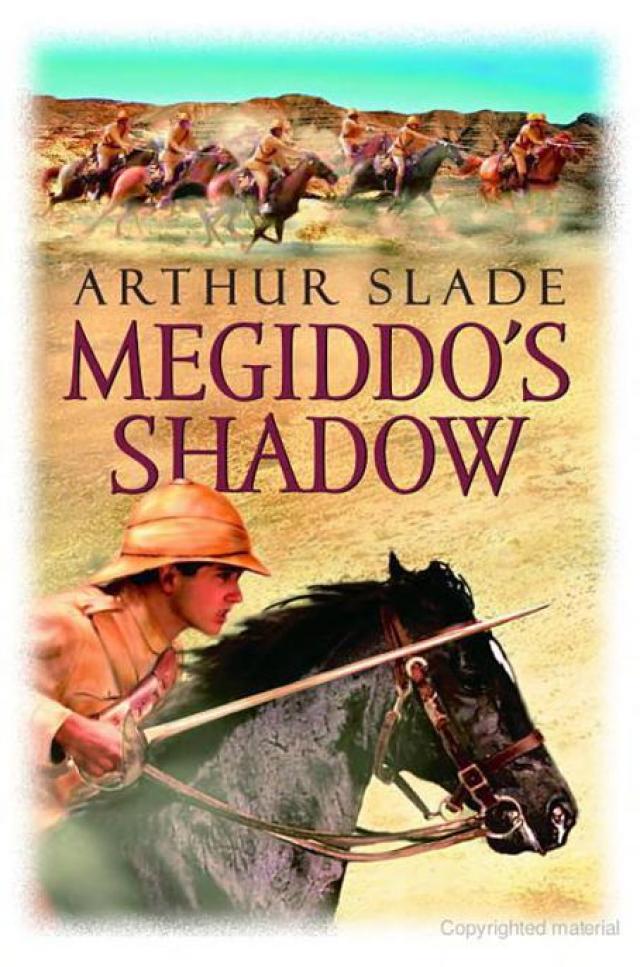


“Yes, sir!” I saluted again and placed the letter in my saddlebag. I charged down the road at a hard gallop. No reprimand or punishment; this was more like a reward. Captain Trollope was a damn fine fellow!
The more I pushed Buke, the faster he went and the smoother his gait became. At top speed it felt as if we were gliding over water. He loved racing; it was holding his position in line that he couldn't stomach. I let him run for several minutes, my identity disks banging against my chest. Then, fearing he'd tire, I switched to a canter.
For all I knew, I was riding right by my family's old farm. I'd seen a photograph of the buildings, but our place could be hidden in any of these green gullies.
I found A Squadron in a valley and watched as they galloped in an attack formation, lances aimed at an imaginary enemy. Half of them stopped and dismounted, ordered their horses to lie down, then used them as cover while firing at targets. The remaining sections wheeled about, roared their battle cries, and skewered the targets with lances. It was quite a sight.
When they were done I rode down and was soon led to Captain Dickinson, a thick-chested man with a drooping mustache and several scars on his face.
I saluted. “Urgent message for you, sir, from Captain Kesteven … I mean, Captain Trollope, sir, the Lord of Kesteven.”
“Oh, and what does his lordship want?” Dickinson opened the message, read it, then looked at me oddly. “Are you Trooper Bathe?” Yes, sir.
“Do you know what this message says?”
“No, sir. It was private, sir.” Was he accusing me of reading it?
“I'll share it with you, then: ‘Good day, Captain Dickinson. Hope you've had time for tea. Trooper Bathe is keen as mustard, but he's green and needs a good workout. Tell him to ride back to his squadron on the double.’”
“That's what it says, sir?”
“Yes.” He chuckled. “Trollope never misses a chance to play a joke. Now, ride hard back to your squadron. That's an order!”
“Yes, sir!” I saluted, smiling.
I kicked and Buke galloped across the hills. It had all been a joke! Captain Trollope was telling me that I belonged; I just had to work harder. I took a different route back, hoping it would be shorter.
We sped over a hill, kicking up mud. My smile grew even wider because the aid post was right below us. What a piece of luck! I charged up to the back of it and yanked on Buke's reins. A nurse sitting on a wicker chair stared with wide eyes. “What can I do for you, duck?”
“Will you kindly inform Emily Waters that Trooper Bathe is here to see her,” I said, trying not to puff. “I mean, if she has time to chat, of course.”
“I will.”
I removed my helmet and hung it on my saddle, then ran my fingers through my hair and wiped the sweat from my forehead. I loosened my greatcoat to reveal more of my uniform. I was on top of Buke and we were on top of the world.
Emily stepped out and did a double take. “Edward? Is that you?”
“Of course!”
“You're in the yeomanry?”
“I transferred three days ago. It's been great fun!”
“Fun? You boys have odd ideas of fun.” She held out her hand and let Buke have a couple sniffs before she stroked his forehead and said, “He's a marvelous horse!”
“He's Bucephalus, after Alexander the Great's horse. I call him Buke, though.”
“Do you fancy yourself another Alexander?”
“Ha! He's just a good horse, that's all.”
She ran her hand over his neck. How I wished those perfect hands were touching me instead. “You've been riding hard.”
“He loves it. He's faster than the wind.”
“I bet.” She gave his shoulder a good pat. “When Vera announced your arrival I assumed you'd hurt yourself again. Why else would you be here?”
“Uh …” I was on top of my horse, in uniform; I felt unstoppable. “I wanted to ask you to a film or a show. Would you go with me?”
“How could a poor little waif refuse a knight in shining armor?”
My heart started beating rabbit fast. “You're not a waif.”
“Well, I'm glad you think that. How about meet me here Saturday at six sharp? That'll give us time for dinner and a show.”
“Saturday? Good! Good! I'll be here.”
“You'd better be!” she said with a chuckle, and the cutest dimples dotted her ivory cheeks. “So how is yeomanry life?”
“Well, for one thing, there's a lot more action.”
“Being bucked off a horse wasn't enough for you?”
“I'm trained for more than that.”
The pop of rifles echoed across the hills and Emily crossed her arms. “You hear that target practice going on all day. They want you to get used to the sound so you forget how deadly bullets are.”
“We have to know how to shoot.”
“And to die, I guess. A trooper from A Squadron died last night. He fell off his horse and hit his head.”
“That's terrible.”
“Ordinary, that's what it was. No medals for him.” She motioned toward France. “Every day men are dying in the trenches. It's all rather ordinary now.”
“It'll be over soon,” I said, trying to sound as if I believed my own words. I'd hoped to make her feel better.
“By Christmas, right? But which Christmas? It does feel so pointless at times. Still, I've applied to go to Etaples. They need more nurses near the front.”
“Just seeing you would make a guy heal faster,” I gushed, my voice pitched a little too high.
She allowed a smile. “That's kind of you.”
I struggled for something clever to say. I wanted to tell her she looked beautiful, even though she had black bags under her eyes. How come other men could banter so easily with girls?
“I was going to look you up,” she said.
“You were? Why?”
“To thank you for helping us when we had all those wounded. You arrived at exactly the right time.”
“It just seemed like the right thing to do.”
“Your friend is still here. He asked after you.”
My stomach churned. “Yes, he … I meant to visit him earlier. I've been busy with the transfer and the training. How is he?”
“He's healing. They'll send him to Lincoln any day now. Why not say hello? His cot is right inside the door.”
I pulled on the reins and Buke took a step back. “Ahh, I can't. I have to get back to the barracks. I was supposed to ride directly there.”
Emily frowned. “He's taking his wounds rather hard; he needs cheering up. Don't wait too long.”
“I won't. I won't. It—it was good to talk to you.”
“Yes, it was, wasn't it?” She grinned. “I kept hoping you'd hurt your arm again just so we could visit. Not proper thoughts for a nurse.”
“If I stub my toe, I'll run blubbering to you. Otherwise, I'll be here Saturday at six sharp!”
“I'll be waiting for you, Mr. Knight in Khaki Armor,” she said, laughing. I could have listened to that sound forever.
I strapped on my helmet and trotted away. Then, hoping she was still watching, I gave Buke a good kick and galloped toward the barracks.
14
Every night, bone weary from drills, I'd collapse on my cot, too tired to move. My mind would still be on the drill field, wheeling into different formations, waiting for the signal to charge. Every moment on Buke made me think of Dad's time in the dragoons; he might have trained on these very hills.
Partway through the week, I placed the ink jar on our small table and wrote:
Dear Father,
I am writing a quick letter between drills. I am in the Lincolnshire Yeomanry now. Imagine, I am part of your old county's yeomanry. I've even been to Aylesby, though I didn't see our home farm.
Uncle Nix arranged for my transfer. We had an important talk about the war and Britain's part in it. He sends his warmest wishes to you.
Remember when you made me ride with pennies squeezed against the horse with both knees? Well, the horsemanship you taught me has truly paid off.
I hope there isn't too much snow this year. I will write again when I get a moment.
Faithfully, your son,
Edward
I sealed the envelope just as Cheevers arrived with a pink gift-wrapped box.
“Spoils of war from one of my birds!” He fired several sugar biscuits my way. I softened one in my tea and let it dissolve in my mouth. “Oh, and there was mail for you, Bathe.” He tossed a letter to me.
15/01/18
ISth Canadian Batt
B.E.F.
Dear Edward,
First, forgive me for taking so long to write. I received your letter asking about Hector in December and am only now replying. 1 have no excuse, other than the obvious one.
I often receive letters from family members who want to know more about how and when their loved one died, and 1 must admit 1 do write responses intended to spare their feelings. 1 do not know exactly what I wrote to you directly after your brother's death, but since you are in the service, I shall tell more of Hector's last hours. I shan't hold back, since you must already know what this war does to men.
First, Hector was always ready to fulfill his duty. On the day of his death he was unwell, but he refused to stay behind. We were to take a German position, and I'm afraid we didn't have as much artillery support as we'd hoped, but we charged on, through the trenches and into the muzzle of a machine gun shooting over the rim of a parapet. My lieutenant led a rush with a runner, the plan being to toss a Mills Bomb right into the gun crew. Both the lieutenant and the runner were killed outright. Hector was the second to run, and he was hit several times in the legs and stomach, but he lived. I'm afraid we couldn't do much for him at the time. He was left out in the open. It took us twenty minutes to dispose of the machine gunners and clear the area.
When I did get back to Hector he was quite pale and hadn't been moved, as it was judged the motion would kill him. You most likely know what a machine gun can do. He knew he was in for it, and he asked for water, but there is no point in giving water to a man with a gut wound. He did get rather delirious in those last minutes and called out for your mother. I find peace in that. He died shortly after.
Hector was a marvelous man and he had an infectious cheeriness that would often make the days that much easier to handle. He and I spoke longingly of Canada and of going home and he mentioned you
several times. I do miss him.
I hope this letter has been of some help.
Sincerely,
Fred Gledhill
I leaned against the tent pole. It was so odd and terrible to know about Hector's last moments. He hadn't been shot through the heart but had had his legs and guts torn apart. To think he had lam there in excruciating pain for so long with none of us, his family, to comfort him. I ached to hug him.
“Bad news?” Cheevers asked. “You don't look so good.”
“It's a letter about my brother, about how he died.”
“You lost your brother?” Blackburn asked.
“Yes. Hector. Last September.”
“Sorry to hear that, mate,” Cheevers said. “We all know someone who's pegged out. Half the chums I went to school with have fallen.” He gave me a soft tap on the arm. “Don't you worry. For every one of us, we'll kill five of them. I promise.”
“We'll win this war,” Blackburn said. “All these grievances will help us carry on.”
“I hope so.” I folded the letter and slid it into my rucksack.
Thoughts of Hector clouded my mind for the next few days. At times I'd even miss a command. Once, Sergeant Applewhite gave me a good going-over for being out of position, but I just couldn't get past the image of Hector in a pool of his own blood, his legs shattered. The vision of him being shot in the heart had become like a painting in my head. But this news from Gledhill changed all that. Now the painting was a lie. It was true that Hector had died a hero—he'd been rushing a machine gun—but his horrible death wasn't what he deserved at all.
On Saturday evening I walked to the aid post, each step tiring me out. It was hardly how I wanted to feel on my way to pick up Emily, so I told myself that Hector would want me to have a good time. In fact, I decided I would be like him that night, charming Emily from the get-go. I'd start off with something like “You outshine the sun,” or “You're as pretty as a spring rose.” That would get everything off on the right foot. I should have asked Cheevers's advice; he likely had a thousand romantic lines. I wanted my first date to be perfect.
Emily waited on the front veranda, wrapped in a long coat, a blue dress peeking out at the hem. The moment I saw her, all thoughts of Hector disappeared. She wore her hair down; her lips glistened. She looked simply gorgeous.
“H-hello.” So much for my clever patter.
“You're shorter without your horse.”
“I'm not short!”
She chuckled. “Don't worry; you're tall enough for me, Mr. Canada.”
Was she being clever again? I was already feeling dizzy
“Town will be jumping tonight!” Emily exclaimed. “Let's go to the Pickled Boar first, then catch the show at the Palace. All the nurses raved about it. You'll take me, right?”
“Of course! It sounds perfect. Smashing, in fact.”
She pinched my cheek. “Don't try and sound English. Your colonial ways are what make you so interesting.”
Interesting? As we walked to Gnmsby I had an extra bounce in my step. “I cleaned all the windows in camp,” I announced like a schoolboy. I wanted to punch myself.
“How exciting!” she said with a wry smile. I tried to think of something more heroic.
“At the rifle range, I scored the highest. The sergeant even gave me a pat on the back. I have a nickname now— the Canuck!”
“How original! May I call you the Canuck?”
“I'd prefer Edward.”
“All right, my sweet Edward.”
I grinned. “I like the sound of that.”
Things were going well. I was keeping an older girl interested. There was a victory in that!
The sun was setting, casting long shadows over Gnmsby An oddly warm night had melted the skiffs of snow and drawn people out of their homes. The sidewalks grew crowded the closer we got to the market. Soldiers were drinking, belching, and backslappmg on the street. Ladies from the munitions factory sat on benches, their faces yellowed from working with TNT.
“They call them canaries,” Emily said. “Yellow skin is the price they pay for making bombs.”
“It won't wash off?”
“It'll wear away after the war.”
I hoped I'd see Cheevers so I could show off Emily, but then thought better of it. One look from him might catch her in his web. Then again, she was too clever for him.
We ducked into the Pickled Boar and sat at a pockmarked table. Steak had been dropped from the menu because of rations, so at the counter I ordered eggs and chips for us. I took the plates back to Emily and returned for two mugs of beer.
An attractive girl wearing too much lipstick sauntered up to a nearby table. A trooper gave her a cigarette, and a few seconds later the two of them went arm in arm up the stairs.
“I like the seediness of this place,” Emily said. “It's kind of dangerous, just like a place you'd find in an adventure novel.”
“The food looks dangerous, too,” I said, taking my seat. The boiled eggs were crumbling; the chips were cold. I'd expected Emily to be somewhat dainty about eating, but she appeared to be racing to finish first.
“You've got egg on your chin,” she said, and wiped it with a napkin. “I feel like your mother.”
That wasn't how I felt about her. I wanted to squeeze her against me, or even take her up to a room. If only … Of course, it was a sin before marriage.
“What are you thinking about?” she asked.
I blushed and she giggled, then patted my hand. “The thought of you going to the front frightens me.”
“We'll be fine.” I worked at keeping my voice deep, confident. “Our training will serve us well.”
“Training won't stop a shell.” She waved her hand. “I'm being a worrywart. Let's have a toast.” She raised her half-empty beer glass. “To our continued friendship.” She clinked my glass.
Friendship?
“Aren't you going to drink?”
I drank, then tore off a chunk of bread. We looked briefly into one another's eyes. What would it be like to kiss her?
“So exactly how old are you?” she asked.
“Uh, old enough.”
“To know better?” She laughed. “Really, you tell me your age and I'll tell you mine.”
I was sweating. “You go first.”
She licked her lips and was about to say something when from somewhere in the smoky haze a clock began to cuckoo. “We'll be late!” Emily said as she stood and hurried out. I followed, still chewing my last bite. Twice I lost her and she had to wait for me to catch up. Exasperated, she grabbed my hand and pulled me down the sidewalk behind her.
Two blocks later I looked up at the spires and rounded corners of the Palace Theatre, a castle in the middle of Grimsby. We joined the line. None of the girls I could see was as pretty as Emily I wished I had the guts to tell her so. I paid for the tickets and we found our seats, which were covered with red velvet and made me think of royalty. I helped her remove her coat, revealing the blue dress.
“That's a lovely gown.”
“Oh, what a kind thing to say.”
We took our seats just as the lights dimmed. Already I was thinking about holding her hand, but I couldn't make myself do it; I was man enough to hold a gun, but not her hand. What was wrong with me?
The first act toddled out: an old comedian who burbled baby-talk songs. Emily leaned close and whispered, “He was probably quite funny fifty years ago.” I laughed and caught a whiff of her flower scent.
The next performers were a song-and-dance troupe called the Sisters of Mercy. I couldn't keep from humming along. They were followed by a juggling gymnastic act. It ended with a musical about Faustus, a man who sold his soul for power. Every song was so unhappy. I stole glances at Emily, who was completely enthralled.