Red company discovery, p.6
Red Company: Discovery,
p.6


“You’ve sent in drones, programmed to return?”
Sharaf nodded. “Of course. Nothing has been successful.”
Captain Hansen began to pace, and I worked hard not to watch her. She was a middle-aged woman, but she kept herself in prime condition—unlike the repulsive Dr. Sharaf.
“While you’ve been working down here, I’ve had my crew probe the region above. We found a retractable dome.”
She pointed toward the roof of the cavern. “Up there. That region is capable of sliding open and exposing this cavern to open space—to Naiad’s almost non-existent atmosphere.”
The group looked alarmed. Several of us flipped our visors shut.
Captain Hansen smiled grimly. “Don’t worry, I don’t intend to open this cave up and expose us all to the hell that’s just outside.”
“What is the purpose of such a contrivance, then?” Dr. Sharaf asked.
Captain Hansen cocked her head. She looked surprised. “Haven’t you figured it out, yet?”
This greatly upset Dr. Sharaf, who hated the slightest suggestion she didn’t know absolutely everything.
Finally, the two women noted that I had my hand up. Captain Hansen pointed at me.
“This… this cavern isn’t a hangar,” I said, “is it?”
“No…”
“It’s some kind of a transportation chamber, right? You fly a ship down here from the surface, and you get close to that machine—and zap, it sends you someplace else?”
Captain Hansen smiled thinly and pointed a finger at me. “That’s what I believe.”
“Preposterous!” Dr. Sharaf exclaimed. “Are you seriously suggesting a pack of vagrants at the very edge of the Solar System managed to develop something so advanced? Earth science can’t even begin—”
“Wrong again,” Captain Hansen said. “No, Doctor. This is clearly alien tech—just like the base we discovered on Eris a year ago. What I’m suggesting is they discovered it out here, and they’ve figured out how to use it.”
“Just as absurd. These rodent-like morons could never—”
“Answer me this, then,” Hansen interrupted again. “Where did that pirate ship we caught up to go? It vanished right here—remember?”
Dr. Sharaf’s mouth gaped. For once in her long life, she seemed to be a loss for words. She turned slowly toward the alien machine, and she pointed a finger at it. “The enemy ship… it activated that machine? That’s what you believe?”
Captain Hansen nodded. “All signs point to it, don’t they?”
Dr. Sharaf didn’t answer, she was just standing there, blinking at the machine. She’d just had her mind blown, as far as I could tell. It was a nice thing to witness.
Chapter 8: A Hasty Retreat
Captain Hansen stared at the alien machine. She seemed to be locked in deep thought.
The hum of the mysterious mechanism filled the cavern. It reminded me of the sound a living hive of bees might make in springtime. I stood quietly nearby wondering what decision she would make.
After a moment, she turned to us and spoke with authority. “All right, everyone. Welks appears to be lost. We don’t know enough about this machine, so I’m not going to risk more lives by lingering here any longer. We’re leaving this cavern.”
Dr. Sharaf, who was still entranced by the alien device, looked up in disbelief. She made a sound that reminded me of a gagging cat. “Captain… what madness is this? You can’t be serious! We’ve discovered something unique. We can’t just abandon this marvel without further investigation.”
Captain Hansen’s expression remained unchanged. “Doctor, I understand the importance of the discovery, but I’m not going to lose another man. We’ll report our findings to Interplanetary Excavations. Let them decide what they want to do about it. Let’s go, people. Back to the ship.”
Dr. Sharaf’s face flushed red, her eyes blazing with anger. “This is preposterous! We may never get another chance like this! You can’t possibly—”
Captain Hansen cut her off with an upraised flat hand. “Doctor, if you don’t board Borag immediately, I will have no choice but to leave you behind on Naiad. Is that understood?”
Dr. Sharaf hesitated for a moment, her gaze locked with the captain’s.
Hansen didn’t wait around. She spun on her heel then led the way out of the cavern. Her stride was unwavering.
As a marine from Red Company, I fell into step behind her. I did take one last look at the alien machine before leaving it, however.
At the rear of the group, Dr. Sharaf trailed after us. Her face betrayed a sea of emotion. She was full of anger and disappointment.
Out of the whole group, she chose to sidle-up to Ledbetter. That was a stunner. What did she think a private was going to do for her?
It soon became evident she just wanted an ear to complain into. She immediately began grumbling to him about the captain’s decision.
Ledbetter, being the kind of guy who could always find humor in most situations, just nodded and pretended to listen. He occasionally threw in a sympathetic comment to keep her going.
“Can you believe it, Private?” Dr. Sharaf vented. “We make the most significant discovery in human history, and we’re just going to walk away from it! It’s unspeakable!”
Ledbetter grinned. “Well, Doc, I’ve got to admit, it’s not every day we find an alien portal. But I’m sure the captain is just being cautious. We wouldn’t want to all end up like Welks, would we?”
He slapped his gauntlets together, as if he was smashing a bug between them. “Bam! Just like that—he’s dead!”
Dr. Sharaf didn’t seem to appreciate Ledbetter’s attempt at humor. She shot him a withering glare and continued her tirade. “I just can’t understand the captain’s mindset. We are obviously on the verge of unlocking the secrets of the universe—but that obstinate mule of a woman is worried about safety!”
Ledbetter suppressed a grin. “I bet you’re right. I bet Welks is happier out there—wherever the hell he is. How can it be worse than a radioactive freezing hole orbiting Neptune? He’s probably proud to be dead.”
Dr. Sharaf ignored his comments and kept complaining. It was as if she couldn’t even hear him. Maybe that was for the best, or she might be getting angry about now.
Dr. Sharaf’s complaints gradually faded into the background as we walked through the base and onward to Borag. I understood her frustration, but I also understood Captain Hansen’s decision. She had an entire ship to worry about.
Glancing up at the blue ball of Neptune, then back down to the blasted base, I did feel a pang of regret. The idea of leaving Welks to an unknown fate—that was rough. What if he came back an hour from now—or a week? What would he do? Eat frozen pirates? Beg for mercy if they came back here to seek vengeance?
It was a worst-case scenario for any spacer to be left behind, to be marooned on an icy rock somewhere. Throughout time, sailors had been lost at sea, but space was much more cruel than that. You were doomed if you were cut off from life support systems, and the odds anyone friendly would find you… they didn’t bear thinking about.
So, what could we do about it? Post a guard outside the machine? That was two men lost. Send another guy into the field, expecting him to vanish? What if that was essentially disintegration? Then, she’d be killing another innocent man.
Just hanging around for a few more days was unthinkable as well. We were deep in enemy territory. Pirates abounded out here, this far from the Sun. Every hour we delayed gave them more time to gather and mount a defense. We might lose Borag with all hands.
No. Hansen had made the right choice—but it was a painful one.
We all boarded Borag with heavy hearts, leaving the mysteries of Naiad behind us. The ship’s engines rumbled to life, and we felt the familiar vibrations under our feet as the massive vessel lifted off the moon’s surface.
Captain Hansen directed Borag toward the refueling station orbiting Naiad. As we approached, we spotted several small pirate vessels, likely scouts or support ships for the mothership we’d been chasing. They must have been lying low while we were busy with the alien machine.
The sight of our approaching ship sent the pirates into a panic. They scattered in every direction. Captain Hansen, however, had no intention of engaging them. She had other priorities, and we couldn’t afford to waste time and resources on these losers.
“Let the raiders go,” she ordered calmly. “Our primary objective is to refuel and report our findings. We can deal with them later.”
The crew followed her orders without hesitation. We all watched as the pirate vessels fled into the vast expanse of space. It was a small victory, but a victory nonetheless.
Our fuel supplies were adequate, but when you were in hostile territory, you couldn’t afford to pass up an opportunity to fill up. As Borag neared the refueling station, I pushed all that out of my brain to focus on the tasks at hand. Red Company had already been mobilized again and ordered to the airlocks.
Borag approached the refueling station, and Freya hailed the operators. She politely requested permission to dock and refuel. Unsurprisingly, they refused to grant us access.
Captain Hansen decided that we would board the station, with or without their leave. She ordered Red Company to prepare for a forced entry.
We’d been expecting this, and we were already on station. We double-checked our spacesuits and armored vests, as there was liable to be a fight.
We exited Borag through the airlocks and began the slow, careful crawl across the void toward the station’s docking portals. The emptiness of space surrounded us, and I couldn’t help but feel a sense of vulnerability as we moved between the two structures. The ship and the refueling station were only a few feet apart. The slightest nudge by either of them would crush us all to paste.
Spread out below us was the vast planet Neptune. I’d never been this close to anything so massive. The station offered a unique vantage point, as we were far closer to the monster planet than we’d been while fighting on Naiad.
Neptune was the eighth planet in our Solar System. Seen from this perspective, it was a magnificent, blue-hued orb. Its swirling atmosphere, dotted with white clouds, created an ever-changing tapestry of patterns. She was a blue jewel that resembled slowly mixing shades of paint.
At this distance, I could even make out Neptune’s faint rings. They were like halos. A circle of delicate loops composed of icy particles and dust.
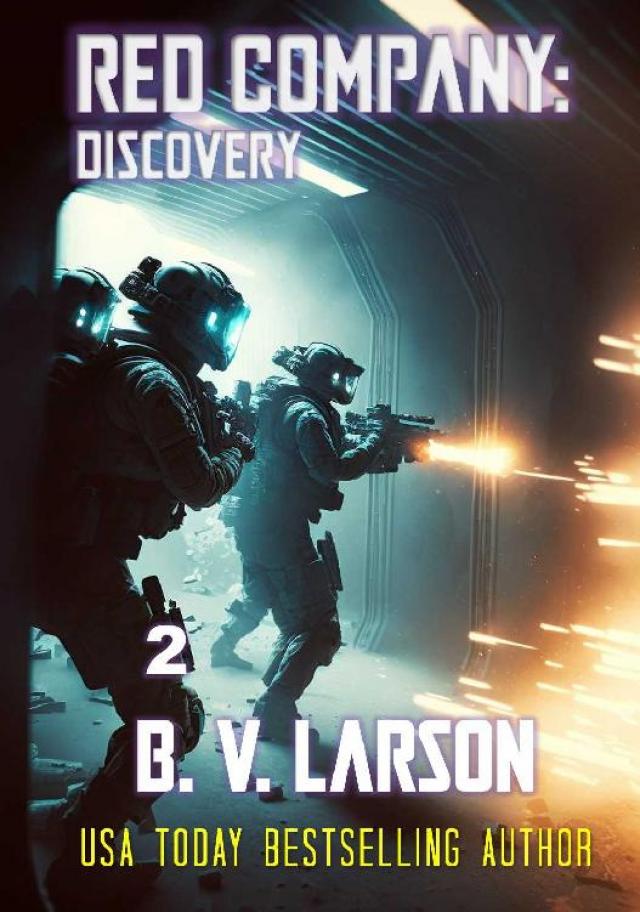
Once we reached the station and clamped onto its exterior metal hull, we quickly set to work. Using small explosive charges and laser torches, we began cutting through the reinforced hatches that stood between us and the station’s interior. Sparks flew as our laser torches sliced through the metal, and our charges sent vibrations through our suits as they detonated.
Finally, after several tense minutes, we managed to create a large enough opening for us to squeeze through. We cautiously made our way inside, unsure of what awaited us. Our weapons were held tightly to our shoulders, fingers on the firing studs.
With each step, I couldn’t help but wonder why the operators were so foolish as to refuse our request for something as routine as refueling. Perhaps they were terrified of Captain Deng and his crew. Whatever the case, they’d left us no choice but to press forward and ensure Borag was fed the fuel she needed.
As we continued deeper into the station, we finally encountered the skeleton crew responsible for its operation. They were clearly unnerved by our sudden intrusion and offered no resistance, choosing to surrender immediately.
There was a lot of hate in their eyes for us, however. They stubbornly refused to help us refuel Borag.
Frustration quickly mounted within our ranks, and Ledbetter began to threaten the uncooperative crew members. His voice grew louder, and his words more menacing.
Sergeant Cox intervened after a minute or two.
“That’s enough, Private!” he said. “We’re not here to shout at these people. We’re here to get the job done. Stand down.”
Ledbetter reluctantly backed off. The station crew, though still uncooperative, seemed to be more wary of us than before. It seemed to me that we would have to find a way to refuel Borag ourselves.
Sergeant Cox surprised everyone when he grabbed one of the rodent-like crew members. With a stern look in his eyes, he dragged the weakling forcefully toward the airlocks. The man struggled and pleaded, but Cox’s grip was unrelenting. He tossed the skinny wretch into the airlock then initiated the process to cycle out the air. Within minutes, the man would be exposed to the vacuum of space.
As the airlock began to depressurize, the crewman’s face contorted in fear. He desperately signaled through the small window that he would help us if only he was spared. Ledbetter watched closely, nodding to himself at Sergeant Cox’s technique.
At the last possible moment, Sergeant Cox hit the override button, stopping the airlock’s cycle. The door slid open, and the man tumbled out onto the deck, gaping for breath like a fish on a dock.
I couldn’t help but feel a bit sorry for the skinny pirate. He was a pitiable sight, a product of a lifetime spent in the weightlessness of space. His elongated, thin frame made him appear more alien than human. He was a poster boy explaining what living in such an environment could do to the human body.
His bones, stretched and fragile from the persistent lack of gravity, gave him a spindly, disjointed appearance, as if he were a marionette held together by thin strings. His limbs hung limply from his body, seemingly unable to support his own weight even in the low-gravity environment of the station.
The crewman’s pathetic and vaguely disgusting appearance was due to the hardships faced by those who lived and worked in the outer reaches of the Solar System.
Cox glared at the man, then turned on the rest of his crew mates. “You will all help us refuel our ship, or you’ll face the same fate,” he growled.
The crew, now fully aware of the dire consequences of their defiance, quickly changed their tune. They begrudgingly assisted us in refueling Borag. Their eyes never seemed to stray too far from the airlock that had nearly claimed the life of one of them.
We finally managed to start the flow of fuel into Borag’s tanks, but right about then we got a call. Captain Hansen’s voice crackled through our comms, demanding to know what had caused the lengthy delay.
However, as the gas began flowing steadily into Borag’s reserves, her tone shifted. Her anger dissolved.
“Well done, Red Company,” she said. “You made it happen.”
When she signed off, Sergeant Cox turned to us in triumph.
“You see, boys?” Sergeant Cox asked the squad. “You don’t just yell at people. That rarely works. Actions speak louder than words!”
We nodded. We’d all gotten a harsh lesson about life and death in deep space. The dull-eyed pirates seemed to have figured out his meaning, too.
Chapter 9: New Orders from Mars
From Red Company’s security ops center, we could monitor most of the ship. That included the bridge itself—unless the captain cut the feed. Today, she’d chosen not to.
As we watched, Captain Hansen disappeared into her quarters to engage in a private communication with Interplanetary Excavations. The rest of us could only speculate about what kind of a screw-job would come from this fateful call to Mars.
When the captain finally emerged, her expression revealed nothing about the outcome of her discussions. She walked over to the ship’s PA system and took a deep breath. A moment later, her voice boomed over every speaker on Borag as she addressed the crew.
“Faithful crew,” she began, “I’ve just concluded reporting our findings to Interplanetary Excavations. We’ve received new orders. We are to return to Naiad to investigate the anomaly we discovered.”
Surprised whispers rippled throughout the ship. Only Accountant Blackwood seemed happy—in fact, he was beaming. No doubt he was sniffing the delightful aroma of a big, fat profit at the end of this voyage. In order to get it, however, we’d have to actually return home in one piece. Many among the crew now thought that was unlikely.
For most of us, the idea of exploring alien pyramids wasn’t alluring. Investigating a potentially dangerous alien technology could be cool—but it could also be terrifying.
Questions and concerns raced through our minds: What would we find? Were we prepared to face the potential risks? And, top of the list: who was going to be next to walk into that bug-zapper after Welks?
Captain Hansen continued, cutting through our chatter. “I know many of you have concerns, and I share them. But this is an unprecedented opportunity, and we have a duty to explore the mystery we’ve discovered. We’ll learn the truth and return to Mars. You have my word.”
About then, we all realized this wasn’t a proposal—it was a done deal. We were going to have to face our fears and investigate the secrets held by the enigmatic machine on Naiad.
As Borag flew back to Neptune’s oddest moon, things went from alarming to far worse. Our sensors picked up the approach of several unknown vessels. It seemed the pirates we’d encountered earlier had sent out a distress call, and reinforcements were on their way to assist them. Captain Deng had given us the slip again, leading us straight into these three bigger ships. Maybe the whole chase had been a trick instigated by the rat-faced pirate.
These approaching ships formed a squadron of three light cruisers. Each ship bore the unmistakable markings of a pirate. They hadn’t reached us yet, but it was only a matter of time.
Captain Hansen quickly gathered her command staff, and everyone aboard logged into the feed to watch as they formulated a plan to deal with this new threat.
Hansen, her navigator Commander Nichols, and weapons officer Lt. Gavinson huddled around a display screen. They were chewing over the specs and firepower of the three pirate light cruisers. Each was similar in size and purpose, but with unique features that set them apart from one another.