The premonition, p.1
The Premonition,
p.1
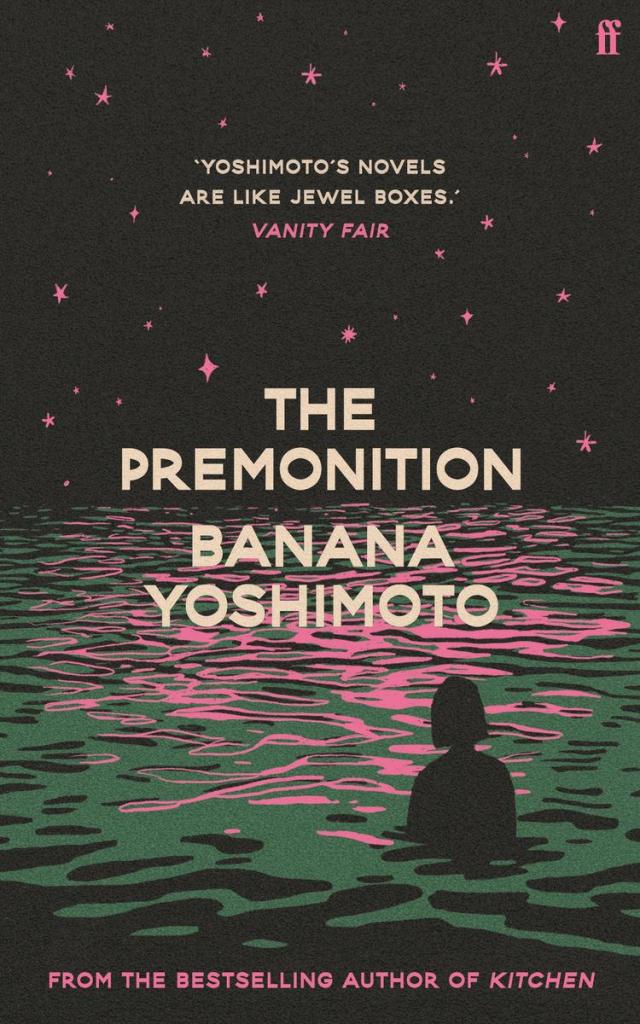


THE PREMONITION
BANANA YOSHIMOTO
Translated from the Japanese
by Asa Yoneda
Contents
Title Page
The Premonition
About the Author
Also by Banana Yoshimoto
Copyright
THE PREMONITION
*
The old house was on a residential street, some distance from the train station. The enormous park it backed onto surrounded it at all times with a wild scent of greenery, and after a rain the air stood as thick as if the entire neighborhood had turned into a jungle, making it hard to breathe.
I spent only a brief time in that house where my aunt lived alone for so long. In retrospect, I can see how special a moment it was—one that had been a long time coming, and would never come again. It makes me feel oddly sentimental to think of those days now. Like a mirage that I suddenly discovered was real, they seem to have been cut adrift from the world outside.
I grieve for the clarity of that time I had with my aunt—how lucky I was to share that space with her during a sliver of time that had appeared only by sheer chance. It was over now, but it had to be. In coming to an end, it had given me something, and only by making my way through was I able to begin to live the rest of my life.
I can see it now: The heavy door made of wood had a cloudy brass knob. The weeds in the neglected garden grew thick and lush, stretching tall among the dying trees, shutting out the sky. Vines carpeted the dark exterior walls, and the windows were patched haphazardly with tape. The dust covering the floor rose and danced translucent in the sunlight before settling again. A comfortable clutter reigned, and dead light bulbs were left in peace. Time had no foothold in that house. Until I turned up, my aunt had lived there quietly on her own, as though asleep, for years.
She taught at a private high school. She was thirty, but single, and had lived alone for a long time. Imagine a reserved, spinster music teacher: in the mornings when she left for work, she was the very picture of one. Each day, she’d dress in a stiff mouse-gray suit, tie her hair back with a plain black elastic, and go on her way through the morning haze, wearing no makeup and a pair of heels of an awkward height. You know the type: a woman who’s hopelessly unfashionable in spite of having an otherworldly kind of beauty. I could only suspect she was doing it on purpose; following a guide on how to disguise herself as a music teacher to whom no one would give a second glance. Because once she was home, doing nothing in particular and dressed down in what seemed to be her pajamas, she transformed into an elegant stranger.
My aunt lived the life of an eccentric. As soon as she came home from school, she took off her shoes and socks and changed into her pajamas. Left to her own devices, she would lounge around all day trimming her nails and her split ends. She’d gaze absently out the window for hours, or lie down in the hallway and fall asleep. She left her books open half-read and her laundry in the dryer; she ate when she got hungry, and went to bed when she felt like it. Aside from her bedroom and the kitchen, the house didn’t seem to have been cleaned in years, and when I first arrived I spent all night battling the dust and grime to remedy the terrifyingly filthy state of the room my aunt gave me to stay in. Even then she was unconcerned and, instead of helping, spent hours baking a cake to welcome me. Every last thing she did was just as topsy-turvy. By the time I finished cleaning and we sat down to eat the cake, day was starting to light up the sky. It was like that with everything— in that household, none of the usual rules or routines of life seemed to exist.
The reason these things still came across as somehow being virtues, I thought, was because my aunt was beautiful. She had pretty features, but in that sense, there were plenty of people more attractive than her. What made her beautiful to me was more like a specific mood whose tendrils pervaded everything, from the way she moved to the way she passed her days to the fleeting expressions that passed across her face when something happened. The feeling was so stubbornly consistent that it seemed unshakable, like something that would continue, untouched, all the way until the end of the world. It made her seem strangely beautiful no matter what she was doing. The vacant yet bright light she gave off filled the space around her. When she lowered her long eyelashes and rubbed her eyes sleepily, she was as dazzling to me as an angel, and when she sat on the floor with her legs sprawled carelessly in front of her, her slender ankles were as smooth and neat as a marble sculpture’s. All of the space within the dilapidated old house seemed to ebb and flow along with her movements.
*
That night, I had called her phone repeatedly, but she never picked up. Worried, I’d headed for her house anyway through the pouring rain. The greenery stood smoky in the dark, and somewhere in the suffocating night air was a hint of lonely freshness. The duffel bag on my shoulder weighed enough to make me stagger, but I walked on determinedly. It was a deep, black night.
Leaving home was what I did when I had things to figure out. I’d take a trip without telling anyone where I was going, or go stay with friends. It always cleared my head, let me see things more clearly. My parents were angry with me the first few times, but by the time I was in high school they’d given up on stopping me, so it wasn’t out of character for me to come out on a whim like this, with no warning. The only thing I didn’t completely understand was why, this time, I found myself heading to my aunt’s house.
She and I weren’t close, and only really saw each other at big family gatherings. But for whatever reason, I’d always been very fond of my eccentric aunt, and there was also a small incident from the past that was still a secret just between the two of us.
*
This was back when I was still in elementary school.
The morning of my maternal grandfather’s funeral, the sky was the kind of bright, cloudy midwinter sky that seemed to be ready to start snowing at any moment. I remember it clearly. I was under the covers, looking up at its diffuse brightness through the paper screen. The mourning clothes I would wear to the funeral waited on a hanger beside the window.
From time to time, I heard Mom’s voice in the hallway catch with tears. She’d been on the phone all morning. I was still too young to understand much about death, but I was saddened by her grief.
Among the calls, though, there’d been one where Mom had raised her voice suddenly before hanging up the receiver.
“Wait, what? Yukino! That’s not …”
There was a silence before she said to herself, more quietly, “How could she?”
Even half-asleep, I understood immediately that my aunt wouldn’t be coming to the funeral.
I’d seen her at the wake the night before. Even then she’d seemed to be on a different wavelength from everyone else. By far the youngest and quietest of Mom’s siblings, she’d stood alone throughout—and looked breathtaking the whole time. She must have been in her only mourning outfit. I’d never seen her in formal clothes before. When Mom pointed out the dry-cleaning tag hanging from the hem of her black dress and removed it for her, my aunt didn’t seem at all embarrassed, or even smile. She simply lowered her head just a little, painfully slowly.
I’d been standing with my family, watching the line of guests, but my aunt captured my full attention. She had dark circles under her eyes, and her lips were pale, the funereal contrast of white and black making her look see-through like a ghost. A huge heater by the reception table outside the gate was spitting heat into the freezing cold darkness. Its roaring flames lent my aunt’s cheeks a vigorous red glow. While everybody else kept busy through their sadness, greeting one another and dabbing at their eyes with handkerchiefs, she alone was still, as if she’d become part of the dark night: empty-handed, adorned with a single strand of pearls, only her eyes shining with strength, reflecting the flames.
She’s holding back tears, I thought. She’d been the apple of my grandfather’s eye, and had been constantly on his mind, especially after she moved out. My grandparents’ home wasn’t far from hers, so they must have seen one another regularly. That was about as much as I knew then, but watching her standing there gazing into the night, I could feel the depth of her sadness like it was my own. Yes, it was easy for me to understand my aunt. Although she spoke rarely, the small gestures she made, the direction of her gaze, the way she turned her head—each of these seemed somehow to tell me whether she was glad, bored, angry. It always confused me when Mom and other relatives would talk about her, sounding both loving and baffled, and say, “There’s no knowing what’s going on in that head of hers.” Why couldn’t they see? And why was it so obvious to me?
The next moment, my aunt suddenly burst into tears. What began as a few clear drops rolling down her cheeks soon turned to sobs, then full-on weeping. I alone had seen it coming. The people standing around were startled and quickly led her away. But they hadn’t been watching. They’d been taken by surprise. I was the only one who had witnessed her. I felt the knowledge as a strange confidence inside me.
All my aunt had told Mom that morning before hanging up the phone was that she was leaving. Mom called her back repeatedly, but she didn’t pick up. The funeral went ahead without her, and Mom couldn’t reach her for days. Resigned, she said, “She must be on a long trip. I’ll try her again in a while.”
I’d gone to my aunt’s house the day after the funeral, convinced she was still at home. I’m impressed I managed it, given I was only nine years old. But each time Mom waited while the phone rang out before laying down the receiver with a sigh, I felt sure m
y aunt was there on the other end—she just wasn’t picking up. I needed to find out if I was right.
I got on the train straight from school, still carrying my schoolbag. Snow was falling intermittently, and it was a terribly cold evening. My heart beat nervously. I just had to see her. When I arrived at her house, it loomed pitch-black in the twilight, and as I went to ring the doorbell, I became worried she wasn’t there after all. I pressed it again and again, like some kind of prayer. Eventually, there was a faint sound behind the door, and I knew she was there, standing wordlessly on the other side.
“It’s Yayoi,” I said.
The door opened with a clang, and my aunt, looking exhausted, stared down at me in disbelief. Her eyes were puffy and red. I knew she must have been alone in the dark house, crying.
“How did you know?” my aunt said.
With trepidation, I said, “I just did.” It was all I could manage to say.
“Come in. Don’t tell your mom,” she said, giving me a small smile. She was wearing white pajamas. It was my first time visiting her on my own, and the inside of her cluttered house seemed lonely and cold.
She took me to her bedroom upstairs. It must have been the only room in the house with a heater in it. There was also a large black piano. She kicked aside various things on the floor to make space for a cushion.
She said, “Sit here. I’ll go get something to drink,” and went downstairs. It was sleeting now outside the window, and I could hear the ice hitting the panes. I was astonished by how dark and quietly night seemed to arrive in her neighborhood. I couldn’t imagine living all alone in a place like this. I started to feel uneasy. Frankly, I wanted to go home. Except—
My aunt came back up the stairs, saying, “Yayoi, are you okay with Calpico?” and her puffy eyes made me feel so sorry for her that I just nodded and took the cup of hot Calpico she held out to me.
She went and perched on the bed, which was the only place left in the room to sit.
Then, really smiling for the first time, she said, “I just skipped school and stayed in bed.” I finally felt myself relax. I didn’t know why my aunt had moved out of my grandparents’ place to live in a run-down place like this. I felt like now that my grandfather was gone, she was truly alone. And because she was treating me like my own person, even though I was just a kid, there was something I wanted her to know.
“Did your mom say I was on a trip?”
“Yeah.”
“Don’t tell her I’m still here. I don’t want to talk to any grown-ups. I can’t handle it. You know what I mean?”
“Yeah.”
My aunt was at music college then. Her shelves were laden with books of sheet music, and one stood open on the music stand on the piano. A messy pile of ruled paper was on her desk, lit by a lamp.
“Were you practicing?” I said.
“Nope.” She smiled, and looked at the open music. “I just left it out. See how dusty it is?”
She stood up and walked quietly over to the glossy piano. Brushing a layer of dust off the keyboard lid, she opened it and sat down on the chair.
“Shall I play you something?”
The room at nightfall was as quiet as eternity. I nodded, and without looking at the music, she started playing something soft. As soon as she sat in front of the keys, her back seemed to grow tall, and I watched her in profile as her head followed her fingers confidently. The tone of the piano and the sounds of the wind and the sleet outside combined into a strange atmosphere, almost as if I were in some other country. For that moment, I was in a dream. I forgot that my grandfather was gone, that my aunt was grieving, and simply opened myself to the sounds that filled the room.
When the piece was over, my aunt let out a breath and said, “It’s been a while since I played.” She closed the lid and turned to me with a smile. “Are you hungry? Shall we order something?”
“No, I have to get home. They don’t know I’m here,” I said.
“Good point,” she said, nodding. “Do you know the way back to the station? I’m not dressed.”
“Yeah.”
I got up. Out in the hallway and down the stairs, the harsh cold seemed to bite into me.
“See you,” I said, putting my shoes on. There was so much I’d wanted to say, but once face-to-face with my aunt in her desolate house, I hadn’t been able to tell her any of it, and that made me feel terribly discouraged. Still, I’d done my best.
I’d just stepped out of the front door when she called out to me.
“Yayoi,” she said, in a quiet voice. It had a kind of echo to it. I turned and looked at her. I could tell she was going stay up all night in her dimly lit room. I felt that by coming here and then leaving again, I was making her even more alone. With the hallway light at her back, her bare feet were the only part of her I could see clearly. There seemed to be a strange light in her eyes. They held back a deep gleam, like she was looking at something in the far distance, like there was something she wanted to say.
“Yayoi,” she said with a small smile. “Good seeing you.”
“Yeah,” I said. I felt pretty sure she understood why I’d come to see her. I waved and left, hurrying back through the freezing dark. When I got home, Mom gave me an earful and demanded to know where I’d been, but I didn’t tell. It felt like a secret I had to keep.
*
All these years, I’d kept my memory of that brief visit to my aunt’s house safe somewhere deep inside my chest: the distinctive color of the air there, and how even time seemed to slow down in her presence. Now it seemed to come rushing back to me in a rush of nostalgia, more strongly and more vividly than ever.
Soon the white walls of my aunt’s house appeared from between the trees, and I could see a light through a window. She was home. I breathed a sigh of relief. I walked up to the house, pushed open the squealing, rusty gate laden with darkly sparkling raindrops, and rang the doorbell. Nervously, I listened to her footsteps approach slowly from inside the house.
Behind the door, she stopped and said, “Who is it?”
“It’s me. Yayoi,” I said, and the door opened with a clang.
Seeing me, she smiled and said, “It’s been a while.” I looked at her big, deep, clear eyes and the kindly curve of her pale, even lips, feeling as though I were in a dream.
“Sorry to just turn up. I tried calling,” I said, swinging my duffel down onto the floor of the entrance hall.
“Oh, the phone? I heard it ringing, but … I didn’t want to pick up. Sorry about that,” she said, and looked at my bag, laughing. “Come on in. Have you been on a trip somewhere?”
“Kind of. I was wondering if I could stay with you for a while, actually. I won’t cause any trouble,” I said.
“Oh no, running away?” my aunt murmured, eyes wide. She sounded hesitant, but deep down I was confident—she won’t say no. We’ve always liked each other.
“… Please?” I said, quietly.
“Of course,” she said brightly, with a look of innocent surprise. “You know I have the space. Stay as long as you like. But come in, it’s raining.”
The soft sound of the rain that night, the darkness of the falling dusk. As soon as the door swung shut behind me, I was in a different, quiet space. We walked down the creaking hallway into the kitchen. The figure of my aunt in her white pajamas cast a great shadow on the wall as she put the kettle on the old stove. She didn’t ask me why I was there, and the scent of black tea filled the room, and I put my elbows on the table and realized—I just wanted to be here again. Suddenly, everything made sense. I was so buoyed and joyful I could have cried, but I was also amazed at myself for feeling like this. All I had to do was come back.
Later, for the first time in a very long time, I heard my aunt play the piano. Its tone was soft, and just like I remembered it. At the kitchen window one overcast afternoon, I watched its beautiful music as it flowed from her room upstairs, threaded through the trees in the garden, and slipped away into the gray sky. I never knew until I lived there that sound could sometimes become visible to the eye. But no—the sight somehow felt more familiar. The elegant melody awakened a sweet feeling in me, as if I’d once spent long days just like that, watching sounds, somewhere in the distant past. Listening with eyes closed, I felt as though I were at the bottom of a green ocean. All the world seemed to be lit up by shafts of light. The current moved limpidly, and in it, my troubles skimmed past me like schools of fish barely brushing against my skin. I had a premonition of setting out on a journey and getting lost inside a distant tide as the sun went down, ending up far, far away from where I started.