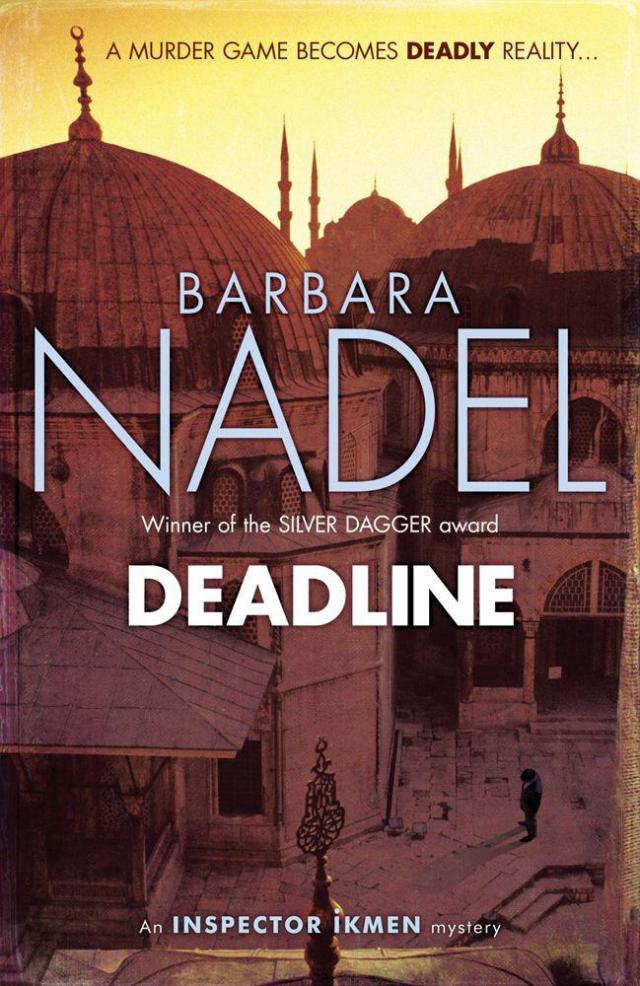
Deadline, p.11
Deadline,
p.11


‘You helped to develop this murder mystery play with the actors, I understand,’ İkmen said.
Light shining through the patterned ceiling domes of the Kubbeli Saloon dappled Burak Fisekçi’s sallow face with tiny spots of bluish light. It made his large features appear unpleasantly mottled.
‘Yes,’ Burak replied. ‘Although not to any great extent. I made suggestions but I was not privy to the proposed climax of the mystery.’
‘Do you remember what they were? The details you were involved with?’
‘Not really.’ He smiled. ‘About trivial things. Early plot points. How the actors should comport themselves in period costume. I studied history at university . . .’
‘Yes.’ Çetin İkmen had known Burak Fisekçi for over ten years, ever since he’d come to work for Krikor Sarkissian. A well-educated man, he had a degree in history from Boğaziçi University.
‘Ceyda and the other youngsters did most of the work. They’re very clever,’ he said. ‘They kept a lot of things close to their chests.’
İkmen looked down at his notes. ‘Mmm.’
Krikor Sarkissian had told İkmen where Burak lived and it was in the same apartment block as Ceyda Ümit.
‘Did you deliberately set out to get your neighbours’ daughter and her theatrical troupe this job, Mr Fisekçi?’ İkmen asked.
‘No. Not really. But once Dr Sarkissian had decided that he wanted some sort of entertainment, I did remember what Cengiz Ümit, Ceyda’s father, had told me about her little company. Of course Dr Sarkissian had the final say.’
‘But you introduced the Bowstrings to him?’
‘Yes.’ He shrugged. ‘Why not?’
‘Why not indeed.’ İkmen smiled. ‘Burak Bey, do you have any idea who might have wanted to kill Söner Erkan?’
‘None at all.’
‘He could, I understand, be a somewhat challenging young man.’
‘As you say, Çetin Bey, he was young. It is in the nature of young men to be challenging and problematic.’
‘But not all young men.’ İkmen smiled again. ‘I didn’t know you when you were the same age as Mr Erkan but I did first meet you when you were in your twenties, Burak Bey. You were far from challenging. In fact I remember being struck by just how mature your attitude was for such a young person.’
‘I think Söner Erkan maybe suffered from a lack of parental control, or rather guidance,’ Burak said.
This mirrored what Ceyda, Alp and others had told İkmen. ‘Rich boy playing at life and messing it up,’ he said. ‘Yes, I’ve come across a few of those in my time.’ He looked across the room at old Hovsep Pars who nodded his head. ‘They can be dangerous.’
‘Not in this case, though.’
İkmen narrowed his eyes. ‘I don’t know about that, Burak Bey,’ he said. ‘Söner Erkan was murdered for a reason. Maybe he threatened someone who killed him in an act of self-defence. Maybe he was blackmailing someone or had committed an act of cruelty or violence against an individual who took revenge upon him. Not all victims are blameless innocents. Far from it.’
‘Allah!’
The man dropped to the floor, hitting his head on the hard, cold tiles. As he fell he made a sound like a goat grunting.
Nar, who had delivered the blow to his head with a copper-bottomed saucepan, bent down to look into his eyes and said, ‘Have I killed him?’
Ayşe Farsakoğlu, mobile phone in one hand, took the man’s wrist in her other hand. ‘No,’ she said. Then she lifted one of his eyelids and looked at his eye. ‘But he’s out for now.’
‘What are we going to do with him?’
The phone Ayşe had borrowed from Nar had just started vibrating when the man had suddenly walked back into the kitchen. None of them had heard him coming. Ayşe, the phone almost at her ear, had looked straight into his eyes, while Ersu Bey had just stood as if frozen to the spot. Luckily Nar, whom the masked man hadn’t seen, managed to get behind him and smash him on the head with a saucepan. Ersu Bey picked up the man’s Kalashnikov rifle and with ex-military efficiency checked it over to see whether it was locked. Ayşe looked at the phone again which had now stopped vibrating. She brought up the missed calls directory and said, ‘That was İzzet. I’ll have to call him back.’
‘Yes, but what are we going to do with him?’ Nar repeated, pointing at the man on the floor. ‘He’s one of them and so I think it’s safe to assume that if he doesn’t go back to wherever he’s supposed to be, they’ll come down here and look for him. What are we going to do?’
‘We could put him in the fridge,’ Ersu Bey said.
‘Yes, but they’ll still come down here looking for him,’ Nar said. She put her hands up to her head in frustration. ‘What was I thinking!’
‘You were thinking he’d seen us and he had a gun,’ Ayşe said. ‘You did the right thing.’
‘But now we have a problem!’
Ayşe just wanted to call İzzet back but Nar was right, the man she’d knocked out was a problem. They couldn’t just leave him in the middle of the kitchen floor. Even if no one came looking for him, eventually he would come round. ‘All right, let’s put him in the fridge,’ she said. ‘No one will be able to hear him in there.’
Ersu put his arms underneath the man’s armpits and began to drag him towards the corridor where the fridges and freezers were. About halfway across the floor, the man began to make groggy, groaning noises. At one point he lifted his head, although his eyes were closed.
When Ersu reached the fridge they had all been in together earlier he called out for someone to open the door. Nar obliged while Ayşe, frowning now, followed Ersu Bey into the fridge. With one last mighty tug, Ersu Bey pulled the man to the back of the fridge and then flopped him down on the floor. Wiping his sweating brow with his hand he said, ‘That wasn’t easy.’
‘No.’
Ersu laid Ayşe and Nar’s coats over the man then stepped over his body and walked out of the fridge to join Nar in the corridor. He was getting used to her now – sort of. It was at the very least reassuring that she still had all the power and aggression of a man. It made Ersu feel a little less isolated.
‘Sergeant Farsakoğlu,’ Nar said. The policewoman was still in the fridge, still staring at the body. She looked rooted to the spot. The body groaned again. ‘Ayşe Hanım!’
Ayşe turned. She narrowed her eyes. ‘How tall are you, Nar?’ she asked.
‘Tall?’ She shrugged. ‘One hundred and ninety-three centimetres when I was measured to do my military service. Why?’
Ayşe looked back at the man on the floor again and said, ‘He must be at least a hundred and ninety. Nar . . .’
Realisation came quickly. ‘Oh, I don’t think so, no,’ the transsexual said.
Ayşe smiled at her. ‘You’d be—’
‘Oh, please don’t tell me it’s my patriotic duty!’ Nar said.
Ersu Bey, confused, said, ‘What’s going on?’
‘What’s going on? I want Nar to put this man’s clothes on and find out what’s happening in this hotel,’ Ayşe said. ‘Stuck down here we don’t stand a chance of finding anything out.’
‘So call your Sergeant Melik back then!’ Nar said. ‘Get your colleagues in here and—’
‘The more my colleagues know about this situation before they come in here, the better,’ Ayşe said. ‘The more intelligence we can give them prior to any action they may take, the more likely it is that we all get out of here alive. Nar, you are the only person here who can fit into this man’s clothes.’
‘But we don’t know his name or—’
‘Hüseyin Hikmet.’ Ersu Bey held up an ATM card that he’d found in the pocket of the unconscious man’s trousers.
‘If that’s his card,’ Nar said. She took a deep breath, exhaled and then stood in silence for a moment. Hüseyin Hikmet, or whoever he was, made more grunting noises.
‘It will be a risk but I know you can handle a gun,’ Ayşe said as she put a hand on Nar’s shoulder. ‘And I know you’re not stupid.’
Nar looked down at Ayşe and shook her head. ‘Ayşe Hanım,’ she said, ‘I’ve got breasts. What can I say? I’ve got breasts that cost me a lot of money and I’m wearing false eyelashes and make-up.’
‘Your make-up can be removed,’ Ayşe said. She glanced quickly across at Ersu Bey who was looking down at the floor in a very pointed fashion. His ears, if not his face, were red with embarrassment.
‘But what about my nails!’ Nar held her hands up. Her nails were long, bright blue and dusted with glitter. ‘What am I supposed to do about these? Rip them off?’
Ayşe could see that the nails were a problem. Even cut right down they would still be blue and glittery. For a moment she felt she’d lost the argument. But then Ersu Bey unexpectedly made a suggestion.
‘We use acetone to remove blemishes from our china,’ he said. ‘There’s at least one bottle of it underneath the sinks. Isn’t acetone what is used to take off nail varnish?’
Time was moving on and even if Inspectors İkmen and Süleyman came to a conclusion about who the murderer might be soon, they could still be wrong. There were a lot of ‘red herrings’ – that was what the famous British crime writers called false leads. And İkmen and Süleyman only had one shot at the puzzle. After that they were out of ammunition.
But what if they did actually solve the mystery of who killed Söner Erkan? Well, that had all been taken account of in the plan. That was no more of a problem than if they got it wrong. It was just that if they did get it wrong, that would be a lot more satisfying.
Chapter 13
‘I hated the sight of him.’
Just to be sure, İkmen asked, ‘Söner Erkan?’
‘He was a little prick!’ Metin Martini, the half-Italian boy who had played the dashing Dr Enzo Garibaldi, was very sure of his feelings. ‘Whatever he said went, because his mummy and daddy gave Bowstrings some money to get started. Or rather they gave their ill-gotten gains to Lions in Iron Cages.’
İkmen frowned.
‘Lions in Iron Cages was the original name of Bowstrings,’ the young man said. ‘Alp came up with it and we all thought it was brilliant.’
‘Is this a reference to the “Lion in an Iron Cage” poem?’ İkmen said.
‘Yes. By Nazim Hikmet, our greatest poet. He likens the lion in the cage to the untameable and uncrushable spirit of freedom. He went to prison for saying things like that. Well, Söner’s parents didn’t like that. They wanted something Ottoman. Arseholes!’
Out of the corner of his eye, İkmen saw the ‘Ottoman’ Mehmet Süleyman smile. ‘So what did they say?’ İkmen asked.
Metin Martini shrugged. ‘I dunno. We get this job with Dr Sarkissian and the next thing I know we’re not Lions any more but bloody Bowstrings!’
‘At the suggestion of Söner Erkan’s parents?’
‘Söner told us,’ he said. ‘He and Alp went to a meeting with Dr Sarkissian, we got the gig, and then suddenly it’s like, “We’re Bowstrings now!” I was, like, No! But then he’s all, “This is just the way it is!” and Alp doesn’t say a word. We were going to be a political company, you know? There are things going on in this country that need to be challenged. I accept we needed to do this kind of gig to get some money together but me and Alp and Ceyda, we had plans.’
‘Could Dr Sarkissian and not Söner Erkan’s parents have made the suggestion to change the company’s name?’
‘Why would he do that?’
İkmen didn’t know. Nazim Hikmet’s work had remained contentious since his death back in the 1960s right up to his official rehabilitation by the state in 2009. It was possible that Krikor Sarkissian didn’t want his charity event to be associated with the work of a long-dead communist but it wasn’t that likely.
‘Söner’s father owns a construction company,’ Metin said. ‘He was just like a builder out in Anatolia until he started doing “good works”.’
‘What good works?’
‘Putting mosques back together in Bosnia after the war.’ Metin pulled a face. ‘Not exactly putting food on people’s tables or giving them hospitals, but he did the whole good religious man thing and so he got in with a load of people who like all that. They put work his way.’
İkmen hadn’t got the impression that Söner Erkan’s family were religious people. The boy himself appeared to have been very far away from being a modest Muslim lad.
‘I shouldn’t be saying any of this to you, I suppose, in case you’re one of them too.’ Metin Martini looked down his long nose at İkmen.
‘One of whom?’ İkmen asked.
The boy waved a hand in the air and said, ‘Religious people.’
‘I have nothing to do with any organisation either secular or religious,’ İkmen said. ‘I serve my country, Mr Martini. That’s all. And at the moment my only concern is to discover who killed Söner Erkan and why. If my colleague and I can’t do that, then we have a very serious situation on our hands.’
‘They’ll kill us.’
İkmen looked over at the masked men who were watching him and said, ‘So they say.’
Metin Martini, following İkmen and Süleyman’s example, lit a cigarette. ‘Well, I didn’t kill Söner, Inspector,’ he said. ‘I hated him and I’ll be honest, I wished him dead more than once, but I didn’t kill him. Why would I serve prison time for that arsehole?’
‘Any idea who might have killed him?’ Süleyman asked.
‘No.’ He shrugged again. ‘Söner was an annoying nonentity, nothing more. None of us liked him.’
‘Did anyone dislike him more than perhaps the rest?’
Metin thought for a moment and then he said, ‘He tried it on with Esma. She was horrified.’
İkmen looked down at his notebook and said, ‘Esma is . . .’
‘She played the American governess, Sarah,’ Metin said.
She was the tall, blonde girl.
‘Do you have any idea what happened when Söner “tried it on” with Esma, Metin?’
‘She told him to fuck off,’ he said. ‘Probably called him a little creep into the bargain.’
İkmen looked at Süleyman who raised his eyebrows and said, ‘So are you having a relationship with Esma yourself?’
‘Me?’ He laughed. ‘No!’
‘You make it sound as if the idea of that is either ridiculous or appalling to you,’ Süleyman said.
The boy averted his eyes, then he said, ‘I like Esma, don’t get me wrong, but . . . Esma?’ He leaned forward then and looked Süleyman straight in the eye. ‘I like European girls, you know? Italians, Spaniards. I can’t do with all this Turkish stuff where you don’t know whether a girl is going to put out or not. It’s bullshit.’
Metin Martini was a very forthright young man and so İkmen thought he’d try to shock him. ‘You want to know if a girl is going to let you fuck her?’
Hovsep Pars gasped audibly.
Metin Martini was completely unmoved. ‘Yes,’ he said. ‘That’s it in a nutshell.’
İzzet rang Ayşe’s mobile and home landline once each but nobody answered either of them. Perhaps she had been calling from her brother’s phone. He called that number again but no one answered. İzzet wondered what to do. If she didn’t want to speak to him, why had she called?
The past few months hadn’t been easy. After the euphoria of their engagement had passed, the reality of the wedding hit and, with it, a host of problems. Money was only one of them. İzzet wanted his children from his first marriage to come to his wedding but their mother was not keen for them to come without her. Theoretically his daughter was too young to travel on her own but he knew that his ex-wife was also making mischief. Then there was his great-aunt Lutza, the last surviving sibling of his grandfather, Fortune. İzzet hadn’t told Ayşe anything about her. He certainly hadn’t told her that Aunt Lutza was, as his grandfather had been, a Jew. In itself it didn’t matter, Ayşe wasn’t the sort of woman who indulged in mindless prejudices. But the fact that he had concealed it from her would make her angry. İzzet himself didn’t know why he’d done it.
He wasn’t a ‘full’ Turk, he couldn’t marry her in opulent, Ottoman splendour, he was rather less attractive than George Clooney. But so what? She was marrying him because she wanted to. Or did she? He looked down at the phone in his hands and contemplated the biggest obstacle to his happiness. Mehmet Süleyman.
She still had feelings for him, İzzet knew that. Every time she looked at him, it was as clear as day. Ayşe thought that İzzet couldn’t see but he could. It was what all the ‘wedding nerves’ had been about. She was nervous because she didn’t know whether she was doing the right thing by marrying him. And yet İzzet knew that if he challenged her about it she would deny everything. She was totally committed to their marriage but was that as a way of escape more than anything else? Did she want to run away from her own foolish passion for a man who was fickle and unreliable? And did he want to take her on under those circumstances? Or was it now far too late in the day to change his mind? After all, he had known about Ayşe and her boss for a very long time and for the last few months he had continually talked himself into believing that it didn’t matter.
Esma cried. She shook too. She was so frightened of what was happening, her whole body was cold with terror and her hands were blue. But she hadn’t hated Söner Erkan, or so she said. She’d found him silly, sometimes annoying and not very talented, but she hadn’t hated him even after he had tried, and failed, to chat her up. He hadn’t, she claimed, even attempted to borrow any money from her.
‘It makes you realise just how much we rely upon forensic evidence these days,’ İkmen said to Süleyman and Arto Sarkissian as they conferred about the people they’d interviewed so far.
Süleyman was only half listening. He still wanted to get as close to the telephone in the Kubbeli Saloon as he could. It was unlikely any of them would be able to plug 155 into it and then leave the handset off the hook without being seen – their captors were watching them all the time – but they had to try.