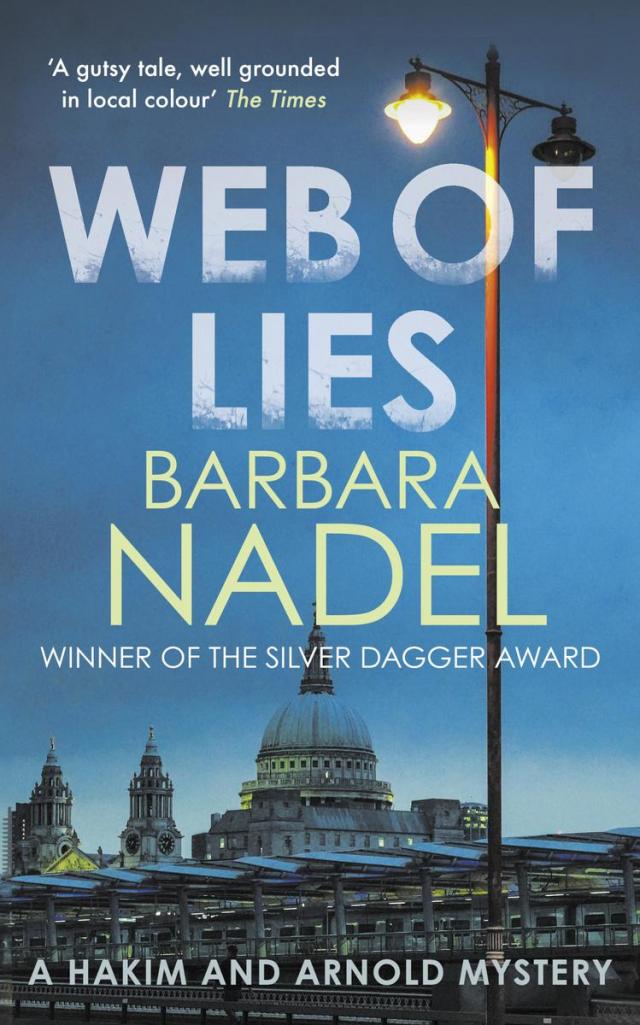
Web of lies, p.5
Web of Lies,
p.5


As Lee drove away from the massive faux-Georgian gaff Billy shared with his mum and her French bulldogs, he thought about how process serving wasn’t the easy gig everyone thought it was. Getting legal paperwork to some people was dead easy, but on other occasions it could be dangerous. If Mumtaz had served on Billy Adams, for instance, it was quite likely the bloke would have slapped her. He didn’t like women, only his mum, and he especially didn’t like Asians. Rita, the mother, was distantly related to the Kray-a-likes, which was why Billy had got his job with them. And the Kray-a-likes, the Carney family, were pure BNP right through to their marrow.
And yet was this unpaid gig Mumtaz had in the City any safer? Wilko Wilkinson had phoned him the previous evening, after their brief meet-up in St Paul’s Churchyard. He’d told him how the baby had died, and it had had a profound effect. Whereas in the past when he found things hard to take, Lee would have resorted to drink or drugs, these days when he got into a state he cleaned. His bathroom and the cooker wouldn’t know themselves after the go he’d had at them at 2 a.m. Of course, whoever killed the kiddie wasn’t necessarily local to the area, but why travel to bury such a small body? According to Wilko it hadn’t been far down underneath the soil. He’d said that it was almost as if whoever put it there had wanted it to be found. That or they were in a hurry.
But if they had wanted it discovered, then why? Lee had never known Wilko that well and, although he knew he was interested in history, he hadn’t realised he was quite so ‘esoteric’. He’d reckoned the five wounds on the baby’s body meant something. Five wounds of Christ and the pentagram or something – Lee wasn’t a great one for that sort of thing. But then Wilko had mentioned he was pulling in George Feldman, whom Lee did know.
Father George Feldman was an Anglican priest who worked out of a church on the edge of Epping Forest. A nineteenth-century Gothic structure, St Mary Magdalene’s Church was so materially neglected it could easily be described as semi-derelict. But in spite of woodworm, vandalism and the ravages of time, George Feldman faithfully ministered to his tiny congregation of ancient women, performed his pastoral duties and, occasionally, performed ‘deliverance’ work. More usually called an exorcist, George was one of a surprisingly large body of people employed by the Church of England to ‘cleanse’ haunted houses and banish demons. Lee had first come across George when he’d been involved in a drugs raid on a house in Manor Park. While the police had arrested a couple in their twenties plus an attic full of cannabis plants, George had been talking to the neighbours about all the weird noises they heard in the middle of the night. It turned out the cannabis factory and the noises were connected. And so had Lee’s association with the vicar begun.
Not that they were close. George was someone Lee saw rarely, but whenever he did, he always enjoyed his company. This was mainly because George rarely talked ‘God’, could swear like a sailor and had a vast stock of weird and hilarious stories to tell about both his ‘adventures’ as a priest and his childhood as the son of an eminent Jewish barrister. George had actually been born and brought up in London’s legal quarter, the Temple.
What City of London CID were going to make of the priest with his permanently stained dog collar, his absolute belief in ‘things unseen’ and his accent out of a 1950s drawing room farce, Lee couldn’t imagine.
Carter Court and its environs had not only taken a lot of punishment during World War II; much of the area had been burnt down during the Great Fire of London in 1666. However, when the area had been redeveloped after the fire, nothing was done to change the layout of these essentially, still, mediaeval streets. After the war, when the whole area had been almost levelled by the Luftwaffe, many of the old buildings had been replaced, but the meandering quality of the tiny streets had remained.
Carter Lane, which had in the twelfth century been called Shoemakers Row, had been used as a cut-through for farmers in the east of the City, taking their animals to market. It allowed them to bypass Ludgate Hill and the cathedral completely. This had brought Mumtaz to the name ‘Lud’.
Like King Arthur, King Lud was a semi-mythical character who was supposed to have founded London in 66 BC. Lud and his sons had unsuccessfully defended the city during the Roman invasion and it was said that he was buried on the banks of the now underground River Fleet, somewhere between Ludgate Hill and Fleet Street. This area was, Mumtaz felt, ‘deep’ London. This was where it had all started, this was where the greatest activity and suffering had taken place – an area of sanctity, violence and trades as old as time.
Mumtaz had dusted off her old digital camera so that she could take pictures of notable buildings and features. Even though everyone used their phones to take pictures, it still looked unprofessional if she was meant to be an academic.
After successfully identifying what had once been St Paul’s Choir School, Mumtaz sat down on a low wall to look at her pictures. After a very few moments, and oddly she felt in a prosperous part of London, she was joined by a woman who was very obviously pregnant.
As she sat beside her, the woman, who was probably in her twenties, said, ‘Sorry, gotta have a sit for a moment. My ankles are like tree trunks.’
She rubbed her legs, which Mumtaz could see were indeed swollen down around the ankles.
Mumtaz smiled.
The woman said, ‘You taking photos?’
‘Yes.’ It was as good a time as any to try out her cover story. ‘I’m conducting some research,’ she said. ‘I’m a historian.’
‘Oh.’
‘This used to be a very busy part of London,’ Mumtaz said. ‘I mean it still is, but what I’m talking about are trades like weaving and leather work, small-scale publishing …’
‘Used to be newspaper offices down Fleet Street,’ the woman said. ‘One of my uncles used to drive his cab round here back in the eighties when all the papers had their offices there.’
‘Do you come from this area?’ she asked the woman. She didn’t think she did. She certainly didn’t sound like the other residents she’d encountered.
‘Nah,’ the woman said. ‘Dagenham. But me and my er, my other half, we live here now. We got a flat.’ Then she smiled. ‘I’m Danielle, by the way.’
Mumtaz nodded. She’d decided that morning that she was going to use a name that was not obviously Asian.
‘Marian,’ she said.
They both went quiet for a moment then. And with only a faint sound of traffic coming from Ludgate Hill, it was almost as if time had stopped around them.
‘I can’t help but wonder whether you have an ulterior motive,’ Barry Feldman said to his brother as the two of them walked up Ludgate Hill towards the great cathedral. ‘You’re like some sort of woodland creature, you never leave the forest.’
George, four years younger than his brother and in many ways still an open book to him, said, ‘You know me well.’
‘I do,’ Barry said.
‘I did buy you lunch …’
Barry laughed. ‘Good God man, El Vino’s is not the sort of place a chap just gobbles his tapas and runs. That wasn’t lunch, it was an Olympic relay race.’
Barry, like their father had been, was a traditional, old-style barrister. He worked diligently and hard for his clients, but were he invited to lunch, especially at El Vino’s on Fleet Street, he expected to be there until closing time. But then, Barry still lived in the Temple.
‘I paid,’ George said.
‘Yes, and consequently I was obliged to slurp down a very nice Cabernet Sauvignon in an order so short you’d need a microscope to see it.’
They stood in front of the great cathedral’s doorway and Barry continued, ‘So what now? If you think you’re finally going to get me to be baptised, then think again.’
‘No!’
‘Then …’
‘We need to go to the churchyard,’ George said. Then he shook his head. ‘But if what I’ve been told is right then I can feel it from here.’
Barry said, ‘Feel what?’
George turned to him and said, ‘Evil.’
‘I don’t think I’ve been to a pub, except with my partner, since I’ve been expecting,’ Danielle said as Mumtaz held the door to The Hobgoblin open for her. ‘They say you shouldn’t drink these days, don’t they? Not like my mum. Not that she got pissed you understand, but women would have half a lager or a wine when they was expecting back in them days.’
Danielle liked to talk and Mumtaz was grateful for it. Already she’d learnt that Danielle knew the ‘old geezer’ who lived in the house next door to the pub, the house with the blue door.
Now she was inside the pub, Mumtaz could see that not only was it smothered in St George’s flags, but it also boasted some features she had thought disappeared years ago. Like the cardboard peanut holder where the more bags were removed, the more ‘features’ of a naked girl were revealed. Like the Pirelli calendar from 1996 …
With more boldness than she actually felt, Mumtaz walked up to the bar. The man behind it was young, dark and handsome in a way she classified, on no real evidence, as ‘Mediterranean’.
‘Morning ladies,’ he said in a cheery Estuarine accent. ‘What can I get you?’
‘Oh, I’ll have a lime and soda,’ Danielle said as she fumbled with her bag. ‘I’ll get these,’ she said to Mumtaz.
‘No, no, you sit down,’ Mumtaz replied. Then she said to the barman, ‘And a Diet Coke for me.’
She handed over a ten-pound note while Danielle, glad to sit down again, sat.
‘You do food,’ Mumtaz said to the barman.
‘Yeah. Pie and chips mainly.’
Lee would be glad he’d won the bet. If she told him.
‘What sort of pies?’
‘The usual,’ he said. ‘Steak and onion, steak and kidney, chicken and mushroom …’
‘I’ll have chicken and mushroom,’ Mumtaz said. She called over to Danielle. ‘What would you like, Danielle?’
‘Oh.’ She still looked flustered and a bit hot in spite of the cold weather. ‘Steak and kidney please. But not many chips. Gotta try and keep me weight under control.’
‘OK.’
‘But let me pay for that,’ she continued.
Even though this ‘case’ was of a non-paying variety, Mumtaz knew she could still put this on expenses. ‘No,’ she said. ‘I can charge it to my department. Glad to have your company.’
Food ordered, she sat down opposite Danielle. Luckily she’d chosen a table away from the bar, by the window, which meant that they could have some privacy. Other than the two women the pub was empty.
‘So this “old geezer” you met …’ Mumtaz began.
Danielle took a sip from her glass and then said, ‘Lives next door to here.’
‘How’d you meet him?’
‘Oh I often walk around,’ she said. ‘Partly trying to keep me weight down, partly I’m a bit bored to be honest. I’m sorry, Marian, you don’t wanna hear about all that.’
Little did she know. When Mumtaz had been married to her husband Ahmet, she had learnt all about isolation and boredom. He’d rarely let her out of the house.
‘You’ve a right to say you feel isolated,’ Mumtaz said. ‘I’ve never had any children of my own, but I have friends who have felt really out of things when they’ve been pregnant, especially if they’ve gone to live away from their families.’
Danielle smiled. She was an attractive young woman and Mumtaz noticed her eyes had teared up when she mentioned ‘family’. She said she came from Dagenham, a largely white area where the working-class families tended to be close.
‘Anyway,’ Danielle said, ‘this old bloke I think does actually come from here. So he might be useful for your project.’
‘Did you speak to him or …?’
‘He come up to me,’ she said. ‘I was here, in Carter Court. All the people my partner knows round here reckon this pub’s a bit rough, but I didn’t know where it was, so I went looking. The old man was coming out of his house and wondered what I was doing here.’
‘You told him?’
‘Yeah,’ she said. ‘He said I looked different to the others.’
‘Different?’
‘You must’ve noticed how most of the women round here look as if they’re going to a garden party,’ she said. ‘The blokes all cycle and the woman float about in flowery dresses. I’m not like that.’
Danielle, that day, was all about denim. Even her long blonde hair was swept up in a denim scrunchie.
‘The old bloke reminded me of me granddad,’ Danielle continued. ‘Same name too, Arthur. He said his family had always lived round here. They used to make candles.’
‘Candles?’
‘Long time ago. Maybe for the cathedral? I dunno. But Arthur himself, he told me he used to catch eels. But then that all stopped for some reason …’
There were still some remnants of crime-scene tape around that flower bed but, other than that, there was nothing to see.
‘Was it murder? Or rather is it?’ Barry asked George as the two men walked towards the site of the child’s burial.
‘My information is that it is an unlawful killing,’ George said.
‘I still don’t see why you’re involved,’ Barry said. ‘Where’s the ghost or the poltergeist?’
‘It’s about evil,’ George responded. ‘If you knew how that child had been murdered …’
‘So tell me.’
‘I can’t! You know that!’
George knelt down and began to silently pray.
Barry had never understood religion. Their parents had been secular Jews, so religion hadn’t been part of their lives as children. As an adult Barry, at least, had forgotten all about it. Their sister, Eve, had become a Buddhist and then given that up in favour of a life of hedonism. Only George had got the religion bug which, he said, had grown out of his political activism. He’d been a right leftie back in the 1980s, always protesting about something. He’d been particularly exercised by the miners’ strike and had spent a lot of time in the coal towns of South Yorkshire. He was supporting pickets at the Orgreave Coking Plant in June 1984 when the police attacked them. Following what turned into a violent confrontation, seventy-one pickets were charged with riot which, back then, attracted a life prison sentence. George was never the same after the Battle of Orgreave, during which he said he’d experienced an epiphany. Theology college followed and then the priesthood and Barry still, more than thirty years later, did not understand.
George rose to his feet. He said, ‘I’m going into the cathedral. You can come or not. It’s up to you.’
Last time Barry had been into St Paul’s had been on a school trip when he was seven.
‘What do you intend to do there?’ Barry asked.
‘Speak to people, clerics.’
‘About what?’
‘About what happened here,’ George said.
‘I expect the police have already done that,’ Barry said.
‘They have.’ George was on the move, Barry following. ‘But not in the right way.’
Detective Inspector Scott Brown liked to give the impression of being a Jack-the-Lad, and it was true he did have the morals of an alley cat and a penchant for binge-drinking, but underneath all that he was a bit shy. And DS Pinker was sassy, which made it all so much worse.
‘That area’s stiff with cameras, guv,’ she said when she came to Brown to talk CCTV around St Paul’s.
He as usual wanted to have everything about any case he worked on wound up yesterday.
‘I’ve still got a shitload of recordings to go through,’ Melina Pinker continued.
Thirty and half Greek, Pinker had the sort of golden Mediterranean looks that Brown found alluring. She, however, had made it known a long time ago that middle-aged macho men were not her thing.
He leant back in his chair and put his arms behind his head.
‘Luckily we can see the comings and goings from the churchyard from four different angles,’ she continued. ‘Plus up Ludgate Hill and round the Tube station. Putting that all together is gonna take some time though.’
‘Initial impressions?’ he asked.
‘Not much round the target time,’ she said.
‘You see anyone carrying anything?’
‘No, just newspapers,’ she said. Then she paused for a moment.
‘What, DS Pinker?’ Brown asked.
‘Guv, I know that uniform have been doing door to door …’
‘For what it’s worth. Hardly anyone lives round there.’
‘Yeah. But,’ she said, ‘wonder whether we’re looking at someone who knows where the cameras are. Someone local or someone from the cathedral.’
‘That’s all possible,’ Brown said. ‘Although no one was in the cathedral, according to their statements.’
‘There’s the footage from inside the cathedral too, sir.’
‘Yeah.’ He rubbed a hand across his face.
She pulled a chair across from an unoccupied desk and sat down.
‘Sir,’ she said, ‘about this exorcist …’
‘He’s not an exorcist, Detective Sergeant, he’s a deliverance minister.’
‘Same thing,’ she said. ‘Wilko told me.’
‘Well, Wilko wants to keep his involvement in this case to himself,’ Brown said.
‘Yeah, but …’
‘Father Feldman has expertise in the field of the occult,’ Brown said. ‘As you know, Pinker, there are aspects of this crime which could be connected to some sort of ritual stuff.’
‘I thought you’d discounted that, guv.’
‘I think it’s a remote possibility …’
‘But not zero?’
Was she one of those women who always looked for the sensational in everything, a conspiracy theory nut? If she was, he’d just gone off her.