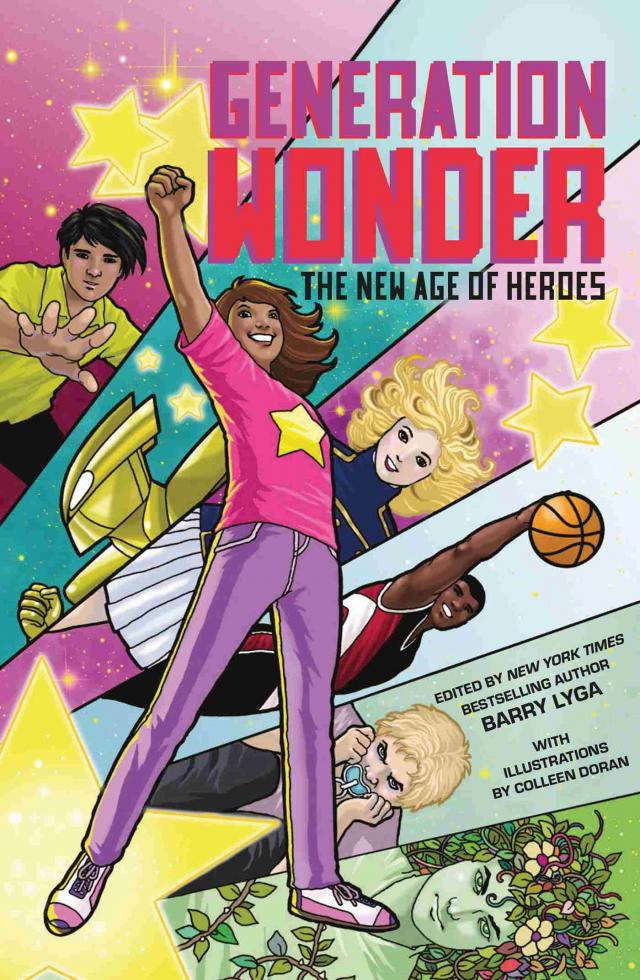
Generation wonder, p.8
Generation Wonder,
p.8


Crow was sitting on Leonard’s chest. He picked at Leonard’s shoulder with his beak.
“You OK, boss?” Crow asked.
Leonard took a deep breath. He’d skinned his elbows when he fell and hit the back of his head. But other than that, he seemed to be intact. And the part of him that was accepting his new role in life was already figuring out what his next moves would be.
Get up and go over to the van. Use some of those zip ties to secure Lee Phillips. Tell the police—who would soon arrive, from the sound of distant sirens he was hearing—how he’d been skateboarding in the lot. Then, when he’d seen someone coming out of that van, how he had slammed the door shut on him. Accept the fact that, for a while at least, he might go from being a zero to a hero. Then go home to tell Aunt Marilyn about the events of the night and talk with her, really talk, about a lot of things.
But right now?
Leonard looked at Crow.
“I really need that bag of energy bars I left over by the streetlight,” he said.
The zip code was new, but Cece felt nothing but old. Another school, another cheerleading squad, and yet another time she’d have to work her way up from the bottom of the cheerleading hierarchy. Now, she worried her body was growing tired. Spent. And at fifteen, she’d never be this young again.
She held out a leg, stretching her hamstring. As if to prove her point, her hip popped.
When Cece opened her locker—if she was counting correctly, this was the sixth locker she’d had since elementary school, all of them with the same smell—her bright blue pom-poms tumbled out, landing on her fresh white sneakers.
“Go, Lions!” someone shouted. Behind her, the hallway was a living organism, seething with movement, teeming with misdirected energy. Cece didn’t turn around and instead kept digging for her gym bag. She’d learned a few schools back that there was only one group of kids she cared about getting to know: the cheerleading squad. Her teammates. The Pinewood Lions were the best in the nation, and as of a few weeks ago, she was officially one of them.
Now she just needed to get them to actually like her.
Cece followed the squeaks and grunts coming from the practice gym and painted on a smile before pulling open the double doors. A flash of gold caught her eye: Maisie, their captain, soaring up to the rafters, her yellow practice uniform a spot of sun against the gray ceiling. Captains earned special pom-poms, and Maisie’s golden pair glinted under the fluorescent lights. She kicked her legs, arched her back. Then gravity beckoned, and Maisie fell from the sky. Her bases—Greta and Hope and Hazel—caught her almost silently. A flawless basket toss.
Twelve girls clad in stretchy miniskirts and tanks, thigh muscles like you wouldn’t believe and fire in their bellies that only seemed to light up more on the mat. The Lions cheerleaders were legendary, and Cece felt lucky to have joined them. She just hated that they didn’t seem to feel the same way.
It wasn’t that her skills were a problem—she was a stunning athlete, powerful and daring—but there was something keeping the rest of the squad from letting her in fully. It had been nearly a month since she’d joined them, and still, she just couldn’t find her way inside.
She needed time, she knew. They needed time.
She cleared her throat, sent a wish to the universe that her tight hamstrings wouldn’t hold her back, and entered the gym, ready to warm up alone. As usual.
“OK, everyone!” Maisie’s voice cut through the chatter, the squeaks of shoes on the shiny floor, and the low music playing from an old stereo in the corner. She clapped her hands. Immediately, the squad fell into place, lining up to face their captain. Cece stood next to Alex, a girl she knew from Spanish class. Cece smiled hopefully at her, but Alex quickly averted her eyes, shifted her hips, and turned her attention back to Maisie.
Cece tried to pretend her cheeks weren’t burning with shame at being slighted yet again by one of her teammates. But this time, in a flash, her embarrassment turned to anger. Cece wasn’t just a good cheerleader; she was a great one. She’d elevated the cheer program at every school she’d enrolled in and had been a star flyer—one of the girls at the top of every stunt, who had the control and flexibility to soar through the air—for years. So why did the Lions make her feel like some kind of second-rate has-been?
“We have a mere eight weeks until Nationals,” Maisie announced, her glittery pom-poms stationed on her hips.
“Eight weeks until we reclaim our title!” Alex blurted. Cece winced—but to her surprise, the rest of the squad hooted and hollered.
She narrowed her eyes and studied her teammates to see if their faces revealed any truths, any buried secrets, about what had happened at last year’s National competition. It was a mystery to everyone in the cheer industry. Even the insider blogs that Cece inhaled whenever she could hadn’t been able to figure out what had caused the world-famous Pinewood Lions to forfeit the biggest, most important competition of the year. After winning every event along the way, the Lions had simply . . . failed to show up.
And still, no one at Pinewood City High School talked about it.
Cece couldn’t really blame them. Imagine being the talk of the cheer industry, the absolute favorites to win, and then skipping out on the whole thing. Imagine passing the trophy case in the front hall of Pinewood City High every day, taunted by the empty space in the front that had been meant for your big triumph.
Cece’s eyes landed back on her captain. Maisie was stoic, dramatic. She met each girl’s eye, lingering on Cece’s longest. “Every one of those weeks will require absolute commitment from each of you. Total dedication and sacrifice.”
They all nodded. Even Cece, whose hamstrings tightened. She imagined she could pluck them like guitar strings. Cece knew dedication. She understood commitment. Her mother was active military—hence all the moving—and she didn’t take promises lightly. She was a Lion, and she was ready for everything that entailed.
She just needed to prove it to her squad.
What Cece loved best about cheerleading was the surprise of it all.
The first time her father had witnessed one of her competitions, she’d been worried he would stop breathing. By the time the event was over, he’d turned a sickly shade of gray, and he’d downed three glasses of his favorite whiskey that night, shaking his head between every sip and whispering, “My god. Those stunts.”
Most people only saw cheerleaders on the sidelines at football and basketball games, leading chants with rhyming words, occasionally throwing a small basket toss to amp up the crowd. But the real sport of cheerleading happened way off the field in gyms across the nation, where hordes of teams gathered to compete, the air practically shimmering with energy. With heat. Everyone waiting to see who could dance, who could choreograph, who could tumble, and most importantly, who could perfect the wildest, most dangerous stunts.
To see who could fly.
Cece lived for it. The adrenaline, the endorphins, the way nearly anything could happen on the mat—how the cleanest tumblers could trip, the smoothest dancers could stumble, the easiest stunts could collapse.
Back in the practice gym, Maisie called a huddle. Today’s experiment was risky, and Cece felt a thick rope of jealousy snake around her heart. I bet I could do this stunt better than anyone, she found herself thinking.
But there was no time to brood. She was new. She had to pay her dues. Joining the circle, clapping and hooting, she understood why Maisie hadn’t chosen her to fly. But that didn’t make it any easier to watch Mina do it.
Someone started a steady drumbeat with her feet, a back-beat that filled the gym with a hum of energy that soon began to crackle like it was rising from the mats. Three bases on the ground, two standing on their shoulders, and Mina way up top, stretching toward the rafters. Cece watched as Mina climbed and flew, her face grim with determination. Up, up, up she went. Tiny but packed with strength, Mina was the Lions’ star, the girl who always got to soar.
“Li-ons, Li-ons, Li-ons,” Cece and her teammates chanted. Mina was close to the top; the stunt was nearly perfect.
But Cece saw something on Mina’s face—a flash of pain, maybe, or surprise—and all at once, it went wrong.
It happened in an instant: Mina, about to leap off her base’s shoulders and dive toward the floor, instead crumpled a little, her body folding in on itself. When she was supposed to be in the shape of an upside-down V, she was tucked into a loose ball. Her ankle hit Vivi in the face. Shocked by the force of it, Vivi fumbled, her own foot digging too deeply into Alex’s neck—Alex, who was holding up the whole stunt from the bottom—then faltered, her knees buckling.
And Mina just . . . fell.
She landed on the mat hard, a pile of limbs, a shout of pain. The girls who were supposed to catch her—whose sole job, in fact, was to serve as a soft place to land—looked stunned. Confused.
And then, furious.
“Are you OK?” Cece dashed to Mina, whose eyes were dazed. She blinked, and her expression turned to terror.
“Um,” she said weakly.
Maisie stomped over. “What the hell happened?!”
“I don’t know,” Mina protested. “I wasn’t . . . someone . . .”
Maisie clapped her hands to get the team’s attention. “Unacceptable!” she screeched.
Her rage had distorted her face, and as Cece stared, speechless—she’d never seen a captain get so mad about a simple stunt fall, especially when, to Cece’s trained eye, it had seemed like a true accident—a flurry of conversation erupted around them. Greta pointed angrily at Alex; Hazel and June both shook their heads, pink blotches of fury climbing up their necks. Crumpled on the floor, Mina, too, was angry.
In an instant, Cece learned something new about the Lions: They weren’t good at failing. Their picture-perfect veneer cracked, and out seeped chaos.
Cece refocused on Mina, who was rubbing her ankle. “Do you need some ice? Maybe we should find the trainer?”
“No,” Mina said quickly. “No! I’m fine. Just a little shaken.”
“Same,” Maisie snapped. Arms crossed, she glared at every member of the squad in turn. Except, Cece noticed, her.
Cece had been involved in stunts gone wrong before. Every cheerleader had! But she had never seen a squad rush to blame someone for a simple fall so quickly, especially one where no one had had any visible bruises or broken bones. Mina was going to be fine, to Cece’s surprise. So why was everyone so pissed?
As Mina straightened up, testing out her ankle, Maisie evened her breath and ferociously fixed her ponytail. “I’ll remind everyone that coordination and trust are what make us successful,” she said witheringly. She waited a beat, and in her pause, Cece saw a flash of something new on her face.
Fear.
So much fear, it took Cece’s breath away.
“If we can’t coordinate, we will fail,” Maisie continued. “Do you understand? And we cannot—must not—fail.”
Silently, the rest of the squad nodded, a sense of humble determination settling over them. And Cece felt it again, that unmistakable certainty that she was missing something. That her teammates were having a conversation without her, even though she was standing right there.
Maisie sucked in a breath, her golden poms at her hips. “Let’s do it again. Now.”
Practice ended early and abruptly. When the squad departed in a flurry of whispers, leaving Cece to roll up the mats by herself, she assumed they were all off to do something exciting without her. Mina’s fall seemed to have been forgotten, including by Mina herself, but the feeling that she had missed some crucial lesson about the Lions hung around Cece long after she’d left the quiet, darkened gym.
At home in the kitchen, her dad was baking his famous chocolate chip cookies while her mom thumbed through a cookbook. “Hey, sweets,” she said. “Any thoughts for dinner?”
“Pizza?” she said eagerly. Her mom’s face fell, her finger hovering over a dog-eared page.
Cece shrugged and dragged her pom-poms and gym bag to her bedroom. On the way, the television in the living room caught her attention, a “breaking news” chyron at the bottom of the screen. It was the local evening news, and a reporter stood in front of a messy scene; debris littered the sidewalk outside an abandoned-looking building, and fear was etched into the lines of the reporter’s face.
“If you’re just joining us, we’re bringing you breaking news from Avenue M in the business district, where another small explosion has rocked the area,” the reporter said, gripping her microphone. “Eyewitnesses claim to have heard several loud noises, followed by an explosion that ripped the roof off of this unoccupied building and shattered windows up and down the block.”
Cece stared. A tiny pinch of tension took root in her stomach.
“This is the fifth instance in recent weeks of unexplained property damage, and while we can clearly see that something unexpected has occurred”—the reporter gestured behind her, to where shards of glass glinted on the sidewalk and a small but dark plume of smoke was rising from the back of the building—”police continue to refuse to answer questions about this latest in what appears to be a series of similar incidents. They are withholding information about any potential victims or suspects, claiming that releasing that information would hinder their investigation.”
She blinked a few times, waiting for the station to cut back to the anchor, and Cece’s eyes panned over the scene. A flash of gold sparked, crackling just at the border of the camera’s range. It caught Cece’s attention, but before her eyes could focus on it, it was gone, and the broadcast switched back to the on-air hosts in the studio. Why was it, Cece wondered, that all local news broadcasters looked like they were related?
In the studio, a salt-and-pepper-haired man who could have been eighty or not a day over thirty-five blinked seriously at Cece. “Thanks for that report from the scene, Liz.” Abruptly, he turned to his coanchor. “Gladys, what do you think?”
Gladys eyed the camera. “Well, Al, I think it’s superher—”
“Let’s move on to the weather!” Al frantically gestured to someone off camera before a map of Pinewood City lit up the screen.
“Whoa!”
Cece jumped, her heart leaping right along with her. “Dad! Warn a girl when you’re creeping up behind her, would ya?”
He pointed at the screen. “Did she just say what I think she said? Superheroes? In Pinewood City?”
Cece considered the idea. It was strange, thinking maybe there were some circling around them right now, perched in the trees dotting their backyard . . .
Before Cece was even born, superheroes and villains had been famous (and infamous) for their epic battles around the globe; they’d been as much a part of the landscape as the weather. But eventually, the collateral damage from their clashes had forced the world’s leading governments to work together on a joint set of superhero restrictions. Since those mandates had been established—Cece’s history teachers had always called them “peace accords,” even though the villains had objected to the term—superhero and villain activity had dwindled. The really bad villains had been vanquished; the really good superheroes had retired. To Cece, it all felt like kid stuff, and imaginary, distant history. Superheroes had become symbols of the past, as antiquated as the old-fashioned answering machines Cece had seen in movies.
“There can’t be any superheroes here,” Cece said. “What about the peace accords?”
Cece’s dad had been a history teacher before she came along. She braced herself for a litany of dates and names and backstories about various government resolutions. She wished she’d grabbed one of the cookies he’d baked for sustenance.
“For starters, I’m pleased to hear you’re learning stuff in history class,” he chuckled. But then his face grew serious, his gaze distant. “After the Villain Uprising of ninety-nine, when the villains were mostly destroyed, the Superhero Alliance could tell they were falling out of favor. They agreed to back off for a while . . . but it’s been twenty years, Cees. And rumors of villains have been rising in the past year or so, especially in the big cities.” He met Cece’s eyes. “As history shows us time and again, peace never lasts. Maybe the villains and the super-heroes are getting restless.”
“So you think . . .” Cece struggled to get the words out. Because if he was right, and if the news anchor had really been about to say what it sounded like she was going to say, there were bad guys hanging around Pinewood City.
“I think . . .” His voice trailed off. He stared at the screen until it cut to commercial, and then he added grimly, “I think you should stay away from the business district for now.”
After dinner—she’d been able to convince her mom that pizza was the right answer—she spent the night watching old clips of the Lions at past competitions. (It wasn’t the first time she’d eschewed any kind of attempt at a social life in favor of improving her craft, and she knew it wouldn’t be the last.) She thought she’d study their cohesion and see if there was some secret to how they all worked together—some insight into how they moved on the mat, how she could mimic them in order to be more accepted. Maybe then she’d finally become a flyer, like Mina.
Because all Cece really wanted to do was fly.
Reviewing the clips was a curious exercise. The squad’s routines were impeccable. The cheerleaders performed like mirror images of each other, each girl anticipating the moves of the one next to her. Cece yawned as she clicked around, scrolling until she landed on last year’s regional competition, the one right before the big national event where the Lions had been expected to win. She hungrily clicked play.
She watched it over and over: the Lions’ pom-poms sparkling in the lights, their choreography flawless, their stunts powerful, Maisie’s golden hands directing the crowd’s attention. Then Cece clicked over to the awards ceremony. In it, all the competing squads lined the stage, drumming the mat with their poms. Poms that, Cece realized, were noticeably not blue or gold.