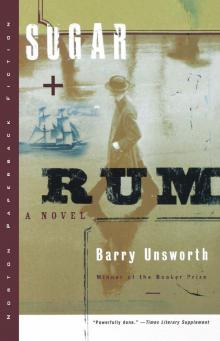
Sugar and rum, p.13
Sugar and Rum,
p.13


He paused for a moment or two, then he said, “I suppose I loved Walters.”
He stopped again and waited, looking not at her but at the table between them, their almost empty glasses. If this was tedious or in some way distasteful she could make an excuse to leave, she could change the subject. But she did neither. Glancing up he saw that her eyes were fixed on him, not discernibly sympathetic, but intent. “I wouldn’t have expressed it like that at the time,” he said. “Free use of that word is the licence of age. It was a very possessive feeling. I was an only child, you know, and I had never had a close friend. I was jealous if he seemed to be getting on well with other people. I wanted to keep him with me. I had one strong advantage, which was a very highly developed sense of direction and the kind of visual memory that makes a print on the mind of landmarks, details of ground. I had sharp senses too, hearing, smell. Still have, as a matter of fact, though my eyes are going now. In the Wadis – that was what we called this part of the front – that sort of thing was very important. It was a kind of labyrinth, you see. I used to line things up, a barn with the door hanging off, a heap of rubble of a particular shape, a shattered tree stump. Even down in the stream beds, thirty feet below ground … No features look exactly alike if you look hard at them, and I did. I always knew where I was. Nearly always. I navigated by a system of signs, pointers – almost like a private language of symbols. I find myself doing the same thing now when I am walking around.”
He drank the rest of his beer. “Not much of an accomplishment,” he said, “but it was useful there. Like another drink?”
“No thanks. I’ll have to be leaving in a few minutes. Do go on.”
“You’re sure I’m not boring you?”
“I’d let you know if you were.”
He nodded. The question had been merely a reflex of politeness; he was intent in his story now. “Thompson had it too,” he said. “That’s the man I saw the other night. He used it differently. I just wanted to survive. Some people, quite a few actually, were without it completely. Walters was one of them. On his own he was liable to go astray, and that could be fatal. He followed me – I always went in front. He trusted me completely. One night we had gone out to recover some ammunition. We were short of Browning ammunition and there was a stack of it in a position we had recently abandoned, a forward observation post, as they were called. It was up a gully near a bridge. The ground near the bridge was marshy. After the rain there was a population of frogs there. They kept up a chorus of croaking, quite loud, but they always fell silent if there was anyone about. There were three of us, me, Walters and a corporal, a man named Peters. He was in charge really but I led the way. I always went first. We had blacked our faces and hands but there was a moon, we knew we could be seen. We came round a bend and saw the arch of the bridge perhaps twenty-five yards away, quite clear in the moonlight. The frogs were absolutely silent. I stopped – I was afraid to go on. The others stopped behind me. As soon as we stopped we heard a rattle of bolts in front of us and a shout and the Spandaus opened up. They had been waiting until we got as near as possible. I could see the traces of the bullets going by me and I could see the flames from the barrels of the guns. By some miracle none of us was hit. There was a channel, a sort of shallow ditch going off the stream bed, and we got into it in time and started crawling back. We had to make a number of detours – we didn’t dare show ourselves above ground. We got into a narrow gully about eight or ten feet deep. I knew we were going in the right direction for our platoon position but I didn’t recognise this gully. At least, I wasn’t absolutely sure. Moonlight is deceptive and there had been no time to take bearings. This was an area we had mined ourselves but there were tracks through it, all of which I thought I knew. We had an argument. Peters said this wasn’t the right track, we should make a wider detour so as to be sure of it. He was frightened. We all were. I saw that Walters was listening to Peters. I said I was certain it was the right track and I started off down it. Walters followed me and then Peters. After I had taken about twenty steps everything went up in a sheet of flame. I felt a tremendous punch on the back of my neck. I was thrown forward onto my hands and knees. For a while I couldn’t see or hear anything. Then I heard moaning sounds. I turned round and I saw Walters lying with his knees drawn up. It was he who was making the noises. I tried to lift him. Then I saw that the middle part of his body had been blown away. I took his head in my hands and he stopped moaning. Then, after a few seconds, he made a single sound which I can’t describe and I knew he had died. Peters led the way back, inch by inch, prodding the ground with his bayonet. He wouldn’t speak to me. He never spoke to me after that.”
Just another story, he thought, trying to shift some impediment in his throat. I’m always telling stories of one sort or of another. “Walters’s body wasn’t recovered,” he said. “The unit that relieved us poured creosote over the corpses to keep down the smell. Of course, I didn’t need Thompson to help me remember all this. In a way I’ve never stopped thinking about it. But I thought, you know, he might help me to find direction somehow. In my life now, I mean. If I could line him up, the way I used to line things up in the Wadis.”
“It was the kind of mistake anyone might have made,” Alma said after a long moment.
But he knew this was merely an impulse of sympathy – it could not be what she really felt. “No,” he said, “I was jealous, I thought it was my only power, the only thing that kept him with me. I still think so. I tried to make the ground conform to my conception. It was an early example of my propensity for metaphor.” On an impulse, to forestall any further kindness on her part, he said quickly, “A man I know called Rathbone is putting on a sort of show next Saturday evening. I’ve got two tickets. I don’t know if you’d like to go. Oh, but it’s May 22, that’s your birthday, isn’t it?”
“What sort of show?”
“It’s a hypnotism show. It is this man’s début as a stage hypnotist.”
“It’s being my birthday doesn’t matter.” She made the abrupt movement of the head with which she seemed to accompany all apparent concessions. “I don’t make much of birthdays.” She glanced at her watch and stood up. “I’ve got to go,” she said. “I’ve got a meeting at two. What did this Thompson say? Did he know you?”
Benson had got up too. He hesitated briefly, then he said, “I didn’t speak to him. I followed him to where he lives but I didn’t speak to him. I don’t seem able to take initiatives these days.”
“You took one with me,” she said. “Where does he live?”
“On the Railton Estate.”
“But those blocks are condemned.”
“There are people living in them all the same,” he said. “Do you mean that you’ll come on Saturday?”
I could have asked her out to dinner, he thought. Something like that. Why this wretched hypnotism show? But he had promised Rathbone.
Alma paused, considering. She was quite small, he noticed for the first time, now that they were standing close together. He was not a tall man but he was taller than she by some inches. He took, in this confused moment of hope, a rapid inventory: the vivid, small-boned face, the straight shoulders, the breasts below the thin jumper not large but definite, and obviously unconfined.
“Yes, if you like,” she said. “But I wish you would go and see this Thompson first.”
All the same it was Zircon the assassin that finally decided him. Elroy Palmer came to see him next day, bearing a key passage. Zircon had now penetrated into the inner sanctum of Jarrold, demented hermaphrodite ruler of Gareg, a planet stultified by too much order, where only straight lines were allowed and wheels had to be enclosed in square casing. Jarrold had just signed his own death warrant by refusing to accept Zircon’s authority as imperial envoy.
Zircon laugh with a laughter inside himself. This the Assassin laugh. He is trained to do this laughter. Not a muscle of his face is moved. Out of your own mouth, Jarrold. At the same time he laughs he feels eloquent disgust for this obscene person stood there in woman’s clothes, red robe with lace trimming, big blond wig all in square waves. Silver baton of power cradled in his soft white arms. Jarrold, your time has come. Not because he dress as a woman, people can dress how they like. But he is an obscene tyrant.
Zircon works the blade down from its pouch in his armpit. No scanning device known on Gareg can detect this knife. His eyes flicker to Bender on the right. Bender going to take care of the guards. In his palm now. This knife will fly at speed of light, aimed by the impulses of Zircon’s brain. He is trained for this work. He perform again that inside laughter as he seeks out with his.eyes the target vein on Jarrold’s neck. That laughter part of the killing, works up power for the knife. Now good-bye, Jarrold. The days are accomplished. Now this knife restore the world of forms, flow of life comes with his death blood.
Benson considered this for some moments. There were the usual vagaries of grammar and syntax but this was Elroy’s language and it worked effectively in subverting an over-regulated planet. He wasn’t sure about eloquent disgust and suspected that Elroy had put the adjective in because he liked the sound of it, which was something he did quite often – it added a certain mysterious charm to his work. And he wasn’t convinced that Zircon could have got an audience with Jarrold without being subjected to a body search. All the same …
“Elroy,” he said, “this has power. Making the maniac for geometrical form himself soft and indeterminate is a masterstroke. I congratulate you.”
Elroy looked back at him seriously and nodded but did not speak.
“He does actually kill Jarrold, I suppose?” The death was not yet described and Benson had the fear still that Zircon would get blocked with his own murderous mirth, trapped for ever in a soundless paroxysm, eyeing the tyrant’s jugular in that room of square-faced sycophants.
“He dies in the next paragraph.” As always Elroy spoke as if the decision had been made elsewhere.
“I’m delighted to hear it. There is one point that occurs to me. Don’t you think it would be better if the weapon that puts an end to Jarrold were curved somehow? A boomerang, say, made out of the same undetectable metal, or a scimitar or a razor-sharp disc? The symbolic shape of liberation, see what I mean?”
“They talked a lot about it on Vekrona before Zircon set off,” Elroy said. Vekrona was the ruling planet of the Confederation. “They understood it had to be the right symbol. They know about symbols on Vekrona. Zircon can kill in any way, he is a trained man. But Jarrold sentenced to die by his own excesses. He is killed by what he loves too much.”
“Killed by what he loves too much,” Benson repeated slowly. He looked at Elroy with a sort of wonder and Elroy looked back with the placid watchfulness which was all his own. Everything about him was the same: dreadlocks, earring, voluminous red hat; the full, slightly everted mouth was set in the same firm mould; the eyes in their boney sockets were heedless, really, of anything he might say, but without insolence. Benson looked down again at the last words of the paragraph: flow of life comes with his death blood. The sign was there. It was not simple but it was there.
He had, almost from the beginning, looked for certain kinds of indications in the productions of his Fictioneers. Relations with them might vary but were always intimate, with something of the intimacy of the confessional; he had thought it possible that threads of vital communication might creep into the texture of what they wrote, pointers, something that might show the way forward.
On the whole he had been disappointed in this. Poor Hogan was burrowing backwards all the time and looked like ending up as some more primitive form of life altogether. Anthea’s poems had a certain shock value but they certainly didn’t prompt anything in him. It was true that Albert and Sheila had affected him in various ways, but none of them constructive. In any case these two seemed trapped in an endless cycle now – the only imminent prospect in Can Spring Be Far Behind? was a broken spring in Sheila’s sofa. As for Madcap Maggie and the saturnine Sir Reginald, they were riding ever deeper into the wildwood, side by side, oaks and anachronisms thickening around them. Not much hope of daylight there.
Zircon was a different matter entirely. Zircon redeemed them all. Here was a man in the remote future, bubbling with lethal laughter, about to act, to break out, to restore the world.
“Elroy,” he said, “I’ve just decided something. Several things in fact. One of them is that I am going to give up my consultancy business, I’m going to disband my Fictioneers. Clive Benson’s name comes down from the door. But I’ll go on with you if you’re willing. I’ll give you any help I can.” He smiled at the serious Elroy. “I would regard it as an honour,” he said.
PART THREE
Reunions
1
Benson had felt sure he would be there, in the same place, going through the same motions, four paces forward, four paces back, dragging one leg, singing his lugubrious hymns. Armed with a bottle of Scotch he had made his way there at the same time of evening, hoping to contrive a meeting somehow – it would look more natural than going knocking on his door.
But Thompson was nowhere to be seen in the vicinity of Central Station, nor was he in the pedestrian precincts around Church Street, where street musicians sometimes performed. He wasn’t down at the Pier Head either, flaunting his crippledom and his crimson mark by the waters of the Mersey. He wasn’t in any of the places where Benson thought of looking for him. It was after eleven when he gave up the search. He knew he couldn’t go home that night without finding Thompson, speaking to him.
He caught a bus to the end of Catherine Street, then followed the exact route Thompson had taken, entering the darkness of the waste ground, feeling under his feet the crunch of broken masonry from old demolitions. The route was printed on his mind in every detail, the exact sequence of ruinous shop fronts in the silent street, commercial dreams long dead. Beyond this there was open ground again, site of more recent demolitions, enclosed on three sides by the blank walls of houses still partially standing. All had been silent and deserted here on the night he had followed Thompson; but now a fire of ripped-up planks was burning in one corner and there were three men and a woman sitting round it on the ground, looking like a picket, he thought – but there was nothing here to guard or defend. Two thin black dogs lay close together against a wall; he could see their sleeping muzzles in the firelight.
He had paused in the shadow of the wall on the corner farthest from the fire. He would have to pass close by it to reach the way through, a narrow passage between the crumbling, half-demolished houses. Normally he might have felt an impulse to join these people, talk to them. Now he wanted only Thompson. He saw one of the men raise a bottle and drink. There was a leap of flame and the woman’s face was lit up by it, ravaged and loose-mouthed.
The fire leapt again and there was a smell of burning tar. In the light of the flames he could see the vegetation of the waste ground, grass sharp with spring, blueish unopened flower-balls of thistles, clumps of dock, the whole expanse clotted with scraps of rag and paper and a wind-drifted refuse of plastic. In the reddish, deceiving light of the fire this litter looked like a crop, like flowers. Across from him, beyond the leap of the flames, the street continued, met another at right angles. He saw people pass, blurred slightly by ripples of heat from the fire, a tall, shambling negro, a woman in an apron, further figures beyond, hard to make out. They seemed to Benson to be moving very slowly as if dazed or stricken in some way. All the life was in or near the fire, with the voices and faces round it, the leaping energy of the flames themselves. He was starting towards it when he saw Thompson, unmistakable in his cap and outsize overcoat, move slowly through the heat blur, pass without looking at anyone between the fire and the wall. Benson saw the birthmark like a shadow on his face, saw the movement of his shadow on the wall behind. Then he had disappeared down the opening between the houses.
Benson followed at once. He felt no surprise. The woman spoke to him as he passed and one of the men laughed but he paid no attention. Thompson was not in sight when he emerged but he knew the way. He went through the sets of bollards, the railed gates, across the crunching courtyards of the estate. No baby cried tonight but there were lighted windows and he heard quarrelling voices from an upper floor.
No light showed from Thompson’s windows. Benson went down the steps without a pause – delay would create suspicion, it must not seem to Thompson that he had been tracked down, but seen and recognised just now in the street. However, at the foot of the steps he stood still for some moments in the darkness, gathering himself together. His heart had quickened. The bottle of Scotch in his coat pocket, his only credential, swung heavily against his side. Debris of some kind, indistinguishable in the dimness, had gathered round the doorstep and along the narrow entry. There was no bell or knocker – he used his knuckles against the peeling wood. Through cracked panels of frosted glass in the upper part of the door he saw a dim light appear inside, saw a shadowy form approach down the passage. For some fumbling moments Thompson loomed against the glass. Then the door was opened and he stood there, still in cap and overcoat, two steps above.
The light was behind him so that his face was in shadow still; there was nothing to be seen of the birthmark but a greater darkness there on the left cheek. Benson’s face was in the light, naked, upturned: and Thompson, it was immediately clear, didn’t know him.