The day i fell into a fa.., p.1
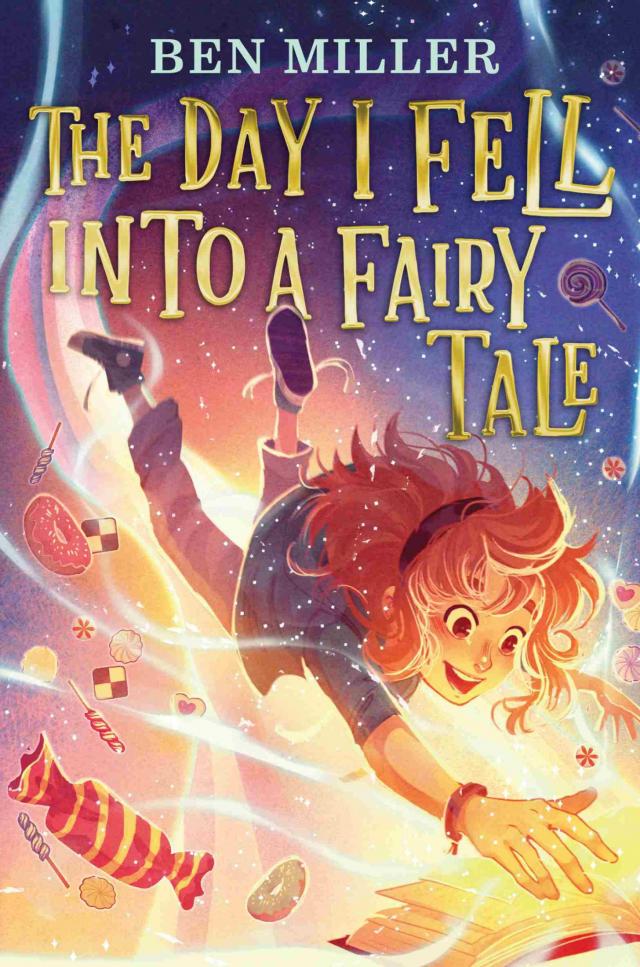
The Day I Fell into a Fairy Tale,
p.1


To my parents, Mick and Marion Miller, who gave me my love of reading
Prologue
Suddenly there it was. A fresh mound of earth, the size of a molehill, right in the middle of the common.
Only it wasn’t a molehill.
Not that anyone saw it form. It was the dead of night and a storm was raging, so the villagers were all safely tucked up in their beds, with their curtains shut and their electric blankets on.
But as they slept, the little mound of earth started to grow. And as the wind howled, and the rain lashed, it grew larger and larger. Higher and higher it rose, until it was the size of a haystack.
Lightning crackled in the sky, and thunder rolled out across the valley. The mound of earth began to shake and its peak trembled and quivered, until suddenly a gleaming white enamel flagpole popped out of the top!
Up and up climbed the flagpole, rising out of the ground like a beanstalk in a fairy tale. Once it had reached its full height, it paused before it, too, began to quiver and shake. Because the flagpole was just the beginning.
Cracks crazed their way across the common as the turf began to warp and split, and something truly enormous began to emerge.
A roof. A colossal aluminum roof! Up and up it buckled, pushed by the cinder-block walls emerging from the ground beneath it. Earth tumbled away, and like a giant rising from its slumber, an entire building began to rise. Girders popped into place, doorframes righted themselves, and sheets of plate glass found their grooves. Once everything was in place, the entire structure fell silent.
Still the rain lashed down, washing everything clean.
Then the heavy gray clouds cleared, and a full moon shone as bright as a penny. The wind calmed and the rain stopped.
In a nearby field, a cock crowed. It was morning now, and across the valley the pale dawn sky brightened to blue. Soon, the first rays of sunlight were chasing across the still-sleeping village. And there, at the bottom of the hill, smack-dab in the middle of the common, what had started as a mound of earth no bigger than a molehill was now a brand-new supermarket.
A breeze fluttered, and at the top of the flagpole, a maroon-and-gold flag unfurled. On it was a single word.
Grimm’s.
Still the rain lashed down, washing everything clean.
Chapter One
Lana was bored. It had finally stopped raining, but she had no one to play with.
Usually her older brother, Harrison, made up the most brilliant games: Knights of the Round Table, for example, or Soldiers and Zombies. But ever since he’d started middle school, Harrison had changed. He had become Serious. Even though he was on vacation too, all he did was sit in his bedroom and work.
After breakfast, when Lana had knocked to see if he wanted to play in the tree house, he had closed the door in her face without saying a word.
Now, ten minutes later, she had returned to check if he’d changed his mind, but found a large sign on his door that read:
VERY IMPORTANT HOMEWORK IN PROGRESS. DO NOT DISTURB.
I’m sure that’s really aimed at our parents, thought Lana. I bet he’s secretly hoping I ask him to play again.…
This time she decided not to knock and found Harrison sitting at his desk, concentrating hard on the books and papers in front of him.
“Didn’t you see the sign?” he said, without looking up. “What do you want?”
“I was just wondering if you’d like to play a game?”
Harrison still didn’t look up.
“We can play whatever you want. Boxers. Pirates. Police. I don’t mind!”
Harrison sighed and put down his pen. He took off his glasses and pinched the bridge of his nose. It was something Lana had seen their father do, and clearly Harrison thought it made him look grown-up and important.
“Lana,” he said. “I don’t have time to play games anymore. Do you know what an oxbow lake is?”
Lana didn’t.
“It’s a special kind of lake that’s formed when a river becomes too twisty. Anyway, I’m busy reading all about them.”
“Maybe after that?” she offered.
Harrison frowned. “Well, after oxbow lakes I need to learn about Archimedes.”
Lana looked blankly at her brother.
“He’s from ancient Greece,” said Harrison. “He’s basically the first scientist.”
“Sounds fun,” Lana said, which it most definitely did not. She tried her best not to look disappointed. It didn’t work.
Harrison’s face softened. A part of him did miss their adventures. For a start, Lana always threw herself into whatever game they played. There were few police officers so committed to maintaining law and order, and few zombies as determined to destroy human civilization as his little sister.
“Sorry,” he said. “We’ll do something soon, I promise.”
But Lana knew that wasn’t true.
* * *
It was time for drastic measures. Whenever she really needed cheering up, there was one place Lana loved to go: the dressing table where her mother kept her perfumes. Lana wasn’t really allowed to play with them, but there was something magical about all those bottles, with their strange names and fancy shapes, that she found hard to resist. So, she snuck into her parents’ bedroom and surveyed the entire collection, examining each one, until her eyes landed on a tall vial made from crimson cut glass, with the word Enchantment printed across the middle in swirling gold letters. She carefully removed the lid and took a deep sniff.
Suddenly her mother’s voice rang out very close by. “Oh, thank goodness! The rain’s stopped!”
Lana panicked, fumbling with the lid, and accidentally squirted the perfume into her left eye. “Ow!” she cried, burying her face in the crook of her elbow.
Her mother put her head around the door. She frowned and sniffed the air. “What’s that smell? Is it perfume?”
“I can’t smell anything,” said Lana. She quickly hid the bottle behind her back. Her eye was smarting, and a tear rolled down her left cheek.
“Are you okay?” asked her mother in concern.
Then it dawned on Lana: her mother thought she was upset.
“Harrison won’t play with me,” she said, quickly making a sad face.
Her mother nodded thoughtfully. “I know,” she said. “He’s worried about his exams.”
“But why?” asked Lana. “He’s only in his first year of middle school. Exams are AGES away.”
“He just wants to be prepared,” said her mother, with a note of worry in her voice. “You know what he’s like.”
“I miss him.”
“Oh, Lana. I’m sorry.” Her mother opened her arms and gave Lana a big cuddle. Lana felt her tears become real. “Your brother’s growing up. That’s what happens.”
Now that she had started crying, Lana found she couldn’t stop.
“Let’s go out and cheer you up,” said her mother decisively, determined to change her daughter’s mood. “Why don’t you come to Grimm’s with me?”
“Where?”
“Oh, it’s very exciting,” said her mother earnestly. “Overnight a supermarket seems to have sprung up from nowhere on the common! I saw it on my walk this morning.”
Lana sighed with disappointment. “It’s school vacation,” she said. “We’re meant to do fun things. And supermarkets aren’t fun.”
“Come on,” replied her mother. “I’ll buy you a treat.”
Lana’s ears pricked up. “What sort of treat? A book?” She might not be able to have fun adventures with Harrison, but if she could find a new book, she could at least read about far-off lands or daring escapes.
“Yes, if that’s what you want. Now, I’m going downstairs to tell your father that we’re going out. Hopefully, by the time you join me, all my perfumes will be back where they belong.”
Lana tried to look innocent.
“Including the one you’re hiding behind your back,” said Lana’s mother with a breezy smile.
Chapter Two
If there was one thing to say about Little Hilcot, the village where Lana lived, it was this: it never changed. As they drove down the hill from their cottage, everything she saw was achingly familiar. There was the same old blue mailbox, standing sentry outside the village shop, and there was the same old row of crooked houses, threatening to collapse onto the tiny village school. Last of all came Hilcot House, with its high yew hedge, where every summer the Gatcombe family hosted the village fete.
But as they made the turn out onto the common, Lana could scarcely believe her eyes. Her mother was right: there, where yesterday Lana was sure there had been nothing but grass, was the most enormous new supermarket. A freshly paved road swept them off the lane and through a neat brick arch into a colossal parking lot, with trees and shrubbery planted in an orderly fashion.
“Well, what do you think?” asked Lana’s mother, parking in one of the newly marked-out bays and turning off the engine.
“Where did all this come from?” asked Lana, gazing up at the shiny new building.
“I don’t know. I suppose they must have been building it through all the bad weather, when everyone was indoors? Although how they did it with no one noticing…” Lana’s mother trailed off, looking puzzled. “Anyway, shall we go and take a look around?”
They both climbed out of the car and headed to the entrance. Lana’s mother unhitched the first in an enormous line of brand-new shopping carts and swished in through the automatic doors.
By the time Lana caught up with her, she was already loading her cart with massive packs of toilet paper.
“Look at this!” her mother cooed. “Forty-eight rolls for the price of twenty-four! And it’s three-ply. We need to snap this up while we’ve still got the chance. As soon as word gets out, this place will be jammed!”
“That’s great,” replied Lana, trying to sound enthusiastic. “But do we really need that much toilet paper?”
“What’s this?” asked her mother in an awed voice. “Buy nineteen boxes of aluminum foil, and get the twentieth free? That’s unbelievably good value.”
“Can I go and find the book section?” asked Lana.
“That can’t be right…,” muttered her mother, in a world of her own. “Thirty-six bags of barbecue briquettes for the price of thirty? I wonder if that’s a misprint.”
Lana was about to say that they didn’t have a barbecue, but thought better of it. And while her mother continued shopping, she quietly slipped away.…
* * *
Grimm’s, it seemed, was enormous. After wandering aimlessly through a huge fruits-and-vegetables section, Lana found herself marooned in a never-ending row of baked goods that finally led to jams and preserves, which merged into cookies and cereals, before making her way through the frozen ready meals aisle and finding herself back at… fruits and vegetables. The shelves and fridges that bordered the aisles were double her height, and Lana began to lose hope of ever finding the book section.
She thought about asking for directions, but not only were there no other customers; she couldn’t see any staff either. The checkout lanes were empty, and there was no one behind the deli counter; the pharmacy and the café were silent. For one brief moment Lana thought she spotted someone stacking the freezers, but it turned out to be her mother, loading her overflowing cart with boxes of frozen pizza.
Lana was about to give up her book search, when she heard a peculiar scuffling noise that seemed to be coming from an aisle toward the far end of the store.
“Fiddlesticks!” rasped a high, nasal voice. “Rickety snickety fiddlesticks!”
Curious, Lana crept forward. There, standing on tiptoe, arms outstretched, struggling to place a large red leather-bound book on a high shelf, was an extremely odd-looking man. He was roughly Lana’s height, but looked much older—as old as her grandpa—and he was dressed in maroon coveralls with smart gold trim. His eyes were beady and brown, his nose and ears were enormous, and his large bald head was speckled with warts.
“Well, don’t just stand there, child!” he barked at her. “Help me!”
Lana leapt forward and placed her hands on the wide spine of the book, on either side of the man’s. His fingernails were long and yellow.
“Push!” The little old man strained. “Harder!”
Lana focused all her effort, but the book was extraordinarily heavy. Before she really knew what was happening, she toppled backward and found herself pinned to the floor, with the book sprawled open across her chest.
“You dropped it!” he spat.
“Sorry,” said Lana, squirming out from underneath. “I did try my best.”
As she spoke, her eye caught one of the illustrations. It was of a witch, with a long nose and a sharp chin, surrounded by a tangled forest.
“No peeking,” snarled the little old man, snatching the book. His face was level with hers, and Lana could see tiny white bristles on the end of his nose. “I’m putting it on a high shelf, away from nosy children like you.”
He was so defensive that Lana instantly wanted to know more about the book.
“Why does it need to be out of reach? What’s in it?”
“Fairy tales,” replied the little old man, hugging the book to his chest, as if he was worried that Lana might try to take it from him.
Fairy tales? Now Lana was really interested! “Can I see it?” she asked. “I’m allowed to buy a book as a treat, and I love fairy tales.”
“Not like these you don’t,” he said, frowning at her. “These are proper fairy tales, centuries old, much too scary for you. You should give that one a go instead.” He pointed to a dull-looking picture book on the lowest shelf. “It’s called The Little Tugboat Who Tried. A big ship breaks down, and a little tugboat tries to pull it to shore. Except the big ship is very heavy, almost too heavy, for the little tugboat.”
“And what happens?” asked Lana.
“Well, he keeps trying,” said the little old man, “and eventually he manages it.”
“Right,” said Lana, thinking that either the story wasn’t very interesting or the man wasn’t telling it quite right.
“Trust me,” he said, pushing Lana toward the picture book. “You’ll be much happier with this. Look, see? Lots of bright, friendly, safe pictures.”
He turned away from Lana, and standing on his tiptoes again, he hoisted the big red fairy-tale book onto the highest shelf he could reach. “There, out of harm’s way, that’s better.” And, without another word, he disappeared out of the aisle and around the corner.
Lana waited for a moment. Then, after a quick look around, she stretched up, pulled the red book down from the shelf, and then hurried off to find her mother. If the little old man was so determined to keep the fairy tales from her, then they must be good.
As soon as Lana was gone, the man peered back around the corner, a tiny smile on his face. “If you want a child to read something…,” he whispered to himself, “tell her it’s forbidden.”
* * *
“What on earth have you got there?” asked her mother, at the checkout. There was no one at the cash register, but she had piled everything from her cart high on the conveyor belt anyway.
“It’s a book of fairy tales,” said Lana proudly. “I’d like it as my treat, please.”
“Oh,” Lana’s mother said, and sneezed six times in quick succession. “Dust,” she croaked, and sneezed another eleven times. “Are you sure this is for sale? It looks very old.”
“Ummm…,” began Lana.
“Can I help you?” said a familiar voice, and Lana’s mother jumped. There, sitting by the register, was the little old man. Except now he had a dark brown mustache and was wearing a white collared shirt with a maroon waistcoat, a maroon-and-gold necktie, and a gold pillbox hat.
“Hello,” said Lana’s mother. “My daughter would like this book, but there’s no price on it.”
“Oh, would she?” he asked, fixing Lana with a stare. “How old is she?”
“Nine,” announced Lana.
“A young nine, or an old nine?”
“I’m sorry?” asked Lana’s mother. “What difference does that make?”
“These fairy tales are not… suitable for a young nine. An old nine, maybe.”
“I see,” said Lana’s mother, who really didn’t like being told what she could or could not do by anyone, let alone strangers. She opened the book and skimmed the contents page. “Oh yes,” she said, smiling. “I used to love these stories when I was little. We’ll take them, please.”
“As you wish, madam,” said the little old man. “But don’t say I didn’t warn you. That’ll be seventeen cents.”
Lana’s mother looked at him blankly.
“But with your introductory discount,” he said with a breezy smile, “I can do it for eleven.”
Once Lana and her mother had left the supermarket, the little old man grinned to himself once more. “And if you want an adult to buy something,” he muttered, “make it cheap.”
Chapter Three
Will you read to me?” Lana asked that evening, as her mother was tucking her into bed. “From my new book of fairy tales?”
“Of course,” said her mother, after she finished sneezing. “Let’s take a look at what we have.… There’s ‘Hansel and Gretel.’ That’s about a little boy and a little girl who get lost in the forest and find a house made of candy.”
“That’s so lucky!” said Lana. “I’d love to find a house like that!”
“Ah, well, that’s what Hansel and Gretel thought, only it was a trap.”
“A trap?” Lana’s eyes widened.