Destination unknown, p.22
Destination Unknown,
p.22


“Great crowd,” she said as the crowd approached Riverside Park at Seventy-Second Street.
“I can’t believe I’m here with my parents,” I said back softly.
“Go Ira and Dalia,” she responded, and I cracked up and smiled at her and took her hand in mine, and the three of us walked together in silence for a while.
Rick, for his part, walked with my dad. Until he saw someone that he knew, and then he ran over and hugged the guy, who was about his age, Black and tall and handsome. And then, suddenly, he was gone, and my parents walked alone in front of us, holding hands. And I think we were all thinking it: Please, God. Let that be someone for Rick to love.
I thought about the future. About how little I knew of what was going to happen, and whether this would be the last year of the AIDS Walk, because they’d find a cure, or whether, twenty years from now, it would be like this but massively larger. I hoped to God it wouldn’t be.
I looked over at CJ, who was the picture of great health, and again, I hoped God would hear me. Please let him live. Please let this amazing man live a long and happy life, because the world needs CJ. He is not done with the world yet, and the world, most definitely, is not done with him.
I just hoped I’d be there for the entire journey. And that it would be very, very long.
Present Day
You will always be the love of my life, CJ Gorman.
From those very first days, then learning about your “death sentence.” To those dicey early 90s, when we almost lost you to toxoplasmosis in ’92, and then again to cryptosporidium in ’94. I will never forget the sleepless night holding vigil by your bed at St. Vincent’s as you lay in your own filth, your breathing labored, and I tried to make some semblance of peace with a life after you.
It wasn’t a real peace. I lied to God that night. I said I’d be okay without you. But of course not. How could I be?
You are me, CJ, and I am you. You are my skin and my conscience and my spirit. We are intertwined. No one has ever known me like you. I have never known anyone the way I know you.
You made it through toxo and crypto and pneumocystis, and you went on disability and we hunkered down in our Chelsea studio. Sometimes we played the victims and wondered why this would happen to us, and sometimes we fought terribly, because you loved your stories and sometimes fiction and fact blurred with you and that was just your nature. And sometimes I forgot that I could do this, and wished that I wasn’t chained to a person who had to take medicines so many times every day, who had to run to the bathroom so frequently.
We marched and protested and got arrested and vowed this was our last time, but then we did it again and again and again, because it was something we could do. We needed to take action, just to keep our hopes alive.
You saw me through Rick’s painful death in ’95. You weathered every storm I had with my parents when I decided to produce off-off-Broadway. You buoyed me when that didn’t work, and you saw me through the raw early years of me trying to write, first nonfiction, then fiction.
And you somehow persevered. You made it through the mid-90s without too many issues, and then the protease inhibitors in ’96. We couldn’t believe … couldn’t allow ourselves to be optimistic because so many times before, our hopes had been dashed. But this was different. And suddenly your T cells, jumping, catapulting, from eight to two hundred to a thousand. And the virus in your blood suddenly undetectable, and all the weight gained back, and your face (mostly) full once again, full and vital and not the face of a young, naive CJ but a weathered soldier, somehow wiser, more real. Once you’ve weighed a hundred pounds at twenty-five, it’s hard to embrace vanity and artifice again, isn’t it?
And yes, in that haze of realizing you would live again, you needed to explore, and you needed to breathe, and you fell in love with Mark, and those were dark, dark days for me, CJ. The darkest. I didn’t know I could be so angry and still survive. I didn’t know if you would come back. I lost you all over again, and you will never be able to remove that hurt from my heart. Never.
But you did come back, and you nestled into me, and I welcomed you back into our life as a unit, and we grew in our careers, and we moved to Phoenix, and we aged, and we got min-pins, and we bought a Volvo, and we moved to the suburbs.
And now here you lie, next to me, snoring gently. Your once-wavy brown hair much shorter, thinner. And my love for you is so strong it hurts a little, still, to see you next to me and not be able to climb inside you and breathe as one, every minute, every day.
The Mormons believe marriage is eternal. We will never be Mormons. But eternal we shall be. We already are.
Thank you, CJ. Thank you for protecting me that first night at the Tunnel. And thank you for becoming my life.
If you’d have asked me back in 1987 where I’d be in 2022, I would have laughed.
Everywhere around me was death, and I was just coming of age as a gay person. I was lonely, precocious, and rebellious. I was three parts CJ to one part Micah, and it wasn’t completely clear how HIV was transmitted yet. I assumed from quite an early age that I would contract AIDS and die like so many other young gay men around me in New York City.
In fact, one of my earliest thoughts as a gay person was the misguided idea that I was going to be the youngest person ever to die of AIDS. There was no Internet to help me understand the facts; there was precious little information at all in the mainstream media.
That’s what it was like to come of age in the early days of AIDS, in the epicenter of the disease. I equated sex with death. I felt that who I was wasn’t worthy of living, and that no one really cared at all if people like me died.
Thirty-five years later, I’m still here. The guilt I feel about being spared HIV is too painful, so I try to avoid that line of thinking. What I can say is that my friends who passed away were the same as me, made of the same stuff. I think of them often and marvel at what they would have accomplished if given more time on earth. The loss of talent is beyond catastrophic.
I wrote this book so that people could experience what I experienced in that time and place. While this is a work of fiction, all references to 1980s people and places are historically correct, with two exceptions: I attended the AIDS Walk and saw the scene described, with the late Michael Callen singing “Love Don’t Need a Reason,” but it was the third annual AIDS Walk in May of 1987, not the fourth in 1988. And Brian McNaught’s book of essays On Being Gay was actually released in 1988, not 1987. The cameos of Larry Kramer and Marsha P. Johnson were taken from actual conversations each legend had with me when I was a teenager. I delivered meals every week for God’s Love We Deliver in 1988 and 1989. I attended several ACT UP meetings at the Lesbian and Gay Community Services Center on West 13th Street between the years of 1988 and 1990, though I was not an active member of ACT UP in that I never attended any of the major protests. This is something I still regret, that I could have done more and failed to do so.
I think this happened because I was sadder than I was angry.
When I think back to the eighties, I realize now that my anger was turned inward. The impact of having literally no representation of people like me in books and television and movies was that I got depressed, that I hated myself instead of hating the enemy: rampant homophobia. I bought into the idea that I was lesser than straight people, and I felt great shame about my burgeoning identity. After all, revealing my identity to my family had created huge tidal waves of angst and fury. I felt that I was the problem.
Oddly enough, for all the work I’ve done on myself over the course of three and a half decades, one of the best resources I’ve ever come across for truly exorcising the shame that came from coming of age during the early years of the AIDS pandemic is The AIDS Memorial on Instagram (@theaidsmemorial). This amazing project is made up of thousands of photographs and stories about those who we have lost to AIDS, and it has helped me see my own beating heart, along with those of all the incredible people we have lost to the disease. I find myself coming back again and again to these visual stories for the healing impact they have on my soul.
Destination Unknown is for everyone who has ever been made to feel ashamed of their identity, anyone who has ever been told that their lives are less meaningful because of who they are.
I hope you will see aspects of Micah and CJ in yourself, and I hope you will come to celebrate them.
Writing a book about a pandemic DURING a pandemic was a special kind of challenge.
While COVID-19 and AIDS were and are extremely different, much of the fear that the former brought out in me during the early days of the COVID pandemic reminded me of the fear I felt during the period of time in which Destination Unknown is set. There were days I just couldn’t face that fear, and many times I thought I might not finish writing this book.
I’m glad I got past that.
First and foremost I wish to thank Chuck Cahoy, my partner in life, who never doubts me even when I do. I love you with my whole heart. Thanks to my mother Shelley, my father Bob, stepmother Roz, sister Pam, and brother Dan. Your loving care means everything to me. To Greg and Terry and Brian and Ray and Joc and Joe and Jim and Lisa and Matt and Kriste and Steve and all my other dear friends: You put up with a lot when I’m struggling, and you stick around. Thank you. A huge thanks to my agent, Linda Epstein, for sticking by my side during a hellish year-plus. To my editor, David Levithan, I could not do this without you. You help make sense of the messy parts. To my Scholastic family, I love you. Thanks for all you do.
Thank you so much to Ed Wolf, who walked me through the medical aspects of what it would mean for someone to test positive in 1987. Thanks to Richard Dworkin for chatting with me about Michael Callen, who I idolized. And to my fans: I don’t know how to express to you just how much your support means to me. And finally, to all my friends who died in the 1980s and 1990s: I miss you so damn much.
Bill Konigsberg is the author of many acclaimed novels, including The Bridge, The Music of What Happens, Honestly Ben, the Stonewall Book Award– and PEN Center USA Literary Award–winning The Porcupine of Truth, and the Sid Fleischman Award for Humor–winning Openly Straight. In 2018, the National Council of Teachers of English’s Assembly on Literature for Adolescents (ALAN) established the Bill Konigsberg Award for Acts and Activism for Equity and Inclusion through Young Adult Literature. Bill lives in Phoenix with his husband, and can be found online at billkonigsberg.com.
Copyright © 2022 by Bill Konigsberg
All rights reserved. Published by Scholastic Press, an imprint of Scholastic Inc., Publishers since 1920. SCHOLASTIC, SCHOLASTIC PRESS, and associated logos are trademarks and/or registered trademarks of Scholastic Inc.
Lyrics from “Love Don’t Need a Reason (What We Don’t Have Is Time)” by Peter Allen, Marsha Malamet, and Michael Callen © 1987 Woolnough Music, Malamution Music, and Tops and Bottoms Music. All rights on behalf of Woolnough Music administered by Warner-Tamerlane Publishing Corp. Reprinted by permission.
The publisher does not have any control over and does not assume any responsibility for author or third-party websites or their content.
While inspired by real events and historical characters, this is a work of fiction and does not claim to be historically accurate or portray factual events or relationships. Please keep in mind that references to actual persons, living or dead, business establishments, events, or locales may not be factually accurate, but rather fictionalized by the author.
Library of Congress Cataloging-in-Publication Data available
First edition, September 2022
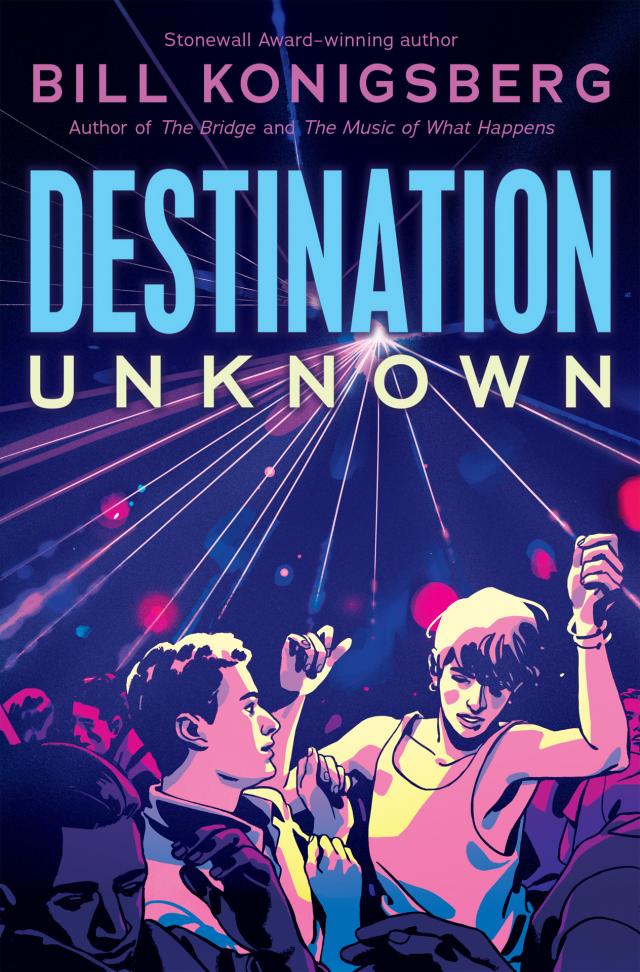
Jacket art © 2022 Partick Leger
Jacket design by Christopher Stengel
e-ISBN 978-1-338-61806-8
All rights reserved under International and Pan-American Copyright Conventions. No part of this publication may be reproduced, transmitted, downloaded, decompiled, reverse engineered, or stored in or introduced into any information storage and retrieval system, in any form or by any means, whether electronic or mechanical, now known or hereafter invented, without the express written permission of the publisher. For information regarding permission, write to Scholastic Inc., Attention: Permissions Department, 557 Broadway, New York, NY 10012.
Bill Konigsberg, Destination Unknown