Heroes for my daughter, p.6
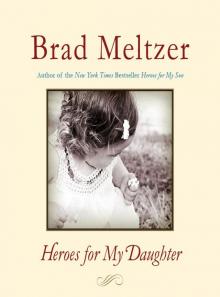
Heroes for My Daughter,
p.6


He says the secret to happiness comes from developing love and compassion for all people.
For your family.
For your friends.
Even for your enemies.
No question, it’s a lesson that’s easier said than done.
But whatever side you’re on—whether you’re arguing about religion, politics, or anything else—it is a message worth sharing.
Remember that not getting what you want is sometimes a wonderful stroke of luck.
—THE DALAI LAMA
TROUBLEMAKER
ABRAHAM LINCOLN
Lawyer. Speaker. President.
One of America’s greatest leaders, Abraham Lincoln lost eight elections. Despite those defeats, he became the sixteenth president of the United States and held the country together during the bloodshed of the Civil War.
Today there is a phrase for it: political suicide.
It’s what happens when you say something that most people disagree with.
In 1858, while Abraham Lincoln was trying to get elected in Illinois to the United States Senate, his rival, Stephen Douglas, represented “most people.”
Douglas said that blacks had no rights.
He said that the promise of life, liberty, and the pursuit of happiness did not apply to them.
The Supreme Court of the United States agreed.
But Abraham Lincoln didn’t.
Lincoln stood up.
Lincoln spoke his mind.
And Lincoln lost.
He was sent home with nothing.
It was political suicide.
But it was worth it.
I am not bound to win, but I am bound to be true. I am not bound to succeed, but I am bound to live by the light that I have. I must stand with anybody that stands right, and stand with him while he is right, and part with him when he goes wrong.
—ABRAHAM LINCOLN
TRAILBLAZER
THURGOOD MARSHALL
First black U.S. Supreme Court justice.
A legendary lawyer, Thurgood Marshall made his name arguing some of the greatest cases of the civil rights movement, including Brown v. Board of Education. As a Supreme Court Justice, he spent decades fighting for the disenfranchised.
While researching this book for you, I was lucky enough to talk to Thurgood Marshall’s son.
I asked him about his father and all that he’d achieved.
I asked him about what kind of person he was.
I asked what he remembered most about him.
But what I really wanted to know was “How?”
How did he get there?
How did Thurgood Marshall manage to take one of the world’s most important cases to the Supreme Court—and win?
I was hoping Marshall’s son would reveal some great secret. And he did.
He told me that everyone always remembers his father’s biggest case, Brown v. Board of Education.
They remember how it ended school segregation and paved the way for the civil rights movement.
But he explained, his father tried thirty-two cases before the Supreme Court. And you don’t get the big case until you do all the ones that come before.
For a moment, I sat there, kicking myself for missing the obvious.
How did Thurgood Marshall get his big chance?
The same way I hope you get yours.
You earn it.
The legal system can force open doors, and sometimes even knock down walls. But it cannot build bridges. That job belongs to you and me.
—THURGOOD MARSHALL
EYEWITNESS
DOROTHEA LANGE
Photographer.
Through the photographs she took, Dorothea Lange gave a human face to the poor, the hungry, and the unemployed during the Great Depression.
In her early unforgettable photographic work, she took pictures of people standing on breadlines during the Great Depression.
From there, the Franklin Roosevelt administration took notice and asked Dorothea Lange to take photos of struggling migrant workers.
The result was Migrant Mother, the photograph on the opposite page of thirty-two-year-old Florence Owens Thompson, whose husband and seven children were sheltered at a pea picker’s camp.
The picture gave the Depression a face that would never be forgotten.
In 1942, the government again approached Lange, asking her to document the internment of Japanese Americans. They didn’t plan to close the camps, only to record them.
The more than eight hundred photos she took showed the truth about the camps: that our own government evacuated people from their homes and forced them to live in horse stalls and bare shacks.
When the government saw the results, they impounded the photos.
It’s because they knew what Dorothea Lange’s true power was.
Her photos didn’t just tell stories.
They made us see the truth when it was much easier to hide from it.
The camera is an instrument that teaches people how to see without a camera.
—DOROTHEA LANGE
WARRIOR
HANNAH SENESH
Poet. World War II fighter.
Determined to fight during World War II, Hannah Senesh was part of a secret British operation that parachuted into Yugoslavia. She was only twenty-two at the time. She was the only woman in the group of paratroopers.
She grew up in a nice home, just like you. She was full of personality, just like you. And she loved writing poems.
But in 1938, as Hitler rose to power and the Hungarian government started passing laws against the Jews, Hannah’s classmates began spitting at the Jews.
In 1939, outraged and fearful, Hannah made her way to what is now called Israel.
But as World War II escalated and information started arriving that Hitler was killing Jews, Hannah Senesh decided she couldn’t just stand there. Her mother was still in Hungary.
Hannah had to fight back.
In March 1944, the young poet became part of a small group that parachuted into Nazi-occupied Yugoslavia, with the goal of crossing into her hometown in Hungary.
Their plan was to help Jews fight the Nazis and rescue those who needed help.
After three months, she finally entered Hungary. She was captured immediately.
In prison, they tried to break her. They wanted the vital radio codes that the British had trusted her with. Hannah never gave in.
They threatened her, beat her, and tortured her. She never gave in.
Even when they arrested Hannah’s mother and said they’d kill her, too,
Hannah Senesh never told the Nazis what they wanted to know.
In the end, they convicted her of treason. She was sent to face the firing squad.
Forever defiant, she wouldn’t beg for a pardon.
She even refused the blindfold so her executioners would have to look her in the eyes.
But let me tell you right now, I didn’t pick Hannah Senesh as a hero because she died.
I picked her because she fought.
And fought.
And fought.
That’s why she’ll always be remembered.
There are stars whose radiance is visible on Earth though they have long been extinct. There are people whose brilliance continues to light the world even though they are no longer among the living. These lights are particularly bright when the night is dark. They light the way for humankind.
—HANNAH SENESH
INSPIRATION
RANDY PAUSCH
Professor. Author of The Last Lecture.
A month after being told he had only three to six months left to live, Professor Randy Pausch gave his last lecture, “Really Achieving Your Childhood Dreams.” But the reason millions watched online—and bought his book—was because it was never a speech about dying. It was about living.
His last lecture has been heard by millions, which is why Time magazine named him one of the world’s most influential people.
But on the day after Randy Pausch died, his six-year-old son, Dylan, walked up to one of his father’s friends and asked, “Is cancer solvable?”
His father’s friend told him the truth: there was no cure for pancreatic cancer.
This clearly didn’t sit well with Dylan, who relayed what his father had told him during the last few days before his death: My dad told me I have it within me to solve problems. How could this one not be solvable?
And that’s exactly why Randy Pausch is so important.
On those days before he died, when millions upon millions of people were watching his lecture, Randy spent his final moments with an audience of three. His three children.
Was the message heard?
Last summer, Randy’s son Dylan went to Capitol Hill. To lobby for pancreatic cancer research.
So yes, it’s great when millions of people hear your message.
But it’s far more important when even just one acts on it.
When it comes to men who are romantically interested in you, it’s really simple. Just ignore everything they say and only pay attention to what they do.
—ADVICE RANDY PAUSCH PASSED TO HIS DAUGHTER
EXPLORER
SALLY RIDE
Astronaut. First American woman in space.
On June 18, 1983, mission specialist Sally Ride broke through the sound barrier, then the atmosphere. For 147 hours, she hovered above us all, inspiring a new generation of astronauts.
When Sally Ride was a child, her teachers used to wheel in black-and-white TVs so the students could watch the space launches.
Back then, only men could be astronauts.
Women were grounded.
Sally Ride didn’t believe that.
So when NASA finally decided to accept women as astronauts,
and she saw the ad that NASA placed in the student newspaper at her college,
Sally Ride applied.
And on June 18, 1983, she became the first American woman to venture into space.
To this day, NASA has never said why she was the first woman chosen.
Some say it was because of her PhD in the field of physics.
Others say it was her physical resolve and athletic ability, which she honed as a tennis player.
And still others say it was because she was fearless.
In truth, it was probably all those things.
But it was also because, when she saw that ad in the newspaper, she saw an opportunity.
And grabbed it,
daring to achieve what no woman had done before.
All adventures, especially into new territory, are scary.—SALLY RIDE
PRINTER
BENJAMIN FRANKLIN
Founding Father. Big thinker.
The embodiment of American ingenuity, Benjamin Franklin led a military revolution—and an intellectual one.
He started as a printer.
From there, he became an author, publisher, thinker, and satirist.
He’s the genius who invented
bifocals,
the lightning rod,
the Franklin stove,
a rocking chair attached by string to an overhead fan,
even the first subscription library.
But he refused to patent his famous findings, since he believed they should benefit everyone.
When he flew a silk kite—with a wire sticking up from the top, and a key attached to the base of the wet string—he helped pave the way for us to understand electricity, making him one of the most celebrated scientists in the world.
And of course, he signed—and worked on—all three of the major documents that helped establish the United States: the Declaration of Independence, the Treaty of Paris, and the U.S. Constitution.
But of all Ben Franklin’s amazing attributes, his best was this:
He never forgot where he came from.
No matter how big his reputation grew, throughout his life, Franklin continued to sign his name: B. Franklin, printer.
He did it because Benjamin Franklin’s true belief was in the power of ordinary citizens.
But here’s the greatest part: No one—absolutely no one—is ordinary.
He that can have Patience, can have what he will.—BENJAMIN FRANKLIN
Tell me and I forget. Teach me and I remember. Involve me and I learn.
—BENJAMIN FRANKLIN
UNCATCHABLE
WILMA RUDOLPH
Fastest woman on earth.
Although disabled by polio as a child, Wilma Rudolph went on to become the world’s fastest woman, winning three Olympic gold medals.
When you’re a runner, how you launch at the start of a race is vital to your success.
Wilma Rudolph had a tough launch.
Born two months premature, she weighed just four and a half pounds.
African American in Tennessee, her family was poor, and she was the twentieth of her father’s twenty-two children.
When she was four, she got polio, a disease that robbed her of the use of her left leg.
When she was six, the doctors had her wearing metal leg braces.
To get to the hospital for physical therapy, her mother rode with her in the back of the segregated Greyhound bus.
When she was nine, the leg braces came off.
Soon, the girl who struggled to walk … began to run.
No one moved as fast.
At just sixteen, she won a bronze medal in the 1956 Olympics.
And at the age of twenty, Wilma Rudolph became the first American woman to win three gold medals in one Olympics.
Without a doubt, how you start in the race matters.
But it doesn’t determine where you’ll finish.
My doctors told me I would never walk again. My mother told me I would. I believed my mother.
—WILMA RUDOLPH
IRREPRESSIBLE
DOTTY RUBIN
My grandmother.
The greatest dancer and show woman on the face of the earth.
I called her “Nanny.” She’s my grandmother. Your great-grandmother.
And when she gave birth to my mom, the doctors told her that my mom had a disorder in her hips and that she’d never be able to walk.
Nanny took her to the House of St. Giles, one of the first hospitals in the country to deal with orthopedic care for children. They got my mom walking.
But here’s what I love:
Ten, twenty, thirty, forty years later—Nanny never forgot what that hospital did for her.
Even when she was in her seventies and eighties and had almost no money, we’d find checks for five dollars … for two dollars … and every year she’d send a check to St. Giles.
Think about your own life.
Think of how easy it is to focus on the bad and how people have wronged you.
Nanny never forgot the good that she was given in this world.
Even as her life got harder—when her husband died—everyone thought she’d never recover. But she did.
And when she went blind, we thought she’d never recover. But she did.
And when she went practically deaf. Same thing.
“How you doing, Nanny?” I’d yell into her hearing aids when we went to visit on the weekends.
“I can’t see anymore, darling,” ninety-year-old Nanny would say. “But I can’t complain.”
She was wrong. She could’ve complained. She was blind and deaf and living without her beloved husband and daughter, who both were already dead.
She could’ve complained all day long.
But no matter how bad it got, Nanny was … irrepressible.
Her optimistic spirit lifted her—and therefore lifted all of us.
She came from nothing—no money. No nice house in the suburbs.
But in life, in her family, she found everything.
Never goodbye, darling.
—DOTTY RUBIN, who when you said “Goodbye” would always insist on “See you later.”
DESIGNER
TERI MELTZER
My mom.
It was the worst day of my professional life.
My publisher was shutting down, and we had no idea if another publisher would take over my contract.
This was terrifying to me. I was racked with fear, feeling like I was watching my career deteriorate.
But as I shared my fears with my mother, her reaction was instantaneous: “I’d love you if you were a garbageman.”
It wasn’t anything she practiced. It was just her honest feelings at that moment.
To this day, every day that I sit down to write, I say those words to myself—“I’d love you if you were a garbageman”—soaking in the purity and selflessness of that love from my mother.
Her name was Teri Meltzer. And she’s who your brother Theo is named after.
Now you’ll understand how I love you.
—TERI MELTZER, on the birth of each of my children
Not everyone is nice like that.
—THE RECEPTIONIST IN MY MOM’S DOCTOR’S OFFICE, when she heard that my mom had died from breast cancer. Always remember: the truth is what people say behind your back.
FIGHTER
CORI FLAM MELTZER
Mother.
She’s the most important hero in here.
Your mom.
When she was in fourth grade, a category-5 hurricane hit the Dominican Republic.
She was only nine years old, but Cori heard that people there were suffering.
Some people wrote checks. Others made personal donations.
Your mother’s solution?
She started a club. To collect canned goods.
Soon, they were running a school-wide food drive.
Even in fourth grade, she was smart: the more people she involved, the more hurricane victims she could help.
I love that story.
And I love it because, all these years later, one of your mother’s favorite expressions is this:
People don’t change.
She’s actually wrong.