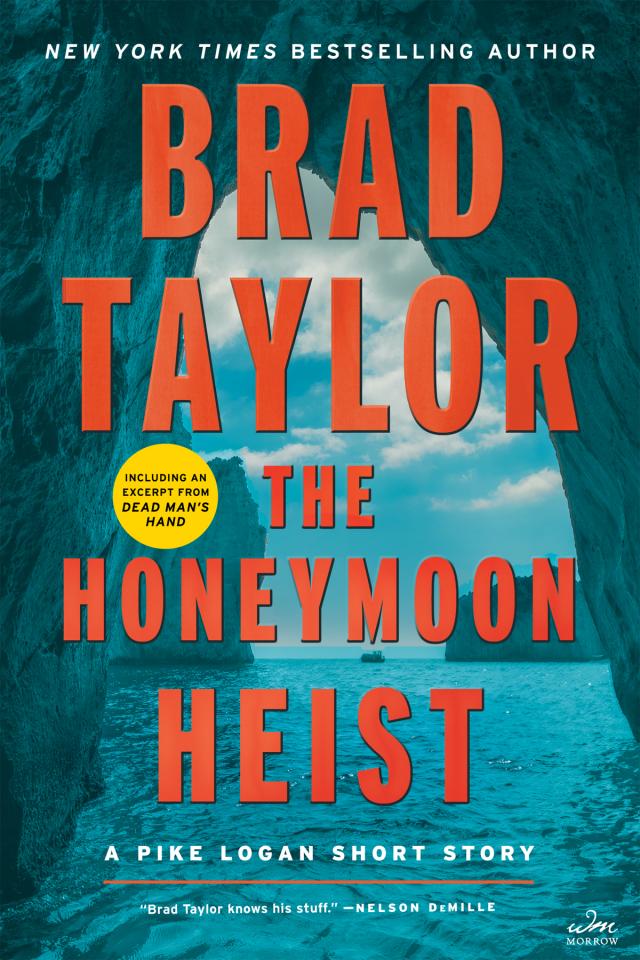
The honeymoon heist, p.1
The Honeymoon Heist,
p.1


Contents
Cover
Title Page
Author’s Note
Chapter 1
Chapter 2
Chapter 3
Chapter 4
Chapter 5
Chapter 6
Chapter 7
Chapter 8
Chapter 9
Chapter 10
Chapter 11
Chapter 12
Chapter 13
Chapter 14
Chapter 15
Chapter 16
An Excerpt from Dead Man’s Hand Laurinburg Airfield, North Carolina
About the Author
Also by Brad Taylor
Copyright
About the Publisher
Author’s Note
I don’t really get a chance when writing my novels to explore the various characters in as much depth as I’d like—because the novels themselves have a trajectory all their own. Sometimes it’s just fun to dabble in the “what-ifs” of the world, and that’s what this is. Readers of the series will know that Pike and Jennifer got married, but there is no real introspection on what that meant. What would a honeymoon involving Pike, Jennifer, and Amena look like? It most certainly wouldn’t be your standard affair, and so I decided to flesh that out here. Hope you enjoy!
Chapter 1
Buck Thompson didn’t look like a master art thief. He looked more like a stevedore. Six feet tall, with a full beard and scars on his knuckles, he was a portly man with wide ears, each now sprouting hair like a werewolf as he grew older. He tended to flannel, work boots, and Carhartt jackets. He was the last person someone would suspect of being an art thief. Drugstore or gas station? Sure, that would fit, because he had, in fact, robbed both at one time or another. But he was smart, his intelligence hidden beneath the flannel.
He’d lucked into a piece of art that was worth over one hundred million dollars, and was now trying to figure out how to translate the canvas into money. And had come upon a wild scheme that just might work.
To the man in front of him, examining a seascape painting, he said, “Can you do it? Can you camouflage the painting to look like a Caravaggio?”
“Yeah, I can do it, but anyone who looks closely will see it’s a forgery.”
“That’s the point. It’s supposed to be a copy. Hell, there are twelve known in existence. The man who owns one is the guy that’s going to assume this forgery for display. Nobody’s going to inspect it—unless it has glaring deficiencies. Can you do that? Using the original as a guide?”
“Why does he want two?”
“He doesn’t. We’re going to confuse this one with the other one he owns. That’s all.”
The old man in front of him looked more like a janitor than a painter, but that was also expected. His name was Miles Turtledove, and he’d been a wizard at armored car robberies in his youth, right up until he wasn’t. He’d been remanded to Attica prison for thirty years, which is where Buck had met him, and where Miles had learned he had a talent for painting. A unique talent. Miles could duplicate any painting on earth, and if he used the exact same materials—canvas, wood, type of paint, whatever—it was hard to discern who was the imitator and who was the master.
Miles had never used his talent for ill-gotten gains before, mainly because he didn’t need to. He’d become somewhat of a local celebrity in New York with his works, because of both his bad-boy past and his skill. Want your own Mona Lisa? He could give it to you, right down to the shadows. Everyone knew it was a fake, but it was so close to the real thing that it gained him a following. He’d become a little bit of his own celebrity, with moneyed people in Manhattan clamoring for one of his creations. Since his parole from prison he’d made a lot of cash off his skill, but this was the first time he’d been asked to use it for a crime.
Not that he really cared. With the amount of money involved, it would be worth the risk.
Buck continued, “The main thing is that he has to be able to strip off the stuff you’re doing to the original painting. He has to be able to get the painting underneath. Nobody cares about your skill on this one. Can you do it?”
Miles turned around and said, “How the hell would I know? You came up with this. Yeah, I can paint over the rice paper, and yeah, it’ll look pretty good, but I can’t promise it won’t damage what’s underneath.”
He pointed a brush at Buck, saying, “If you believe this is going to be something like The Thomas Crown Affair, where someone just hoses the painting down, revealing what’s underneath, things don’t work that way.”
Truthfully, Buck did think that. In fact, the movie had given him the idea, but he had no expertise in painting whatsoever.
He said, “As long as it can be removed. That’s the main thing. He can do his own restoration when it’s done.”
Miles chuckled and said, “Well, I’m using a weak oil-based paint as the core, and a water-based paint on the layer, but truthfully, this painting should have been restored before I even started.”
Known as Rembrandt’s The Storm on the Sea of Galilee, it was the master’s only known seascape, and had been prominently displayed at a place called the Isabella Stewart Gardner Museum until March 18, 1990. On that night, thirteen works of art were stolen in what would become the largest art heist in world history, valued at over half a billion dollars. None of the works were ever recovered, and most of the men suspected of involvement had died—some violently, others by natural causes.
Buck’s ex-wife was the cousin of a friend of a man who’d apparently been involved, and when that cousin had died seven years ago, he’d been asked to clean out the barn on the outskirts of Boston to help out the family, cataloguing everything and placing the things of value in storage. He’d grumbled, because ordinary labor was anathema to him—especially when he wasn’t getting paid—but his ex-wife had promised a relief from two months’ alimony, and so he’d agreed. Then he’d found the rolled-up canvas.
He immediately knew what he held, as the Gardner Museum heist was literal lore in Boston’s local crime scene. He’d ransacked the place at that point, but none of the other paintings were found. That didn’t really matter to Buck, as the painting he held was worth over one hundred million dollars. The problem was how to unload it because everyone knew it had been stolen.
He’d done some research and found that that was the biggest obstacle. As soon as such a painting became available, with the requisite hooks out for buyers, invariably the only one who bit was law enforcement.
In the end, there was just no way to sell a stolen masterwork unless you were hired by the person who wanted it. Putting little teasers out into the art world, hoping to get someone interested, it invited all the wrong sorts of interested. History was replete with spectacular heists that had netted absolutely nothing but a jail sentence. He was sure that was the reason none of the Gardner paintings had ever surfaced. Since finding the canvas seven years ago, he’d studied up on the phenomenon, and had learned that hard truth.
Paintings were different from other thefts of value, such as gold statues or famous jewels. For those, the gold could be melted down or the jewels broken up—at a steep loss from the cultural value, but a value, nonetheless. For art? What are you going to break up and sell? The paint? You had to have someone willing to buy the painting, and no collector would touch a piece of art outside the system—especially if he knew it was stolen from a brazen heist.
The latest he’d read about was a 2007 daylight robbery in the Jules-Chéret Fine Arts Museum of Nice, France, where gunmen walked away with over one hundred million in art. Three years later, they were desperate to offload the treasure but could find no buyers. There was only one who showed interest, a Russian member of organized crime, and they’d eagerly attempted to sell. He turned out to be an FBI agent, the paintings were recovered, and all the men went to jail.
The only way to succeed in such a heist was to have a buyer on board before the theft, and that’s what Buck decided to do: find a guy who would have hired him in the first place. But that was no easy task.
He needed someone who didn’t care about the provenance, but was willing to take the risk of purchase, be that to hang in his basement bar next to a Rolling Rock beer poster or simply to put in a safe because he knew he owned something secret. And Buck had a few contacts to make that happen—but he needed to be careful. Unlike blaring loud and wide that he had the canvas, he’d spent seven long years tracking down a buyer, never being loud enough to attract attention.
Using contacts within the Irish Mafia in Boston, he’d made connections with the Italian Mafia, and then had springboarded into the real world of mafioso work in Italy, finding a buyer: a man from Naples, Italy, who was extremely rich, and apparently extremely connected to the underworld. The kicker was he collected fine art.
He’d never been arrested, never even been openly accused of wrongdoing, but everyone in Italy knew what he represented. He was real. There was no way he was an FBI agent pretending to be a Russian oligarch.
The dance had taken over a year, but eventually, they’d come up with a plan, and now it was up to Buck to make it happen.
The rewards were incredible, but so was the risk. If anything went wrong on this, he knew that he was the expendable pawn. There was no way that the man in Naples would chance getting arrested, and Buck understood he was the only linkage for that to happen. If things went sideways, the Italians wouldn’t allow him to be arrested.
If something went wrong, he was a dead man walking.
Chapter 2
I tried to wrestle the wheel away from Knuckles, saying, “I’m the one who needs the practice here! Let me do it.”
He shoved me aside. “This requires touch. You’ll wreck the boat, and it’s my ass on the line here. My name is on the rental.”
I said, “That was because I thought being in the Navy actually mattered. You don’t know anything more than I do about driving a boat. And you won’t be there in Positano. Get out of the way.”
Knuckles was a Navy SEAL, which meant I’d thought he knew something about boats simply because he was in the Navy, so I’d had him put his name on the rental, but it turned out, he was as bad as I was when it came to watercraft. He didn’t know a damn thing about boats, other than how to dive off one into the water. I’d flown him down to show me the ins and outs of boating before our trip, only to have him look at the widget in question, figure out how it worked, then lecture me on how it worked.
In Charleston, South Carolina, one didn’t need a boat license to rent a watercraft, but I did for Italy—well, I did if I wanted to rent anything larger than a johnboat—so I was supposedly getting some instruction from Knuckles before I took the test, which had so far proven futile.
I’m not sure why I thought he’d be a help, because his Navy time certainly did him no good. Hell, at one point, I’d even owned a sailboat here in Charleston. An extreme fixer-upper that I’d lived on for a time. I’d never taken it out on the water because it wasn’t seaworthy—but apparently I knew more about boats than Knuckles did, and I was from the Army.
We’d spun around Charleston’s harbor, each taking turns going up and down the Wando River, gradually getting faster and faster as we tried to one-up each other, until we’d eventually tired of the back-and-forth. We’d driven to the mouth of Shem Creek for a little bit of an afternoon siesta, and Knuckles was refusing to leave the cockpit.
Jennifer had had enough.
Behind me, she said, “You guys are absolutely pathetic. Pike, I’m getting the boat with the skipper.”
We both quit fighting, me turning around and saying, “You can’t do that. I can drive the boat.”
“No, you can’t. Amena has more maturity than you two. There is no way I’m getting on a boat alone with you in Italy.”
“You won’t be alone. Amena will be with us.”
Amena was my adopted daughter, currently sitting on a bench at the back of the boat and looking at me disapprovingly. I could tell she was thinking about siding with Jennifer, which I needed to short-circuit.
I said, “Right, Amena? All for one and one for all?”
She slid her eyes to the right, glancing at Jennifer, and I knew she was about to agree with Jennifer not because of my boating skills, but because of what had happened earlier.
Before we’d left for the harbor, Amena had come out of her bedroom in a bikini, with a bottom half that looked like it had less fabric than a dishcloth and the top trying mightily to accent her assets that weren’t there yet. It was a nonstarter for me. She was only fourteen, but she was exotic, like something only seen in magazines. It was hard to tell where she came from, with hazel eyes, dark skin and a lithe body, and I didn’t think the bikini was appropriate.
In my eyes, bikinis had a gap. If you were five or six, wear them all day long, but after that, until you were sixteen or so, you wore a one-piece. I just didn’t think it was right for a fourteen-year-old to wear a bikini—especially her, because of how attractive she was. She didn’t get it, but I did. When she looked in a mirror, like every other teenager, she saw nothing but flaws, but I saw what others would, and a bikini at that age was unseemly. Younger girls, fine. Older women, fine. In between, where predators lived, give it a rest.
She’d become incensed, because she was all about becoming an “American” and believed I was being a prude. Which, of course, I was. She’d seen the Kardashians on YouTube and television and thought that was something to emulate. I thought it was something to burn. Then I had become incensed when I learned Jennifer had bought it for her.
We’d had a little bit of a standoff when I’d found out that they’d gone shopping precisely to get the swimsuit. Jennifer had ripped me up and down about my views, which honestly surprised me. Amena was, after all, our daughter now. Jennifer said she wouldn’t wear a bikini either, asking me if we had any potato sacks for the boat, and that was the end, because Jennifer not wearing a bikini on a boat would have been a travesty.
Which is to say, I lost. The final nail in the coffin was Amena telling me I’d only be happy if she wore a burka. That was a deep cut, because she’d fled Syria from the Islamic State, who wanted every female to wear a burka.
Knuckles kept the boat at idle, heading into Shem Creek, and Amena looked at me with hooded eyes. I waited, but knew she was going to support my side, no matter what I’d said earlier. Because at the end of the day, she was a pirate just like I was, and she had a connection to me that no stupid argument could break. She was wearing the damn bikini, after all.
She said, “Let’s see him park it and then make a decision.”
Knuckles grinned, stepped back and said, “All yours. Don’t wreck the boat.”
I said, “Okay then, all hands on deck. Amena, get the bumpers ready. Jennifer, get the throw line.”
We puttered into the mouth of Shem Creek, passing the shrimp boats tied to the docks, and headed to Red’s Icehouse, a low-country staple of boats and boozing. I passed a bunch of idiots on paddle boards lazily heading out to the mouth of the creek, not realizing that when the tide reversed, they’d be paddling their asses off just to maintain their position, ending the day with a sunburn and sore muscles.
Yeah, that’s from experience.
We pulled up to the dock of Red’s, with Amena looking at me intently and Knuckles shouting all sorts of crap like he knew what he was talking about. But he didn’t.
I slid the boat in next to another one, which is how Red’s did its docking—with each boat tied to the one next to it—and Amena’s gaze never left my eyes. She really didn’t want to screw up, which is something I loved about her. If we’d have been hit with an iceberg and the boat was about to sink, she’d still have held those bumpers waiting on me to give her the word.
I flicked my head, and she dropped the bumpers. I slid next to the boat, gently kissing it, and Jennifer tossed the deckhand the rope. Within seconds, we were tied up. I said, “See, I can do this. It’s not that hard.”
Knuckles said, “You’re just lucky. You almost slammed into that other boat.”
Which was a lie.
Everyone at the bar had watched us approach, and I could see the men ogling Jennifer. Which I knew would happen. Long and lean, Jennifer looked like a surfer, with blond hair stuffed into a baseball cap and an athletic motion that told anyone who was looking that she was more than their equal. It actually gave me pleasure, because the entire point of this expedition was to get ready for our honeymoon, and I was the one with her.
Jennifer and I had finally tied the knot and become officially married, not the least because we needed to be a “parenting unit” for the adoption of Amena, and Jennifer had demanded a honeymoon. Like, a real one. Not some three-day Caribbean cruise or a beach house on the Isle of Palms here in Charleston. So, she’d done the research and found the town of Positano on the Amalfi Coast of Italy, at a hotel called the Villa Magia—which was rated as one of the best hotels in the universe.
With less than a dozen rooms, and a staff at your beck and call, she’d booked it, spending the better part of our yearly wages. She’d started researching various excursions, and had come upon a boat trip to Capri, complete with a captain. I’d balked at that, deciding I could be my own captain and save some money, and here we were, me learning how to drive a boat from a guy who didn’t know any more than I did. But that didn’t really matter in Charleston.
Most people here faked driving a boat just like Knuckles and me, with everyone apparently thinking the engine was powered by Bud Light.
Jennifer put on a cover-up, and Amena followed suit, because she did whatever Jennifer did. She, like Amena, had no idea of her effect on the opposite sex, which I just loved, because I wasn’t what you’d expect to see with her. Knuckles, yes. Me, no.