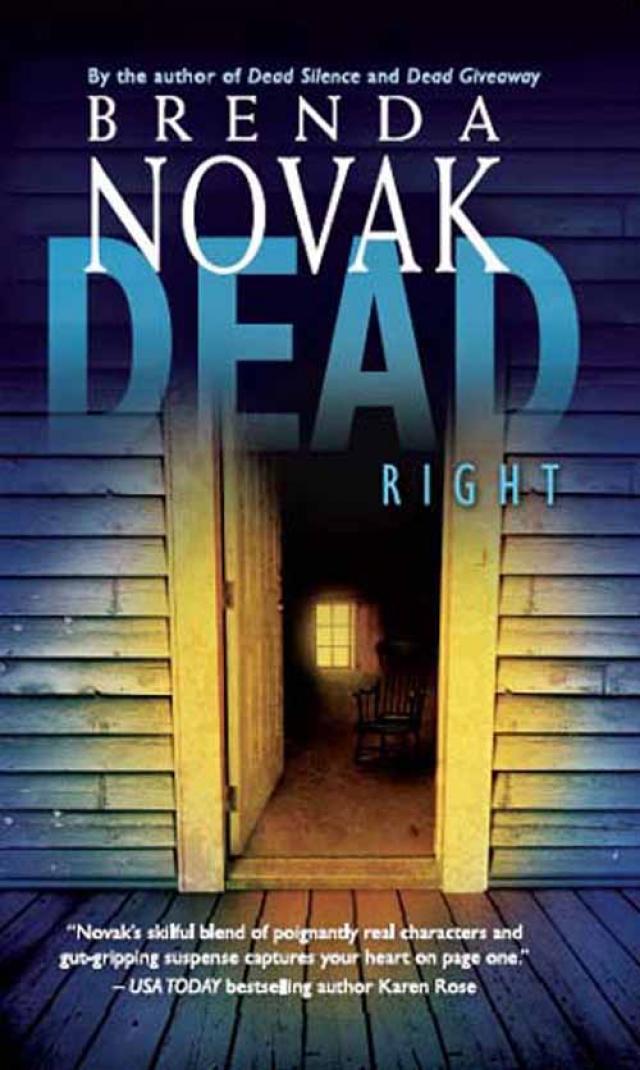
Dead right, p.25
Dead Right,
p.25


“You did what?” he asked. Like Clay, she knew more about Barker’s disappearance than she was telling.
Her eyes rounded in fear. “Nothing! I did nothing!”
She was growing agitated, panicky. To calm her, he turned the conversation in a different direction. If he could keep her talking, he might eventually learn what she wanted to reveal yet was so desperate to hide. “Did Lee ever talk about his first wife?”
Her mouth parted as if this question surprised her. She seemed to examine it, looking for traps, then answered hesitantly. “He talked about her occasionally.”
“Did he seem to miss her?”
“No. He never had anything good to say about her, although I begged him not to malign her in front of Madeline. No child should hear such things about her mother.”
“What ‘things’?” he asked.
“He hated Eliza, pure and simple.”
Hunter had sensed as much from what Eliza had recorded in her journals and even in the sermons Barker had given. Often focused on self-denial, self-reliance and strength through adversity, each sermon seemed to tout a virtue Barker did not believe his wife possessed. One sermon actually went so far as to say that anyone who suffered from depression was afflicted by God for the sin of ingratitude.
Eliza didn’t come across as a particularly strong individual. But she’d always managed to care for her daughter, which was unusual for someone so consumed by despair. He had to respect that. And she was fiercely determined to protect Madeline. Hunter thought he knew from what—but he needed more than his own conjecture if he wanted to convince anyone else.
“Hate is a pretty strong word,” he said.
“There’s no other way to describe it,” she responded. “He said she let him down in the worst possible way. That she was stupid and weak. The only time I ever heard him curse was when I tried to get him to tell me some of her better qualities. He couldn’t come up with one. Instead, he called her a…” She lifted a hand that sported several large, sparkling rings, probably as fake as the gilt around her mirrors. “Well, I’m sure you can guess.”
He took a stab at it. “Bitch?”
“Worse. Much worse.”
“Can you give me a hint?”
She shuddered as if it was too abhorrent to contemplate. “It doesn’t matter. You get the idea.”
Irene couldn’t even say the word, and yet her preacher husband had used such terms to describe his first wife, who was the mother of his child?
Hunter was pragmatic when it came to people. He put no one on a pedestal, realized that preachers had the same appetites, desires and weaknesses as everyone else. But after reading Barker’s fiery sermons and knowing what kind of hell Madeline’s father preached about, Hunter could hardly imagine him speaking in terms much more vulgar than bitch. But if Barker was so hypocritical in this regard, it followed that there’d be other inconsistencies, as well.
“Wasn’t he afraid you’d repeat what he said?”
“Who’d believe me?” she said with a laugh.
“What made you approach him about his ex-wife in the first place?” he asked.
Irene fingered the necklace at her throat. “I did it for Madeline, of course. I wanted her to have something positive to identify with. The poor girl was struggling to figure out if her mother was the loving person she remembered or this monstrous figure Lee made her out to be.”
“He couldn’t see that he was making the situation even harder on Maddy?”
“He didn’t care. The less she loved her mother, the more completely he could replace Eliza in his little girl’s esteem.”
That sounded like Antoinette. “How selfish,” he murmured.
“I’ll be the first to admit that Eliza Barker had problems,” Irene said. “You only have to read one of her poems to see that. But no one’s all good or all bad. There are so many people in this town who worshipped her. They must’ve had some reason.” Her voice turned wry. “Lord knows it’s not that easy to impress folks around here.”
He felt the deep loneliness in that statement. “You would know.”
“Yes,” she said sadly.
“Why do you think he was so ungenerous with Eliza?” he asked. “Because of the hurt he felt over her suicide?”
“The hurt?” she scoffed. “He wasn’t hurt. If anything, he was relieved to have her gone.”
The vehemence in her last phrase surprised Hunter. It surprised Irene, too, judging by the frightened look that suddenly claimed her pretty features. “But we never argued over Eliza,” she said. “We never had any real problems.”
She’d been grilled about her own complicity in Barker’s death so often that she was afraid to make any negative comment, especially one spoken with such passion. “I understand that,” he told her.
At his response, she seemed to calm down, so he ventured another question. “Did he keep any pictures of her?”
“No. He destroyed any he came across. But I managed to save a few, and let Madeline keep one between her mattresses. She pretended she didn’t care if she had it or not, but I know she did. She felt angry and lost, that was all.”
“At least she had her father,” he said, just to see how Irene might react.
She glanced at the window again. “You’d better go.”
“I have just a couple more questions—”
“I’ve got to be at work by noon. And all of this happened a long time ago. Sometimes it’s better to leave the past alone.”
“Even if there’s a chance Barker killed his first wife?”
She swayed as though the shock of what he’d just said had hit her like a physical blow. “I—I…what?” she stammered.
“You heard me.”
“It was a suicide.”
“It appeared to be a suicide,” he conceded. “But I don’t think Eliza would’ve left Madeline. She was too determined to protect her.”
“She was depressed.”
“She loved her daughter more than anything, was absolutely consumed with taking care of her. Why would she suddenly abandon her?”
Irene’s throat worked as she struggled to swallow. “It can’t be. There…there was a note. From what I heard, it was written in her own hand.”
Hunter realized he was probably going too far by suggesting what he had. Now that he’d said the words aloud, they’d spread. And he didn’t want this to get back to Madeline. But he’d never know more than he knew now if he didn’t follow his instincts. And the shocking question had definitely caused Irene to lower her defenses.
“Was it a note or was it another journal entry?” he asked.
“Good Lord.” Squeezing her eyes shut, she brought a quivering hand to her mouth.
“Irene?” He gently touched her arm.
She gazed up at him, her eyes filled with torment.
“Was he capable of murder? Were you afraid of him?”
She started to shake her head, but he tightened his grip. “Tell me the truth.”
“The truth?” she said bitterly. “I’m not sure I know what the truth is anymore.”
“Were you afraid of him?”
She stared into space.
“Were you frightened of him?” He’d spoken more loudly, more insistently, and this time she answered.
“Yes,” she said. “He was one of the most vile men I’ve ever known.”
Hunter’s heart tripped over itself at this admission. “Was he a pedophile?” he asked. “Did he molest Grace?”
Before she could respond, the sound of a motor intruded. They both turned to the window as a large, black truck whipped into the drive.
It was Clay. Irene must’ve called him the moment Hunter knocked. And he didn’t look happy.
“Get out,” he said as soon as he reached the doorway. “And don’t come back unless you’re with the police or you have a subpoena.”
Hunter didn’t argue. Clay was well within his rights. But as he got in Madeline’s car, he knew he’d never forget the tears running silently down Irene’s cheeks as she stood there shaking.
Clay answered the door to find Pontiff standing on his front porch. “What is it?” he asked, instantly concerned. There was a purposeful, determined air about the police chief that set off alarms in his head.
Pontiff rocked up on the balls of his feet, as if he was conscious of his height, which was a mere five-ten. “Did you do it?”
Narrowing his gaze, Clay stepped outside so that his wife wouldn’t hear the conversation. Fortunately, Whitney was upstairs playing with her Barbies, so he didn’t have to worry about her. His mother had told him that someone had broken into Madeline’s house. Until now, he’d chosen to think of it as some kind of prank, just as he’d told himself the “she” in that note could be anyone. Stop her or I will? Who would’ve written that about Madeline? Everyone in Stillwater loved her, except maybe Mike Metzger. She believed Mike killed her father and had pressed him a little too hard because of it. But no one knew better than Clay that wasn’t true. “Do what?”
“Steal that box?”
“I don’t know what you’re talking about.”
The door opened behind him and Allie stepped out. Clay immediately recognized the stubborn glint in her eye that told him she’d heard their voices and wasn’t about to be left out of this. But she didn’t speak. She slipped her hand inside his and turned her attention expectantly to Pontiff.
“Someone broke into Madeline’s house last night,” Pontiff explained.
“I know.” Allie’s grip tightened on his hand. “But that has nothing to do with my husband. He’s as upset by it as anyone.”
Pontiff didn’t respond. He was too busy glaring at Clay, looking as if this was the last straw, as if this was where he finally brought Clay down.
But it wasn’t Pontiff who scared Clay. It was Hunter Solozano. Hunter hadn’t taken his advice about leaving town. He’d shown up at Irene’s first thing this morning, asking if Barker might’ve been responsible for killing Eliza! That was something Clay had never considered—none of them had—but Clay wouldn’t put it past Barker.
Somehow Hunter already knew more about the bastard than anyone in Stillwater. To top it off, Irene had admitted that Madeline’s father was the vilest creature she’d ever known, which they’d all sworn never to do.
“That remains to be seen.” Pontiff finally deigned to speak. “Who else would care about that box?”
The wind smelled like snow. Clay noticed it, and noticed the feel of his wife’s slim fingers intertwined with his—because he didn’t know how long he’d be free to enjoy such simple pleasures. “I have no idea what box you’re talking about.”
“The reverend’s things. One of the boxes you packed up when you dismantled the office in your barn.”
Clay made a noise of impatience. “You’re not making a damn bit of sense, Toby. Why would I break into a house for which I have a key to take what I gave freely in the first place?”
At this a flicker of doubt passed over Pontiff’s face, but he spread his feet and propped his fists on his hips, near his gun. “Just show me your hands. And pull up your sleeves past your elbows.”
Clay nearly refused. This was bullshit. He’d die before he’d ever hurt or threaten Madeline. But Allie squeezed his hand again, silently pleading with him to make it easy for a change.
“I’ll do you one better,” he said and Pontiff backed up as he stepped forward and stripped off his whole shirt, as well as the T-shirt beneath. “You see anything here that concerns you?” Clay challenged, turning around. “You want to take pictures? Allie, go get a camera. We’ll send Chief Pontiff on his way with a bunch of time-stamped digital pictures for his files.”
“No.” Pontiff shook his head, looking bewildered. “No, there’s…there’s no need.”
Clay tossed his shirts on the chair of the porch. It was only forty degrees outside, but he didn’t care. He was going to make a statement, guarantee that Pontiff saw all he wanted. “What were you hoping to find, Toby?”
“The—the perpetrator cut himself pretty bad. There was blood everywhere. It led from the window that was broken through the kitchen and down into the basement.”
The mention of blood caused fear to uncoil in the pit of Clay’s stomach. Who’d want to break into Madeline’s house badly enough to stick around once he’d been injured? And who, besides Maddy, would give a damn about Barker’s belongings?
Stop her or I will…Stop her from what? Digging for the truth?
It wasn’t logical that anyone else would feel threatened by Madeline’s persistence. Clay had Barker’s body buried in his own cellar, which was why he could never leave this place. It was his secret, his problem. No one else’s. So why the note?
“That’s all I needed,” Pontiff muttered, then started for his car.
Their interview was over. Pontiff seemed satisfied. But something strange was going on, and Clay had no confidence in the local police department’s ability to solve it.
That left Hunter.
Clay couldn’t believe he was even considering it but he knew what he had to do. For Madeline’s sake, he was going to turn that note over to the man who could destroy him.
The trailer was cold. As if the door had been left hanging open for hours. Or the windows. A woman sat crying on the tattered couch, her face buried in her hands.
Madeline recognized her as Bubba Turk’s sister, Helen, because she’d occasionally seen them together, along with the woman’s teenage daughter, who was with her now, trying to comfort her. Chief Pontiff and Norman Jones, a recent hire, were also in the threadbare living room, as was the county coroner, Ramona Butler. Pontiff and Ramona were bent over Bubba Turk, who was lying on his back on the floor, his massive body taking up all but a small perimeter in which they were trying to work.
“Hi, Maddy,” Norm said. The pallor of his skin had a noticeable green tinge, and he stayed as far from the body as possible.
“Hi, Norm. Where’re the emergency personnel?”
“Wasn’t any need to make ‘em drive all the way over here. It was—” he cleared his throat “—obviously too late by the time we arrived.”
At this exchange, Toby, still kneeling on the floor next to the body, glanced over his shoulder. “Who called you?” he asked.
“Your wife,” Madeline replied. “We happen to be friends, remember?”
He stared at her for a second, then sighed. “I shouldn’t have told her,” he grumbled. “It’s already too crowded in here.”
The past few days certainly hadn’t strengthened their relationship. Toby himself had called her when they found Rachel Simmons’ body; she’d joined them at the quarry at his invitation. Now, only two weeks later, he seemed to have an aversion to her presence.
Her life was changing. Opposing people she’d known for years and hiring Hunter was costing her everything that had once meant so much to her. Family. Friends. And even, indirectly, Kirk. Who knew how many times they would’ve reconciled and split again if Hunter hadn’t come along? Despite her growing resolve, their breakup wouldn’t have lasted, not in the face of all this pressure. It was the incident behind the tree that told Madeline it was really over.
“I have a right to be notified,” she said, her tone no kinder than his. “I’m the press, remember?”
“There’s nothing here to report.”
“The loss of a fellow citizen is important to me,” she told him tartly and tried not to wrinkle her nose at the smell, some of which came from the trailer itself and not Bubba. “What happened?”
Ramona Butler, the county coroner, was a small, bony woman who raised horses outside of Iuka. “I’m betting it was a heart attack,” she said, leaning back on her haunches. “I imagine he clutched his chest, then stumbled and hit the corner of the counter. There’s quite a lot of blood, so his heart was still beating when he hit it. Maybe that’s what actually killed him.”
Pontiff looked at the counter she’d indicated, but Madeline couldn’t bear the sight. The bloody gash she’d glimpsed on Bubba’s forehead upset her. Death upset her. Bubba’s lifeless body brought back images of her mother. Opening the door to her bedroom. Finding the dark figure, barely visible because of the tightly drawn shades, lying on the floor like a discarded garment. Rushing forward and crying out, “Mama! Mama, what’s wrong?” as she touched her shoulder. Then bending close to see why her mother wouldn’t answer and, as her eyes finally adjusted to the dim light, finding a hole in the side of her head.
Madeline suddenly felt claustrophobic in the tiny room. She wanted to run outside and drag big gulps of air into her lungs. But Helen, weeping on the couch, reminded her that she wasn’t the one suffering here. Refusing to do anything that would draw undue attention her way, she edged closer to Norm. “Don’t tell me Helen found him,” she whispered.
He nodded. “They were supposed to go grocery shopping. When he didn’t answer the door, she came in and—” he wiped beads of sweat from his forehead “—and then she called us.”
“He never locked his door, not while he was home,” Helen said, interrupting their hushed conversation. “Why would he lock it now?” she demanded of the room at large. “I couldn’t find the key he gave me, couldn’t help him.”
Norm grew a shade paler as his eyes fastened on the bloated body, and more sweat popped out on his forehead. He was too rattled to help the crying sister, so Madeline slipped past him and knelt in front of her. “Did you know something was wrong, Helen?”
“I was worried.”
“Why?”
“Because I kept calling him this morning, and he didn’t answer. I even called Ray next door and asked him to go over, but Ray couldn’t get an answer, either.”
“You think Bubba might’ve been alive when you got here?”
“Stop beating yourself up,” Ramona said. “That definitely wasn’t the case.” She’d answered with less tact than Madeline might’ve hoped for, but that was Ramona. She wasn’t highly empathetic or patient. She was merely efficient, with a cool, detached air that was probably necessary to her emotional well-being, considering the gruesome nature of her work. “Judging by the temperature of the body, he’s been dead for hours. At least eight.”