Two gun rio kid, p.4
Two-Gun Rio Kid,
p.4
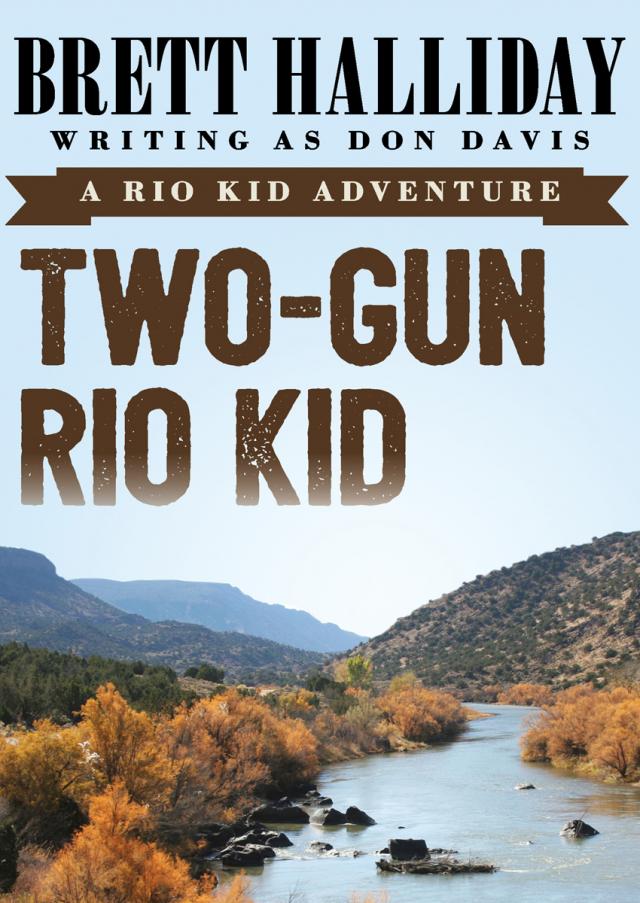


For two hours, now, the road they had traveled had been a familiar one to the Rio Kid. It paralleled the Mexican Border about a mile inside United States territory, following a winding course through the broken foothills of the mountains that rose to the north.
In the faint cool light of a half moon the Kid’s eyes picked out remembered landmarks as the road led on toward the old Bar L ranch though the sharp outlines of the rough terrain were softened and blurred by the shimmering yellow-tinged moon-glow.
The road climbed a long upward slope now, and at the crest of that long slope the Kid knew he would look down upon the range he had ridden many times in his boyhood. The eastern boundary of the Bar L followed the top of the ridge down to the Border, and he recalled every aspect of the old broken-down gateway through which the road passed. In later years the boundary fences of the Bar L had fallen into disrepair, and the old wooden gate always sagged open. The Kid could only vaguely recall Jim Thompson, former owner, who had been driven to give up the ranch because of the depredations of Border rustlers. He could recall his father’s indignation at the time, and how they had been forced to ride closer guard on the Triangle A herds after the Bar L became deserted and unstocked, removed as a buffer between the Aiken range and the Border.
Thunderbolt was loping smoothly up to the top of the long ridge now. The Rio Kid drew himself erect in the saddle, his belly muscles tightening, a strange choked feeling in his throat. His gray eyes glistened with an eagerness he had been putting away from him for years, the bleak hardness of his young features relaxed into the lines of youth again.
He had waited long and ridden far for the feel of this moment. He had always sworn he would come back some day, but it was hard to realize that day had actually arrived. Those hard, danger-strewn years on the renegade trail through Mexico were behind him now. The future was rich with promise. His old friends, his sister Peggy, the right to remove his two guns and return once more to the name of Hugh Aiken.…
Thunderbolt snorted and swerved to a sharp halt at the top of the rise. Instead of a wooden gate sagging open invitingly into the Bar L pasture, the moonlight showed latticed iron gates uncompromisingly barring the way.
The Kid frowned at the transformation that had come in his absence. He rode close to the swinging gates and found them padlocked with a heavy chain. They were swung on hinges between high solid posts of oak, and in each direction a new four-strand fence of heavy barbed wire was stretched tightly between heavy cedar posts spaced at short intervals.
The Kid’s frown deepened two vertical creases in his forehead. This was a plumb unfriendly way to greet a returning pilgrim. What the hell was the meaning of padlocked iron gates? First time he had ever run across anything like that in the cow country where there always was a warm welcome for a wandering rider.
And across the old Bar L range, too. That was more than strange. It was downright crazy. His gray eyes narrowed to slits, and his hand strayed into his shirt pocket for tobacco sack and a book of papers.
The Bar L range! He had planned to make the old ’dobe ranch house his headquarters while he spied around and got the lay of the land without sticking his head into a noose. He had written Charlie Barnes a letter asking his old friend to meet him there, thinking it would be a safe place for a hideaway.
He felt a tingling in his scalp as he sat motionless on the black stallion in front of the locked iron gates. An instinct of caution that he had learned to obey during those past three years. The feel of danger was there in the night-silence on the lonely ridge-top.
What other changes had taken place since his hasty departure? For three years he had been deluding himself with the belief that things had stood still back home while waiting for his return. In all his imaginings he had come back to find everything just as he had felt it.
His lips were cold and tight as he licked the cigarette paper and put the rolled cylinder of tobacco between them. He hesitated with the head of a match against saddle horn for striking. He felt more profoundly alone than he had ever been in his life. Always before an implicit belief in his own future had been a spectral figure that rode by his side along the lonely way. It had been a matter of patience, and he had schooled himself in patience; unswerving determination, which he had never lost; the inward knowledge of his own innocence and the confident assumption that he would some day return to Arizona and prove that he was innocent.
Now he was shaken by a loss of confidence. What had appeared a simple matter in his imaginings began to present all sorts of insuperable difficulties. He had been cut off from all communication with Chapparell for three years. What a fool he had been to think everything would stay just as it was until he returned to vindicate himself. He had pushed blithely on from El Paso after writing that letter to Charlie without a care in the world. It had all looked so simple when viewed from afar. Now, faced with a locked gate instead of the sagging neglected fence he had known, the way ahead seemed direfully complex.
If this had happened to the Bar L, how could anyone guess what other sweeping changes had taken place. He felt lost, like a boat adrift on an unknown sea without a compass. What was there he could be sure of now? He didn’t even know that Charlie Barnes still lived. He should have waited in El Paso for a reply.…
He scratched the match across the horn of his saddle. It made a rasping noise that was loud in the blanket of night silence. The flame that spurted up was unaccountably bright. He cupped his hands over it quickly, ducked his head with a furtive air to put his cigarette into the flame.
By this action he was sharply reminded that he was a fugitive from the lynch rope, a wanted man with a ten-thousand-dollar reward upon his head. He had almost forgotten that during these past weeks since he had crossed the Rio Grande in the Big Bend district of West Texas. True, he had encountered many of the old yellowed reward posters along the way, but he had become contemptuous of them because he had changed so much it was difficult to recognize the Rio Kid from those faded pictures.
It was different here in Arizona, in the shadow of the crime that had driven him across the Border. He would be instantly recognized here. His instinctive cupping of the match flare and hiding his features while he sucked fire into his cigarette brought the gravity of his danger into vivid focus.
He let the cigarette go out between his lips, threw it to the ground with an angry gesture. Thunderbolt snorted and stamped a foot in the dust. He curved his neck, nuzzled his rider’s knee with soft questioning lips.
The Kid leaned forward and patted his satiny neck. He muttered, “Yo’re wonderin’ what th’ hell, Old Timer, ain’t you? Wall, so’m I. There’s thuh Border a mile south. All I gotta do is foller this here fence. I know the trails on the other side. I’ve rode ’em before. An’ I’m all to once afraid I don’t know the trails hereaboots. It’d be awful easy tuh ride into somethin’ I couldn’t ride out of if I go on.”
Thunderbolt tossed his head and nickered softly. It seemed to the Kid the stallion was saying, “You know best. I don’t like this country either … but whatever you say …”
He let his agile, lean-hipped body slump lower in the saddle while he considered the situation well. If he turned south across the Border now there would be no retracing his steps, ever. He knew that much. He had dared a lot coming this far on the way home. If he turned away now it would be the end of his dreaming.
Yet, better to end it that way than by swinging at the end of a rope. He wondered how Peggy had held up during the three years he had been gone. In the beginning he hadn’t let himself think about Peggy. Not outwardly. It had been too painful. They had been very close after their parents died. He knew her pride, and her fierce unyielding loyalty. It couldn’t have been easy on her.
Would it be best for Peggy if he turned back now? Three years had given the wound time to callous over. Wasn’t it likely his return would just reopen the old wound? Was it selfishness that had brought him back to clear his name?
He laughed. A short bitter laugh that echoed away eerily frem the wind-swept ridge where he had halted. God knew it would be easier to turn back. He could cross the Border and go east to Juarez, across the river from El Paso. A girl named Kitty was waiting for him there. He knew Kitty would be waiting. She wouldn’t ask him any questions. Kitty wasn’t the sort to ask questions.
A pinprick of light showed westward and a little south, near to the Border. The Rio Kid straightened in the saddle and stared downward from the ridge, unaccountably fascinated. There was someone down there. A night rider lighting a cigarette. A thousand mad fancies rioted through his mind. Charlie Barnes, perhaps. Faithful old Charlie, a day ahead of the hour set by the Kid in his letter. The match flare had showed not more than a quarter of a mile away. He had to restrain an impulse to lift his voice in a shout that would tell Charlie he was there on the ridge.
He didn’t know the night-rider was Charlie Barnes. He cursed himself for a fool. It might be anyone else. An enemy who would start shooting the moment he was recognized. The future beyond that locked gate was peopled with enemies. The unknown was a challenge that lured and drew him on. His feeling of utter aloneness increased. If he passed beyond that barrier he would have to turn himself into a skulking figure of the night, afraid to approach any man lest he be recognized.
He wasn’t used to skulking. Not even while riding the owl-hoot trail. He had never cringed from meeting any man, had learnt dependence upon his guns and his skill in handling them.
But even the Rio Kid’s two guns would avail him little here where every man’s hand would be against him. The moment he rode down into the Bar L range he would be committing himself to a sneaking course of action. It could not be otherwise.
His black stallion nickered again, and turned his splendid head inquiringly. The Kid asked, “Gettin’ tired of standin’ here lookin’ at that locked gate? Well, so’m I. What the hell they mean by lockin’ a gate acrost a road? A man’d think, by God, they didn’t want me to ride this way.”
Thunderbolt tossed his head and nickered.
The Kid’s gray eyes became bleak in the cold moon-glow. “Lockin’ me outta my own home range, huh?” He slid his hands to the worn butts of guns tied low on his hips, and the cold wood gave back encouragement to him.
He drew his right-hand gun, and lifted the reins from the saddlehorn with his left. He pressed his thighs against Thunderbolt’s sides and the eager black pranced forward close to the hinged gates.
He leaned from the saddle and turned the padlock so it lay flat against one of the iron bars, pressed the muzzle of his .45 against the small keyhole.
The racketing crash of a single gunshot thundered up the hillside from below and directly ahead. The Rio Kid lifted a strained face to the moonlight and stared down the slope. No other sound came to him. The reverberating echoes drummed away into the distance and were swallowed up by the night.
The Kid’s pulse drummed in unison with those resounding echoes. His finger was tight on the trigger, but still he did not increase the slight pressure necessary to blast the gate open.
That shot was a warning that something was going on down there. The moonlit night was no longer a beckoning solitude, but was peopled with unseen wraiths who lit matches and fired shots into the night with no reason at all.
He set his teeth together tightly, and his lips came back from them in a snarl of derision at himsself and at his hesitancy. He was getting the jumps—like an old woman.
He pulled the trigger of his .45 and a leaden slug smashed the padlock under the muzzle. Thunderbolt pranced away and snorted. From long force of habit the Rio Kid reloaded the cylinder of his gun before holstering the smoking weapon.
Only silence beyond the fence answered the challenge of his shot.
He reined Thunderbolt forward to the gates again, leaned from the saddle and flipped the chain loose. The gates creaked on their hinges as he rode through. He left them swinging open in defiance of range etiquette, lifted Thunderbolt into a swinging gallop in the direction of the shot he had heard.
There’d be no more question of turning back.
5
When Charlie Barnes reached the boundary fence between the Triangle A and Bar L ranches he encountered swinging iron gates fastened shut with a heavy chain and an open padlock looped through two links.
He frowned heavily at the padlock and chain as he passed through into Bar L range. It was the first time he had ridden that way since Henry Pelham took over the ranch. He’d heard rumors of locked gates on the Bar L, but had shrugged and discounted those rumors. Now he decided it was a man’s own business if he wanted to padlock the gates to his property.
The sun had disappeared below the western horizon and the beginning coolness of evening came on as Charlie rode toward the cluster of ranch buildings where only a few years before there had been nothing but a single abandoned adobe structure.
Almost immediately after passing through the iron gates a change was noticeable in the range feed along the way. A lush greenness showed in the Bar L pasture, instead of the listless yellow of the Triangle A pasture. It was positively uncanny to see how the wire fence seemed to act as a line of discrimination between an area that had received bounteous rainfall and the parched dryness of Peggy’s range. Sleek, contented cattle grazed here, and in the soft twilight of the Arizona evening a serene atmosphere of smug self-satisfaction seemed to be exuded by the land itself.
You couldn’t blame Henry Pelham for that, Charlie reflected as he rode along. Whatever the man’s sins he certainly possessed no magical power that induced rain to fall on his range while it avoided neighboring ranchers. This was merely another evidence of an unsatisfactory law of nature which Charlie had observed often before: Let a man once hit a streak of bad luck and it appeared that God took a perverse delight in visiting every other form of misfortune upon him.
Right and wrong had nothing to do with it. All the old copybook maxims took a beating when it came to the facts. God didn’t frown on wickedness and reward virtue. Not in Arizona, anyway.
As Charlie rode on into the wide flat meadow where Pelham had introduced the startling innovation of cutting hay and stacking it for winter feed, he ceased bothering with abstruse meditations upon the singular ways of the Almighty to let his mind take an active interest in the scene before him.
There was a stretch of rich grassland here, almost a mile wide and several miles long. Three or four sections in all, perhaps. Years ago there had been a deep gully down the center of the meadow, cut in the sandy soil by rushing spring freshets that boiled down from the mountains. In the hot summer months the gully had always been bone-dry, but Pelham had changed that by the simple construction of a levee across the upper end of the wide valley that formed a reservoir to catch and hold the spring floods, backing the precious water up into a miniature lake and impounding it to be released through a series of side ditches as needed through the growing season.
It was, Charlie saw, a crude but effective method of irrigation which made the grass in the valley grow rank and knee-high instead of the short growth it had formerly attained. And even now it was ready for a first cutting of hay, with plenty of time yet for a second crop to grow high before the heat of summer was over.
Charlie shook his head in dismay at himself and his own disloyal thoughts as the evidence of Pelham’s bold imagination and ingenuity was spread out before his eyes. For generations the ranchers of the West had stubbornly refused to recognize progress, to change the settled way of the range. Grass was for grazing during the summer, to fatten beef-stuff for fall shipping. That’s the way it was done all over the West, which resulted in a great influx of fat beef to the markets in the fall, with a subsequent dropping-off of the market price because of lack of demand.
And, conversely, market prices were high in the spring when cattle were gaunt and thin from scarcity of winter feed and there was little if any range stock fit to be shipped to the slaughterhouses.
An unwilling admiration for Pelham welled up inside Charlie Barnes as he realized that the Bar L owner was successfully turning tradition to his own advantage. By cutting the meadow hay and stacking it during the summer, forcing his stock to graze the more barren hillsides for sustenance, he was reversing the time-honored fattening time and shipping his beef in the spring while prices were high.
Against Charlie’s innate cattleman’s distrust of any change that smacked of turning the range into farmland was the indisputable evidence of his eyes that Pelham was making money while those about him were bogged down in debt and barely making ends meet.
He began to wonder if those vague rumors against Pelham, the insinuations that he was in league with the Mexican Border rustlers might not be wholly without factual basis. He wanted to hate Henry Pelham, he wanted to believe the worst of the new Bar L owner, but he could not be otherwise than honest with himself. Here was reason enough for Pelham’s prosperity. Scorn his methods or hate them, a man had to admit he was using his head for something besides a place to rest his hat.
Riding across the lushly grassed valley, Charlie turned his thoughts unwillingly to his own small ranch north of Chapparell. As Pelham had pointed out less than an hour ago, the same opportunity existed there for cutting hay and stacking it for winter feed. Not on so large a scale, but with a little conservation of water and some rudimentary attempt at irrigation he had nearly a section of land that would grow as good hay as Pelham grew.
Instead, Charlie still followed the old custom of grazing his stuff on it through the summer, trying to fatten them up after a hard winter for fall shipping. And each fall for years past, market prices had been growing less and less until now they reached a low point where a man was sometimes lucky to get back transportation costs from a shipment. It was a slow sure way of going broke, and Charlie was one of the few Arizonians who had sense enough to realize he was bucking the inevitable. Yet for years he had gone on the same old way, ostrich-like, refusing to take modern advantage of the possibilities of his own ranch.