

Dandd dragonlance ra.., p.1
D&D - Dragonlance - Raistlin Chronicles 02,
p.1
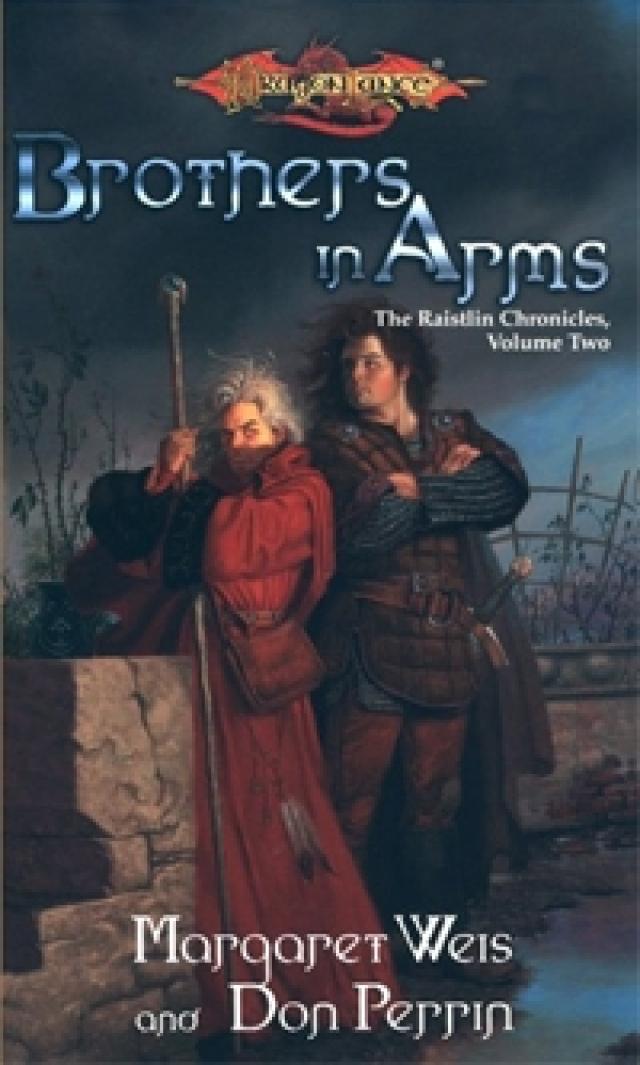


Dragonlance
The Raistlin Chronicles Volume 2
Brothers in Arms
by Margaret Weis and Don Perrin
“I don’t care about your name, Red. I don’t want to know your name. If you survive your first three or so battles, then maybe I’ll learn your name. Not before. I used to learn the names, but it was a goddamned waste of time. Soon as I’d get to know a puke, he’d up and die on me. These days I don’t bother”
Mists shrouded the Tower of High Sorcery at Wayreth and a light rain fell. The rain shimmered on the mullioned windows. Drops welled up on the thick stone ledges of the windows, overflowed to trickle down the black obsidian walls of the Tower, where the raindrops collected in puddles in the courtyard. In that courtyard stood a donkey and two horses loaded with blanket rolls and saddlebags, ready for travel.
The donkey’s head was lowered, her back sagged, her ears drooped. She was a spoiled donkey, fond of dry oats, a snug stable, a sunlit road, and a slow and easy pace. Jenny knew of no reason why her master should travel on such a wet day and had stubbornly resisted all attempts to drag her from her stall. The burly human who had attempted to do so was now nursing a bruised thigh.
The donkey would still be in her warm stall, but she had fallen victim to a ruse, a foul trick played on her by the big human. The fragrant smell of carrot, the lush scent of apple-these had been her temptation and her down-fall. Now she stood in the rain, feeling much put upon and determined to make the big human suffer, make them all suffer.
The head of the Conclave, the master of the Tower of Wayreth, Par-Salian, gazed-down upon the donkey from the window of his chambers in the North Tower. He saw the donkey’s ears twitch, and he winced involuntarily as her left hind hoof lashed out at Caramon Majere, who was endeavoring to secure a pack onto the donkey’s saddle. Caramon had fallen victim to the donkey once this day and he was on the lookout He, too, had seen the telltale ear twitch, understood its portent, and managed to dodge the kick. He stroked the donkey’s neck and produced another apple, but the donkey lowered her head. By the look of her, Par-Salian thought-he knew something about donkeys, though few would have believed it-the ornery beast was contemplating rolling on the ground.
Blissfully unaware that all his careful packing was on the verge of being dislodged and squashed flat, not to mention soaked in a puddle, Caramon began loading the two horses. Unlike the donkey, the horses were glad to be away from the confinement and boredom of the stalls, were looking forward to a brisk canter and the chance to stretch their muscles, see new sights. The horses frisked and stamped and danced playfully on the flagstone, blowing and snuffling at the rain, and looking eagerly out the gates at the road beyond.
Par-Salian, too, looked at the road beyond. He could see where it led, could see the mad far more clearly than others at that time on Krynn. He saw the trials and travails, he saw the danger. He saw hope, too, though its light was dim and wavering as the magical light cast by a crystal atop a young mage’s staff. Par-Salian had purchased this hope, but at a terrible cost, and, at the moment, hope’s light did little more than reveal to him more dangers. He must have faith, however. Faith in the gods, faith in himself, faith in the one he had chosen as his battle sword.
His “battle sword” stood in the courtyard, miserable in the rain, coughing fitfully, shivering and chilled as he watched his brother-limping slightly from his bruised thigh-ready the horses for their journey. A warrior such as the brother would have rejected such a sword outright, for it was, to all appearances, weak and brittle, liable to break at the first pass.
Par-Salian knew more about this sword than did the sword itself, perhaps. He knew that the iron will of the young mage’s soul, having been tempered with blood, heated by fire, shaped by fate’s hammer, and cooled with his own tears, was now finest steel, strong and sharp. Par-Salian had created a fine-honed weapon, but like all weapons, it had a double edge. It could be used to defend the weak and the innocent, or to attack them. He did not know yet which way the sword would cut He doubted if the sword knew.
The young mage, wearing his new red robes-plain homespun robes without adornment, for he had no money to purchase better-stood huddled beneath a rose tree blooming in the courtyard, finding what shelter he could from the rain. The thin shoulders of the young man shook occasionally, he toughed into a handkerchief. At every cough, his brother, hale and robust, would pause in his work to glance back at his frail twin anxiously. Par-Salian could see the young man stiffen with irritation, could see his lips move and almost hear his curt admonition-for his brother to get on with his task and leave him be.
Another person bustled out into the courtyard, just in time to prevent the donkey from spilling. A t and dapper man of middle years, wearing gray robes-he would not spoil his white robes with the stains of travel-and a hooded cloak, Antimodes was a welcome sight His cheerful air seemed to dispel the gloom of the day as he chided the donkey, all the while fondling her ears, and instructed the robust twin on some point of packing, to judge by the hand-waving and gesticulating. Par-Salian could not hear -their conversation, but he smiled at the sight Antimodes was old friend, mentor, and sponsor to the young mage.
Antimodes lifted his head and gazed at the North Tower, looking up at Par-Salian looking down.
Though Antimodes could not see the Head the Order from where he stood in the courtyard, he knew perfectly well that Par-Salian was there and that he was watching. Antimodes frowned and glowered, making certain that Par-Salian was aware of his ire and disapproval. The rain and the mist were Par-Salian’s doing, of course. The Head of the Conclave controlled the weather around the Tower of High Sorcery He could have sent his guests off in sunshine and springtime had he chosen to do so.
In truth, Antimodes was’ not that upset about the weather. It was merely an excuse. The real reason for Antimodes’s he was his disapproval of the way Par-Salian bad handled the young mage’s Test in the Tower of High Sorcery. Antimodes’s disapproval was so strong that it had cast a cloud over the two men’s long friendship.
The rain was Par-Salian’s way of saying, “I understand your concern, my friend, but we cannot live all our days in sunshine. The rose tree needs the rain to survive, as well as the sun. And this gloom, this dreary darkness is nothing, my friend, nothing compared to what it yet to come!”
Antimodes shook his head, as if he had heard Par-Salian’s thoughts, and turned grumpily away. A practical and pragmatic man, he didn’t appreciate the symbolism, and he resented being forced to start out on his journey wet to-the bone.
The young mage had been watching Antimodes closely. When Antimodes turned away and went back to placating his irate donkey, Raistlin Majere turned his own gate to the North Tower, to the very window where stood Par-Salian. The archmage felt the gaze of those eyes-golden eyes, whose pupils were the shape of hourglasses-touch him, prick his flesh as though the tip of the sword’s blade had sliced across his skin. The golden eyes, with their accursed vision, gave no hint of the thoughts behind them.
Raistlin did not understand fully what had happened to him. Par-Salian dreaded the day when Raistlin would come to understand. But that had been part of the price.
Was the young mage bitter, resentful? Par-Salian wondered: His body had been shattered; his health ruined. From now on, he would be sickly, easily fatigued, in pain, reliant on his stronger brother.
Resentment would be natural, understandable. Or was Raistlin accepting? Did he believe that the fine steel of his blade had been worth the price? Probably not. He did not yet know his own strength. He would have time to learn, the gods willing. He was about to receive his first lesson.
All the archmages in the Conclave had either participated in Raistlin’s Test or they had heard about what had occurred during the Test from their colleagues.’ None of them would accept him as an apprentice.
“His soul is not his own,” said Ladonna of the Black Robes, “and who knows when the buyer will come to claim his property”
The young mage needed instruction, needed training not only in magic, but in life. Par-Salian had done some discreet investigation and found a teacher whom he hoped would provide a suitable course of study. A rather unlikely inst actor, but one in whom Par-Salian had a lot of faith, though this instructor would have been astounded to hear so.
Acting under Par-Salian’s instructions, Antimodes inquired if the young mage and his brother would be interested in traveling east during the springtime, to train as mercenaries with the army of the renowned Baron Ivor of Langtree. Such training would be ideally suited to the young mage and his warrior brother, who needed to earn their bread and butter, all the while honing their martial skills.
Skills they would need later, unless Par-Salian was very much mistaken.
There was no need for hurry. The time of the year was early fall, the season when warriors begin to think of putting away their weapons, start searching for a comfortable place to spend the cold winter days by the fire, telling tales of their own valor. Summer was the season of war, spring the season of preparing for war. The young man would have all winter, to heal. Or rather, he would have time to adapt to his handicap, for he would never heal.
The story of Raistlin’s Test in the Tower of high Sorcery is related in The Soulforge Such legitimate work would prevent Raistlin from exhibiting his talents in the local fairs in exchange for money, something heâ
€™d done in the past, much to the shock of the Conclave. It was all very well for illusionists or unskilled practitioners of the art to make spectacles of themselves before the public, but not for those who had been accepted into the Conclave.
Par-Salian had yet another motive for sending Raistlin to the baron, a motive the young man would never-if he was lucky-come to know. Antimodes had his suspicions. His old friend Par-Salian never did anything just for the doing of it, all his means were aimed at a specific end. Antimodes had endeavored to find out, for he was man who loved secrets as a miser loves his coins, liked to-count them over in the night, fondle them and gloat over them. But Par-Salian was closemouthed, would not fall victim to even the-most cunningly laid snare.
The small group was at last ready to set out Antimodes climbed upon his donkey. Raistlin mounted his horse with assistance from his brother, assistance that he accepted churlishly and with an ill grace, by the looks of it. Caramon with exemplary patience, made certain his brother was settled and comfortable, and then he swung himself easily into the saddle of his own large-boned steed.
Antimodes took the lead. The three headed toward the gate. Caramon rode, with his head down against the slashing rain. Antimodes left with a backward glare for the North Tower window, a glare expressive of his extreme discomfort and irritation. Raistlin halted his horse at the last moment, turned in the saddle to gaze at the Towel-of High Sorcery. Par-Salian could guess what was going through the young man’s mind. Much the same had gone through his mind, when he had been young.
How my life has changed in only a few short days! I entered this place’ strong and confident. I leave it weak and shattered my vision cursed, my body frail. Yet, I leave this place triumphant. I leave with the magic. To gain-that, I would have traded away my very soul. .
“Yes,” Par-Salian said quietly, watching until the three had ridden into the magical Forest of Wayreth and there vanished from his mortal sight. His mind’s eye kept them in view much longer.
“Yes, you would have. You did. But you don’t know that yet”
The rain fell harder. Antimodes would be cursing his friend heartily now. Par-Salian smiled. They would have sunshine when they left the forest. The sun’s heat would bake them dry; they would not have to ride long in wet clothes. Antimodes was a wealthy man, fond of his comforts. He would see to it that they slept in a bed in a reputable inn. He would pay for it, too, if he could find a way To do so that would not offend the twins, who had only a few meager coins in their purses, but whose pride could have filled the royal coffers of Palanthas.
Par-Salian turned from the window. He had too much to do to stand there, staring out into a curtain of ram. He cast a wizard-lock spell upon the door, a strong spell that would keep out even the most powerful mages, wages such as Ladonna of the Black Robes. Admittedly Ladonna had not visited the Tower in a long, long time, but she took great delight in arriving unexpectedly and at the most inopportune moments. It would never do for her to find him involved in these particular studies.
Nor could he allow any of the other mages who lived in or frequented the Tower to find out what he was doing.
The time was not right to disclose what little he knew. He-did not yet know enough. He had to learn more, to discover if what he had begun to suspect was true. He had to learn more, to ascertain if the information he had gleaned from his spies was accurate.
Certain that no one short of Solinari, God of White Magic, could break the spell cast upon the door, Par-Salian seated himself at his desk. On the desk-which was of dwarf-make a present from one of the thanes of Thorbardin in return for services rendered-lay a book The book was old, very old. Old and forgotten, Par-Salian had found the book only by references made to it in other texts; else he himself would not have known of its existence. At that, he’d been forced to search for it for a great many hours, search through the library of the Tower of High Sorcery, a library of reference books and spellbooks and magical scrolls, a library so vast that it had never been catalogued. Nor would it ever be catalogued, except in Par-Salian’s mind, for there were dangerous texts there, texts whose existence must be carefully guarded, texts known only to the Heads of the Three Orders, certain texts known only to the Master of the Tower himself. There were also texts of whose existence even -he was not aware, as proven by the book in front of him, a book he had finally discovered in a corner of a storage room packed either mistakenly or by design in a box labeled “Child’s Play.” judging from the other artifacts to be found in the box, the box itself had come from the Tower of High SSorcery in Palanthas and dated back to the time of Huma. The box had undoubtedly been among those hastily packed when the mages had swallowed their pride and abandoned their Tower, rather than declare all-out war upon the people of Ansalon. The box marked
“Child’s Play” had been shoved into a corner and then forgotten in the chaos following the Cataclysm.
Par-Salian brushed his hand gently over the leather cover of the old book, the only book to be found in the box. He brushed away the dust and mouse-droppings and cobwebs that had partially obliterated the book’s embossed title, a title whose letters he felt as bumps beneath his fingertips. A title that raised bumps on his flesh. “The Book of Dragons”
2
The trees of Wayreth Forest, wayward and magical guardian of the Tower of High Sorcery, lined up like soldiers on parade duty, stood tall and silent and stern beneath the lowering clouds.
“Guards of honor,” said Raistlin.
“For a funeral,” muttered Caramon.
He did not like the forest; which was no natural forest but a wandering and unexpected forest, a forest that was nowhere in sight of a morning and all around you in the evening. A dangerous forest to those who entered it unawares. He was thankful when they finally left the forest, or perhaps it was the forest who finally left them.
Whichever way it was, the trees took the clouds with them. Caramon removed his hat and lifted his face to the sun, basking in the warmth and the radiance.
“I feel like I haven’t seen the sun in months,” he said in a low voice with a baleful, backward glance at the Wayreth Forest, now a formidable wall of wet, black-boled trees, shrouded in gray mist. “It’s good to be away from that place. I never want to go back, not as long as I live.”
“There’s absolutely no reason you should, Caramon,” Raistlin said. “Believe me, you will not be invited back. Nor,” he added an undertone, “will I.”
“That’s good,-then,” Caramon said stoutly. “I don’t know why you’d want to go back.. Not after” -he glanced at his brother, saw his grim expression, the eyes glinting, and faltered-“not after … well ..
what they did to you.”
Caramon’s courage, which had been squashed flat in the Tower of High Sorcery, was reviving wonderfully in the warm sunshine, out from under the shadows of the watching, distrustful trees.
“It’s not right what those mages did to you, Raist! I can say it now that we’re away from that horrible place. Now that I’m sure no one’s going to turn me into a beetle or an ant or something just for speaking my mind.
“I mean no offense, sir,” Caramon added, shifting his attention to their traveling companion, the white-robed archmagus, Antimodes. “I appreciate all you’ve done for my brother in the past, sir, but I think you might have tried to stop your fiends from torturing him. There was no need for that.
Raistlin could have died. He very nearly did die. And you didn’t do a thing. Not a damn thing!”
“Enough, Caramon!” Raistlin admonished, shocked.
He glanced anxiously at Antimodes, who, fortunately, did not appear to have taken offense at Caramon’s blunt statement. It almost appeared as if the archmagus agreed with what had been said.
Still, Caramon was behaving like a buffoon, as usual.
“You forget yourself, my brother!” Raistlin stated angrily. “Apologize-“
Raistlin’s throat constricted, he could not breathe. He let fall the reins to grip the pommel of the saddle, so weak and dizzy he feared he might fall from the horse. Leaning over the pommel, he tried desperately to clear his throat. His lungs burned, just as they had during the time years back when he’d been so sick, the time he’d collapsed in his mother’s grave. He coughed and coughed but could not catch his breath. Blue flame flickered before his eyes.


