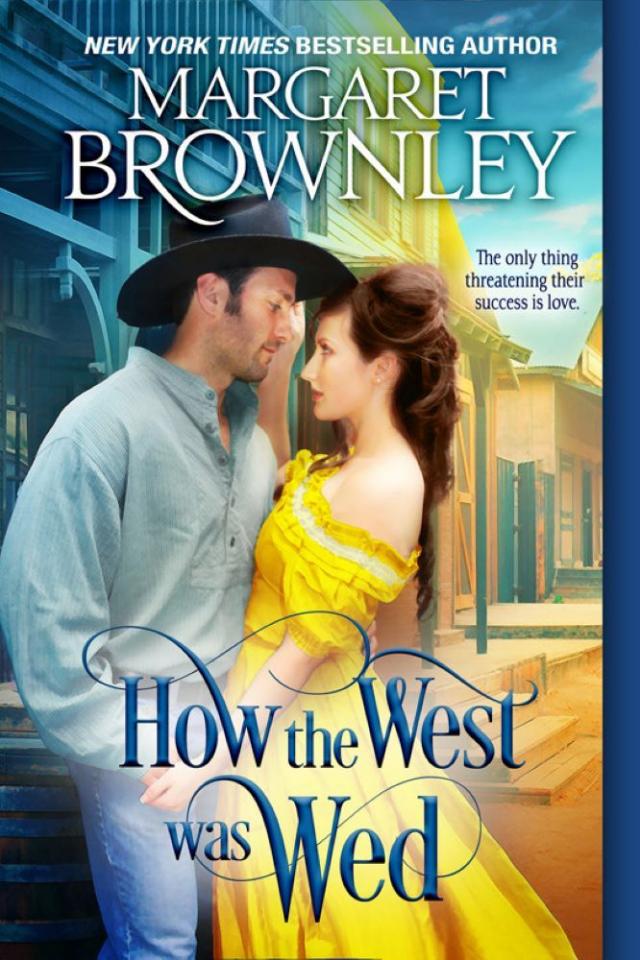
How the west was wed, p.6
How the West Was Wed,
p.6


Mrs. Posey tried to act like she was unaffected by his presence, but when he greeted her with a smile, her red cheeks gave her away.
Mr. Wade turned his attention back to Josie. “I must say, you look like you’re in a horn-tossin’ mood.”
Josie rested her hands on her lap. “I just had an unpleasant encounter with a former subscriber.”
He raised an eyebrow and stroked his upper lip. “I hope you put the person in his or her place.”
“Oh, yes, indeed I did. I sent her over to your newspaper.”
He laughed. “That’ll teach her to mess with you.” He glanced at the other chaperones before looking down at her foot keeping time to the music. Blushing, she pulled her feet back, letting the hem of her skirt hide her high button shoes from his probing eyes.
An altercation between two young men sent Mrs. Posey and the other three chaperones scurrying across the room. Since Mr. Wade blocked her way, Josie had no choice but to remain seated.
He lifted his gaze. “You don’t look like you belong here, Mrs. Johnson,” he said, indicating the row of empty chaperone chairs.
“Oh? And where do you think I belong?”
“On the dance floor with me.”
Her hearted fluttered, and she shot a quick glance at Mrs. Posey, who thankfully had her back toward them. “I hardly think that would be proper, Mr. Wade.”
His gaze dipped to the gold locket on her chest. “I meant your departed husband no disrespect.”
“I was thinking about your reputation. Your new subscriber might take issue with you dancing with someone who dares to accept advertisements from a bawdy house.”
“I’m willing to risk it if you are.”
The challenge in his eyes was too good to ignore. As much as she loathed the idea of dancing with him, she was bored out of her wits. Anything had to be better than sitting on the sidelines all night, even dancing with a man she disdained. She lifted her hand to his just as Mrs. Nosey—she mentally chided herself—Mrs. Posey returned, disapproval pouring out of her like smoke from a fire. She stared at Josie’s hand clasped in his.
“You do know it’s against the rules for chaperones to dance, don’t you? To say nothing about women in mourning.”
“Yes, of course, Mrs. No— Posey,” Josie said, pulling her hand away. Blast the woman and her meddlesome ways. She gazed up at Wade. “I wouldn’t think of doing anything improper.”
It was hard to know if Mr. Wade’s look of disappointment was feigned or sincere. “What a pity. I was hoping we could show these youngsters how it’s done.”
“How it’s done?” she asked. “Oh, you mean how two adversaries can dance without killing each other.”
He chuckled, and warm humor filled his eyes. “Since I’m here strictly for pleasure, you can hardly call me an adversary.”
“Oh? Then what should I call you, Mr. Wade?”
“Brandon. You can call me Brandon. What can I call you?”
“Your business opponent,” Josie said, refusing to succumb to his charms no matter how tempted she was.
A smile ruffled his mouth. “As you wish.” He glanced at Mrs. Posey, who had left her seat again to scold a young couple daring to stay together for an alarming three dances. “Will your duties as chaperone last till midnight?”
She hesitated. “No, only till ten.” The dance ended at midnight, but couples started leaving much sooner, so fewer chaperones were needed after ten.
“Ah.” He leaned over to whisper in Josie’s ear, his breath sending surprisingly pleasing ripples of warmth down her neck. “Since you are currently indisposed, would you at least consider giving me a raincheck for when you’ve completed your duties?”
As he straightened, Mrs. Posey returned, her glare suggesting she suspected something awry. The woman missed nothing. Josie flicked her fan, but the slight breeze did little to cool her heated face.
“Sorry, Mr. Wade, but I see only sunny skies ahead,” she said firmly, putting him in his place not just for her sake, but Mrs. Posey’s as well.
He accepted her decision with a gentlemanly bow. “It’s always a pleasure, Mrs. Johnson.”
He took his leave and was soon caught up in a ring of young ladies all vying for his attention. Josie glared at the fawning women and forced herself to breathe. It surprised her—
indeed, horrified her—that the idea of being in another man’s arms—in Brandon Wade’s arms—was suddenly not all that unthinkable.
Chapter 7
A large reward has been offered for the capture of cattle rustler Jack Patterson, who escaped an Austin jailhouse. He left a note saying that he feared a lynching would ruin his reputation.
—Two-Time Gazette
No sooner had Brandon settled at his desk that morning than his compositor, Stan Booker, handed him the proofs for that week’s paper.
“Looks good, Chief,” Booker said, his white teeth flashing against his dark skin. Booker was a former slave who had originally insisted upon calling Brandon boss, the Dutch term for “master.” When Brandon objected, Booker took to calling him chief.
“You say that every week,” Brandon said.
Booker shrugged. “When you work for the best . . .” He headed for the door. “Need anything? I’m on my way to the post office.”
“No, nothing,” Brandon said. Pen in hand, he set to work proofing.
Though he’d allocated only two inches for last week’s May dance, his practiced eye lingered over each obligatory sentence. It wasn’t the punctuation, spelling, or even syntax that commanded his attention. It was the vision of Mrs. Johnson seeming to float up from the printed page. How could a woman dressed in stark black—a grim reminder of her sad status—appear so utterly fetching? Though cloaked in the respectable mantle of grief, her strong spirit had been clear in the rigid set of her shoulders and almost defiant lift of her chin.
She’d turned down his invitation to dance, but she’d wanted to accept. He’d bet his life on it. He’d read it in the depth of her turquoise eyes, seen it in the wistful look on her face. Sensed it in the way her body leaned ever so slightly forward to place her hand in his. Had it not been for Mrs. Posey, the lady would have been in his arms, no question.
Surprised to find Mrs. Johnson occupying his thoughts yet again, he initialed the page proof in front of him and moved on to the next. If he had his druthers, he’d yank the boring dance piece altogether. But it was news. No doubt the Gazette would give the dance full play, with every dress described down to the smallest detail. He could almost picture Mrs. Johnson at her type-writing machine, graceful hands posed over the keys, lush lips pursed as she considered her choice of words.
The door to his office swung open, offering a welcome distraction from his disturbing thoughts, though he wasn’t especially happy that his savior was the land developer Mr. Troop.
“Hope I’m not too late for Friday’s paper,” Troop said, extending his hand. A round-bellied man with a doorknocker mustache, he was as oily in his appearance as he was in his business practices. The only thing in his favor was his generous advertising budget.
Brandon stood and shook the man’s hand. “You missed the deadline. We’re just about to go to press.”
“I’ve got something I need you to run in this week’s paper.” When Brandon failed to respond, Troop added, “I’ll make it worth your while.”
Hesitating, Brandon lowered himself into his chair. Having to make changes at this late date meant extra work. Something would have to be cut or edited down to make room. On the other hand, Troop was the paper’s most lucrative advertiser.
“Get any results from the last ad we ran?” Brandon asked.
“Not exactly.” Troop sat on the chair in front of the desk and crossed his legs.
His answer didn’t surprise Brandon. Troop was a speculator of the worst kind. He grabbed land at the cheapest price possible and held on just long enough to sell it at great profit to himself. He’d purchase hundreds of acres of prime property outside of town during the last economic downturn and split it into two-acre lots. Now that the economy had picked up momentum, he was ready to make his move.
Brandon had had his eye on one of the lots bordering the river, but the price was too steep for his blood. It was too steep for anyone else, as well, which is why the prime property sat empty.
Troop balanced his derby on his knee. “That’s why I’m here. I thought you could help me with a new venture. I’m giving away lot number eleven free.”
Brandon’s ears perked up. Lot eleven was the one he wanted. The property faced the part of the river where he liked to fish and Haley enjoyed swimming. “Did you say ‘free’?”
“Yes, indeed. Give a little, gain a lot.” The waxen smile spreading across Troop’s face failed to reach his eyes, suggesting that the giving part was done with great reluctance. “As you know, the properties are a distance from town. I’ve not had much luck convincing people to travel out there to inspect them. I’m convinced that once people see the improvements made to the land, the lots will sell like hotcakes. Of course, that’s only gonna happen if I can persuade prospective buyers to travel out there and have a look.”
Brandon nodded. “Yes, I can see where that might pose a problem. Living in town is more convenient.”
“Yes, but this is Texas, and we Texans like our wide-open spaces. The town is getting too crowded. You can’t even tether your horse without risking a black eye. And the sidewalk is so crowded you practically have to walk sideways. That’s why I believe the time is right to strike.”
Troop rubbed his hands together in anticipation, and the ends of his mustache twitched.
“I believe I’ve come up with the perfect solution,” he continued. “I’m holding a race. The starting line will be located just outside town limits. The first one to reach the property will be declared the winner. Once everyone sees what fine land is out there, the offers will start pouring in.”
Interested, Brandon sat forward. “A race, huh? That should get attention.” Already, ideas for headlines popped into his head. “When will the race take place?”
“Saturday. Which is why I need it in this Friday’s edition.” Troop pulled a folded sheet of paper out of his pocket and tossed it onto Brandon’s desk. “That has all the information you’ll need. The race will start promptly at ten in the morning at the sound of a pistol.”
Brandon unfolded the paper and quickly scanned the hand-written copy. “This should get you a good turnout, but since you missed the deadline, I’ll have to charge more.”
“No problem,” Troop said. He pulled a wad of money from his pocket and peeled off a generous-sized banknote. After paying for the ad, he then placed his bowler on his head and rose.
“Is the race open to everyone?” Brandon asked.
“If you’re wondering if you can enter, the answer is yes. In fact, I insist. The more the merrier.”
Brandon pulled away from his desk and shook the man’s hand. Already he pictured a house facing the river and a front porch where he and Haley could sit at day’s end to watch the sunset.
With a satisfied nod, Troop turned to the door. “See you Saturday.”
***
Josie sat at the type-writing machine working on her next editorial—or at least trying to. She knew what she wanted to write but was unable to think up a fresh slant. She needed a bold headline or compelling opening sentence—something that would catch readers’ eyes. Hoping for inspiration, she searched through the stack of papers in the “ideas” basket and came across the column Mr. Wade had written. What was that doing here? She could have sworn she’d discarded it.
Everything he’d written about himself was true and then some. It would serve him right if she did, indeed, publish that awful editorial of his. But of course she wouldn’t. There had to be a way of saving the Gazette without stooping to such tactics. She ran a fine newspaper and once the initial novelty of Mr. Wade’s sensational type of journalism wore off, her readers were bound to return. Or at least she hoped so.
Stooping to his level was not an option, but the thought annoyed her enough to break through her writer’s block. Swallowing her irritation, she rolled a fresh piece of paper into the typewriter and began striking keys. Something needed to be done about the traffic problem in town—the subject of that week’s column. During business hours, horses and wagons were parked helter-skelter, blocking the road. Flaring tempers and daily fistfights between frustrated drivers were now the norm.
She typed away for a few minutes, then paused. Rereading what she had written, her heart sank.
“That insipid piece you wrote . . .”
“It’s not insipid.” She sighed. Nor was it sweet. Yes, the article was the result of good reporting. She’d quoted several prominent citizens including the mayor and her friend the sheriff. The facts were accurate, and she’d offered possible solutions. Okay, maybe it wasn’t the most exciting piece ever to grace the pages of her newspaper, but did everything have to be fun and entertaining?
For answer she tore the sheet of paper out of the roller and ripped it into a dozen little pieces.
Just as the scraps of paper fluttered to the floor, Hank’s voice floated across the room. “I’m lot neaving.”
Josie pushed herself away from the type-writing machine and stood. “What?”
“I said I’m . . .” He hesitated as if struggling to get the words right. “Not leaving.”
She knitted her brow. “I’m not sure what you mean.”
“I said I’m lot neaving.” His voice grew more insistent, the look on his face more stubborn. “I belong here, and this is where I intend to stay!”
“Hank, you know I can’t afford to keep you. And . . . and you could work for . . . that other newspaper.”
“Maybe. Maybe not. But this is not just a job. It’s my home. If you want me to leave, you’ll have to carry me out feet first.”
Sighing, she picked up the balls of paper that had failed to reach the wastepaper basket. Trust Hank to offer the one line of reasoning that allowed no room for argument. Humble as it was, she, too, loved the old place. Loved the smell of paste and ink ingrained in the rough wooden walls. Loved the way the sun seeping through the holes in the roof cast glimmers of light onto the dark wood floor.
The Gazette was housed in one of the few wooden structures left. Built long before the town existed, it had once been the cabin of a buffalo hunter. All the newer buildings in town were built from the more fire-resistant adobe but didn’t have the same homey feel as her office.
Her fondness for the old place had a long history. She’d been only ten when she first walked into the office of the Gazette and handed the editor a poem she’d written about a beloved pony who had passed away. Having poured heart and soul into that poem, she’d been certain that the editor would hate it. Or worse, even laugh. Much to her surprise, he’d agreed to print it and had invited her back to watch it roll off the press.
She’d taken him up on his offer and had watched in wide-eyed amazement as the printing press spread her words of loving grief onto sheet after sheet of paper. It was magic. Still seemed like magic all these years later. The thought of the Gazette folding under her management nearly broke her heart.
Oh, good heavens, now she was going to cry. She pulled a handkerchief from her sleeve. “I hate the thought of you working without pay.”
Hank swung his chair around to face her. “I didn’t say I’d work without pay. I said I’m lot neaving.” After a pause, he added, “Maybe, as part of next week’s pay, you’ll let me place an advertisement in the paper.”
She dabbed at the corner of her eyes. “You want to advertise for a job?”
He shook his head. “Nope. For a wife.”
***
On that Saturday morning in mid-May, dawn broke bright and sunny—the perfect day for traveling. Josie had every intention of getting an early start for Austin, but everything conspired against her.
It all started with Papa, who cornered her in the kitchen to inquire as to how things were going at the newspaper. She couldn’t lie to him, but neither could she bring herself to admit the full extent of her problems.
“I’ve hit a little bump in the road,” she said.
Papa’s eyebrows practically rose to his receding hairline. “Word around town is that your paper is in trouble. Don’t sound like no little bump to me.”
She ran her hands up and down her crossed arms. “I’m sure there are people who wish that was true.”
He narrowed his eyes. “I told you buying that newspaper was a mistake.” Papa was a tall, broad-chested man with definite ideas on how a woman should conduct herself. As far as he was concerned, his three daughters had soundly failed on all accounts. “How can anyone consider you respectable when you dabble in politics and crime?”
“I write about them, Papa. I don’t dabble.”
“You know what I mean.”
Fortunately, she was saved from his “the trouble with women today” lecture by Mama, who made it her business to step in whenever things grew too tense between Papa and his daughters. Grateful for the reprieve, Josie quickly made her escape. But it was already nine thirty by the time she reached Meg’s house to pick up the hope chest promised to her cousin in Austin.
While Meg’s husband, Grant, lifted the heavy wooden trunk into the back of her wagon, Josie stood in the shade of a tall magnolia tree fanning herself.
“Are you all right?” Meg asked.
“No, I’m not. I’m hot. I don’t know why I have to wear these awful widow’s weeds for a full two years!”
She still had five months of public mourning left—a thought that did nothing for her spirits. She could hardly wait to return to her normal wardrobe. Not only did the dark fabric absorb the heat, but Ralph had hated seeing her in drab colors. He would no doubt consider her black dress more of an affront to his memory than the sign of respect it was meant to be.
Meg’s eyes filled with sympathy. “It won’t be long, dear sister.”