Nightborn, p.10
Nightborn,
p.10


What did it mean, that Ian had found no evidence to prove the blue light was real? Lack of evidence isn’t proof of anything, he reminded himself. I didn’t even know what kind of proof to look for. But the thought offered little comfort.
“All right,” Leo said. “We’re all here now. Let’s begin with a round of observations.” He looked at Ian, a slightly raised eyebrow suggesting that he had seen past the botanist’s façade and wanted to know the reason for his mood. “You want to start us off?”
Lips tight, Ian shook his head. “The others can go first.”
So around the circle they went. Lise went first, describing the crowd of colonists that had greeted her at sunrise, seeking medication for one thing or another. Headaches, anxiety, nausea—symptoms of a stressful night, she said. Nothing significant or mysterious. The medications from Earth were still potent enough to handle such mundane issues, which was good, but although the colony now had bins full of analgesics and sedatives, the supply was nonetheless finite. The colonists would have to learn to deal with minor discomforts on their own, if the supply was to last until they could produce local substitutes.
“I’ve set up fermentation tanks in the module to breed Penicillium mold,” she told them. “As soon as the first batch is mature we can start to make our own antibiotics.”
How her eyes gleamed as she reported that! What a milestone it would be, for the colony to be able to produce its own medicines! One more step toward true independence. How rewarding it must be, Ian thought, to achieve something measurable, rather than chase after the intangible!
Then it was Dani’s turn.
She had done her share of counseling that morning, mostly guiding people in calming meditation after a night of strange dreams. The nightmares themselves were no surprise—the true night seemed to have opened the floodgate for bad dreams—but the similarities of some of the dreams was disconcerting. The more details she described, the more Ian leaned forward to listen, drawn to her words with an almost physical force. More than one person had dreamed of a strange blue light, she reported, that either emanated from the ground or flowed along it, like water. Some had seen sparks of blue fire, like in Sally Chang’s recurring nightmare.
If he was going mad, then others shared his madness.
Finally the others were done, and Leo turned to him. Ian inhaled slowly, taking a moment to steady his nerves. He didn’t want his voice to betray how uncertain he felt about his own observations. Then he said, “I saw it. Not in dreams. For real.” When he saw that some seemed confused about what he was describing, he clarified, “The blue light. What others saw in their dreams. I saw it while I was awake.” Which still doesn’t rule out the possibility of delusion, he reminded himself. God knows there were times in Earth history when a group of people had shared the same delusion. Sometimes a whole community. But surely if he was having visions of the same thing that others were dreaming about, that meant that something real must have caused it, right?
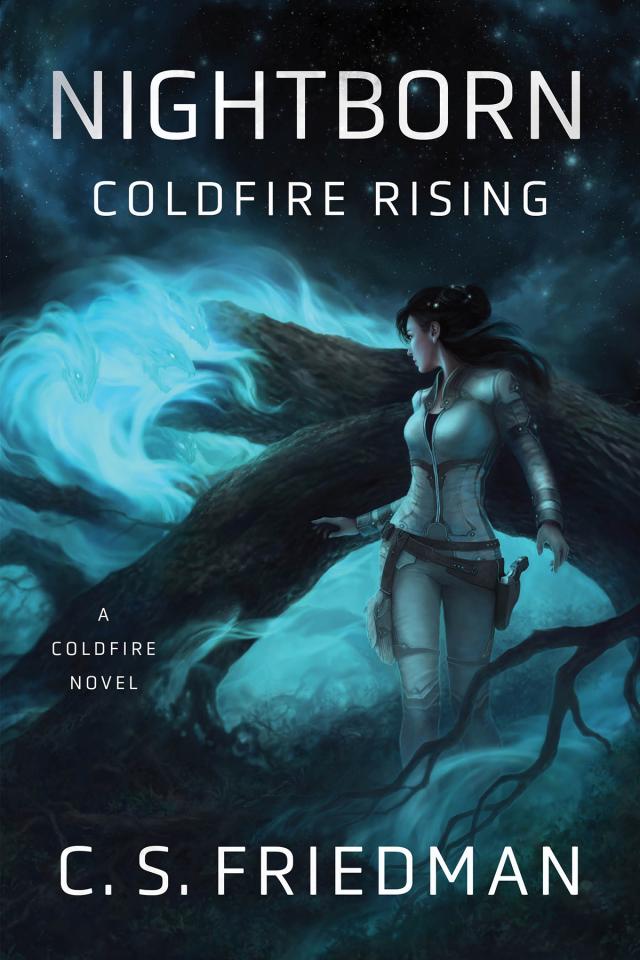
“I was looking out at the land beyond the camp, when a strange light seemed to rise up from the ground. A blue glow that rippled in waves over the grass, like water. There were visible currents, and in a few places it looked like they were flowing around invisible obstacles. It was . . .” He drew in a deep breath. Beautiful. Terrifying. “Otherworldly.” Then he smiled faintly. “For whatever that word means on an alien planet. Sometimes parts of the current would go dark, and be nearly invisible, and then they would brighten again, to almost neon intensity. It looked like they were reacting to something on the ground. I honestly wasn’t sure if the whole vision was real or not, or if my mind was just playing tricks on me. But then I heard your report.” He looked pointedly at Dani. “Clearly it wasn’t my imagination. Or at least, not only my imagination.” The last statement was a question.
“When did it start?” Leo asked. “Before or after the true darkness began?”
At least Leo was taking him seriously; that was reassuring. The knot in his chest eased a bit. “I’m not sure. That’s when it became visible, but it could have been there before that, and I just became able to see it. I don’t know.” He paused for a moment, struggling to find the right words to communicate what he had felt last night. “Have you ever seen those pictures that are made to trick the eye? They seem like normal art at first glance, but when you start to look away, or your eyes go slightly out of focus, suddenly you realize there’s another picture hidden within the first, that you couldn’t see when you were looking directly at it. You have to not look for it, in order to see it.”
“Magic Eye,” Anna supplied.
Ian nodded. “Exactly. This felt like one of those pictures. There was a moment when my eyes suddenly focused properly—or perhaps, unfocused properly—and then the light was visible. Maybe it had been there all along, like in those pictures. Or maybe the true night generated it somehow.” He shook his head. “I’ve replayed it in my mind a thousand times, but I’m still not sure.”
“Sally Chang has been dreaming about her blue fire for a while,” Dani offered. “So that wasn’t dependent on the true night.”
“Did the stuff you saw look like fire?” Johnny asked Ian.
“There were parts of it could be mistaken for that,” Ian said. “If you didn’t see all the rest.”
“That argues for it having been here all along,” Pravida mused. “But maybe the true night is what made it visible in something other than dreams.”
“To humans,” Joshua reminded her. “We have no idea what the local wildlife is seeing. Maybe that kind of landscape is normal in their eyes.”
The concept that all the animals on Erna might be seeing something that humans couldn’t was unnerving; what if Terran life forms weren’t equipped to perceive this world properly? That would be one hell of a handicap to have to deal with. “I tried taking samples,” Ian said. “Not that I had the best equipment for it.” He pulled two small plastic bags out of his pocket to show them. “I figured whatever was causing the light show, maybe I could capture a bit of it to study.” To prove it was real, he thought.
Leo’s eyes narrowed. “That is assuming there was anything to capture. Light itself has no substance.”
“No, but the things that create it do. Back on Earth there are numerous species that can do that.”
“Bioluminescence,” Ted mused. “Is that what it looked like?”
Ian nodded. “I’ve seen a glow like that on the shores of New Zealand—waves of blue light breaking against the beach. The Aurora of the Sea, they call it. In that case it’s caused by plankton, but many other species on Earth can conjure light: Insects, fish, algae, even bacteria.”
“And worm spit,” Ted reminded him. “Don’t forget worm spit.”
Despite his mood, Ian smiled slightly. “And worm spit. The salient point is, light like that doesn’t just appear out of nowhere; it almost always has a biological source. So I figured whatever was causing this light show, maybe I could scoop up a bit of it to study later. But I got nothing.” He shook his head in frustration. “A few grains of pollen, dust, insect detritus, just like you’d expect to be floating around in the air over a grassy field. Nothing that showed any sign of luminescent potential.”
“Don’t forget about the Northern Lights back home,” Johnny said. “Nothing there could be captured in a specimen bag.”
“But those don’t cling to the ground like this did. And . . .” He hesitated. “There’s more.” Now he would have to depart from Dani’s narrative, and with it the precious anchor of common experience that had been keeping his spirit steady. Jeff saw the same thing I did, he reminded himself. But seeing the same thing as someone who was mentally unstable wasn’t exactly comforting.
“There was violet light as well. The deep shade of purple that bleeds from an ultraviolet lamp, at the very limits of human perception. It was mist-like, as if it had physical substance. Tendrils of fog, rising up from the ground like living creatures. . . . ” He shuddered.
“Jeff’s purple snakes?” Lise asked.
Ian hesitated. “Could be. I didn’t see what Jeff did, so it’s hard for me to compare. But these seemed to be coming toward me, almost like they were sniffing me out. I backed away as fast as I could.” He was looking down at the floor now, so that their reactions wouldn’t distract him from the memory. “As soon as Domina appeared they began to pull back, and then just disappeared into the ground again.” He drew in a deep breath. “I returned to that spot after the sun came up. I wanted to see if anything there might explain what I’d seen. I found . . .”
For a moment he couldn’t continue. He was remembering the sharp bite of fear he’d felt during that exploration.
Lise said gently, “Ian?”
“I found an animal burrow,” he told them. “Probably the opening to some kind of underground warren. It was exactly where the purple light had appeared. As if the light had been deep inside those burrows, waiting for darkness to fall.” Or waiting for a human to come near enough for it to touch. He shuddered.
“Purple snakes rising out of darkness,” Dani said quietly. “That’s what Jeff described.”
Ian nodded.
“But Wayne wasn’t killed during a completely dark night,” Pravida said. “At least one moon was out, as I recall.”
“But the waste pit was enclosed,” Lise reminded her. “Maybe that blocked out enough light to accommodate these . . . things.”
No doubt everyone was remembering what the misty ‘snakes’ had done to Wayne. It was something Ian had been trying hard not to think about, given that he might have come close to suffering the same fate. But the fact that this group had taken his report seriously, and was trying to come up with theories to explain where the things came from, eased his spirit a bit. At least they believed that his vision was real. “There’s more,” he warned.
“Jesus,” Joshua muttered. “Worse than that?”
His lips tightened. “That depends on how you interpret it.”
He told them about the blue light inside the camp, how the serene force that flowed across the grasslands became turbulent and chaotic inside human territory. And not only where humans were standing, but anywhere within the camp’s border.
“Shit.” Ted whistled softly. “I just . . . holy shit.”
Ian drew in a deep breath. “Whatever this stuff is, it doesn’t like humans.”
There was silence for a moment as the implications of that sank in. Finally Anna said, “You’re thinking—what? That it’s somehow sentient?”
Ian hesitated. “The snakes seemed to have conscious intent. The blue stuff? I don’t know. But it’s clear that our presence here disturbs it.”
“What if it was some kind of network?” Ted offered. “Some kind of force, or life form, that connects all the local species? That would explain what happened to the insects. The network identified us as bad, so the local life fled.”
Ian nodded. “Like a mycorrhizal network.”
“Yes.”
“But what’s providing the connection? It would have to be something humans lack.”
“Or don’t know how to use.”
Joshua scowled. “In English, please.”
Ian’s mind was racing now. So many possibilities! It was hard to slow his thoughts down to focus on any one of them. “Back on earth, there are fungi that live underground, that can connect to trees. They can pass water and nutrients from one tree to another, and if one is attacked by insects, others are chemically ‘warned’ so they can take defensive action. All without thought or intention. Just biochemical signals.”
Ted’s eyes were bright with excitement now. “There are whole forests that are networked, so that all the trees there are extensions of the same living entity. A sort of vegetative hive mind. Why couldn’t that happen here? Only not just with trees, this time. With all living creatures.”
“That would not only explain the insects,” Pravida allowed, “but the attacks as well. If the network sees us as an alien invader—disconnected from the whole—it might respond to us as a body responds to an infection . . . . ” Her voice trailed off into silence.
“What you’re suggesting,” Johnny said, very quietly, “is that the planet hates us.”
Lise shook her head. “That would imply sentience. A global consciousness. Nothing like that exists on the other colony worlds.”
“That we know of,” Anna reminded her. “Maybe the other planets are just more . . . friendly.”
“Again,” Johnny observed, “the language of sentience.”
“Any sufficiently complex system can appear sentient,” Ted told them. “Look at how we talk about evolution—as if nature had conscious intent and planned the best adaptations. We know intellectually that’s not how it works, but it can appear that way if we only look at the end results. The point is . . .” He drew in a deep breath. “This ecosystem appears to be rejecting us. That may be what cost two people their lives. Obviously not a viable situation. But what the fuck are we supposed to do about it?”
For a moment there was silence. How do you address an infection when you are the infecting agent? Ian wondered.
“Okay,” Pravida said at last. “If we’re going to start talking strategy, we need a name for this phenomenon. We can’t keep calling it ‘the mysterious network that appears as blue light in people’s dreams.’”
Lise was about to respond, but suddenly there was a loud boom from outside the pod; the floor shook. An explosion?
Leo was first to the door. As he opened it, a wave of acrid smoke greeted them. They all covered their mouths as they exited, with whatever fold of clothing they could. But then the cloud blew past, giving them a clear view of the place where the palisade was being erected.
A tractor was burning.
It was the largest one they had, and with the help of a backhoe attachment it had been digging a narrow trench for trimmed tree trunks to be set into. Now the tractor was consumed by fire, waves of smoke belching forth into an otherwise pristine sky. A woman was being dragged away from it—the operator?—while others gathered around her. Yet others were shoveling dirt onto the flames, from the mounds of loose soil the backhoe had just gathered.
Lise hurried to where the operator was being tended to, and knelt down by the woman’s side to check her out. Her face was streaked with soot, making it hard to identify her at first, but after a moment Ian saw that it was Melisande Seely, a member of the construction team. It didn’t appear she’d been badly burned, thank God. She was coughing, but after Lise examined her for a moment she seemed satisfied. “She’ll be all right,” she announced. “But I’ll give her a full checkup at the clinic to make sure.”
Leo crouched down by Melisande’s side. “What happened here?”
The woman wiped sweat-soaked soot from her eyes with the back of a sleeve. “Damned if I know.” Her voice was shaking. “It was digging just fine for a while. Then I smelled oil smoking, and I got down from the cab to check the engine, and then—it just blew.” She shook her head. “Thank God I’d climbed down to check it.”
The flames were dying down now, leaving behind a charred metal armature splattered with dirt. The vehicle looked beyond saving, but hopefully at least the backhoe attachment was salvageable; the colony couldn’t afford to lose that.
Looking at the ruined cab, Ian thought, The same technology that makes it possible for us to tame this new world makes us vulnerable. What would happen to us if it all disappeared tomorrow? Would our book-learned skills be enough to save us?
“That’s the second tractor to fail,” Ted said from behind him. “Unlikely to be a coincidence, don’t you think? The tractors in all the other colonies worked fine, so the problem isn’t our equipment.”
Ian turned to look at him. “What are you suggesting?”
“Well, if there is something here that hates humans . . .” He nodded toward the tractor. “Maybe it would attack the things we need to survive.”
Ian’s eyes narrowed. “You know that sounds fucking crazy, right?”
“This whole place is fucking crazy.”
“You’re suggesting that a biological network—assuming that’s what we’re dealing with—could not only manipulate living things, but destroy machines. That seems a bit fantastic, even for an alien world.”
“Is it? A single bird can bring down a jet plane. Mold can foul an electrical connection.” Ted gestured back toward the camp. “There’s nothing we brought with us that biological entities couldn’t destroy. Assuming they were directed properly.”
“None of which would explain the attacks on people. Tia appears to have been killed by something straight out of a Filipino horror vid. Wayne died in the same way as someone in a science fiction movie. How would a biological network know what we were thinking? What we feared?”
For a long moment Ted said nothing. The two of them just stood there, watching as the smoldering ruins of the tractor slowly cooled, the last tendrils of smoke dispersed by the breeze.
“Just because we don’t understand something,” Ted said at last, “doesn’t mean it’s not possible.”
Commander’s Personal Log
Year One
Day Seven
We have given a name to the strange blue force: fae. It was Ian’s suggestion, unanimously approved. It harkens back to Terran legends of mysterious lights that lured men to other worlds—or perhaps to their deaths—and of shadowy creatures that might be either good or evil, who took pleasure in toying with mankind. Whatever is causing the phenomenon here, there is no denying that it appears magical, so the name suits it.