The wrong good deed, p.1
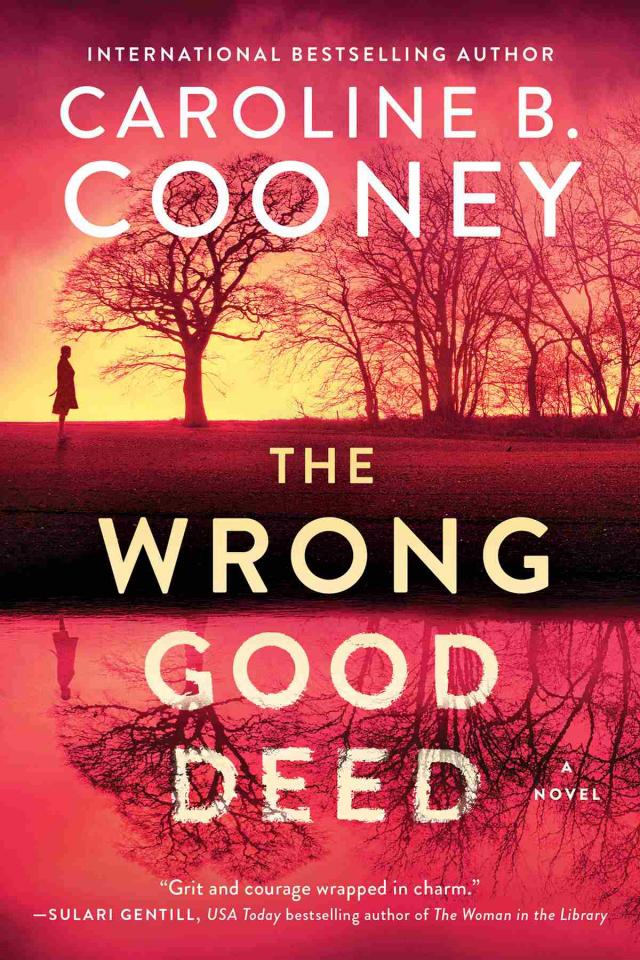
The Wrong Good Deed,
p.1


ALSO BY CAROLINE B. COONEY
Among Friends
An April Love Story
Before She Was Helen
Both Sides of Time
Burning Up
Code Orange
Deadly Offer
Diamonds in the Shadow
Driver’s Ed
Emergency Room
Enter Three Witches
Evil Returns
The Face on the Milk Carton
Family Reunion
Fatal Bargain
Fatality
Fire
Flash Fire
Flight #116 is Down
Fog
For All Time
Forbidden
Freeze Tag
A Friend at Midnight
The Girl Who Invented Romance
Goddess of Yesterday
The Grandmother Plot
He Loves Me Not
Holly in Love
Hush Little Baby
I’m Going to Give You a Bear Hug!
I’m Not Your Other Half
If the Witness Lied
Janie Face to Face
Last Dance
The Lost Songs
Mummy
Nancy and Nick
New Year’s Eve
Night School
No Such Person
Out of Time
The Party’s Over
The Perfume
The Personal Touch
Prisoner of Time
The Ransom of Mercy Carter
Saturday Night
Snow
The Stranger
Summer Nights
The Terrorist
They Never Came Back
Three Black Swans
Tune in Anytime
Twins
Unforgettable
The Vampire’s Promise
The Voice on the Radio
Wanted!
What Child Is This?
What Janie Found
What Janie Saw
Whatever Happened to Janie?
Thank you for downloading this Sourcebooks eBook!
You are just one click away from…
Being the first to hear about author happenings
VIP deals and steals
Exclusive giveaways
Free bonus content
Early access to interactive activities
Sneak peeks at our newest titles
Happy reading!
CLICK HERE TO SIGN UP
Books. Change. Lives.
Copyright © 2023 by Caroline B. Cooney
Cover and internal design © 2023 by Sourcebooks
Cover design by James Iacobelli
Cover images © Silas Manhood/Trevillion Images, Mark Owen/Trevillion Images
Sourcebooks, Poisoned Pen Press, and the colophon are registered trademarks of Sourcebooks.
All rights reserved. No part of this book may be reproduced in any form or by any electronic or mechanical means including information storage and retrieval systems—except in the case of brief quotations embodied in critical articles or reviews—without permission in writing from its publisher, Sourcebooks.
The characters and events portrayed in this book are fictitious or are used fictitiously. Any similarity to real persons, living or dead, is purely coincidental and not intended by the author.
All brand names and product names used in this book are trademarks, registered trademarks, or trade names of their respective holders. Sourcebooks is not associated with any product or vendor in this book.
Published by Poisoned Pen Press, an imprint of Sourcebooks
P.O. Box 4410, Naperville, Illinois 60567-4410
(630) 961-3900
sourcebooks.com
Library of Congress Cataloging-in-Publication Data
Names: Cooney, Caroline B, author.
Title: Wrong good deed : a novel / Caroline B. Cooney.
Description: Naperville, Illinois : Poisoned Pen Press, [2023]
Identifiers: LCCN 2021023668 (print) | LCCN 2021023669 (ebook) | (hardcover) | (trade paperback) | (epub)
Subjects: GSAFD: Mystery fiction.
Classification: LCC PS3553.O578 W76 2022 (print) | LCC PS3553.O578 (ebook) | DDC 813/.54--dc23
LC record available at https://lccn.loc.gov/2021023668
LC ebook record available at https://lccn.loc.gov/2021023669
Contents
Front Cover
Title Page
Copyright
Sunday One
Two
Three
Four
Five
Six
Seven
Eight
Nine
Monday Ten
Eleven
Twelve
Thirteen
Fourteen
Fifteen
Sixteen
Tuesday Seventeen
Eighteen
Nineteen
Twenty
Wednesday Twenty-One
Twenty-Two
Thursday Twenty-Three
Twenty-Four
Twenty-Five
Friday Twenty-Six
Twenty-Seven
Twenty-Eight
Reading Group Guide
About the Author
Back Cover
SUNDAY
ONE
Clemmie and her friend Muffin sat in the sixth pew on the right side of the center aisle. They were getting to their feet for the last hymn when Muffin grabbed Clemmie’s arm. “We have to get out of here!” she whispered. Her face was distorted with fear. “Quickly! Shove to your right.”
Do we have a shooter? thought Clemmie. Her mouth went dry. Should I scream a warning? Why isn’t Muffin screaming?
“That man on the far side of the center aisle?” said Muffin, her voice shaking. “Two pews down, two people in?”
The entire congregation was now standing. Clemmie was too short to see the aisle, let alone across it and down two pews, but she peered around anyway, looking for weapons. There had been a rash of church shootings this year. Many churches, including Trinity Hill, now had a policeman on duty in the parking lot Sunday morning—squad car facing out, lights whirling. It was both comforting and appalling.
“I used to know him,” said Muffin. “I don’t want him to see me. We have to get out of here.”
It wasn’t a mass murderer? It was just somebody Muffin used to know? Clemmie sagged with leftover fear. Muffin elbowed her. It wasn’t a gentle nudge. It was a sharp, urgent poke.
There were two couples between Clemmie and the far side aisle, and she wasn’t about to shove them out of their pew just because Muffin had spotted an acquaintance. She shook her head and raised her hymnbook, hands trembling from the idea of a shooter.
Muffin leaned around her, tapped the closest husband on the shoulder, and said over the crescendo of the organ, “I’m so sorry. We have to leave early. Please excuse us.”
They had come in Clemmie’s car. If Muffin wanted to bail on church, Clemmie had to drive. She was forced to put her hymnbook back on the rack, gather her handbag and Bible, and slide past, murmuring apologies. Muffin strode out of the sanctuary, all but breaking into a run.
It was ridiculous. There were three or four hundred standing bodies between Muffin and the acquaintance. He couldn’t possibly see what Muffin was doing, and if he’d been across the center aisle and two pews closer to the chancel, he wouldn’t have had a view of Muffin to start with.
Few people noticed their exit. Although Clemmie herself sang from the hymnbook, almost everybody else looked up at the huge screens. Didn’t they have enough screens in their lives? They needed screens in church too? And the screens had only the words. Clemmie liked to read the notes, enjoy the chords, see who the composer was, and think about the year in which the hymn had been written.
Muffin hurried into the narthex. She cast a frantic look back at Clemmie, but to the police officer positioned at the exit door, she gave a pleasant smile.
So because of Danger Man, I have to skip the hymn and annoy our whole pew, thought Clemmie, but he isn’t sufficiently dangerous to bring in the police.
The moment they were out of the building, Muffin said, “Run. He’s going to follow me.”
Muffin was, in fact, a runner. She was devoted to this awful practice, rising before dawn every day, dressing in leotards or tights or whatever they called them nowadays, running several miles on a strict pattern. She was as trim as a girl, although her face was deeply lined, so there was no hiding her age. Clemmie had never been interested in running. It was her belief that only flat-chested women could enjoy it anyway. Plus she didn’t have the balance for it these days; she couldn’t even wear high heels to church. What was the point in fashion if all your shoes were flats? She handed Muffin her purse because it held the key fob. Now Muffin could run ahead, duck inside the car, and maybe even hide, a frequent activity for Clemmie, who had spent half a century living under somebody else’s name, but not one she had ever pictured for Muffin.
Of the several church parking areas, Clemmie preferred the eastern end of the upper lot, close to the rear exit. It was a bit of a hike.
She and Muffin were wearing twin jackets, purchased at the L.L.Bean outlet store where they had stopped on a New England fall-color bus trip. The vivid indigo-blue jackets were tailored in an almost formal fashion. When the excitement of the purchase was over, Clemmie didn’t actually want to wear hers; the gaudy color attracted too much attention. Clemmie detest
ed attention. But Muffin often texted, asking Clemmie to wear it, and then they matched, like elderly cheerleaders.
Muffin peeled her jacket off, although the day was raw and chilly. “Take yours off, too, Helen. It’s too bright. He’ll see it.”
Clemmie was still shaky from the thought of a shooter. How slow her response had been. What if it had been the real thing? She would have let the whole congregation down, checking and double-checking and not wanting to embarrass herself if she were wrong.
“Please,” said Muffin. She was crying.
Astonished, Clemmie shrugged out of her jacket, folded it neatly, and carried it in front of her. Muffin darted ahead up stone stairs and scurried between rows of cars. Clemmie walked calmly, not looking back, because she wouldn’t recognize Danger Man anyway.
She did not want to know the backstory to Muffin’s flight. She had become the neighborhood visiting nurse, so to speak, and was knee deep in sick people, friendless people, and people in pain. The sorrows of her past made Clemmie a soft touch. She never asked difficult or invasive questions since she would not answer such a question herself. She just listened and helped. Right now, however interesting Muffin’s history might be, it could also present one more burden for Clemmie to shoulder and even solve.
By the time she reached her car, she was shivering from the unseasonable cold. She slid back into her jacket and eased behind the wheel, sinking onto the soft, fine leather. The seat with its wonderful memory adjusted itself in a leisurely way for a short driver with short legs. She retrieved her purse from Muffin because she liked to drive only when her handbag was within touching distance. She started the engine and pressed the button for the seat heater. So cozy to curl her spine into all that warmth.
Muffin actually lay down across the back seats. “Go, Helen!” she cried, her voice breaking. “Go, go, go!”
Clemmie headed toward the main road. She meant to go straight, but the light went red. There were several ways home to Sun City, so rather than wait and increase Muffin’s distress, she took a right on red, mentally revising her route. Then she touched the navigation button and up came the wonderful map to reassure her. Cars these days were so much fun.
Half a mile later, she made another turn onto Shirley Road, not well traveled at any time, but on a late Sunday morning, entirely without traffic. The road was narrow and potholed, probably on the county list for improvement, but road repair lists were long and not enough people lived here to put Shirley Road at the top. Most rural acreage in the county had been swallowed at a stunning rate by developments, condos, apartments, strip malls, gas stations, fast-food restaurants, and nail salons. But here on Shirley there were still a couple of marginal farms, with white-fenced pastures and flat, wet fields.
“Thank you, Helen,” said Muffin in a weepy voice. “It was from a long time ago. I never expected to cross paths after all this time. It’s one of the amazing things about a retirement village like Sun City. You’re always bumping into some connection. People join the New York-New Jersey-Connecticut Club and find out that their kids’ junior high principal lives here too. So it shouldn’t surprise me that somebody from long ago would appear. Although you would think church would be safe.”
Clemmie decided to take the next left onto Patterson Church Road. It was not the quickest way, but certainly the prettiest, because a few miles up were two charming little churches. One brick AME Zion, where her friend Gale went, and one clapboard Baptist.
Leggings! she thought. That’s what leotards are called now.
Clemmie both loved and loathed the slow recall of old age. Not that your seventies were old these days. Seventies were the new fifties.
She caught up to a small gray pickup truck wandering slowly from one side of the road to the other. She assumed it was pothole avoidance. There were two girls in the little cab, driving with the windows down, although it was not warm enough for that. Perhaps they were in love with how their long hair swirled out.
The turn from Shirley Road onto Patterson Church was angled slightly backward and required a serious slowdown. Patterson Church was narrow and had no verge, but was flanked by deep drainage ditches thick with weeds. Clemmie liked the 1930s air of this road—little old houses surrounded by haphazardly planted overgrown shrubbery, junked agricultural implements, and pansies planted in white-painted tires. Probably by next year it would sport several subdivisions, one of which would be gated, plus an apartment complex and the latest elementary school.
The little gray pickup failed to make the acute turn. Both driver-side wheels drove neatly into the invisible ditch. The truck tipped severely but evenly on its left. It happened slowly. If the girls were wearing seat belts, Clemmie doubted they would have a scratch. But there was no way out of that ditch except a tow.
Clemmie did not want to stop, what with Muffin crying quietly to herself in the back seat. But she was not the kind of person who failed to help people, especially since the ditch made this a Good Samaritan parallel if there ever was one. Clemmie braked gently. “Muffin, stay down.”
“Helen! What are you doing?” Muffin whispered frantically. “Do not stop!”
The passenger door of the little truck opened with difficulty, because of the extreme tilt, and out slid a very young girl, barely into her teens. She was thin and pretty with long, thin, pretty hair and clothing suitable for July. She was sobbing.
Clemmie came to a full stop and put down her window. “Is anyone hurt?”
“No. We’re fine. But now what?” the girl wailed.
“Do you have your cell phone?”
The girl looked at her, like, What—are you mental? Of course I have my cell phone.
“Call your parents,” said Clemmie, and the girl said, “No, no. No, I’m sure we’ll be fine. Jayleen, we can get out of the ditch, can’t we?” She turned huge eyes on Clemmie. “My sister’s driving.”
The sister now crawled out the passenger side, too, having no way to open the driver door. It was so awkward that both girls exploded in giggles. When Jayleen finally got herself upright on the pavement, she looked so young she couldn’t have had her driver’s license more than a minute.
“Helen!” whispered Muffin. “Keep going. They have their phones! They’re not hurt!”
But Jayleen also got weepy and said, “Now what?”
“Call your parents,” Clemmie repeated, and the sisters exchanged looks, like, Then we’d be dead.
Clemmie had been a Latin teacher for half a century, and still taught, which her friends at Sun City considered lunatic, and she liked teenagers. These two probably don’t have permission to use the truck, she thought. Or Jayleen really isn’t old enough to drive. Or nobody has insurance. “I can’t stay in the middle of the road,” she told them. “I’ll pull into that driveway and walk back and we’ll decide what to do.”
“No! You don’t have to do that,” said Jayleen. “We’re fine, really. Aren’t we, Jaymie?”
Clemmie drove a few hundred feet to the weedy gravel drive of a house set so far in that she could barely see it. To leave their driveway open, she had to park behind scary shrubbery that in warmer weather would be snake habitat.
“How could you?” asked Muffin, as if Clemmie had taken up human trafficking.
“Muffin, you’re fine here. Nobody can see my car from the road, let alone spot you. And you don’t have to get home quickly; you just had to leave church quickly. Read a book on your cell phone or something. I’ll be back in a jiffy.”
TWO
The girls were now standing in the middle of the road, as if getting hit themselves would be preferable to calling anybody. They were clearly sisters, so pretty with their matching straw-like hair. “Did you reach your parents?” asked Clemmie.
“Let me try again,” said Jaymie in a high fake voice. She played with her cell phone, but failed to tap the screen. “They’re not answering,” she said happily. She backed up against the gray tilted length of her petite truck and took a selfie. Jaymie did the same. They compared pictures and took selfies featuring them both.
“Do you have another phone number to try?” asked Clemmie.
Jayleen stepped up. “I’ll call my father.” She played with her phone. “No answer,” she said sadly.
Whatever else the sisters’ future included, it wasn’t acting. Clemmie needed to get this show on the road, so she tapped her own phone. “Nobody’s hurt,” she said to the voice that answered 911, “but there’s been a one-vehicle accident at the corner of Shirley Road and Patterson Church. A small pickup truck is in the ditch, and the driver is a teenager who can’t reach her parents. We don’t need an ambulance, but we do need a trooper.”