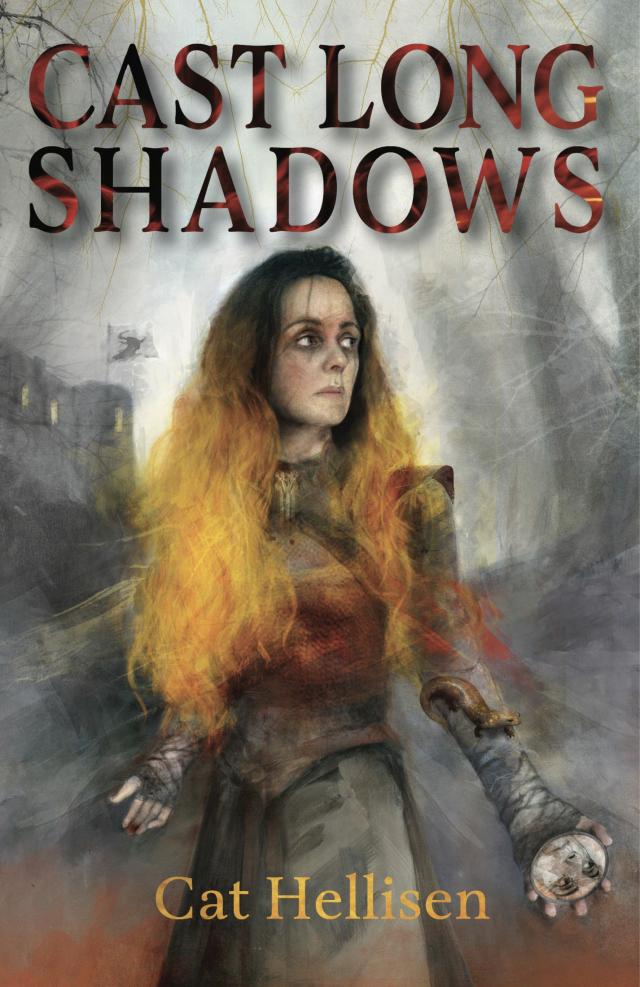
Cast long shadows, p.16
Cast Long Shadows,
p.16


"No." Marjeta looked to the watchful figure of Lilika, who was smiling thinly. The nurse-guardian took a seat on a narrow chair near the wall. She seemed to slide out of sight, small and unobtrusive. She hadn't liked that gift, Marjeta could tell, hadn't liked the idea of someone else holding any kind of power over her diminutive charge. "I'm not. But I'm older than you."
The girl shrugged. "Everyone is older than me." She paused in her stroking. "You’re not the one Father wanted."
"No." Her stomach went cold and tight, and for a moment Marjeta thought she was going to throw up right there, nothing but bile and snow. "He was meant to marry my sister, but she died. So here I am."
A moment of stretched out silence grew, the ends of it icy. Silviana appeared to be mulling this over, her brow creased in thought. "My mother also died," she said, finally. "People say I killed her."
"Did you?" Marjeta kept her face still. She knew what it was like to feel guilty, but the guilt was her own secret, and Val had whispered her forgiveness before she died. No one else knew about Sasha, and about the secret ride into the forest. No one had ever thought to accuse her of her sister's death — and to do that to a child. Marjeta shivered. What a pointed cruelty.
Silviana looked up from her contemplation of the rug and folded her hands in small fists. For a moment she looked so like Val that Marjeta's lungs began to ache. "Perhaps," said Silviana, and Marjeta breathed out. "I don't remember."
"It would be strange if you did." Her voice was shaky, a last leaf on an autumn bough voice, and Marjeta concentrated harder on pushing away all her thoughts of Val, on feeling nothing. This girl hadn't killed her mother. Men liked to say that because it gave them something to blame. Life was like that, full of risks and dangers, even when your battlefield was a wool coverlet and a wide bloody sheet.
"Strange." Silviana's face broke into an unexpected smile. "Brother Milos says that all the women of Petrell are witches, and that Papa shouldn't be bringing vipers like you into the castle."
There was a quick sound of indrawn breath, and Marjeta turned her head slowly to look at Areya, who had taken a seat across the room, as a mirror to Lilika. Areya's head was bowed, but Marjeta could see the dark flush of her cheeks. On the opposite side of the room, Lilika had placed a woven willow basket at her feet and was unfolding an underskirt across her lap and selecting thread. She wasn't paying attention to the talk — or so it seemed — but there was a sly smile caught just in the corner of her mouth. A barely-there twitch. Marjeta noted it and narrowed her eyes.
She needed to speak to the girl without her wolf-protector, but now was not the time. Marjeta bent down, and took a seat crosslegged by Silviana, so close to her that their knees met. She was dizzy with exhaustion from the days of travel, the newness of the castle, the wine and rich food at the feast, and now this solemn, lonely little girl — one minute vicious as an adult, and the next vicious as a child. She smoothed her hand across the bear fur and breathed in the musky faint smell. For a moment, Marjeta wished she had something to occupy her hands — wool to wind or thread to stitch. She had no interest in it, but it was mindless work and would have served as a kind of armour against the vulnerability of simply talking to Silviana.
So, the man who had washed her hands and blessed her in the entrance hall was her enemy, then? Marjeta was hardly surprised. He had seemed aloof and disdainful, as though she were an untrained cur let loose in his house to piddle in a corner. "The priests of Furis call all women witches." She was probing at a wound. Pretending idiocy to get a reaction. To see where a child's loyalties might lie, when she knew full-well they would lie where her nurse had told them to. "Sky and Earth and Sea do not need men as priests." Marjeta leaned back and let herself smile. "I don't follow the gods of men."
"Lee-lee says different." Silvi folded her arms across her chest. "She says that in Petrell you have three gods made of old rubbish, and you feed them bread and oil and the women dance naked around them and ask for blessings."
"People ask them for blessing, yes." She laughed at the idea of any of the women in her father's castle dancing naked about their house idols. "And we feed them bread and oil. But nothing more than that. I have my own set of house gods. I could show them to you some time, if you'd like."
The girl was mercurial. Her sullen expression dropped away to be replaced by one of utter delight. "I want to see them!" she said. "Are you truly a witch — can you do magic?"
Marjeta had no magic. She knew that. But so many ill things had happened that Marjeta wondered if her father had been right to send her away. Perhaps, Marjeta thought, she could do magic, but hers was broken and twisted and made everything come out wrong. It showed her death and killed the things she loved. "No," Marjeta said softly. "Of course not."
The lines had been drawn long before her arrival. The priest Brother Milos was teaching Silviana that her stepmother-to-be was a viper, and probably hissing the same to every ear that would hear him. While Duke Calvai had paid Marjeta no more attention than he would a shipment of unbleached linens, that couldn't hold forever.
In a matter of years, they would be married and Marjeta would need to bring red cheeked heirs into the bear den; squalling hairy monsters. She shuddered. What would Val have done? How would she have dealt with this? It had been her path, after all. At the time Marjeta had only been concerned that Val's wedding would take her away and that she would lose her sister and closest friend. She hadn't given much thought about what it had meant to Val. How neither of them had any say in the final decision. They might have argued their cases for or against certain lords and dukes, to be sure, but even so their choices would have been limited, and their father's word would have overruled their own.
Tears burned behind Marjeta's eyes. She kept them wide, scared that, if she blinked, they would be dislodged to run down her face. Childish. Weak. No, she was going to use this burning.
So, she was a viper? Brother Milos wanted a serpent to point at, an enemy that he could denounce. Well, Marjeta would give him one, but she wasn't going to be a viper for him. The Petrells were salamanders born in fire. She was going to rise from righteous fire, with a skin more poisonous to touch than any viper's bite could be. Marjeta held onto the heat of her unshed tears, twisting it round the little red thread of her weak and useless magic. Feeding it. She felt the pain drying up, to be replaced by something cleaner. Being scared and lonely would destroy her here. Rage she could use.
It wouldn't do to rush into this new world with no alliances. She needed Silviana on her side. It was already clear that Lilika held her in control. Now the girl was to become a pawn, tugged between the two of them. It wasn't exactly how Marjeta had planned to go about her life in the Jurie castle, but it was exactly what her mother had been trying to make her realise. She'd just been too selfish in her own unhappiness to understand what all those lessons had been for. Why Mama had made her sit and embroider. It had nothing to do with making pretty things or sewing charms. It had been so she could hear the talk of the women and broaden her education.
Marjeta smiled. Witchcraft and gods were dangerous ground, but she was sixteen, and she remembered enough of her own wishes from half a lifetime ago. "Do you know the game Hare and Foxes?"
Silviana shook her head.
"Ah. Well, all we'll need are three small white stones, and one grey one — bigger than the others. And a piece of chalk."
"Chalk?"
"To draw the markings."
"Where will we get stones?"
Marjeta frowned. "From the grounds, of course."
Lilika coughed nervously. "I'm afraid the Lady Silviana is not allowed to leave the castle under any circumstances."
Confused, Marjeta cocked her head to stare at the little nursemaid. The woman met her gaze with a barely concealed triumph. "I was told as much. I did not mean to break those rules," she said. "There are stones on the castle grounds."
"No. You see, you misunderstand. The Lady Silvi is not to leave these walls. She must stay in her rooms at all times."
Marjeta stood. "You mean to say that Silviana has never been outside?"
There was no answer. Marjeta stared at the two of them: Lilika smirking as she stabbed her needle into the underskirt, her hand played, and Silviana sitting wide eyed and forlorn on the bear skin rug at her feet. When she'd assumed Silviana was a prisoner in a pretty cage, she hadn't quite known the extent of it. Marjeta would have to gather stones herself some other time. "Oh. Well, perhaps another game," she said softly. "Is there one you can think of?"
Silviana clutched at her chest briefly, then nodded, and that was how Marjeta found herself hopping on one leg through the passageways of the rooms belonging to the little girl. It had been years since she had played this game with Val, where one had to copy the other, and the actions grew more and more ridiculous until one or the other collapsed in hysterical giggling. It was not a game you could play on your own. Marjeta was hard pressed to imagine Lilika playing this. Perhaps she did what she had to in order to have the heir on her side. Her mouth thinned. Lee-lee had definitely played silly games, and perhaps she even cared deeply for Silviana.
It was to be a very odd war, Marjeta realised. This battle for affections. And no matter what she hinted, she had no real magic like her sister's.
She would need a plan and she would need information.
*
Marjeta's father had left soon after the ceremonies and the feasting turned to sullen hangovers and roiling stomachs. They'd had a brief, emotionless goodbye, and then Marjeta was alone.
Perhaps not totally alone. It became more and more evident to her that her mother had chosen well in sending Areya with her. The lady's maid was a voice of calm and reason. And home: familiar accents, familiar sayings. Marjeta found that the days here passed much the same as they had at home. The Duke Calvai Jurie might be wealthier, but his vast lands and holdings still ran on the same seasonal clocks. Eskin, the nearest village, might be kept at a distance, its boundary marked by the Penitent's tower, but there was still the citadel that was contained within the summer palace's grounds and all it took to keep the palace community going. Sewing, and repairing, gathering and feasting, milking, churning, weaving, and the day in and out drudgery of work.
The duke had left Marjeta alone since that one brief meeting at the feast table. If he was at all troubled by her presence, Marjeta had no sense of it. He had no time for girls, even — or perhaps especially — if they were engaged to him. Soon the rhythms of castle life became comfortable and boring. Marjeta was still being tutored in all the things she was expected to know as the future wife of a duke. She had to embroider and weave and work as she always had. While it was true there were more servants here than in her family home, even a duke's future wife was expected to help where she could and Marjeta found herself following her own mother's path, sewing shirts to hand out on feast days, embroidering intricate charms into hems and collars. The people of the nearby village of Eskin and Verrin, the city of the old fort and the home of Jurie's army, would not bow their heads to her unless she made them love her. They had loved the Duchess Belind like she was their sun, and there was no way Marjeta could hope to outshine her. She could do only what her mother had trained her to do.
Marjeta soon learned that the duke's absences were to be many and long. And it was Brother Milos who held the men and women of the palace in his fierce, cold grip while the duke spent most of his time in Fort Verrin. The palace where she now lived had once been the summer home of the ruling dukes of Jurie. After Belind had expressed a desire to live there rather than at the Verrin seat, the court had been relocated. It was far from a convenience. While the summer palace was more opulent, larger, and warmer than the traditional hill fortress in Verrin, it had moved the ruling family far from the heart of trade and consequence. As a result, the Juries and their retinue lived in a pretty, gilded bubble, their only thoughts on their secluded world. In Verrin there was news of war, and grim-faced soldiers practising with their light rifles and swords, and farmers paid their taxes straight into the war coffers, but in the summer palace, hardly a breath of outside discontent entered. Instead, the palace was left isolated to stagnate in its own petty feuds and power grabs.
It was so very unlike her own upbringing in Petrell, where the castle had been a rough and ready fixture of the town, its arms wide enough to enfold the villages and markets. Here, Marjeta was distanced from reality. And that strange distancing and the duke's frequent stays in Verrin made the summer palace feel rather like a private fiefdom under the control of one man.
Brother Milos, the head of the Temple of Furis, and Duke Calvai's right hand. Everyone of rank in Jurie's court was expected to attend nightly services in the chapel hall. It was a chapel of the horned god Furis, filled with strange foreign incense from the east, and the images painted onto every wall told the life story of the foreign god, from his birth — sprouted whole from the head of a milk white bull — to the day his own horns erupted from his skull in sharp points, to his sacrifice of his bloodied heart to save his people, on to his final moments when he ascended to the sun and made it brighter.
Marjeta had never paid much attention to the horned god while in her father's court. She'd been aware of him as something that her father pretended to follow. There had been a priest at home, and a handful of lay brothers, but they'd had nowhere near the power the men of Furis had here. The celebrations and feast days that marked the year in Petrell had revolved around the Three and various minor forest and water deities. Even the Day of the High Sun, which was the most important day in Furis's worship calendar, overlapped with the midsummer celebrations that she'd grown up with. Furis's feast days had been tacked on as grudging extras. All the things Marjeta had learned about him were simply that he came from the east and he sometimes appeared to his people as a white bull. More than that he hadn't interested her.
"Why do I have to know this?" Marjeta pushed a dense roll of text away from her across the low wooden table. She was in the under-library, a stacked room filled with dust and pamphlets and codices and folios. Ancient hand written books and new printed hymnals and treatises were shelved in a haphazard order understood only by the librarian, Caneth.
He was an old man, a back bent double from hunching over his desk, and weak watery eyes that seemed to work only by candle light. He rarely ventured into the sunlight, as it gave him aches in his head so intense that he would vomit for days. Despite his strange, slightly misshapen appearance, Marjeta had found Caneth easy to talk to. He treated all men and women the same — as if they were fools, but valuable ones to be talked to with patient kindness.
"The texts of Beathis?" Caneth looked over the edges of his spectacles. "Because I was given to understand that you had little knowledge of the horned god," he said. "It is a primer text, useful to read before tackling the collected bibles of the east."
"Have you seen the horned god?" Marjeta asked.
Caneth snorted. "No more than I've seen the sun rise at midnight, but that's not to say it has never happened or that Furis himself isn't watching us now, invisible as air." He straightened a little at his desk. "One does not have to see a god to know he exists — only to see his actions."
"I can see my gods." Marjeta pointed out.
"No, you see three idols. Of which every household has a set. Hardly the same thing as frightful beings from beyond this world."
Marjeta shook her head. Could Caneth not see? Even though her mother's worship of The Three annoyed her more often than it did not, they were still more real than Furis. She had grown up with the idols in her room, had fed their tributes to the salamander in the hearth and never been struck down by some almighty power, but that didn't mean The Three were powerless. Or that the idols were nothing more than carvings. "The Three see through the eyes of every idol," she told him. It was the sort of thing her mother said, but now she felt a strange prickle under her skin, wondering at the truth of it. Did they? The thought was far more terrifying than the idea that they did not.
"Do they?" Caneth echoed her own thoughts. "How very boring for them, I should think." He shuffled through the papers on his huge, cluttered desk. The lights in the oil lamps flickered and smoked, greasy tendrils that had licked the under-library's beams black. "Regardless, you must read the texts, like it or not. The duke expects every member of his court to take part in the service and worship, and he will want you marked in the faith before he marries you."
"That's still years away."
"But the Feast of Horns is in a matter of months, and as the duke's intended, you will be expected to take part and to know the responses."
It was true there was no escaping the regiment of Furis's feast days, at least not in the near future, but Marjeta kindled a small hope that she could find a way to avoid this coming marriage. A pale, hopeless hope. She was already being moulded into what the duke wanted. After her religious readings, she would be tutored in the ways of the duchy of Jurie and after that, she would be cleansed and shepherded to Silviana's suite of rooms where she would sit with the girl and with the sour-faced Lilika, and stitch until her pricked fingers felt as though they were ready to drop off.
The only good thing would be listening to Areya hum as she worked. She kept up a constant refrain of all the songs of Marjeta's home, and if she half closed her eyes (pricked thumbs be damned!) she could pretend that the dark haired, snow girl stitching so prettily across from her was her sister Val, and Lilika could be reduced to a blur of shadows and form, a maid or mother, it didn't matter. If she let herself daydream, she could fall back into a world where after her lessons she would be free to ride Dust through the fields and woods, where Sasha loped at her side, and the world was unchanged and familiar.