The siren sea, p.1
The Siren Sea,
p.1
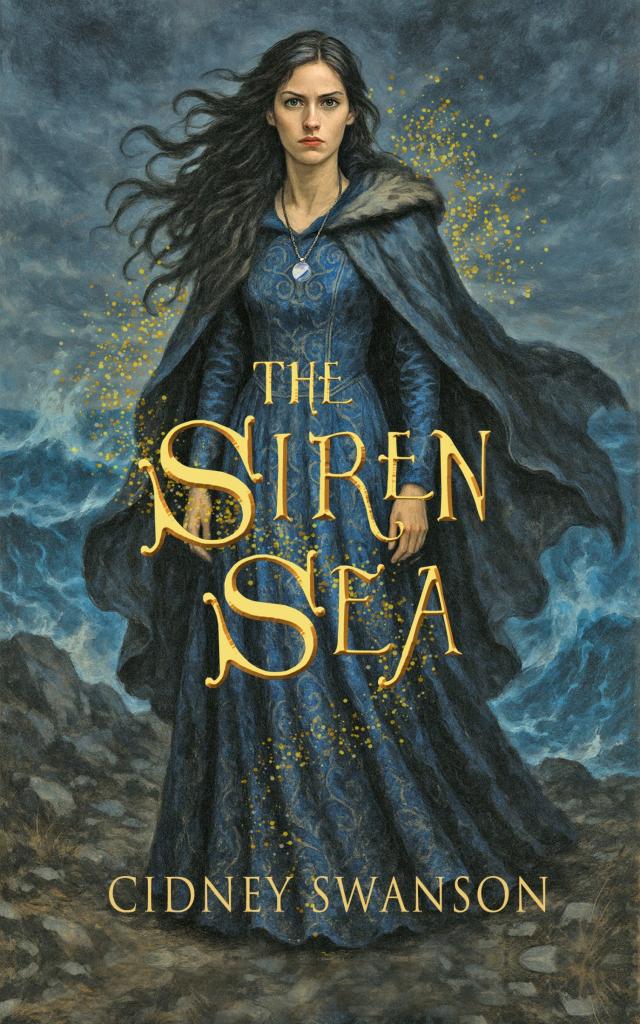


Cidney Swanson
3rd Edition Copyright © 2025 by Cidney Swanson
All rights reserved, including the right to reproduce this book or portions thereof in any form whatsoever.
This is a work of fiction. Names, character, places, and incidents are products of the author’s imagination or are used fictitiously. Any resemblance to actual events or locales or persons, living or dead, is entirely coincidental.
Cover art © by Cidney Swanson. All rights reserved.
ISBN 978–1–939543–84–4
Also by Cidney Swanson
The Thief in Time Series
A THIEF IN TIME
A FLIGHT IN TIME
A SWORD IN TIME
A CROWN IN TIME
A DUEL IN TIME
A BRUSH IN TIME
A PASSAGE IN TIME
AN EMPIRE IN TIME
Books Not in a Series
SIREN SPELL
For Kim Ridder,
herb woman and life-long friend
these many decades
1
BEFORE AND AFTER
Once there was a girl who dwelt in a small farmhouse on an island. The girl was small, but her fate was not. The island was small, but its reputation was not. As for the farmhouse, it was merely small, though also cozy and beloved. At least this was so, before.
Before and after: these are the lines that divide lives and stories. For Katrin-of-the-not-small-fate and her younger brother Cyril, there were two befores and two afters. First, the loss of their mama, and then a second loss, their tato. Mother and Father gone: two befores, two afters, and a world of change.
After, the siblings remained under the same thatched roof on the same small farm with its six hens and its orchard of apple and cherry trees. They stayed together in body, if not in spirit, for Katrin blamed her brother for their father’s death.
The stone wall enclosing orchard and cottage, or stonecote, as their mother had called it, abutted the grounds of a famed abbey on Talisfarne, an island bounded to the west by the Siren Sea and to the north by the Leviathan Sea, sometimes called the Sea of Worms. The abbey sheltered religious brothers and sisters and hosted an abbey school (also famous) where dukes and thanes from the five kingdoms sent their children for a princely education. Katrin and Cyril’s father had tutored at the school before his death.
The siblings might have left the stonecote and taken up residence in the abbey dormitorium, for, as the children of a tutor, they were entitled to be educated, fed, and housed without cost. Possibly, each hoped the other would move out, but both were stubborn, and neither had. They shared other traits besides stubbornness, of course. They had the same hair color (brown) and eye color (sea-gray), but perhaps most importantly, they shared the same longing to know things.
When Katrin had been four, she had mistakenly believed her name was “Katrin You Never Knew Such A One For Questions.” This was what her mamaly said when introducing her to others, whether to the bee-keep or abbey matron or the magister of the library. Katrin’s little brother Cyril had only a short name: “Cyril Such A Sweet Lad,” and Katrin was especially proud of herself for being able to recite her very long one, which was more than Cyril could do. She had learnt the entire thing by heart, like one of her father’s scholars memorizing a psalm.
When she was five, she learned her mistake.
“That’s not a real name,” said an older girl.
Katrin, offended but also curious, asked her mother for the truth of the matter.
“You are Katrin Halvorsdotter,” said Mamaly.
She was not Katrin You Never Knew Such A One For Questions after all.
However, it remained true that Katrin never tired of questions. Her habit of asking them garnered for her more facts than friends, but this did not dissuade her. At six, she was curious about many things: insects and trees and shrubs and people—but mostly she was curious about magia. This was perfectly understandable for a child growing up with the Siren Sea to the west and the Leviathan Sea to the north. Talisfarne was surrounded by fey creatures with magia in their very bones.
“Is it magia,” Katrin asked her mother one night at bedtime, “when you mix tonics and salves?”
Her mother looked thoughtful before she answered. “I suppose it is a kind of magia. One which the Most High gives to the daughters of Grandmother Yeva.”
Katrin and Cyril knew the stories of Grandmother Yeva and Grandfather Adam.
“Does the Tsar forbid Baba Yeva’s sort of magia?” asked Cyril, always interested in what was lawful or unlawful.
“No, my darling,” said their mother, kissing his forehead. “But it is not true magia. The greatest magia of all is love, my dear ones. This, you will learn as you grow older.”
Katrin thought she understood what her mother meant. When shins were bruised, a poultice of Viklond arnica was all very well, but it was not so healing as her mother’s caress. Love was strong magia. Of course it was.
As Katrin grew older, her questions grew as well. Her father encouraged these questions as surely as her mother shook her head over them.
“The abbey sisters in the kitchen are always whispering, ‘Magia multiplies,’” said seven-year-old Katrin. “What does that mean?”
“It is part of an old saying,” replied her father. “Magia multiplieth, magia graceth, magia calleth.”
Katrin cared only about the first part of the saying. “How does it multiply?”
“Come,” said her father, taking her to their apple orchard.
Here, he exchanged the word “magia” for “miracle” and spoke of how a fallen apple rotted, died, and in time, birthed a tree sprung from its seed. “And see how greatly it multiplies?” He pointed to the other trees in the orchard.
This might have been magia, but it wasn’t the kind Katrin wanted to know about.
Katrin wanted to know about the magia that haunted the shores of Talisfarne. She wanted to know about sirens’ magia, or that of the Golden Fish in the story, or of the water worms that trod the deep out toward Viklond.
When she asked her mother or the abbey sisters about fey magia, they said, “Hush, hush.” They said it and they crossed their fingers and some spat over their left shoulder as well. Perhaps, thought Katrin, it was a subject for when she was older, like the begetting of children.
At eight, she turned again to her father. A scholar must surely know a great deal about magia.
If magia was found in the bones of the fey, did it live in her bones as well?
No.
Could she have some for her next birthday?
No.
For her next, next birthday?
Her father had put down his scroll and chucked her under the chin.
“We must obey the law of the Tsar,” her father replied, taking her in his arms.
She snuggled close, breathing the scent of sage that seemed always to cling to his clothes. “Tato, why does the Tsar hate magia?”
“He does not hate it, nor forbid its use.”
“Then will you barter Brother Anton for the reliquary of magia he wears on a cord? For my name-day gift at the feast of Holy Ekaterina?”
“I cannot. The law forbids it. None may barter or sell or trade in magia.”
“Even when it is enclosed in a reliquary?”
“Even then. This is how we keep the Tsar’s Peace.”
“We keep the Tsar’s Peace by not killing rusalki and water worms,” said Katrin. “That is what Brother Anton says.”
“Yes,” replied her father, “by not killing sirens and worms, but also by not trafficking in their bones—”
“Which is where the magia lives,” said her younger brother Cyril, who had crept closer to hear the conversation.
“Can you see what a small step it would be,” said their father, “from dredging bones out of a siren graveyard to taking the life of a very old creature who has gone there to die?”
“That would be very wicked,” said Cyril.
“It would,” agreed their father.
“Someone who would kill a dying fey for her bones might also kill an old but not-quite-dying fey,” Katrin said slowly.
“Yes, child. So the Tsar has forbidden all trade in siren bones or the ribs of water worms or—”
“The skeleton of a golden fish,” concluded Cyril, reciting it by heart.
Katrin frowned. Did this mean that only the very wicked possessed magia? She did not think Brother Anton wicked.
“Could magia bring me a friend?” asked Katrin.
This was the real question. She was old enough now to notice that whereas her brother had many friends, she had none.
“Let your tato get back to his studies,” said their mother. “Come and help me with the elderberry shrub.” In the same way that Katrin never ran out of questions, her mother never ran out of chores.
So Katrin would go and help her brother pluck the lacy flowers from the elderberry bushes, or gather the berries that had ripened, or trim the canes, after asking permission of the elderberry, of course. But while Katrin labored, the questions would gather and gather until, eventually, inevitably, they began to spill forth once more.
“She must join her brother at school,” declared Mamaly.
“I think she must,” agreed Tato. He added brightly, “Perhaps she will find a friend or two, as well.”
“Perhaps,” her mother said, less brightly.
At nine years of age, therefore, Katrin began attending lessons at the abbey school with eight-year-old Cyril. If she did not find frien
dship, she did find answers to many of her questions. She came to understand that whether it could bring her a friend or not, she was not likely to possess fey magia in her lifetime. No one in her family had passed reliquaries down in the days before the Tsar’s Peace had forbidden the making or buying or selling of these items. And so, at ten, Katrin began to take more interest in her mother’s “magia,” the herb-lore that Baba Yeva had passed to her daughters. She made a friend or two by tending the small injuries of her fellows, but the friendships tended to fade as the injuries improved. Katrin doubled down on her study of herb-craft. Perhaps those cured of greater maladies would be friendly for longer.
But lessons with her mother were cut short when Katrin was eleven and the family was visited by the pustule sickness. Even if Katrin had been better steeped in herb-lore, she was too overcome with fever to be of help. Baba Bogdana came and cared for them. “I am too stubborn to die of the pustule sickness,” declared the old woman. As Katrin’s fever lessened but her mother’s did not, Katrin’s thoughts turned once more to fey magia.
Was that a reliquary ring that Baba Bogdana wore on her gnarled finger? Too weak to rise from bed, Katrin begged the old woman for magia or miracle, whichever would make her mother well again. Katrin’s father recovered from the sickness, as did Cyril. So, too, did Katrin, waking in sound health one night as the abbey bells called for middle-of-night prayers. She padded, weak and slow, from her sleep pallet to watch Baba Bogdana as she hovered over Mamaly. Was the old woman chanting or praying? Invoking magia or beseeching the Most High for a miracle? Katrin, falling asleep at the foot of her parents’ bed, never found out. Her mother departed to Heaven before the bells called for dawn prayers, and Bogdana departed for the road outside the family’s cottage. It was too late to ask of the old herb-wife whether magia or miracle had failed to heal their mother.
By the time she was twelve, Katrin was a solitary creature who no longer asked questions about magia. If magia had failed, of what worth was it? If the miracle had not come, well, perhaps the Most High no longer performed them. Let the philosophers argue about the existence of miracles or the proper applications of magia. Katrin had chores. She had school. She had her mother’s herbal texts to study and herb beds to tend.
As for Katrin’s question about magia and whether it might gain her a friend? The question yawned and stretched, turned itself around three times, and settled for a long nap in an unused corner of her heart. If it stirred, she shushed it as one might a baby brother, lulling it back to sleep. Another three years passed away, and with them, Katrin’s father, too, passed away. Her questions, however, did not. For even those questions afforded the coziest spot by the fire do not sleep forever.
2
THAT GRIM DAY
Cyril Halvorsson stood at the edge of the Sea of Sirens, staring out at the rock hummock known as the Siren’s Footstool. He picked up a stone, smooth and cool, and turned it over in his palm. It had been a year since his father’s death, in these very waters. A year of blaming himself, a year of regrets. He clutched the stone tightly.
“Run, Cyril! Run for Father Mikhail and Padraig the blacksmith!”
These were the last words his father had spoken to him. The abbey bells had been marking the hour of nine. Cyril had run. But then he’d stopped, ducked behind a gorse bush, and turned to watch. By now, the marauders had made it ashore, a carcass in their stern, its silver scales stained with blood. Cyril felt ill. Was his father being brave or foolhardy? Cyril reached for his dagger. He should help. Should he help? Or should he run? Paralyzed with fear and indecision, he had done neither.
His father had spoken softly, warning the intruders they had broken the Tsar’s Peace. The attackers, siren hunters, had not spoken softly. The argument had grown violent and they had dragged Cyril’s father into the sea and drowned him, abandoning his body as they fled in their agile craft. The bells had chimed ten before Cyril had risen from where he hid. He walked into the sea, swam out, and recovered his father’s lifeless body.
That grim day had marked a new course for Cyril’s studies. Before he had pursued ecclesiastical law; after, he shifted his focus to the laws pertaining to magia, its lawful use and its unlawful gathering. Someday he would find those who had murdered his father, and he would see them punished according to the laws codified under the Tsar’s Peace.
Turning the stone in his palm again, once, twice, Cyril threw it into the sea, watching as it cut an arc across the azure sky before vanishing in the waves.
Since his father’s death, Cyril had ventured into the waters of the Sea of Sirens only once, for the race on the chill feast day of Holy Ekaterina. Despite the weather, he had won the swimming contest, as he did usually, presenting the prize of a hazelnut torte to Katrin, as was his custom. She had not thanked him. Had not attended the festivities at all. Did she think it was an offense, to compete here, where their father had perished? He had not asked. The siblings no longer spoke.
After that however, he had swum only to the north of the island, in the Leviathan Sea. The water churned more violently to the north, and Cyril had gained strength in the months since. His shoulders had broadened, his chest grown barrel-like. In the sea, it did not matter that one of his legs was shorter than the other, one of his feet smaller. In the sea, none could surpass him.
Cyril had been born a perfect fish, according to his mother. “My little golden fish,” she would call him. He remembered less and less of her each year, but her kiss as she called him her perfect little fish—to this memory he held fast. There had been no tale young Cyril demanded more often than that of the Golden Fish who granted wishes to the poor but worthy.
For a time, Cyril had mistakenly believed his mother meant that he would one day transform into an actual Golden Fish, and he earnestly looked forward to the day when he might grant wishes to the poor but worthy. When he’d told this to his sister Katrin, she had laughed and said that the point of the tale was to be the poor but worthy person rather than the greedy and unworthy person. Cyril had shrugged. He didn’t want to be either person. He wanted to be the one giving wishes away.
A seabird squawked at him, bringing him back to the present. To this fateful place. The sea. The hummock. No, he would not swim here today. He turned from the sea and began the walk back to the abbey. He had to get off the island, away from the memories that haunted him as surely as fey haunted the deeps.
Once, it had been his chief desire to teach here like his father, but now, he was counting the days till he could leave Talisfarne behind. He would start afresh. He had a plan in place, and it was progressing well.
Dukes and lords and wealthy merchants needed someone among their household staff who specialized in Magia Law. Here at school, Cyril had the opportunity to befriend the sons of lords and wealthy merchants whose fathers would require someone like him. Cyril had always excelled as a scholar; lately he had added the arts of rhetoric and diplomacy to his studies. Who knew but that he might someday labor for the Tsar himself? The Tsar’s city was assuredly where he could discover who had killed his father. All dealers in the forbidden magia trade were drawn irresistibly to the great city of Nyiv. But first he had to get off the island. And to do that, he needed a position in a great household.
And to do that, he reminded himself, marching back to the abbey, he must bolster friendships, make strategic alliances, and, yes, occasionally fawn at the feet of those whose fathers could afford to keep a law scholar amongst their retinue.
Thus far, Cyril had avoided parting from his cottage home and moving into the dormitorium, but perhaps it was time to do this. Because he lived at a distance from the other scholars, there were japes and capers he was not a part of, and these sorts of things increased the bonds between school fellows. These very madcap adventures might be what would get his foot in the door with a lordling who could gain him a position.
Perhaps it was time to give up on Katrin, and the hope that she would forgive him. Forgive him? Holy Yosip and Maria! He would settle for her speaking to him once in a while. But perhaps he should move on. Soon enough, he would leave Talisfarne forever. He ought to see Brother Ignatius about transferring the family stonecote and its lands to Katrin. She would like that. Or perhaps she would simply stare at him and say nothing, as was her habit these many months.