Slow gods, p.1
Slow Gods,
p.1


This book is a work of fiction. Names, characters, places, and incidents are the product of the author’s imagination or are used fictitiously. Any resemblance to actual events, locales, or persons, living or dead, is coincidental.
Copyright © 2025 by Claire North
Excerpt from The Stars Undying copyright © 2022 by Emery Robin
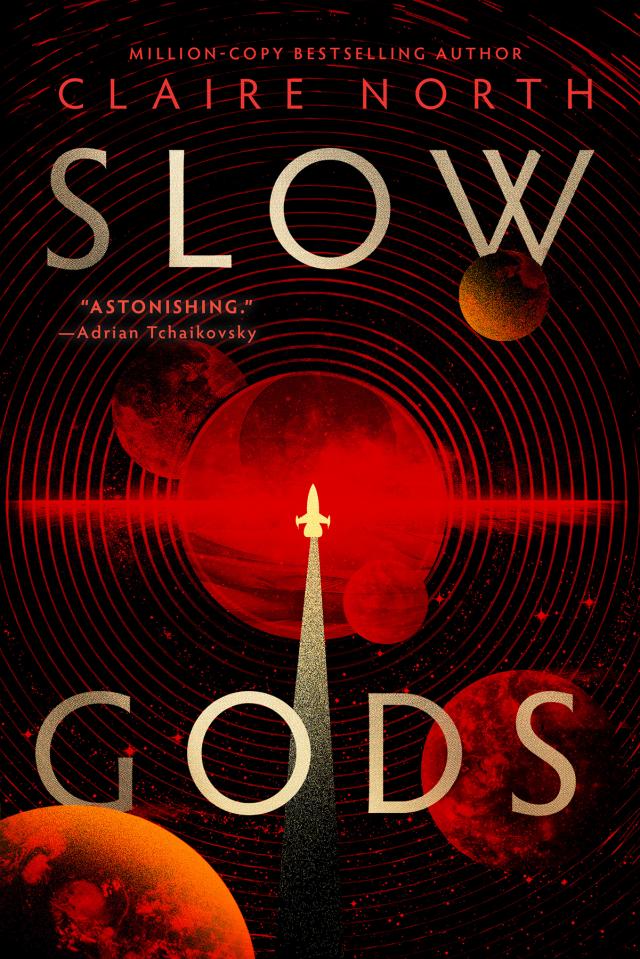
Cover design by Nico Taylor
Cover images by Shutterstock
Author photograph by Gareth Webb
Hachette Book Group supports the right to free expression and the value of copyright. The purpose of copyright is to encourage writers and artists to produce the creative works that enrich our culture.
The scanning, uploading, and distribution of this book without permission is a theft of the author’s intellectual property. If you would like permission to use material from the book (other than for review purposes), please contact permissions@hbgusa.com. Thank you for your support of the author’s rights.
Orbit
Hachette Book Group
1290 Avenue of the Americas
New York, NY 10104
orbitbooks.net
First Edition: November 2025
Simultaneously published in Great Britain by Orbit
Orbit is an imprint of Hachette Book Group.
The Orbit name and logo are registered trademarks of Little, Brown Book Group Limited.
The publisher is not responsible for websites (or their content) that are not owned by the publisher.
The Hachette Speakers Bureau provides a wide range of authors for speaking events. To find out more, go to hachettespeakersbureau.com or email HachetteSpeakers@hbgusa.com.
Orbit books may be purchased in bulk for business, educational, or promotional use. For information, please contact your local bookseller or the Hachette Book Group Special Markets Department at special.markets@hbgusa.com.
Library of Congress Control Number: 2025933622
ISBNs: 9780316586306 (trade paperback), 9780316586344 (ebook)
E3-20251022-JV-NF-ORI
Contents
Cover
Title Page
Copyright
Part 1: How I Died Chapter 1
Chapter 2
Chapter 3
Chapter 4
Chapter 5
Chapter 6
Chapter 7
Interlude
Part 2: Beneath the Lover’s Light Chapter 8
Chapter 9
Chapter 10
Interlude
Chapter 11
Chapter 12
Chapter 13
Chapter 14
Chapter 15
Chapter 16
Chapter 17
Interlude
Chapter 18
Chapter 19
Chapter 20
Chapter 21
Chapter 22
Chapter 23
Chapter 24
Chapter 25
Chapter 26
Chapter 27
Chapter 28
Chapter 29
Chapter 30
Chapter 31
Interlude
Chapter 32
Part 3: How the Shine Went to War Chapter 33
Chapter 34
Chapter 35
Chapter 36
Chapter 37
Chapter 38
Chapter 39
Chapter 40
Chapter 41
Chapter 42
Chapter 43
Chapter 44
Chapter 45
Part 4: The Size of Infinity Chapter 46
Chapter 47
Chapter 48
Chapter 49
Chapter 50
Chapter 51
Chapter 52
Chapter 53
Chapter 54
Chapter 55
Chapter 56
Chapter 57
Chapter 58
Chapter 59
Chapter 60
Chapter 61
Chapter 62
Part 5: Where Once There Was a Star Chapter 63
Chapter 64
Chapter 65
Discover More
Extras Meet the Author
A Preview of The Stars Undying
Also by Claire North
Praise for the novels of Claire North
Explore book giveaways, sneak peeks, deals, and more.
Tap here to learn more.
PART 1
How I Died
Chapter 1
My name is Mawukana na-Vdnaze, and I am a very poor copy of myself.
The Major tells me that it is important that I channel my curiosity into expansive things, and goes to great lengths to keep me occupied. Regulated. To this end, I have written numerous papers on subjects such as extra-planetary botany, xeno-archaeological linguistics, inter-species sociology, the history of art, and one slightly whimsical article on juggling, which received a surprising amount of traction.
However, when my efforts are cited, it is rarely in the context of the work itself. My detailed analytics, exhaustive research – these are not of interest. Rather it is my otherness, my non-being/being, my perceived deficiencies in certain matters of sentience that seems to capture people’s imagination, regardless of how absurd these metrics are when one actually stops to think about them.
In short: I am a frustrated academic.
People get anxious when I am frustrated. They are concerned it may provoke unpredictable consequences. Thus, to keep me occupied, it has been suggested that I write down some of my experiences in a less formal manner, with an eye to “mainstream” audiences. I do not see the point – there are plenty of romantically inclined individuals with harrowing tales who will happily share their trauma in exchange for cash and an inter-planetary speaking tour, thank you very much.
However. I do appreciate that if left to my own devices, I can experience unwanted episodes. It would pain me deeply if my actions were to cause emotional or physical harm to those around me.
In telling my story, there are certain things I should perhaps lie about.
(I am a dreadful liar.)
I should make myself a hero. Pretend I knew certain things before I did, was not used by strangers and gods, did not leave people behind.
I should claim that I understand love.
This last is most important, and I am trying.
I am always trying.
Is that not enough?
Chapter 2
This is the story of the supernova event known as Lhonoja.
By the end of it, several planets will have burned, a couple of civilisations will have fallen, and I will have spoken to an entity some consider a god, and whose theological status will remain in question throughout.
Before then, I must explain how I came to be, and for that, I must take you back several centuries, to Glastya Row.
Glastya Row started as a landing strip on the planet Tu-mdo.
Most urban establishments on most colonised worlds begin this way. Tu-mdo had been a prime terraforming candidate – comfortable gravity, good magnetic shield, not too hot, not too cold, not tidally locked and already possessed of a moon which, once water was thawed out in sufficient volume, would serve to stir the great big mixing bowl of Tu-mdo’s freshly churning oceans. The first colonists didn’t even need to spend five centuries in arcologies waiting for atmospheric conditions to settle, but were out and breathing without aid within a couple of pioneering generations. Two millennia later, Glastya Row had been transformed from pioneer’s outpost to merely another borough of some few million in the great city of Heom, a middling hub of profit and endeavour within the interplanetary-spanning United Social Venture.
They say you can tell a lot about a Venture based on how its employees name their children.
In Antekeda, the Venture that ran my city, these were the most common middle names given to children at birth:
Chairman – 15 per cent
Entrepreneur – 10 per cent
Director – 9 per cent
Abundant – 5 per cent
Diligent – 4 per cent
In Theymann, a Venture specialising in deep space habitation, the distribution skewed towards Pioneers and Engineers, while in Halsect there was an almost sentimental emphasis on children called “Aspiring”.
My parents had all the ambition you might expect of residents of Glastya Row, combined with a grim realism. Thus when I was born, my name was registered as Mawukana “Respected” na-Vdnaze. I might never achieve dazzling heights or have great Shine, but dammit, my neighbours would at least know that I was respectable.
It would be fair to say that things went downhill from there.
I am told that I cried an unhallowed amount when I was born, though no one seems able to clarify what “unhallowed” means. I imagine my scream rose a little in volume as they implanted my Chint in the top of my plump left bicep, already embedded with the debts I had accrued to the Venture that ran the hospital that sheltered me – 400 Glint for a standard birth, plus another 1,873 Glint for basic costs such as bedding, vaccinations, postnatal check-ups, vitamin shots, etc.…
Thus, before I was placed upon my mother’s breast, I was marked with the overriding feature of life on Glastya Row – the debt I owed.
As befits two individuals who named their child “Respected”, my parents were not irresponsible. They had carefully saved for this moment, and were between them able to bring my initial debt down to a mere 700 Glint, and keep on top of the 1.5 per cent child-rate interest payments my existence accrued. Moreover, to
welcome me into the world, Antekeda gifted me with fifty shares, my ownership marking me as a citizen of the Venture. By the time I turned fifteen and sat my assignment exams, those shares were worth nearly 600 Glint – though my educational and civic debts were well in excess of 92,000.
This system, we were taught, was about fairness. We were pioneers and our world was a place of scarcity, hardship and struggle. Everything the Venture gave us – the air we breathed, the roads we walked down, the schools we learned in – had been sweated for, bled for, and our debts were a marker of the needful labour we would give back in return.
All are born equal, and by their labours shall they rise.
This philosophy was the underlying constitution of the United Social Venture. Both it and the more anthropologically engaging qualities of social and economic status that arose from it were known as Shine.
We were not a high-Shine family. My parents ran a small restaurant that served cold-broth dumplings to hot middle Managers too tired and busy to cook. They did their best to improve their Shine, constantly cooing over difficult, well-dressed customers and putting themselves forward to run catering events in Shiny houses or at Shiny events, but nothing could really wipe the smell of Glastya Row off their grease-stained aprons and soap-scoured fingers. Every six months, an Antekeda representative would come by and offer them another course or long-distance learning diploma in business growth and radical enterprise, and sometimes my mother, always the more energetic of the two, would sign up and do her coursework and pay her fees, and talk at the table about how this was it. This was the change we needed to get out, move up. It never came to anything.
During my “cute” years, which I was told were seven to eleven years old, I worked as a waiter in the shop in the hope someone would give me that most wondrous of miracles, a “tip” for my services. By the time I was twelve, you could see the shape of the adult I was going to be. My father’s thick, straight black hair was overgrown around my mother’s sunset-through-smog face. I was always a little short, with green-grey eyes that narrowed to almost impossible lines when I squinted in confusion (as I did a lot) and pale lips that didn’t smile enough, or smiled wrong, or just didn’t quite get the smiling business right, whenever I tried to move them.
“Smile with your eyes,” my mother commanded, during one of her we-shall-advance phases. So I stood in front of the mirror in the grubby upstairs bathroom and squeezed my eyelids tight and waggled my eyebrows and tried to inventory every tiny muscle about my growing grubby dishcloth of a face, until I could at least achieve something that didn’t seem to upset people too badly.
Despite, or perhaps owing to, these efforts, I was relegated to the back of the kitchen so that my mother could stay out front, charming and occasionally bamboozling the customers. By the time I was fourteen and my schooling was getting unfeasibly expensive, it was already apparent that I would not have a Shiny life. Most of my classmates were starting to drop out into the menial labour that was the heart of every Venture, and those who remained were preparing for adulthood with an endless dance of alliances, enmities, petty acts of cruelty and theft, out-daring each other in who could game the system. Bullies thrived – so long as they were not caught. Being caught was far worse a sin than being a thief, a liar or simply cruel.
Many economists, observing the Shine, have marvelled at the low levels of educational obtainment common across its population. The circular economies of most other worlds, powered by the sunlight or atomic reactors and fed by agricultural systems whose architects can sit in their pantries dispatching drones to the harvest, consider education not merely of primary importance to the success of their systems, but as frankly the most interesting thing the population can do with their expansive time.
However education breeds curiosity. And curiosity is one of the very first qualities that the leaders of the Shine seek to eliminate from the population.
I do not believe I was an unhappy child.
Neither do I think I was happy.
I did not understand the games that the Shine required. I struggled to lie, struggled to apply the dichotomy of winner and loser to the world I saw around me. When I tried playing, people laughed at me for doing it wrong in some mysterious way that I could not fully comprehend, and in time I simply stopped trying. I made friends with the most vulnerable and afraid, because they seemed to need friends the most, but simply sharing a sense of being outcast and alone is not quite the same as the meeting of true and lingering minds. I became quieter and quieter, since it was safer to be a nonentity, a child worth neither robbing nor mocking, than to try and fail so badly at the rituals of life that my peers seemed so gifted in. I passed my exams by rote, but showed no entrepreneurial spark save in the sciences, which was an unfashionable and underfunded discipline.
There was no question of being able to pay senior school fees when I turned fifteen, and no real need for me in the restaurant while my parents were able-bodied, so I took the only job that would have me and started work at the local traffic tower. Initially I was a runner, doing whatever errands my bosses needed doing; by the time I turned eighteen, I had been promoted to junior flight-caller, directing sub-atmospheric cargo traffic in the airspace around the city. When they gave me the first two scars on my left ear to mark my entry into the world of work, I felt moderately proud. Pain sometimes has that effect – we imbue it with meaning, to try and make it seem like it has a point. Very few things sum up life in the Shine better than our scars.
The work was harmless enough – computers did most of the actual route planning and plotting, and my main duty was to be screamed at by irate customers when they weren’t given priority, and to occasionally override the bot’s default settings to let a VIP – or someone who’d paid to be treated like a VIP – through. Very occasionally we’d get a small spaceflight vessel at the high-thermal pad on the edge of the city and I’d try to chat with the captain on comms – someone who’d seen other worlds, other stars – but my understanding of the worlds beyond my own was so stagnant, so limited, that I didn’t really know what to ask.
“Maw,” sighed Ruc, the most indulgent of my colleagues in the tower, “you just don’t get it, do you?”
“Get what?”
“All of it. Just… all of it.”
In the language of the Mdo, the peoples who are the Shine, there are two words for “us”. The first is the cohesion of necessity. In the early days of the Ventures this was the sacred “us” – the “us” of the slowship, of recycled air and recycled oxygen, of shared heat and metal and danger. It was the inviolable “us” of peoples who, if they cracked at all, would be torn apart. Then the ships settled, colonising the worlds that would become the Shine, and this first “us” became the “us” of our shared Venture, of the tight bonds of labour and the scars we bore. This second “us” is the “us-not-like-them”. It is the “us” that is the barrier against which no other can break in, and was the “us” that was always used when people explained why I could not be with them.
Then the Slow came.
Chapter 3
This is what I knew about the Slow, the day qe came to Tu-mdo:
I knew that the Slow was a machine, and it was old. Older than the Shine, older than the Accord of planets that existed outside Mdo space. No one could remember a time when the Slow hadn’t existed, and archaeologists kept on uncovering further proof of its ineffable ancientness. A perfect black sphere moving through the interstellar darkness at a maximum of 0.3 of the speed of light, despite this sedate progress between the stars the Slow had a knack of showing up in the vicinities of major galactic events just before they unfolded. This had uncomfortable implications, which the Shine largely chose to ignore.
The quans referred to the Slow as “qe”, saying that “it” was the pronoun you used for an insentient object, like a kettle or a biscuit tin, whereas qe was very obviously alive and thinking. The Shine disapproved of such nuance, rattling off the usual nonsense about souls and sacred flesh and so on. But even the Shine knew better than to ignore the Slow, when qe deigned to speak.
The Slow qimself did not come to Tu-mdo, instead sending qis messengers, black boxes tumbling through space, propelled by no-one-was-quite-sure-what but that pundits grumbled was probably “some sort” of ion drive. Six of qis messengers entered sub-light broadcast range of the planets Cha-mdo, Ber-mdo, Tu-mdo and Yu-mdo and the orbital habitats Reio-tu and Khd-tu before astronomers detected them. The military immediately wanted to shoot them down, as militaries do, but the diplomatic corps bartered them down to merely imposing total comms blackout with nuclear strikes a poised backup.