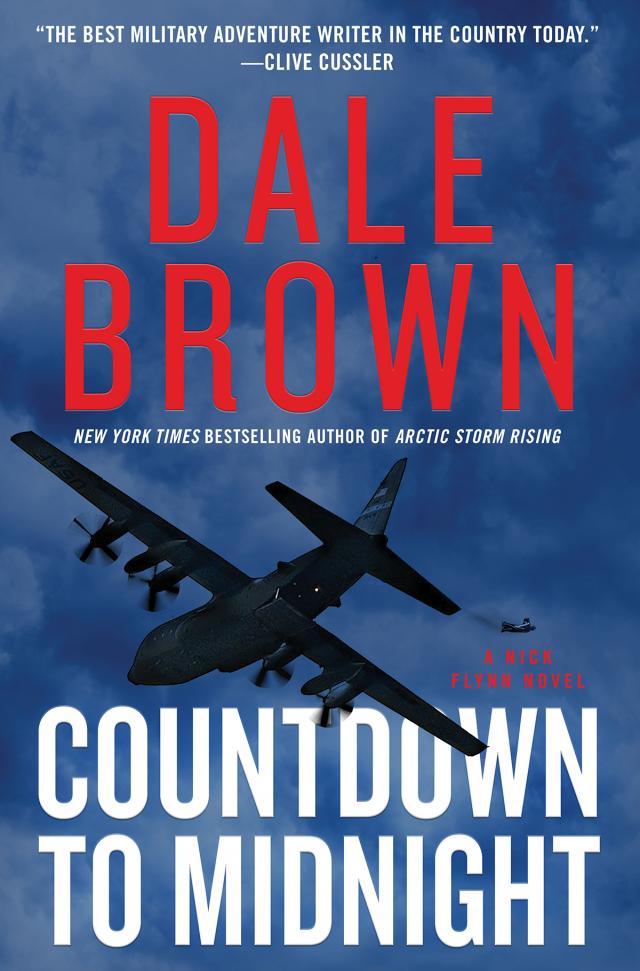
Countdown to midnight, p.29
Countdown to Midnight,
p.29


“Strike that!” the camera operator said sharply. “Course change observed.” He shot a glance at his partner. “Shift us two windows aft this time, Pete. I need a clearer angle.”
Fox resisted the urge to unbuckle and move to look at the monitor himself. The Gulfstream was still hitting pockets of significant turbulence and it wouldn’t do anyone any good for him to risk being tossed into the ceiling or against a bulkhead.
The tracking camera rolled down the aircraft’s cabin, drawing closer to him. It halted smoothly. Again, the camera traversed toward the forward edge of the window it had stopped beside. “Confirm that course change,” the operator said. He swung toward Fox with a troubled expression. “Sir, it looks as though the Gulf Venture is now engaged in making a series of wide, three-hundred-and-sixty-degree turns.”
Fox stared back at him. “The tanker is just steaming in circles?”
“It looks that way,” the other man said carefully. “And the ship’s speed is coming down to around five knots. Whatever they’re doing, it sure doesn’t seem like they’re in a real hurry anymore.”
Frowning in perplexity, Fox studied the map on his open laptop. What were the Iranians and Russians aboard that tanker up to now? Circling in place like this wouldn’t bring the ship any closer to the United States—and it was still several hundred miles outside the maximum predicted range for the three-stage rocket hidden inside its hull. Then he froze. “Oh, my God,” he muttered. “We’ve been wrong.”
“Mr. Fox?”
He looked up. “We’ve been wrong about the range of that missile. It’s got to be more like twenty-five hundred miles, not two thousand. They’re in striking range now.”
“The weather’s still really crappy, though,” the camera operator offered. “Even through my IR filter, I can see that ship—big as it is—pitching and rolling pretty significantly.”
“Which explains why they’re still steaming in circles,” Fox realized. “They’ve reached their pre-set launch coordinates. Now they just have to wait for the weather to clear.” He slapped the intercom button on his armrest. “Laura, what’s the most recent forecast?” he asked urgently.
“Wait one,” she replied from the cockpit. After a moment, she came back on. “This front’s passing faster than first predicted, Br’er Fox. NOAA says its computer models and satellite data now suggest a return to good conditions over this part of the Atlantic sometime in the next four to six hours. They’re calling for light winds at just seven to ten knots, with diminishing wave action.”
Fox nodded to himself. While its record of long-range weather prediction was as mixed as that of any other group of meteorologists, the National Oceanic and Atmospheric Administration’s short-term forecasts were highly regarded. And they were widely broadcast, which meant the crew of the Gulf Venture must now realize they would have an acceptable launch window in just a few hours.
Rapidly, he typed a short text message to Flynn and his assault force standing by in central Florida. Containing the tanker’s current latitude and longitude and its observed movements disguised as stock market share prices, it closed with a simple exhortation: EXECUTE BUYBACK IMMEDIATELY. That was the coded signal for the Dragon team to go . . . and go now.
Fox hit the send button and then keyed the intercom. “We need to set down on Bermuda as soon as possible,” he told Van Horn.
“Copy that,” she said tersely. “On this heading, we’ll be outside of that ship’s radar horizon in thirty minutes. Maybe less. As soon as we’re clear, I’ll declare a minor in-flight passenger medical emergency and request landing permission from the controllers at L. F. Wade International there. We should be on the ground in less than an hour.” Despite the obvious tension in her voice, there was a tiny undercurrent of humor. “So one of you guys back there better get busy pretending to be sick. And make it convincing, because I don’t want some snotty British bureaucrat making trouble. Not when I have another plane to catch.”
Aboard the Gulf Venture
That Same Time
Viktor Skoblin held on tight to the railings of the bridge ladder while the oil tanker rolled through an arc of more than twenty degrees, slammed broadside on by a large wave. From this high up, he could see that the sea was a vista of white-capped gray rollers all the way out to the close horizon. In the gathering darkness, thick clouds and bands of rain obscured the sky, cutting visibility to less than a nautical mile.
As the big ship rolled back the other direction, he gritted his teeth and pulled himself up the rest of the way and out onto the open starboard wing. They’d been in the grip of this storm for more than a day. But for most of that time, the tanker had been heading northwest on its pre-plotted course—keeping its stern to the oncoming waves and wind. Now, though, for some reason, the Gulf Venture was steaming in circles, which greatly worsened the impact of the bad weather on its motion. Instead of simply pitching up and down as the following waves rolled down the length of its hull, the huge vessel was currently pitching, rolling, and yawing almost all at once as it shouldered across an endless succession of foaming, white-capped swells.
For once, the two Quds Force commandos guarding the bridge entrance stepped aside without being asked. Despite their bright yellow foul weather gear, they looked drenched from head to toe. Skoblin hurried past them without making eye contact. Once inside the bridge, he grabbed hold of the edge of the plot table to stay upright as the bow of the tanker smashed through another wave. Spray fountained high into the air before crashing down across the forecastle.
The Gulf Venture’s captain, Reza Heidari, and Dr. Hossein Majidi, the missile scientist in charge of the Zuljanah rocket, looked across the plot table at him. “You have a question, Major?” Heidari asked mildly.
“I do,” Skoblin said, unable to stop himself from scowling. “Why the devil are we circling in place like this? In the middle of this fucking storm? Why aren’t we proceeding directly to the launch point as planned?”
Heidari shrugged. “For the simple reason that there has been a slight change in our plans.”
“What sort of change?” Skoblin demanded sharply. His orders from Voronin might counsel patience with their Iranian allies, but there were limits to the amount of nonsense he was willing to put up with. Heidari might command the ship, but he was directly responsible for ensuring that this operation went ahead as intended. If the local sea or weather conditions dictated a need to delay their arrival at the launch point, he should have been briefed first. A flicker of suspicion stirred into flame inside his mind. Were the Iranians in communication with Tehran after all? Despite all their talk about the need for absolute radio silence? And if so, were the ruling theocrats suddenly getting cold feet about going through with MIDNIGHT? It was a contingency Voronin had planned for, which was one of the reasons the nuclear submarine Podmoskovye was secretly trailing them now—with additional Raven Syndicate troops aboard.
In answer, Heidari nodded toward a digital countdown clock fixed above the plot table. Its readout showed the estimated time remaining before their intended attack. As Skoblin watched, the numbers it showed abruptly changed—altering from T −26 hours to just T −4 hours.
Caught off guard, he swung back to the two Iranians. “You’re launching almost a day early?” he blurted out. “How is that possible?”
Majidi smiled back at him. “Simple,” the white-bearded scientist said. “Our Zuljanah rocket has always been able to fly farther than we told your Mr. Voronin and the rest of your people.”
Skoblin stared at him. “You lied to us from the beginning?” he growled.
“Naturally,” Heidari said flatly. His eyes held no trace of any emotion. He shrugged. “It seemed a simple precaution in the circumstances . . . just in case you had secret orders of your own to alter the conditions of our mutual alliance at the last moment.”
“I have no such orders,” Skoblin lied.
“That is good to know,” Heidari said. He shrugged again. “As I said, this one small deception was only a precaution.”
“And are there any other changes of plan I should know about now?” Skoblin demanded angrily.
“Just one,” the Iranian Revolutionary Guard naval officer said blandly. He nodded to someone behind the Russian. “Carry on, Rostami.”
Skoblin stiffened, hearing the unmistakable sound of a submachine gun bolt cycling. Carefully, he glanced over his shoulder and saw one of the Quds Force commandos at the hatch covering him with his 9mm weapon. He swore inwardly. This act of treachery had been carefully planned. The bearded Iranian commando was too far away for him to reach before being shot down. And both Heidari and Majidi were well out of the line of fire. Slowly, he raised his hands.
“A wise move, Major,” Heidari told him. He picked up an internal phone. “Touraj? We’re done up here. Carry on with your end of things.”
“So what now?” Skoblin asked bitterly. “You kill us?”
The Iranian looked at him quizzically. “Why would we do that, Major? We are allies, are we not?” He nodded toward the commando. “This is only another temporary safeguard. For the time being, I’ve decided to disarm you and your men. My own soldiers will provide any necessary security until the rocket lifts off. Once that’s accomplished, we’ll return to the normal state of affairs for the voyage back to Iran.”
The phone buzzed sharply. Heidari picked it up and listened intently for a few moments. He nodded abruptly. “Excellent work, Touraj. We’ll send Major Skoblin down to join his men shortly.” He turned back to the Russian. “I’m sure you’ll be glad to know that we’ve secured and disarmed your Raven Syndicate personnel without any serious injuries—apart from a few bruises, that is. You’ll be held securely in one of the ship’s storage compartments until after the missile is away.” He smiled and gestured to the countdown clock, which now showed T −3 hours and 55 minutes. “I realize your new accommodations may not be very comfortable, but at least you can console yourself with the knowledge that the inconvenience will be of short duration.”
Aboard BS-64 Podmoskovye
That Same Time
One hundred meters below the surface of the Atlantic, Captain First Rank Mikhail Nakhimov frowned at the circular grease pencil track drawn on the control room’s plot table. It showed the Gulf Venture’s course according to Podmoskovye’s passive sonar systems, which were picking up the noise made by the tanker’s enormous screws thrashing through the water. He looked up at Konstantin Danilevsky, his Raven Syndicate coequal for this mission. The ex-Spetsnaz colonel wore a similarly perplexed expression. “Does anything in what you know of operational plan for MIDNIGHT explain this sudden change of course?” Nakhimov asked.
Danilevsky shook his head. “Nothing. That ship is still more than four hundred nautical miles from the projected launch coordinates.”
Nakhimov leaned over the table, watching as his navigating officer penciled in another arc, showing that the oil tanker was continuing the series of 360-degree turns it had unexpectedly begun making several minutes before. “And nothing in the covert satellite phone reports from your men on board suggested this was coming?”
“You saw the same communications summaries from Moscow I did,” the Raven Syndicate officer replied icily. “So you already know there was nothing.”
“I’m also familiar with the concept of special coded messages hidden within otherwise innocuous reports, Colonel,” Nakhimov said. “And it occurred to me that you might have seen something that I did not.”
Danilevsky allowed himself the hint of a smile. “A reasonable assumption, Captain. But in this case, I’ve received no such communications.” He gestured upward. “Can you come to periscope depth and raise your communications mast? Our team aboard the Gulf Venture may be trying to signal us now with some explanation for this change.”
Nakhimov shook his head. “That would be far too dangerous. In the current rough sea state, our periscope mast would feather.” He saw the bigger man’s look of incomprehension and explained. “I mean that our mast would throw up a spray of white foam whenever it hit a wave.”
“Which could easily be spotted by lookouts aboard the tanker,” Danilevsky realized.
Nakhimov nodded. “Precisely.” His mouth turned down. “I don’t know just how our Iranian allies would react to learning that they were being trailed by a submarine, but I can’t imagine they would be pleased.” He made a decision. “We’ll drop back a few kilometers so that we’re out of sight and contact Moscow using one of our remaining satellite buoys.”
“How long will that take?” Danilevsky demanded.
Aware that nothing about this conversation was private in the submarine’s crowded control room, Nakhimov turned to his radio officer, Lieutenant Volkov. “What’s your estimate, Leonid?”
The younger officer pursed his lips, considering the question. “Between transit time to a safe distance and the time required to launch and recover our Relay One submersible? I would guess somewhere around forty-five minutes, sir.”
Danilevsky grunted. “A lot could happen between now and then.”
Nakhimov shrugged. “True. But our passive sonar arrays can pick up the propeller noise from that ship out to more than one hundred miles, even in this storm. If anything changes, we’ll know soon enough.”
Thirty-Six
Orlando Apopka Airport, Florida
A Short Time Later
The Quartet Directorate’s leased LM-100J Super Hercules was parked just off Orlando Apopka’s single runway. Long shadows cast by the last sliver of sunlight stretched across the thin strip of grass and train tracks separating the runway from a nearby divided road, the Orange Blossom Trail. Lights from some of Orlando’s outlying northern suburbs already glowed brightly along the dark eastern horizon.
Nick Flynn waited at the foot of the large aircraft’s open rear ramp. Ahead of him, the other seven members of his Dragon assault team struggled up into its cavernous cargo compartment. They were hauling themselves along a rope rigged to the ramp. Between their wingsuits, ram parachute packs, oxygen masks and cylinders, weapons, ammunition, and other special gear, they were carrying significantly more than a hundred and twenty pounds of added weight strapped to their backs, chests, and thighs. He fought down a laugh when Cooke looked back at him and uttered a high-pitched bray, mimicking a heavily loaded pack mule squalling in angry protest.
Two more men in coveralls stood waiting at the top to assist each overburdened member of the assault force into one of the mesh seats that lined one side of the compartment. In flight, they would crew a rail-mounted tracking camera and telescope system—the twin of the one aboard Fox’s Gulfstream G650 business jet. If the Gulf Venture drastically altered its course before their civilian Super Hercules turboprop aircraft reached the target area, that long-range, IR-capable camera would be their only hope of finding the ship.
The big aircraft’s four powerful Rolls-Royce engines were slowly spooling up, with their six-bladed propellers starting to spin. Dust and small bits of debris kicked up by the steadily increasing prop blast swirled away into the air.
Flynn saw Gwen Park leave the rented hangar they’d been using as temporary quarters and a base of operations. She hurried over to join him. “What’s the word?” he asked loudly, raising his voice to be heard over the rising engine noise.
“NOAA’s most recent forecast confirms that weather conditions are improving rapidly over your target zone,” Four’s chief of security for Avalon House shouted back. “By the time you reach that area, winds near the surface should be minimal. But the high-altitude winds will still be fairly strong.”
He nodded. “We’ve trained for that,” he assured her. “Any more news from the Gulfstream?”
“Just that they’re headed for Bermuda now,” she said. “That, plus a personal message for you from Ms. Van Horn.” She leaned closer. “She asked me to tell you again that you are not, repeat not, to get yourself killed . . . or she will be extremely pissed off.”
“Yes, ma’am, I’ll do my best on that,” Flynn promised solemnly.
Gwen Park nodded. “See that you do.” For a brief instant, the trace of a dry smile appeared on her face. “For what it’s worth, I’ve never yet seen Laura get really angry. But I strongly suspect it’s an experience I would rather avoid. So spare me that if you can.” Then she clapped him gently on the shoulder and stepped back. “Good luck, Nick.”
Flynn grabbed hold of the rope and pulled himself slowly up the raised surface of the ramp and into the rear of the Super Hercules. By the time he reached his seat, the ramp was already whirring upward. It closed and latched into position with a sudden vibration that could be felt even over the pulsing throb created by the aircraft’s engines, each producing more than 4,500 horsepower.
The LM-100J’s pilot, Jack “Ripper” Ingalls, came aft from the cockpit a moment later. He checked to make sure each of his passengers was belted in, making his way steadily down the row of seats toward Flynn.
“No jumpmaster this time?” Flynn asked with a grin.
Ingalls shrugged. “Hell, Nick, I don’t even have a copilot on this jaunt.” He tapped himself on the chest. “I’m the sole member of this bird’s flight crew.”
“Isn’t that totally illegal?”
Ingalls matched his smile. “Oh, yeah. On the other hand, if we get caught, I’m guessing the act of transporting a bunch of heavily armed private soldiers out to board and capture an Iranian-flagged oil tanker will make the fact that I also tore up a whole bunch of FAA regulations doing it the least of my worries.”
Flynn chuckled. “There is that.”
“But since I am risking both my personal liberty and pilot’s license for you guys, I’ve got a question I really need answered,” Ingalls continued.
“Shoot.”
The pilot pointed to the oddest-looking piece of equipment worn by Flynn and all the others on his Dragon team. Each of them had what appeared to be a three-foot-wide streamlined wing with twin engine nacelles attached to a breastplate. “What in God’s name is that Rube Goldberg contraption?”