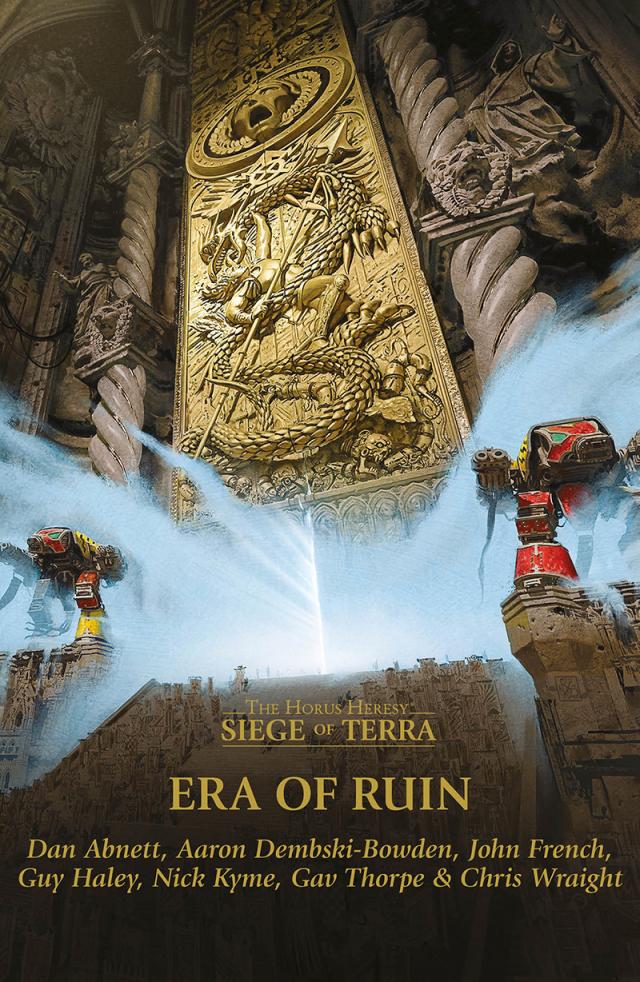
Era of ruin, p.12
Era of Ruin,
p.12


The thing that came out of the doorway was impossible. Its whole form was neither fixed nor fluid – at one moment easing its way through the portal, at the next a thing of solid matter, bearing whirring saw blades and guns that gleamed with las and plasma power. Its innards glowed like a reactor, glimpsed between plates of metal and ceramite that shifted and locked as it moved, assuming a form as large as a Contemptor Dreadnought, more than twice as tall as Tetzhou and far broader and heavier. Exposed bone sheathed in molten ceramic hardened into curved and spiked surfaces. The main sarcophagus on what must surely have once been a Dreadnought assumed the leering features of a horned Neverborn face, sculpted from cable and pneumatic pistons.
Pale-yellow lumens regarded the arriving group with what Tetzhou thought was interest rather than hostility.
‘We require a servitor of more mass,’ whispered Qorph, coming up to stop a few steps behind Tetzhou. A little further back, the rude magos’ intermittent bursts of machine tongue gave the impression of maddened babbling.
Prompted by the adept’s words, Tetzhou couldn’t hear the signature thud of the servitor. He dared not take his eyes from the monstrosity assembling itself in the outer chamber a few metres away, but the absence of the construct made him want to tear his gaze away to check on its whereabouts. Instinct screamed at him that something was wrong.
‘Adept,’ he growled. ‘Where is the servitor?’
Confused by the legionary’s question Qorph turned, confident he would find the servitor just a few metres behind them.
The half-man construct was further back than he expected, about twenty metres away. Qorph found himself staring down the lenses of the multi-laser barrels, backlit by the flickering strobe of the corrupted lumen circuits in the ceiling. An aura of tainted noospheric data surrounded the combat-servitor, like a sickly melange of scrap code and nonsensical bursts that shrieked and blistered through Qorph’s noospheric awareness.
He could sense that the influence stretched back along the corridor, emanating from the command chamber where Rakhbani was operating the controls. Concern for the magos spiked for a split second until realisation dawned on the acolyte.
‘Rakhbani is corrupted! He’s turned the servitor against us!’
With a speed possible only to the augmented and noospherically aware, Theokleia snapped a data-cordon out across a new noospheric connection, momentarily cutting off the baleful influence from the traitor magos.
‘A simple enough proof of concept,’ Theokleia calmly announced, packets of modified data-code streaming across the link even as the viral taint of Rakhbani’s control started to eat away at the quarantine. ‘Once the vessel is cleansed, I shall use the evolved data to purge the master system.’
The words rumbled out from the nightmare apparition in the sanctum in a combination of sonic and data-waves so as to nearly overwhelm the senses. The bark of Tetzhou’s bolt pistol seemed tinny and distant. White armour blurred across Qorph’s vision as he looked back at the master-beast, to be swatted away by a still-forming limb made part of flesh but studded with metal barbs.
Tetzhou recovered with a roll, slow and awkward compared to the legionary Qorph had seen fighting within the inner walls of the Imperial Palace. With almost languid ease, twin whips of ribbed plasteel flexed out across the White Scars legionary’s chestplate, almost ripping it from its mountings as he again tumbled across the sanctum floor.
‘Empty boasts!’ Theokleia’s code was replicating at an exponential rate, burrowing into the combat-servitor’s systems like armour-piercing bullets against unprotected flesh. ‘Nothing stands outside the great Cosmic Artifice. All can be rendered to our knowledge through the wisdom of the Machine God.’
Qorph couldn’t keep his attention on both the giant machine-creature and the ongoing data battle, flicking his senses from one to the other and back again. Each time he looked at the behemoth that had once been a Legion war engine, he caught glimpses of Tetzhou swinging his blade and firing his pistol, neither with any noticeable effect. Shields and phasing fields sprang into life around the creature, deflecting shots, absorbing the energy of the legionary’s blows.
Broken screens flickered into life across the sanctum, displaying the same twisted Neverborn face but with varying expressions of joy, hate, anger and misery. The voice boomed from a dozen external address systems and crackled across a score of data-conduits.
‘Magos, your anticode will not work, you have to listen to me.’ Qorph grabbed Theokleia’s arm as he entreated her, earning himself a glance from her mask that managed to convey bottomless scorn despite its lack of expression.
‘Unhand me! You are no better than this misguided traitor.’
‘It’s not working!’
Qorph could see the obliterator infection gathering against the code-wall, not just pushing against it but becoming attuned to it, turning anticode into versions of itself. Even as Theokleia’s countermeasures weakened, it was growing stronger.
With a boom of laughter from the sanctum the obliterator presence gnawed through the last of Theokleia’s data-shield, racing back into the systems of the combat-servitor.
The barrels of the multi-laser glowed for a split second and then the magos disappeared amidst a hail of light beams, cut to pieces by the fusillade.
Qorph reacted without thinking, diving through the archway into the sanctum, closer to the obliterator fiend. It was the only place out of sight of the servitor. He heard its crashing tread as it advanced, impelled forward by the will of the obliterator via Rakhbani.
The obliterator had finished building its new form inside the sanctum’s outer chamber and turned its bulk towards Qorph. Broken faces on the screens focused their attention on him, eyes glittering with scrolling lines of code.
For a few moments the voice lulled Qorph into a data-dream, returning to Mars as herald of the obliterator, ripping open its archives of the forbidden, raising up mighty edifices to the glory of the Machine God as the One Creator. A million servile priests laboured at the data-mines for his enrichment and his name was spoken as one of the prophets of obliteration.
‘False promises,’ spat Tetzhou, hacking off a limb that had grown into a plasma muzzle. Superheated matter exploded across the floor, melting plasteel tiles. ‘The quest for knowledge has true meaning, not the finding of it. I am my pain and my weakness. In time it shall make me stronger. Without effort there is no earned reward, just gratification. Its words are the shadows of clouds on the plains, do not give them form.’
A fist like a battering ram smashed the legionary from his feet, hurling him into a wall of terminals. Amidst the spray of sparks, Neverborn faces glowered at him from the cracked screens while wires slithered out of split plastek casing. On the obliterator a new plasma gun formed from the ruin of the old, coalescing into being from raw material made from regenerating flesh. In seconds it would blast the Techmarine into oblivion.
It would obliterate him.
‘I’ve seen your soul, Neverborn filth,’ snapped Qorph, running forward to spear a data-spine into an exposed part of the obliterator’s flank, just above an armoured hip. As the tip pierced matter, Qorph unleashed his own data-flood. Unlike Theokleia he had studied the metaphysical elements of the Neverborn closely and, with the last pieces provided by the tendrils of obliterator code that had been trying to invade his noospheric senses, he had the antivirus. Not just a cleansing of scrap code but a flex of warp-derived, ever-shifting algorithms. They quickly took on their own life, combining and feeding on the obliterator code itself.
The obliterator bellowed in frustration as Qorph hauled himself backwards. Confused, the combat-servitor opened fire, blasting lethal red beams into the sanctum, slashing wounds across the metal and flesh of the beast. It responded against itself without thought, plasma and shells ripping apart the servitor.
Shrieking from back down the corridor announced that the antivirus had expanded through to the other chamber and was cleansing Rakhbani, shredding everything it found, data and biological consciousness combined.
The vectors of the obliterator contagion itself supplied the mapping for the new code to follow, Qorph’s antivirus now honed to delete this specific strain. It flowed into systems throughout the inner space port, leaping from terminal to terminal, turning the obliteration against itself. In Qorph’s senses it blossomed like a magnificent, destructive black flower.
Shuddering, the obliterator stumbled back, unable to keep one form, haphazardly growing limbs and faces, guns and blades, while vents gushed blood and oil spewed into the air from breaking blisters. Plasma fumes wreathed from a plethora of iron-fanged mouths.
A massively powerful hand grabbed Qorph’s cowl and yanked him from his feet. For a moment he feared Tetzhou had been turned.
‘We have to get clear of the blast,’ the legionary snapped, lifting Qorph to his shoulder and breaking into a lopsided run.
He looked back as Tetzhou raced along the corridor. Plasma glare grew brighter and brighter. The purge and the explosion would gut the heart of the space port – not exactly restoring the systems as they had been tasked to do. Even so, Qorph felt a moment of satisfaction as the brightness became white hot and his noospheric sense burned with the screams of fracturing meta-code.
They rounded a corner and kept going, the lumens falling dark around them, environment filters and fans becoming stationary. The whole level was dying around them.
‘Why did you not accept its offer?’ The question nagged Qorph, and if he were to die in the next few seconds he wanted to know that of all things. ‘And who cursed you with such crude bionics?’
‘I did,’ grunted Tetzhou. ‘Well, through my servitor. I used it to rig them out of war plate parts when I was the only survivor of an ambush. I would have died not far from here otherwise.’
‘If you get me out of this alive, I will get them replaced for you.’
‘We’ll live, and I’ll keep them. It’s good to remember that flesh and machine are meant to be separate.’
‘Though it will displease my Order, I feel I must agr–’
A boom and sudden noospheric static swept over them, followed by silence. Tetzhou slowed to a stop, keeling to one side in his discomfort like a holed sailing ship.
Qorph felt nothing. Not even simple electrical impulses, except for Tetzhou’s war plate and his own augmetics.
Total system purge.
AFTER THE DAWN, THE DARKNESS
GUY HALEY
To the south there was lightning of gold, purple, blue and black, unnatural colours. The sky was still tainted, and the refugees kept their heads downcast, eyes firmly on the dirt, not wishing to see. It could have been night, but the days were equally dark, except when the lightning flashed. Then the shadow was stripped away, and ruin was revealed, broken hab-spires leaning in mourning on each other, mountains of rubble from which rose the sickly odours of decay, slumped mounds in place of Imperial glories. At least in the dark, the people could pretend not to see. The lightning mocked them, highlighting the wreck of Unity, of hope, of everything. It made them look at what they had lost.
As bad as the lighting was, for the ten thousand survivors in the camp the accompanying thunder was worse, for it recalled the war. When the thunder rolled, the survivors retreated into private hells, memories of when the walls of reality broke and nightmares spilled out from their proper places. Each crackle in the cloud brought a scream from somewhere, sometimes near, sometimes far, but consistently, like an echo.
Katsuhiro did not scream. He was on the move, doggedly picking his way across the uneven ground, placing his feet carefully to avoid sprawling legs. Others were shuffling through the dark, those with enough energy to get up and move. There was precious little shelter in the camp. It was, in truth, a containment area, not a place to live. Three high fences of razor wire butted up against a scorched wall of rockcrete, the only surviving side of some building or other that had been atomised in the conflict. If you looked through the cracks in the wall out of the camp, there was a rippled field of glass behind, perfectly round, preserving the vitreous after-effect of an energy cannon fired from orbit.
‘Hush now, hush,’ Katsuhiro said to the bundle clutched to his chest, though the child was quiet, eyes shut, fingers twitching in his dreams. He seemed peaceful. The child slept soundly through the worst of the storms. He had been born into this world after world’s end. Violence seemed not to affect him.
‘Hush now, hush,’ Katsuhiro said again, anyway.
The wall was ahead. Katsuhiro crept through the people on the floor with a slow tide of other ghosts, seeking shelter by the stone. He would not try the handful of tents bellying in the rising wind. Those already within might let him in. People knew him. Some cared that he carried the child. But status aside, kindness aside, the truth was that space, mass and time – all the things that made the universe work as it should – had once more become absolutes, and there would be no room.
There was not enough of anything. Not water, nor food, nor shelter. The war was over, the struggle went on.
Katsuhiro was half the man he had been, in the most literal sense. Never big, he was now a wisp, skin wrapped awkwardly over bone. The coat he wore had once fitted him, more or less. Now it was as voluminous as one of the shelters, and stiff with dirt, so that sometimes he had the bizarre idea it had grown into a suit of angel’s armour, and that he had not shrunken so.
He did not like to look at the sticks his limbs had become.
Within the coat, the child was warm. In the manner of fathers since the dawn of time, Katsuhiro rested his face on the top of the child’s soft head, breathing in his gentle scent. That was still there, under the grime and the filth of the camp. He wasn’t the child’s father. He often wondered who was, but he felt he had earned the right to take comfort in his smell.
‘Hush now,’ he muttered, though the child slept on.
The other bowed figures split off, they all had their favoured spots, like Katsuhiro. He always had somewhere, someone, something, often by chance. Maybe that was why he had survived when so many others had not. Chance. Not the Emperor. Definitely not that.
‘He protects,’ Katsuhiro said. ‘Hah! They’re the biggest fools of them all. If that were true, where is He now? He’s dead. He protects!’ Katsuhiro scoffed.
You’re still alive, said a more reasonable voice in his mind.
He ignored it.
The storm gave a terrific bang, and the child jerked in his sleep.
‘Hush now, just the storm,’ he said. ‘It’s moving in closer, off the plains to the south.’ The plains he had first fought on, when it all began. The plains where he had seen ancient hells disgorge all their evils.
This he did not say.
He reached a fan of rubble slipped down from the wall and started to climb, exaggerating his lean forward so that if he did fall he would catch himself, and not hurt the child. Up he went, lumps of rockcrete slithering away under his feet. Everything was bone dry. The dust sucked away what little moisture his skin had held onto. His hands were cracked and sore. He was severely dehydrated. He had given most of his water to the child, along with most of his food.
He got to the top. The wind was blowing strongly, uphill from the plains of Ind, a reverse of the usual direction. Nothing was as it had been.
There was a ledge at the top of the rubble, a part of a floor jutting out from the side. It was big enough for him to sit with his legs stretched out in front, while he rested his back on the wall. His boots scraped away the dust accumulated on the floor, revealing tiles of black and white. He was always surprised to see them. They were covered over each time he came.
He was tired. The climb, though short, had depleted his meagre stores of energy. At times like this, the child was the heaviest burden in the world, and when he put his head against the rockcrete of the wall, he thought he might never be able to lift it up again. But he could not close his eyes. They remained fixed on the skies to the south.
The lightning gave a terrific display. The colours were unnatural but beautiful, and he watched safe in the knowledge that there was nothing at play in the heavens.
‘Look, look, no monsters in the sky,’ he said to himself. ‘They are gone.’
What awful being could overcome such creatures? Katsuhiro knew. He thought of the light in the Hollow Mountain, of Keeler’s ecstasy. That horrible, pressing presence. The lightning was a reminder of that. He wanted to turn away, as he had in the Astronomican, as he had turned away from worship, when he shut his eyes against that all-consuming fire.
He made himself watch the lightning.
They called the camp 1207-Alpha 23, Montagne Wall, though there was no wall left to speak of, only a mountain range of rubble. He wasn’t entirely sure where the camp was in relation to where things used to be. The Palace’s topography had been erased blast by blast. When the haze cleared enough, he could see what he thought was the Eternity Wall space port. Or perhaps it was Lion’s Gate? They were near one of them, he was sure of that. Sometimes he thought he had himself oriented, only for something huge and undeniable to loom up out of the murk to prove him wrong. If this were Montagne, he thought, and he faced it, then the Eternity Wall space port should be to his right, and Lion’s Gate to his left. But he could not be sure. One of the others had a compass, a simple device with a magnetically charged needle, a design as old as time. The needle had spun slowly round and round, like an old man with a failing mind who, disoriented, cannot find his way out of a familiar room.