His last command, p.27
His Last Command,
p.27


TWENTY-ONE
15.50 hrs, 198.776.M41
Fifth Compartment
Sparshad Mons, Ancreon Sextus
For a whole day, they held them off.
About three hours after Rawne’s unilateral repulse of the Blood Pact, the enemy struck again from the east, using the quartz bastion of Ridge 19 to shield its approach onto the compartment floor. By then, following consultation with DeBray, Wilder had brought the entire bulk of the Eighty-First First into position on the eastern flank in anticipation of just such an event, leaving the Kolstec Fortieth to assume responsibility for Hill 56.
At that point, the day seemed to turn spectacularly bad. Massed in much more considerable numbers than before, the Blood Pact poured out into the scrub, resolutely determined not to be denied a second time. The Eighty-First First became locked in place, rigidly defending a two-kilometre line of rough ground from hasty dug-outs, relying heavily on its crew-served weapons.
In apparent coordination with the Blood Pact’s attempt at an eastern breakthrough, the Archenemy armour brigades beyond Hill 56 renewed their assault. All possibility of the fatigued Rothberg tankers withdrawing evaporated. With the Hauberkan reserves, they became tangled in an increasingly feral struggle, which was only relieved by the arrival of the promised Sarpoy armour, the force that had been supposed to replace them on the field. More Kolstec infantry was rapidly sent down from post 36 to reinforce both Hill 56 and Wilder’s line, and strings of Valkyries began flying urgent munition runs back and forth across the southern compartment to keep both fighting zones supplied.
By nightfall, it became evident that the Archenemy was not going to back down from either fight.
Through the course of that long, wearisome day, Wilder had kept himself updated with news from the Mons as a whole. From the sound of things, the third compartment was in an even worse state. Both Wilder and Fofobris had sent requests to high command, via DeBray, for reinforcement, but got little satisfaction. Significant reserves had been sent through to the third compartment, where the situation was described as ‘grave’. After a while, even that choked off. Wilder listened to frantic and disheartening vox-traffic describing mayhem in the first and second compartments, where relief columns were becoming boxed in by personnel fleeing the third compartment fighting. There were also ominous reports that some of the relief forces themselves had broken back, too scared of what they had heard was happening ahead of them. Some of these units were actually reported to be ‘in flight’. Others, more cautious perhaps, were declaring ‘mechanical problems’ and other set-backs that were preventing them from moving.
It was an ugly picture. The two key ‘hot’ compartments, three and five, were enduring massive offensives, and the rest of the Imperial strength was milling around in headless confusion, unable or unwilling to come to the aid of either.
It had been Wilder’s professional experience that warfare ebbed and flowed. Quiet days, quiet months, could be suddenly disrupted by angry flares of enemy activity. He did not see anything especially sinister in the fact that the enemy had chosen that particular day to coordinate and unify its defence of Sparshad Mons. In many ways, he’d been waiting for it to happen.
But there was no denying how successful the Archenemy had been. No one knew for sure how centralised the enemy command was in the mysterious heart of the Mons, but by whatever means, it had orchestrated a shatteringly well-timed attack on all sides. And the systems and discipline of the vaunted Imperial Guard had seized up, paralysed, as a result.
In the fifth compartment, fighting continued after nightfall. As the temperature dropped, the ferocious tank battle behind Hill 56 raged on, lighting up the low horizon and painting the looming black walls of the compartment with a shadowplay of coloured flashes. At Wilder’s line, the intensity dropped a little, but all through the night the support weapons of the Eighty-First First continued to hammer away at invasive attempts by Blood Pact strike teams to edge their way forward in the darkness. Just after midnight, one force almost broke through, but it was denied by Callide’s Company after a brutal, forty-minute gun battle across the frosty scrub.
Other dangers lurked in the darkness. Stalkers appeared again, some inexplicably, haunting the darkness behind the Imperial front, as if they had somehow lurked hidden during daylight in dens or lairs in the southern part of the compartment. Two munitions convoys were attacked, and men lost, and Fofobris’s Kolstec troops on the hill suffered a series of predatory raids from the rear.
The next day dawned, but the sun was only a little bruise of light against the black undercast. The unnaturally dark smoke rising off the third compartment war zone was blanketing the entirety of Sparshad Mons. The surreal twilight it created seemed like the product of some foul sorcery.
Along the Eighty-First First’s position, things were quiet for the first few, chilly hours of the day. Vox distortion levels rose, and the inexplicable daylight winds groaned across the scrub and clumpy thorn-rush. Then the Blood Pact renewed its assault on the eastern flank.
This time they sent stumble-guns to shatter the infantry line that had repelled them time and again the previous day. Wilder had been forewarned about these things via the garbled reports flowing out of the third compartment. They were supposed to strike down everything before them like skittles, random and wild, and make a path for the ground forces.
There were three of them. They came down across the escarpment of Ridge 19, rattling like pebbles in a mess can. At a distance, they seemed so odd, so unthreatening, Wilder’s troops just stared at them. Steel balls, trundling in across the damp, gritty soil. Then their spines started to glow and they began to flash out searing plasma beams in all directions, like jumping firecrackers.
The men and women of the Eighty-First First, veterans all, did not break in panic as the inexperienced Binars had done the day before in the third compartment. They held their line. That resolve cost them nearly thirty lives in the time it took to kill the stumble-guns.
The worst of the losses were amongst L Company, Varaine’s troop. Oblivious to the stupendous rally of gunfire they sent at it, the stumble-gun rolled into them and crushed those that it did not dismember and char with its beams. Corporal Choires, one of Varaine’s toughest, finally halted its progress. Luck, more than anything else, had left Choires unscathed as the ball-weapon rolled past, and he bowled a grenade in through its armoured structure, annihilating the operator. Choires did not live to celebrate. As it expired, one of the stumble-gun’s final, spasmodic plas-beams vaporised his head.
Commissar Hark led an attack on the second weapon, determined to stop it before it reached the Eighty-First First’s position. Despite the loss of four of the troopers bold enough to go with him into the reach of the lethal device, Hark blasted shot after shot into it with his plasma pistol, and managed to kill the operator. Directionless, the stumble-gun rocked to a halt, smoking.
Caffran, Guheen and the Belladon Gespelder, each of them armed with a tread fether and supported by anxious teams of loaders, used up fourteen rockets between them stopping the third. One of the last two rockets managed to penetrate the heavily armoured sphere deeply enough to touch off its plasma vats or cause some kind of critical weapon failure. The stumble-gun exploded like a miniature star. Guheen and Gespelder argued amiably over which of them should claim the kill.
The Eighty-First First line rippled with mingled cheers at the sight of the last stumble-gun’s demise, but the relief was short-lived. With stalk-tanks and modified cannon platforms to the fore, the Blood Pact main assault came in.
Three hours of intense fighting followed. More than once, Wilder was afraid they would be overrun and slaughtered, but Hark and Novobazky, along with the company leaders, kept the position firm. Even Rawne, Wilder noted, with a mix of satisfaction and annoyance, led from the front, spurring the Guardsmen on.
Just before noon, a phalanx of Hauberkan treads, part of the reserve element from post 36, arrived in support. The formidable range and effect of their main weapons crippled the coherence of the Blood Pact front, and forced it into retreat.
Wilder was amazed. He’d never thought he’d be glad to see a Hauberkan tank.
After the battle, an uneasy lull settled. Keeping a careful eye on the ridge, the Eighty-First First took advantage of the quiet spell to eat rations, service weapons, and even catch a few, quick minutes sleep. Though it was long past the middle of the afternoon, conditions had not improved. The day was still lightless and dismal, the air bitter cold, and the ground hard as lead. Wrapped in camo-cloaks and bedrolls, troopers huddled down beside boulders or nested in patches of stiff grass. Some just sat, looking out across the scrubland, where hundreds of corpses, and the wrecks of fighting machines, lay scattered all the way back to the jagged quartz of Ridge 19.
The Hauberkan treads had taken up position on the left flank of the Eighty-First First position, and Wilder went to liaise with the crews, leaving Baskevyl to supervise munition distribution from a pair of Valkyries that had just arrived from post 36.
‘I think we should go now, while it’s still quiet,’ Mkoll said. ‘If we leave it much later, it’ll be dark.’
Rawne nodded. They’d found a place to talk away from the others, behind some broken lime trees about thirty metres away from the E Company slit trenches. Criid, Varl, Feygor and Larkin were with them.
‘All right. Everyone gather what you need and meet up out beyond those rocks in fifteen minutes,’ Rawne said. ‘We–’
Varl suddenly made a brusque, throat-cutting gesture with his finger and Rawne shut up. Gol Kolea and Ban Daur were approaching.
‘Everything all right?’ Kolea asked.
‘Fine,’ said Rawne.
‘Just taking a breather,’ Varl said.
Kolea glanced at Daur. ‘See? They’re just taking a breather. I told you there was nothing dodgy going on.’
‘You’re right,’ said Daur, leaning against the trunk of a lime and folding his arms.
‘And you said they looked conspiratorial,’ Kolea said to Daur.
‘I did. I did say that.’
Kolea looked at Rawne. ‘There’s nothing conspiratorial going on here, is there?’
Rawne said nothing. Kolea looked at Mkoll instead. ‘Is there, chief? Just a bunch of comrades, taking a breather, hanging out. I shouldn’t read anything into the fact that all of you are lost souls who went to Gereon?’
Mkoll held Kolea’s gaze without any sign of discomfort. ‘There’s nothing going on, Kolea,’ he said.
Kolea pursed his lips and looked up at the sky for a moment, as if watching the black clouds chase. ‘I got roasted a little bit,’ he said at length. ‘For siding with you yesterday, Rawne. Wilder was pretty gakking pissed off we pulled C and E out of the line without his say so, even though it turned out we had a good reason. I don’t blame him, either. If I was Wilder, I’d be mad as hell. This is a good unit, and most of that is down to his hard work pulling it together.’
‘Noted,’ said Rawne. ‘Why are you telling me this?’
‘Because I’d hate to see that happen again,’ Kolea replied. ‘It’s a great thing all of you made it back to us, but if you refuse to settle, it’s going to cause problems. If you’re chasing secret agendas, for instance. It’ll be divisive. How will Wilder maintain authority if you constantly refuse to work with him? The Eighty-First First will suffer. And everything and everyone that used to be the Tanith First will suffer too.’
‘I understand that,’ Rawne said. ‘But there are just some things…’
‘Like what?’ asked Daur.
Rawne inhaled deeply before replying. ‘Some things that won’t fit into your nice, ordered boxes. Gut instincts. Feelings. I don’t dislike this man Wilder. And I honestly have no intent to damage this unit. But there are just some things.’
‘Are they important?’ Daur asked.
‘Feth, I think they are,’ Rawne replied.
‘So bring Wilder in. Get him on your side, instead of sneaking about behind his back, pissing him off, and undermining his command.’
‘Wilder won’t–’
‘How do you know what Wilder will or won’t do, Elim?’ Kolea asked. ‘Have you asked him? Have you given him a chance? Ban’s right, Wilder’s a good man, and when us Ghosts thought you and Mkoll and Gaunt were all dead and gone, we counted ourselves lucky to get him as a commander. I say you go talk to him.’
Rawne looked at the others. None of them made any comment.
‘Gereon really messed you lot up, didn’t it?’ Kolea said softly. ‘I think you all got so self-reliant, you’ve forgotten how to trust anyone.’
‘You don’t know what it was like,’ Feygor growled.
‘No, I don’t. You bastards still won’t tell me. But I think I just hit a nerve, didn’t I? You’ve forgotten how to trust.’
‘We trust each other,’ Rawne said. ‘And we trust Gaunt.’
‘Is this about Gaunt?’ Daur asked.
‘Perhaps,’ Rawne said.
‘So where do your loyalties lie?’ Kolea demanded. ‘To this regiment or to Gaunt? Because if the answer’s Gaunt, this isn’t ever going to work.’
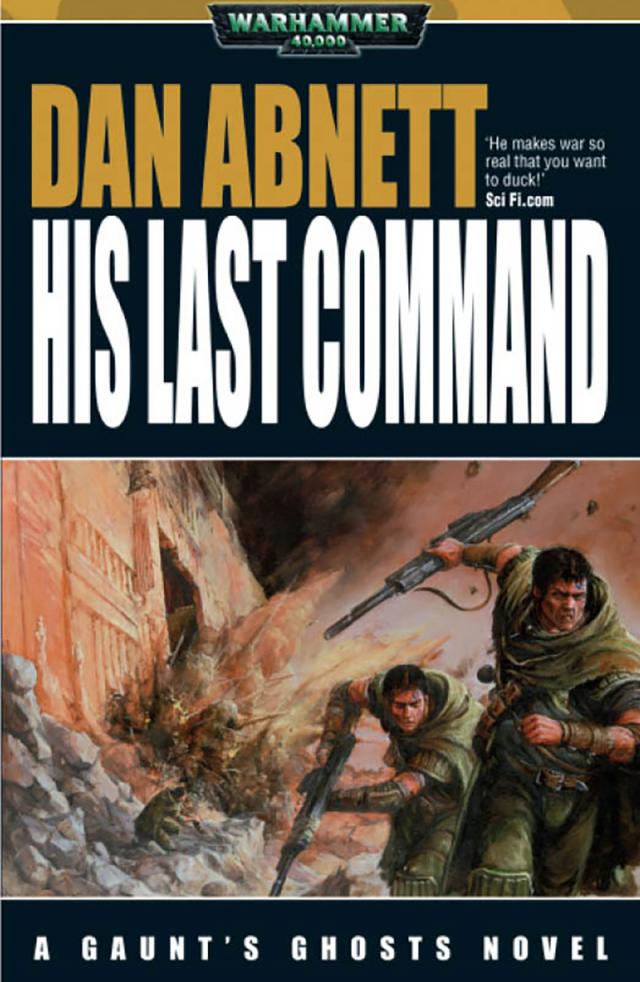
‘Do you remember his last command?’ Criid asked. They all looked at her. The wind gusted and lifted her long hair away from her face, and they all saw the ugly scar across her left cheek, the blade wound she’d grown her hair to hide.
‘His last command to the Tanith First,’ she repeated. ‘Before we left for Gereon, Gaunt told the Ghosts that if he didn’t come back, they were to serve whoever came in his place as loyally as they had served him. We should tell Wilder, Rawne. As soldiers of the Imperium, we’re obliged to, because that’s what Gaunt ordered us to do.’
‘Good news,’ Baskevyl said to Wilder and Novobazky. ‘We just got a signal from 36. We should expect some serious reinforcement by dawn tomorrow. Van Voytz has committed the entire Frag Flats reserve to the front line.’
‘Everything?’ Wilder said.
‘The full works,’ Baskevyl confirmed. ‘I guess he’s getting as tired of this place as we are.’
‘Don’t look now,’ Novobazky said. Rawne, Mkoll and Kolea were walking across the scrub towards them.
‘Great,’ said Wilder. ‘Don’t go far, either of you. I’ve seen friendlier looking mutinies.’
He took a few steps forward, and Kolea and Mkoll fell back a little so that Rawne came up face to face with Wilder.
‘Major?’
‘Colonel. I think there’s a good case to be made for us starting over.’
‘Really?’ Wilder raised his eyebrows.
‘The situation is difficult, and the return to this regiment of the Gereon mission team, particularly myself and Sergeant Mkoll, must have unsettled loyalties.’
‘You could say that.’
‘My actions yesterday can’t have helped much.’
That brought a smile to Wilder’s face. ‘All right, Rawne. And don’t think I’m not appreciating you making this effort, but I get the feeling there’s something more to it.’
‘You’d be right. There’s something that has to be done. I was just going to go ahead and do it, but Major Kolea took the trouble to remind me that I am an officer of the Imperial Guard and have a responsibility to clear things with my commander.’
‘Bonus points for Major Kolea,’ Wilder said. ‘All right, shoot. What’s this thing?’
‘It’ll be dark soon,’ Rawne said. ‘After last night’s experience, we should form a secure rearward perimeter to prevent any stalker trouble.’
‘Agreed. Absolutely. See, that wasn’t too hard, was it Rawne?’ Wilder said. He paused and saw the look on Kolea’s face. ‘There’s more, isn’t there?’ Kolea nodded.
‘Sir,’ Rawne said. ‘I’d like to take advantage of the current lull not only to set up a perimeter, but also to try tracking these stalkers.’
‘Tracking them?’
‘Mkoll’s pretty sure he can do it.’
‘Tracking them?’ Wilder repeated.
‘To find out where they’re coming from,’ Mkoll said.
‘You mean dens or lairs or whatever?’
‘Or whatever,’ Mkoll agreed.
‘Why?’ Wilder asked.
‘That’s the part you’re not going to like,’ Kolea said.
‘We’ve not had that already, then?’ asked Wilder.
‘I received a message from Gaunt,’ Rawne said.
Wilder took a casual step backwards and looked sidelong at Novobazky and Baskevyl. ‘You know that feeling?’ he asked them. ‘When you find out your girl’s still writing letters to an ex-lover?’
Baskevyl sniggered.
Wilder looked back at Rawne. ‘Rawne. Rawne, I couldn’t feel much more undermined if you… if you got hold of a frigging land mine and… and put me under it.’
‘That probably sounded better in your head, didn’t it?’ Rawne said.
‘Yes,’ said Wilder. ‘Really, much, much better.’
‘Listen to me, Wilder,’ Rawne said. ‘As everyone – including high command, the Commissariat, the Inquisition, and our old comrades in the Tanith First – has been quick to point out, the team that went to Gereon came back different. You don’t spend that long on a Chaos-held world and not have it affect you. It changed the way we fight. It changed the way we live and think, the way we trust. All of those changes were alterations forced on us by the simple need to survive. Gereon left its mark on us.’
‘Like a taint?’ Novobazky asked. He was only half joking.
‘Yes,’ said Rawne. ‘But not the kind you mean. Just to stay alive, we developed a… a hunch. An instinct. What would you call it, Mkoll?’
‘A sensitivity,’ Mkoll said.
‘Yes, a sensitivity. A little inkling that rang alarm bells when things weren’t right. When the ruinous powers were playing tricks or about to strike. I’ve got that inkling now. So’s Gaunt. We’ve had it since we first set foot in this place.’