The secret of the nighti.., p.34
The Secret of the Nightingale Palace,
p.34


This is a work of fiction, though much is based on actual events and people. It is true that San Francisco’s Japanese Tea Garden was designed and maintained by the Hagiwara family, American citizens of Japanese descent who were forced to leave their home and live in an internment camp after the bombing of Pearl Harbor. I was moved by their experience, but the story of the Nakamura family in this novel grew from my imagination. Likewise, though I mined many details from the history of my own Jewish American family in writing this book, Goldie and Anna are purely my own creations. I feel deeply grateful to my Sachs, Gold, and Goodman relatives for sharing their stories with me.
Several years ago, on a visit to the Cameron Art Museum in Wilmington, North Carolina, I happened to see a book of prints by the artists Ando Hiroshige and Utagawa Kunisada II, which affected me so deeply that for months afterward I couldn’t get it out of my mind. In part to satisfy my own fascination with these pictures, I used them as seeds for the story that eventually evolved into this book. Happily for me, the Cameron was wholly supportive of my efforts; I’m particularly appreciative of Holly Tripman, the registrar, who later indulged my curiosity by pulling the collection out of storage and allowing me to spend an entire morning examining it.
In order to give an accurate account of the medical issues addressed in this book, I relied on the guidance of several physicians. Thanks to Dr. Walt Laughlin, Dr. Robert Rotche, and Dr. Michael Moulton, who gracefully adapted their professional expertise to the service of fictional accuracy and plot development, for which, I am quite sure, medical school never trained them. Thanks, too, to Louisa Canady, a specialist in Japanese koi, who helped me to better understand the spawning habits of these fish.
I’m grateful to Judy Goldman, George Bishop, Diane Sachs, Ira Sachs, Jr., and Todd Berliner for reading early drafts of this manuscript and commenting on it so perceptively. Karen Bender, Rebecca Lee, Clyde Edgerton, Robert Siegel, Sarah Messer, John Jeremiah Sullivan, Celia Rivenbark, David Gessner, and Nina de Gramont provide the understanding and support that makes living in Wilmington, North Carolina, a source of comfort and creative inspiration for a writer. My agent, Douglas Stewart, has, as always, been a warm and wise guide through the serpentine paths of publishing, while my editor, Emily Krump, offered just the right insight at just the right moments. My family, including Rose Sachs, Ira Sachs, Sr., Lynne Sachs, Mark Street, Boris Torres, and all the Namerows, Berliners, Smiths, and Vidulichs are a constant source of inspiration, support, and good cheer. And, finally, thanks to Jesse and Sam Berliner-Sachs for all their love, which keeps me going.
P.S.
Insights, Interviews & More . . .
About the author
Meet Dana Sachs
© Cornel Faddoul
DANA SACHS’S writing has appeared in National Geographic, the Boston Globe, and other publications. She is the author of The House on Dream Street, The Life We Were Given, and If You Lived Here (a novel) and she lives in Wilmington, North Carolina.
A Conversation with Dana Sachs
Many authors have quirky or distinct writing rituals. What is your writing process like? As someone who has written both fiction and nonfiction, do you find your process changes based on the book? How so?
Some writers insist that you have to write for a specific number of hours every day. I’ve never been able to do that. Especially since I’ve had children, I have to write whenever I get the chance. I don’t want to sound like some Supermom, though. My kids are in school all day now, so if I can’t find the time to write during their school day, I don’t have anyone to blame but myself. As for the differences between fiction and nonfiction, yes, the differences are significant. But, at heart, I’m a storyteller. The main challenge is finding a way to tell that particular story.
Writing experts often advise people to “write what they know.” In writing The Secret of the Nightingale Palace, did you follow this rule? How did you follow this rule, and how did you break away from it?
I can best answer this question by describing the process through which I created the character of Goldie. When I began the novel, I wanted to model Goldie on my paternal grandmother, Rose. In the finished book, the similarities between the two are clear: they both come from large, poor Southern Jewish families; they both married twice and, through shrewdness and hard work, became successful in business; they both developed a devotion to fashion and, from an early age, exhibited an innate sense of style. However, Goldie’s story is, ultimately, very different from that of Rose, who never lived in San Francisco, never married the heir of a prominent family, and never (to my knowledge, at least!) fell in love with the “wrong” guy. Goldie’s character and story changed with the evolution of the novel. Fiction creates its own demands, which are often unexpected, and I had to address those demands with my imagination, not from real life. In the end, Goldie still has a lot of Rose in her, but they’re very different people.
In the cases where you were writing about something new, how did you go about researching those subjects?
As a former journalist, I love research. I had great fun, for example, figuring out popular salad dressings from the 1940s. Any history lover could, like me, lose hours reading about the mustard gas disaster that took place during World War II in the Italian port city of Bari, but a fiction writer gets to call those absorbing hours “working.” Sometimes, though, our research comes in the form of simply experiencing life, which can be mysterious, intriguing, unsettling, and, occasionally, very painful. When I first began The Secret of the Nightingale Palace, a dear friend of mine was dying of cancer. She had always been a deeply engaging, charming person, but at the very end of her life she became angry, lashing out at the people who loved her best. The anger was shocking, and heartbreaking, because she had come to the end of her life and there was no way to resolve her anger or ease the pain it caused before she passed way. Though that experience for me was nothing like “research,” it did inform my thinking as I tried to describe Ford’s deterioration from leukemia and the ways in which Anna was left with emotions she couldn’t resolve and questions she couldn’t answer.
The historical portions of the book include accurate details about life in San Francisco leading up to the Second World War. Were there any interesting details that you wanted to include, but couldn’t fit into the story?
Oh, many! Here’s one I love. When Henry Nakamura tells Anna about his time in the internment camps during World War II, he describes the jewelry that his sister, Mayumi, made out of tiny shells that she found by digging in the dirt behind their barracks. I would have liked to describe in greater detail the artwork that Japanese internees created, because the items themselves are extraordinary—model ships and trains, tiny carved wooden birds, delicate embroidery, to name just a few. The art also serves as a testament to the ways in which humans find relief from suffering. For online pictures, see “The Art of Gaman: Arts and Crafts from the Japanese American Internment Camps, 1942–1946,” a 2010 exhibition at Smithsonian: http://americanart.si.edu/exhibitions/archive/2010/gaman/.
Anna and Goldie bond over their shared love of art and aesthetics. Which artists or works of art inspire you?
At one point in the novel, Anna considers the difference between herself and Ford when it comes to art. She values work that touches her emotionally, while he always tried to understand it intellectually. I’m a little Anna and a little Ford. I like to understand, for example, why critics value a piece of art, but that won’t mean I’m inspired by it. As a fiction writer, I’m drawn to art that hints at worlds, relationships, and conflicts that exist beyond the work itself. Japanese printmakers do that. So does Vermeer. Joseph Cornell does it, too. The contents of his boxes remind me of precious objects collected by mysterious people over many, many years. I can’t think of any better description for his artwork than “novelistic.”
What are you reading right now? Are there any books or authors that you continue to go back to?
I keep returning to the great storytellers, like Jane Austen, George Eliot, and Henry James. Their worlds seem so real, their characters so human, despite the fact that they inhabit societies and centuries very different from my own. Other writers I deeply admire are Somerset Maugham, Barbara Pym, Nancy Mitford, Raymond Chandler, and Flannery O’Connor. And, yes, of course, I love many contemporary writers, too, including Kiran Desai, Alice Munro, Alan Bennett, David Mitchell, Ann Patchett, Haruki Murakami, Rohinton Mistry, Toni Morrison, and Julian Barnes.
About the book
Questions for Discussion
A great deal of The Secret of the Nightingale Palace focuses on grace and poise. How do these themes interact with the concepts of death, dying, and love? Do you think that Goldie effectively taught Anna about grace and poise?
There are two sets of sisters in the novel (Goldie and her sisters; Anna and Sadie). How do these sisters serve as foils for one another? Do they motivate or discourage one another?
Anna has a lot of trouble deciding what to do with Ford’s wedding ring. Is it fitting that she loses it in the tea garden? Do you think she should have tried harder to find it? Should she have handled this differently?
The narrative switches between Goldie’s history and Anna’s present. What are the parallels between the two women? What is the effect of the reader knowing more about Goldie’s past than Anna does?
Goldie has had two seemingly unfulfilling marriages: the first to Marvin (who loved her but would never be attracted to her), and the second to Saul (their marriage was described as a business relationship). How does Goldie’s past influence her judgment of Anna and Ford’s marriage? How does it change the reader’s opinion of Goldie to find out that she and Henry have been seeing each other for all these years? Do you like her more or less?
How do the concepts of nationality, ethnicity, religion, and class play into the plot? Did this story resonate at all with your own family’s/ancestors’ experiences coming to America or their attitudes now?
Goldie is an interesting combination of strength and traditional values. Do you think she could be seen as a feminist character? Why? Why not?
In the wake of Ford’s death, Anna struggles to come to terms with her feelings for him. Though she remembers that they were once in love, his behavior was often cruel during his illness. Does Anna ever make peace with the bitter end to their relationship? Do you think Ford’s slow death is well portrayed? How did it affect Anna’s ability to move on?
Goldie and Anna rebuild their relationship over the course of their journey and manage to reestablish the closeness they enjoyed in the past, too. Would you say that they have a friendship that goes beyond the fact that they are family? How does their age difference impact their understanding of each other? Do you have friends who are significantly older or younger?
The art portfolio that Henry gives to Goldie seems to have a strong effect on her. Why is she so drawn to the pictures? What is the significance of Goldie passing on the portfolio to Anna? Is there a work of art that affects you in a similar way, or that you are particularly drawn to?
Do you think that Naveen and Anna have a future together? What is it that draws her to him? Is he similar to or different from Ford? Henry? Do you agree with Goldie that there can only be one love of your life?
Read on
Have You Read?
More from Dana Sachs
IF YOU LIVED HERE
Forty-two-year-old Shelley Marino’s desperate yearning for a child has led her to one of the only doors still open to her: foreign adoption. It is a decision that strains and ultimately shatters her relationship with her husband, Martin—the veteran of an Asian war who cannot reconcile what Shelley wants with what he knows about the world. But it unites her with Mai, who emigrated from Vietnam decades ago and has now acquired the accoutrements of the American dream in an effort to dull the memory of the tragedy that drove her from her homeland. As a powerful friendship is forged, two women embark on a life-altering journey to the world Mai left behind—to confront the stark realities of a painful past and embrace the promise of the future.
“Sachs is an expansive and generous writer who gives us, at all times, the pulse of life being lived. She’s the real deal.”
—Louis Bayard, author of Mr. Timothy and The Pale Blue Eye
Don’t miss the next book by your favorite author. Sign up now for AuthorTracker by visiting www.AuthorTracker.com.
Advance Praise for The Secret of the Nightingale Palace
“In this unconventional road-trip tale about a grandmother and granddaughter crossing America to return a precious Japanese artifact obtained during WWII, Dana Sachs offers a graceful exploration of the human heart. With her signature elegance, she examines the burden of family secrets and how the complexities of culture can both divide and unite at the same time. The many nuanced moments of this hypnotic, satisfying novel will linger in your thoughts long after you finish the last page.”
—Kim Fay, author of The Map of Lost Memories
“The Secret of the Nightingale Palace delightfully expands the route of the American road-trip novel. Old-fashioned in the best of ways, this story of a grandmother and granddaughter—revisiting the past in order to chart the future—has all the romantic elegance of the ’62 Silver Cloud in which they zoom across the country.”
—Michael Lowenthal, author of The Paternity Test and Charity Girl
“Dana Sachs’s beautifully written novel, The Secret of the Nightingale Palace, is so pitch perfect that you’ll be sad when it’s over. A gifted storyteller, Sachs has created a multigenerational page-turner that will keep you reading late into the night. Brilliant!”
—Celia Rivenbark, author of New York Times bestseller You Don’t Sweat Much for a Fat Girl
“Dana Sachs plunges us into the taut glamour of 1940s prewar San Francisco, where Goldie Rubin’s relentless scrabble up from poverty unfolds a complex, unforgettable character: fearless, outrageous, and wise. Sixty-five years later, as Goldie spars with her gifted, grief-stricken granddaughter in a cross-country road trip, Sachs takes us from fury to laughter and loss to healing as the true value of a Japanese treasure is finally revealed.”
—Pamela Schoenewaldt, author of When We Were Strangers
Also by Dana Sachs
If You Lived Here
The Life We Were Given: Operation Babylift, International Adoption, and the Children of the War in Vietnam
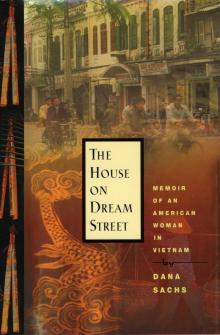
The House on Dream Street: Memoir of an American Woman in Vietnam
Two Cakes Fit for a King: Folktales from Vietnam (with Nguyen Nguyet Cam and Bui Hoai Mai)
Credits
Cover design by Emin Mancheril
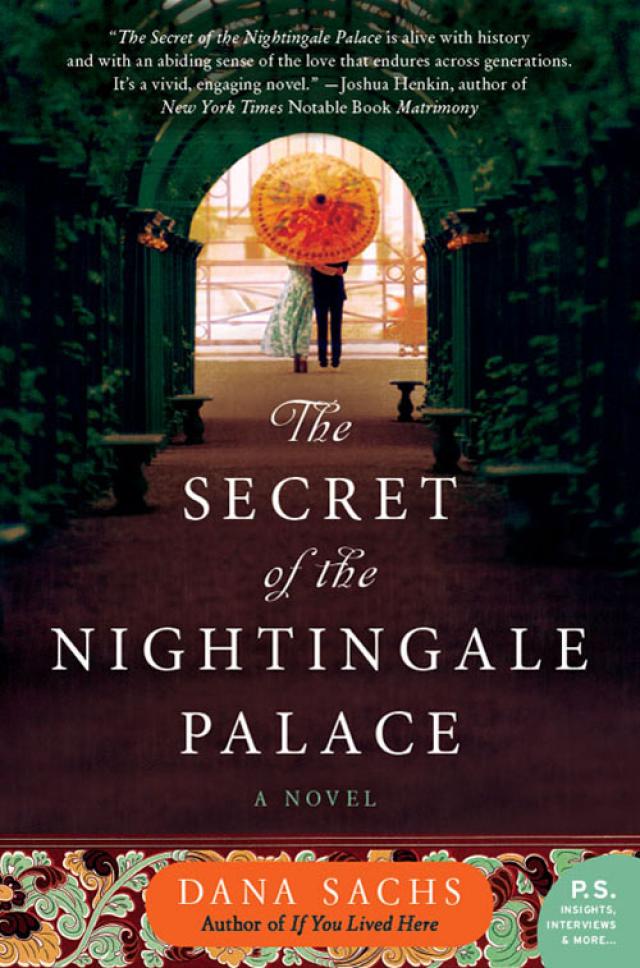
Cover photograph © by Oleg Oprisco/Trevillion Images
Copyright
Grateful acknowledgment is given for permission to use the epigraph from Arthur & George by Julian Barnes published in 2006 by Knopf, an imprint of Random House.
This book is a work of fiction. References to real people, events, establishments, organizations, or locales are intended only to provide a sense of authenticity, and are used fictitiously. All other characters, and all incidents and dialogue, are drawn from the author’s imagination and are not to be construed as real.
P.S.™ is a trademark of HarperCollins Publishers.
THE SECRET OF THE NIGHTINGALE PALACE. Copyright © 2013 by Dana Sachs. All rights reserved under International and Pan-American Copyright Conventions. By payment of the required fees, you have been granted the nonexclusive, nontransferable right to access and read the text of this e-book on-screen. No part of this text may be reproduced, transmitted, downloaded, decompiled, reverse-engineered, or stored in or introduced into any information storage and retrieval system, in any form or by any means, whether electronic or mechanical, now known or hereinafter invented, without the express written permission of HarperCollins e-books.
FIRST EDITION
ISBN 978-0-06-220103-4
EPUB Edition MARCH 2013 ISBN 9780062201041
13 14 15 16 17 OV/RRD 10 9 8 7 6 5 4 3 2 1
About the Publisher
Australia
HarperCollins Publishers (Australia) Pty. Ltd.
Level 13, 201 Elizabeth Street
Sydney, NSW 2000, Australia
http://www.harpercollins.com.au
Canada
HarperCollins Canada
2 Bloor Street East - 20th Floor
Toronto, ON, M4W, 1A8, Canada
http://www.harpercollins.ca
New Zealand
HarperCollins Publishers (New Zealand) Limited
P.O. Box 1
Auckland, New Zealand
http://www.harpercollins.co.nz
United Kingdom
HarperCollins Publishers Ltd.
77-85 Fulham Palace Road
London, W6 8JB, UK
http://www.harpercollins.co.uk
United States
HarperCollins Publishers Inc.
10 East 53rd Street
New York, NY 10022
http://www.harpercollins.com
Dana Sachs, The Secret of the Nightingale Palace