The harrowing of doom, p.1
The Harrowing of Doom,
p.1


The Harrowing of Doom
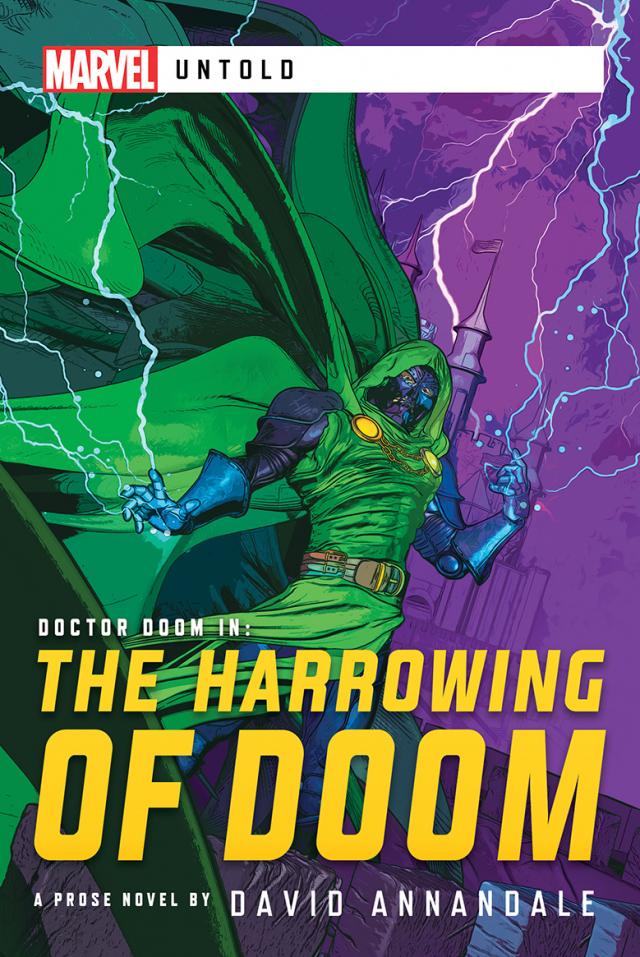
The tread of armored boots echoed up the vaults of St Peter. The stained glass windows seemed to tremble at the monarch’s step. Zargo had never seen Doom this close. Doom was tall, but his presence turned him into a colossus. He filled Zargo’s vision and consciousness until it seemed he should burst through the tiny walls and roof of the church. A faint hum and metallic clicks came from Doom’s armor, and Zargo suddenly knew what the machinery of fate sounded like.
He looked up at the mask and quailed before its titanium grimace. Even worse were the eyes, looking out from behind rectangular slits, eyes that had seen so much, eyes that knew, where Zargo had only the weak fabric of belief. Doom’s hooded cape, somehow untouched by rain, draped the metal of the armor, its dark green suggesting the sorcerous power of the natural framing the wizardry of technology.
FOR MARVEL PUBLISHING
VP Production & Special Projects: Jeff Youngquist
Assistant Editor, Special Projects: Caitlin O’Connell
Manager, Licensed Publishing: Jeremy West
VP, Licensed Publishing: Sven Larsen
SVP Print, Sales & Marketing: David Gabriel
Editor in Chief: C B Cebulski
Doctor Doom created by Stan Lee & Jack Kirby
© 2020 MARVEL
First published by Aconyte Books in 2020
ISBN 978-1-83908-052-4
Ebook ISBN 978-1-83908-053-1
This novel is entirely a work of fiction. Names, characters, places, and incidents are the products of the author’s imagination or are used fictitiously. Any resemblance to actual events, locales, organizations or persons, living or dead, is entirely coincidental.
No part of this publication may be reproduced, stored in a retrieval system, or transmitted, in any form or by any means, electronic, mechanical, photocopying, recording or otherwise, without the prior permission of the publishers.
This book is sold subject to the condition that it shall not, by way of trade or otherwise, be lent, re-sold, hired out or otherwise circulated without the publisher’s prior consent in any form of binding or cover other than that in which it is published and without a similar condition including this condition being imposed on the subsequent purchaser.
Cover art by Fabio Listrani
Distributed in North America by Simon & Schuster Inc, New York, USA
ACONYTE BOOKS
An imprint of Asmodee Entertainment Ltd
Mercury House, Shipstones Business Centre
North Gate, Nottingham NG7 7FN, UK
aconytebooks.com // twitter.com/aconytebooks
For Margaux, and the dreams we celebrate.
Prologue
“I know thee for a man of many thoughts,
And deeds of good and ill, extreme in both,
Fated and fatal in thy sufferings.”
Byron, Manfred, II.ii.34-6
April 30.
The bonfires of Latveria burned high on Walpurgis Night. They burned in the market squares of Doomstadt, the roar of the flames echoing down the narrow streets, the glow catching the steep gables of the houses and turning their shadows into claws that stretched across the cobblestones, wavering and hungry. They burned before the churches of St Peter and St Blaise, and the gargoyles on the façades seemed to shift back and forth, eager to take flight and revel in the night’s dark work. One burned on the rooftop of the Werner Academy, the blaze high and isolated against the night like an eye both fearful and knowing. They burned too in the countryside outside of the city of Doomstadt. They burned with special purpose there, where the night lay heaviest, unbroken by the doubtful refuge of streetlamps.
The people danced around the bonfires. Arms linked, faces turned upward to see the flames strike at the night, they danced and they chanted. Their chants were pleas for protection.
In Latveria, the people did not plead for protection from witches. They pled for the protection of witches.
In Doomstadt, the city named for the witch revered above all others, costumed children ran in groups down the streets. Some of the children in each group were disguised as demons. The others were gargoyles. To anyone not born in Latveria, it would have been difficult to tell the two apart, based on appearance. All the children bore horns and fangs. There were wings of cardboard and crêpe paper, even made of leather stretched over a wire framework. It was the actions that distinguished the demons from the gargoyles.
The demons ran ahead of the gargoyles. They yowled outside the doors of houses where the windows were lit by brass lanterns in the shape of gaping skulls. When the doors opened, the gargoyles descended on the demons with snarls and chased them away, before the group reformed and the performers were rewarded with pyro-wands to throw on the bonfires and smear the night with eruptions of blue and green and violet.
On Walpurgis Night, Latveria embraced its paradoxes. Evil against evil, monsters against monsters, in the land where angels had vanished from its myths. On Walpurgis Night, the darkness danced, and the people danced with it. The people feared the shadows and they loved them. The bonfires threw light, but at their edges, the darkness, imperious, was stronger than ever.
Shadows ruled over Latveria. And one shadow was supreme, its dominion absolute.
On Walpurgis Night, he who cast it walked abroad in his kingdom.
His was the shadow that was feared above all others. His was the shadow that defined Latveria. Without it, there was no Latveria. His shadow threw itself over every square inch of the land, and, midnight or noon, it was always there. The truth of Walpurgis Night in Latveria was that his was the shadow in whose honor the bonfires burned and the people chanted. The dancers and the demons and the gargoyles might not fully understand this truth. The celebration and its rituals were ancient, but all the centuries of observance and the slow accretion of variations had been tending to their present form, their present purpose. The people might only sense the truth. Victor von Doom grasped it, because his being had shaped it.
The nature of Walpurgis Night in Latveria was one of his works, and he walked far beyond the walls of Castle Doom that he might look upon this work and see that it was good.
On other nights, on other days, Doom would march through the arteries of his city with the majesty of a god, his passage preceded and followed by the heavy boots of his honor guard. Walpurgis Night was different. On the night of shadows, he chose to be one. He walked alone, the deepest darkness passing next to the revels, allowing himself to appear only as a glimpse, a glint of armor, the vanishing swirl of a cape. In this way, his presence spread to become all of the night. Wherever the people looked, they sensed him. He was everywhere. They felt his gaze, though they could not see him, and knew they must do all they could to propitiate him.
There were other reasons why Doom walked abroad and observed the celebrations. The rite of Walpurgis was an old one. It was powerful. Things stirred on this date. Deep currents flowed, and they demanded his attention. When he journeyed into the hills beyond the city, and the bonfires became little more than fireflies dotting the darkness, he could sense the warp and weft of the night more clearly. He could feel forces at work, and how thin the barrier between the world and the ones that came after it had become.
Doom climbed higher in the hills. Above the tree line, the wind was strong. He spread his arms, and his cape billowed. Like the tip of an iceberg, the wind was the trace of the greater current on the other side of the barrier. Walpurgis Night seethed with potential. The awareness of what it could become had haunted the unconscious of lesser minds for millennia. It haunted Doom too, because it felt like an answer he could not yet use.
Doom stopped at the top of the hill. He turned around to look back at Doomstadt, at the glowering lights of Castle Doom rising from its central peak, and at the bonfires flickering across the landscape. This was his domain. It was not his only one. And on this night, there were others that felt so close he could almost reach out a titanium-clad hand and seize them.
Walpurgis Night offered so much.
So different from Midsummer.
The thought made him grimace. The solstice was less than two months away. The year was swinging around, bringing with it the duel, and the burden of shame, and guilt, and rage, and frustration that marked the event. Hell must already be laughing at him, laughing in anticipation of his appointed fight with its champion, and the defeat that would come, as it had year after year after year. The defeat that would mean Hell would keep the soul of Cynthia von Doom for another twelve months.
Your son can command that a city bear your name, Mother, but he cannot free you.
He had fought the duel more than fifteen times. So many times that he knew how the coming one would end, no matter what champion Hell sent. His defeat was as certain as the need to fight. He would never turn away from the duel. And because he could not, he would go into battle with the sickening, treacherous sliver of hope that this time, this time, things would be different. On Walpurgis Night, with the duel still far enough away that he could think about it with a degree of calm, he felt immune to that hope. But it would come, like a cancer triumphing over remission, to torment him before the battle, and deepen the agony afterward.
This time. This time.
The words were poison. They tasted of death and futility.
Doom knew he would always be defeated. Hell ne
ver made a contract that it could lose. The Midsummer Night duel would always be on Hell’s terms, never his. He was trapped in a bargain as foul as the one that had trapped his mother’s soul.
She had been desperate to save her fellow Romani people from the persecutions of Baron (soon to be King) Vladimir Fortunov. She had given her soul to Mephisto in exchange for the powers to defeat Vladimir. Mephisto had cheated her. He had given her power, too much power to control. She had failed to bring down Vladimir, and had inadvertently killed a village-full of the innocent.
Mephisto had used Cynthia von Doom’s need to save her people, her urge to do good, to damn her. And he was using her son’s need to save her in turn, to hold him in a cycle of endless defeat and humiliation.
The wind gusted. It moaned with the echo of spirits. Midnight was long past. The witching hour was close, and the barrier was gossamer-thin. Doom breathed deeply, tasting, though his mask’s filter, the air growing colder with the touch of unquiet tombs.
If only there was a way to change the terms of the duel. If only there was a way to make Midsummer more like Walpurgis Night. This was the night most holy to his mother. This was the night that honored her most of all.
If only…
The great bells in the high tower of the castle struck three. The witching hour began. With the last reverberation of the toll, revelation came to Victor von Doom.
I have been a fool. I have been wrong to see the duel as the failed means to an end. It is what it can lead to that is important.
Walpurgis Night was not the respite before Midsummer. He must force Midsummer to be the stepping stone to Walpurgis.
He would have his terms.
I will take Hell by the throat, and I will squeeze.
Doom laughed. Amplified by projection units in his helmet, the laughter echoed across the hills. It rolled over the villages, and through the streets of Doomstadt. The shadows rose high at its thunder, and the bonfires quavered. The people faltered in the chants, and they shivered.
The darkness had spoken, and they feared what it would command.
Part I
Midsummer’s Noose
“Patience – and patience! Hence – that word was made
For brutes of burthen, not for birds of prey!
Preach it to mortals of a dust like thine, –
I am not of thine order.”
Byron, Manfred, II.i.35-8
Chapter 1
Mount Sivàr raised its barren crown east of Doomstadt, Latveria’s border with Romania. It was isolated from the rest of the chain, as if it had marched west, the vanguard of granite invasion. Trees clustered thickly around the lower half of Sivàr’s upheaval, then halted abruptly. Above the trees, the slope was not steep at first, but it was a brutal vista of rockslide debris and deep gorges. Then the peak thrust up, its sides nearly vertical, its faces bleak and savage. When the rising sun cast its shadow over the land, it was like the second coming of night.
Doom’s flight to Sivàr brought him to the mountain as the heat of the day faded, and gloom deepened on the western flank. He used his waist-mounted jetpacks to bring him to a point a few hundred yards below the line where the rubble-strewn slopes gave way to the naked face of the mountain. His goal was near the peak. He could have flown directly there. But that would not have been a strategic approach. There were ways of winning a struggle where the opponent never even knew there had been one, just as there were errors that would create a battle for which there was no need.
There was a power in the high reaches of Mount Sivàr. Doom had never tested himself against it. It was not his intention to do so now. Such a struggle would not be useful to him. He had other things in mind for the dweller in the peak.
He began the long climb. It was still possible to walk at this altitude. His titanium boots rang loudly against stone as he strode effortlessly between the leaning piles of granite. He was pleased with the sound of his march. Let his arrival be known. Let the mountain be aware of who had come.
His path through the wounds of stone became long and tortuous. Massive rockfalls blocked his way in one direction, and then a jagged crevasse stopped the way forward in another. Every time his route was barred, he resisted the temptation simply to fly over the obstacle. Instead, he surveyed the landscape carefully, every boulder and crack and patch of scree turned into an individual datum, the mountain slope nothing more than an object of analysis to be anatomized and understood. She who lived on the mountain had set terms to control what she believed was her corner of the Earth. Doom would follow the terms so rigorously, he would make them his own.
She had her path up and down the mountain. It was one that she traveled safely, and that she believed guarded her. He would walk it, and she would wonder if it was truly a work of her will after all.
The grey of evening had come when Doom reached the end of the rubble and reached the mountain face, a sheer black monolith in the failing light. Climbing Mount Sivàr, even with equipment, would be suicidal for even the most expert alpinist. Doom smiled tightly behind his mask. The pleasure came less from the challenge than from the ease with which he would best it.
He spoke the incantation softly, the syllables weaving together to form a command, whispered yet iron. What was hidden shed its veil. A narrow ledge appeared before him. It was less than three feet wide, its edge crumbling and treacherous. It zigzagged its way up the mountain face, a barely visible thread. This was the path she walked. This was how she descended from her home and returned.
Doom started up the path. He marched swiftly, though he knew the consequence of each step before he took it. The fall of dusk did not hinder him. His helm lenses would soon switch automatically to night-vision, and as he walked, he kept up a steady, rhythmic litany of sorcery. The spells were minor, so slight that they required no effort, and barely any movement. His fingers subtly traced delicate glyphs in the air. He murmured so only he could hear his words, though the world obeyed all the same.
He came upon the first of the wards at the start of the second switchback. Revealed by his will, its cat’s cradle of intersecting lines glowed a soft violet. It was a simple ward of warning, created to be unfelt by the one who triggered it, but its caster would know in that instant that someone was ascending her path. Doom could have dispelled it with a gesture. Instead, he stepped onto it. He saw the flash of its signal shoot to the mountain peak. He stayed where he was, arms crossed.
Look down. The night will not trouble your eyes any more than it will mine. Look. Know who is here. Know that you have time to prepare. Know that I do not come in stealth, or as the lightning.
He stayed there a full minute, then moved on.
The wards became more numerous the higher he climbed. Many of them were traps. They made gaps in the path look like solid stone, or they called upon falls of rock. These he disarmed, though the warnings he continued to trigger.
Heed your sentinels. I draw near.
The climb was a long one. It was full night before he was halfway up. There was time to contemplate the encounter to come. More than a mountain separated Doom from the power in the heights. Decades had passed since they had last seen each other. Decades heavy with history, freighted with pain. Their paths had been set by the same tragedy. It haunted them both. They were caught in its grip. Doom saw an escape for himself, and so he needed her help. She would, he was sure, respond to the same need. But she would have to be convinced that the escape was there. She had lived so long under this shadow, she would find it difficult to believe there was a chance of liberation.
At the witching hour, Doom reached the top of the mountain. He had timed his arrival for this moment, exactly one day after his Walpurgis Night illumination. This hour belonged to him, but also to the power on the mountain. It had belonged to his mother once too.
The concealed ledge came to an end at the mouth of a cave just below the frowning, heavy brow of the peak. A black standing stone of polished granite stood beside the entrance. Its network of runes glowed crimson at his approach. He stopped a few feet from the stone, just outside the cave. This was the most powerful of the wards. Another step forward, and he would trigger its response. The latent spells hummed with a sub-aural but psychically resonant pulse. Unleashed, their attack would be massive. Disarming the wards would itself be a challenge. He refused it. Instead, facing the torchlit glow of the cave, he opened the next phase of the campaign he had begun thousands of feet below.