Neferata mortarch of blo.., p.17
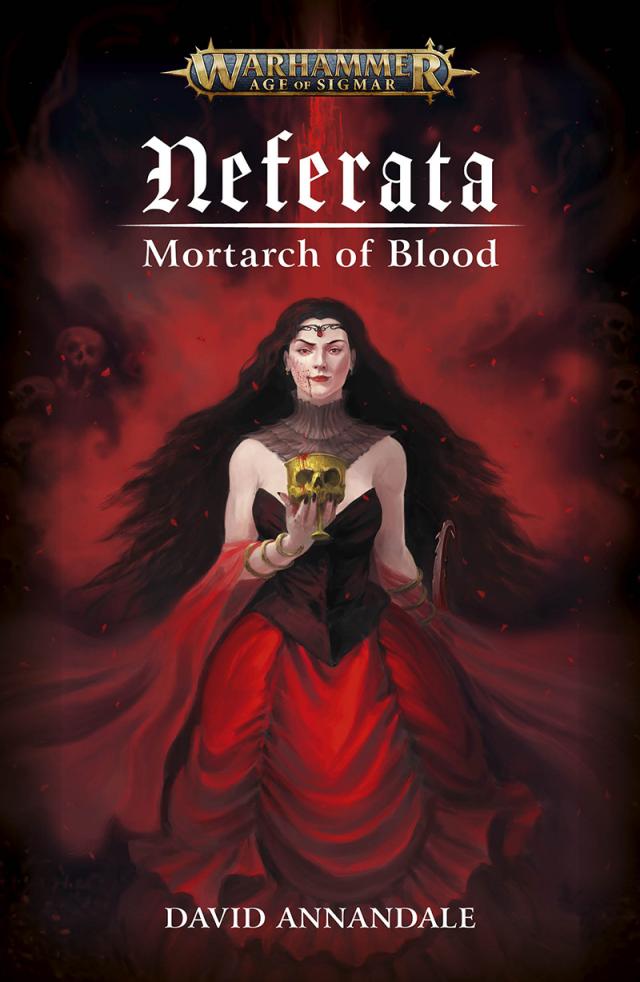
Neferata: Mortarch of Blood,
p.17


Neferata took Nagadron north, the better to see the end of folly, the shared folly of Venzor and Ruhok that they had any right to the city.
The usurper was fighting with the Lord of Khorne. They had come to grips, and Ruhok was trying to snap the vampire in half while Venzor lashed at him with a frenzy of sorcerous bolts. To their rear, Bloodbound fled from the onrushing collapse. They cut each other down in their panic. Those who were close enough to the edge to see the Maw were frozen. They understood, to their cost, what they saw. No being could behold the destroyer and not know it for what it was, for it nestled in the deepest recesses of every thought, every belief, every consciousness. Every reality.
Neferata heard the glorious sound of the Bloodbound screaming in fear, and she laughed. Her laughter rang across the city in agony, clear and strong and merciless.
Venzor and Ruhok stopped in mid-strike. They stared at their doom. Not far from them, Kathag, alone among Ruhok’s Gorechosen, had understood the nature of the maelstrom in time to turn away. ‘Do not look!’ he cried. ‘Do not look!’
His warning was a whisper in a gale. Only Neferata heard it, and she smiled.
The bloodsecrator and the slaughterpriest did not run. Neferata witnessed the crumbling of their faith. Their muscles went slack. Their faces went dark with monstrous comprehension. At the last moment, just before the ground beneath their feet dropped away, the bloodsecrator hurled his huge icon into the pit. Then they vanished, unable even to curse.
Ruhok, too, was paralysed. He stared directly into the face of doom, but when it came for him, he raised his voice in a thunderous roar. His pain and his rage would have hurled fortress walls to the ground, but the Maw of Uncreation took his anger, and so this too, only Neferata heard. Then he fell, a meteor of crimson armour plunging into the terminal grey.
Venzor tried to flee, gabbling in terror. But he turned his head away too late. He was too slow, and when the Maw came for him, he looked at it again, all choice stolen. His last scream was high and long, rich in all the shades of terror.
Only Kathag moved fast enough. He tore through the struggling hordes of Bloodbound, trampling them into the ground, sprinting for the outer walls. He looked back only once, from the top of a hill of rubble. Instead of staring at the Maw of Uncreation, he looked up, and Neferata met his gaze.
‘Run!’ she called to him, and laughed. ‘Tell them!’ she shouted, as the Exalted Deathbringer turned and ran again, fleeing the collapsing city, the all-destroying hunger at his back. ‘Tell them all! Tell your god what you have seen this night!’
Whirling, growing, whirling and growing, the Maw of Uncreation swallowed the armies, casting the legions into final silence. It pulled the outer walls of the city down, and the northern edge of the abyss stretched into the land beyond. There were no fires now, no defenders and no attackers. The Maw had claimed them all.
The glow from the base of the Tomb of the Unnumbered sent tendrils to the circumference of the pit. They were the arms of disruption, and they prevented the material of Shyish from restoring the balance that restrained the Maw of Uncreation. The strain on Neferata’s sorcerous engine was enormous. The Tomb of the Unnumbered began to crack. Slabs of dark rock fell from its sides. Splits webbed across its façade, turning it into a broken eggshell. Foul light gleamed from inside. The engine was on the verge of flying apart.
Neferata did not know what would happen if it destroyed itself. And its work was done. Balance must be restored. So she turned the Staff of Pain towards the hovering monument and jagged sorcery crackled across the night to the Tomb. The force was powerful, but it did not drain her as before. She was not unleashing magic now. She was releasing the strain.
The spell struck the Tomb of the Unnumbered. The tendrils of light flared, then vanished. Now there was a rush of new material into the Maw faster than its hunger could grow. The vortex began to withdraw. The grey sank down into the darkness, receding to its chamber.
The Tomb of the Unnumbered began to descend. The open claw closed, the two halves returning to one another and, as far below the Annihilation Gate shut once more, so did the Tomb come to ground with a boom that shook the city. Destruction slumbered again, covered by the sleep of death.
The tremors ceased. Silence fell over Nulahmia. The silence of dread, the silence of rubble, the silence of Neferata’s rule. The northern quarter was a slumped pit. Phantasmal energies floated over it, a nimbus of green and loss. Mile after mile after mile of the city was utter ruin. The destruction was more complete than anything that had happened during Lascilion’s siege. What Neferata had created, she had destroyed. What she destroyed, she could create anew.
She brought Nagadron down into the wasteland. She dismounted and began to walk, first through what had been the Silent Quarter, then onwards, into the ruins of the north. The sound of her boots on broken stone rang sharply in the quiet. The wind gradually picked up again, keening with grief. And then, though the end of the furnace season of Crematory was still far in the future, it began to rain.
The rain fell up. It rose from the rubble, droplets darkened with ash. Neferata stretched out her hands, and the mourning of stone pattered up against her palms. She smiled, followed the flight of rain to the sky, where clouds turned sluggishly in aftershocks of pain.
At her back, she felt the sudden gathering of night. She wheeled around to see the coming of a god. She had expected his arrival. That did not make it any easier. Now she would see the ultimate consequences of her risk.
The ropes of night became limbs and armour. The cold fire of the gaze appeared, and then the terrible skull. In glory and might, he who was dread incarnate, he who was death incarnate, materialised before her. His armour was ribbed in golden wraithbone. Long spurs rose from his shoulders, symbols of his grasp reaching out beyond his form. In his hand he held Alakanash, the great Staff of Power, his authority captured in blade and bone.
Nagash was here to render judgement.
‘You risked my Realm,’ said the god of death.
‘I was not reckless with Shyish, master,’ Neferata answered, her tone humble and respectful, but not cowering. She must stand by her actions. ‘I knew, once I permitted it, that the balance would be restored.’
‘You knew, or you believed?’
‘The line between the two was insignificant.’
‘Yet it exists.’
Neferata bowed her head. ‘I do not believe that you did not know the Maw of Uncreation lay below Nulahmia, master. I do not believe you did not know I would, in time, make use of it.’
The eyes of the death’s head glowed with what she hoped was amusement.
Nagash swept his hand, taking in the devastation of Nulahmia. ‘The city was a different risk. You sacrificed much.’
‘It is mine to sacrifice. Is it not?’
‘Yours? Yours by my dispensation.’
Neferata said nothing, waiting.
The cold fire in Nagash’s gaze grew brighter, and she was sure, now, that she saw dark pleasure there. ‘Yes,’ he said. ‘Yours. Through your skill at deceit, you have destroyed a legion of Khorne and reclaimed the right to your city entire. I revoke Arkhan’s claim.’
Neferata held her face still. She kept her triumph in her heart, though she had no doubt Nagash could see it. She lowered her head again. ‘My thanks to you, my lord. My service, eternally, is yours.’
‘So it must be,’ Nagash warned, and he faded from view, death returning to the night. The sense of his gaze lingered, a call to obedience.
Neferata turned back to Nulahmia. The city was wounded, bleeding. Her city. To wound and to heal as she saw fit.
Her city. Bleeding at her command.
For all blood is mine.
ABOUT THE AUTHOR
David Annandale is the author of the Horus Heresy novels Ruinstorm and The Damnation of Pythos, and the Primarchs novels Roboute Guilliman: Lord of Ultramar and Vulkan: Lord of Drakes. For Warhammer 40,000 he has written Warlord: Fury of the God-Machine, the Yarrick series, several stories involving the Grey Knights, including Warden of the Blade and Castellan, as well as titles for The Beast Arises and the Space Marine Battles series. For Warhammer Age of Sigmar he has written Neferata: Mortarch of Blood. David lectures at a Canadian university, on subjects ranging from English literature to horror films and video games.
An extract from Soul Wars.
At the heart of the Realm of Death, the Undying King waited on his basalt throne.
He sat in silence, counting the moments with a patience that had worn down mountains and dried out seas. Spiders wove their webs across his eyes, and worms burrowed in his bones, but he paid them no mind. Such little lives were beneath the notice of Nagash. His awareness was elsewhere, bent towards the Great Work.
Then, Nagash stiffened, alert. Purple light flared deep in the black sockets of his eyes. The scattered facets of his perceptions contracted. The disparate realms slid away, as all his attentions focused on Shyish and the lands he claimed for his own.
Something was wrong. A flaw in the formulas. Something unforeseen. The air pulsed with raw, primal life. It beat upon the edges of his perceptions like a hot wind. He shrank down further still, peering through the eyes of his servants – the skeletal guardians that patrolled the streets endlessly. He saw… green. Not the green of vegetation, but dark green, the solid green musculature of things that should not be in Nagashizzar. He heard the thunder of rawhide drums and tasted a hot, animal stink on the air.
Something was amiss. Inconceivable. And yet it was happening.
Nagash shook off the dust of centuries and forced himself to his feet. The creaking of his bones was like the toppling of trees. Bats and spirits spun in a shrieking typhoon about him as he strode from his silent throne room, shaking the chamber with every step. He was trailed, as ever, by nine heavy tomes, chained to his form. The flabby, fleshy covers of the grimoires writhed and snapped like wild beasts at nearby spirits.
He cast open the great black iron doors, startling those of his servants in the pillared forecourt beyond. That the fleshless lords of his deathrattle legions were gathered here before the doors of his throne room, rather than seeing to their duties, only stoked the fires of his growing anger. ‘Arkhan,’ he rasped, in a voice like a tomb-wind. ‘Attend me.’
‘I am here, my king.’
Arkhan the Black, Mortarch of Sacrament and vizier to the Undying King, stepped forwards, surrounded by a gaggle of lesser liches. The wizened, long-dead sorcerers huddled in Arkhan’s shadow, as if seeking protection from the god they had served briefly in life and now forever in death. Unlike his subordinates, Arkhan was no withered husk, for all that he lacked any flesh on his dark bones. Clad in robes of rich purple and gold, and wearing war-plate of the same hue, he radiated a power second only to that of his master.
Nagash knew this to be so, for he had made a gift of that power, in days long gone by. Arkhan was the Hand of Death and the castellan of Nagashizzar. He was the vessel through which the will of Nagash was enacted. He had no purpose, save that which Nagash gifted him. ‘Speak, my servant. What transpires at the edges of my awareness?’
‘Best you see for yourself, my lord. Words cannot do it justice.’
Though Arkhan lacked any expression except a black-toothed rictus, Nagash thought his servant was amused. Arkhan turned and swept out his staff of office, scattering liches and spirits from their path as he led his master to one of the massive balconies that clustered along the tower’s length. At his gesture, deathrattle guards, clad in the panoply of long-extinct kingdoms, fell into a protective formation around Nagash. While the Undying King had no particular fear of assassins, he was content to indulge Arkhan’s paranoia.
‘We appear to have an infestation of vermin, my lord,’ Arkhan said, as they stepped onto the balcony. ‘Quite persistent vermin, in fact.’ Razarak, Arkhan’s dread abyssal mount, lay sprawled upon the stones, feasting on a keening spirit. The beast, made from bone and black iron, its body a cage for the skulls of traitors and cowards, gave an interrogative grunt as its master strode past. It fell silent as it caught sight of Nagash, and returned to its repast.
Many-pillared Nagashizzar, the Silent City, spread out before him. It was a thing of cold, beautiful calculus, laid out according to the ancient formulas of the Corpse Geometries. A machine of stone and shadow, intricate in its solidity, comfortable in its predictability.
It was a place of lightless avenues of black stone veined with purple, and empty squares, where dark structures rose in grim reverence to his will. These cyclopean monuments were made from bricks of shadeglass, the vitrified form of the collected grave-sands. Harder than steel and polished smooth, the towering edifices resonated with the winds of death.
Nagashizzar had been made from the first mountain to rise from the eternal seas. There had been another city like it, once, in another time, in another world, and Nagash had ruled it as well. Now all that was left of that grand kingdom were threadbare memories, which fluttered like moths at the edges of his consciousness.
Those memories had taken root here and grown into a silent memorial. Or perhaps a mockery. Even Nagash did not know which it was. Regardless, Nagashizzar was his, as it had always been and always would be. Such was the constancy of his vision.
But now, that vision was being tested.
Nagash detected a familiar scent. The air throbbed with the beat of savage drums and bellowing cries. Muscular, simian shapes, clad in ill-fitting and crudely wrought armour, loped through the dusty streets of Nagashizzar. Orruks. The bestial, primitive children of Gorkamorka.
Below, phalanxes of skeletal warriors assembled in the plazas and wide avenues, seeking to stem the green tide, but to no avail. The orruks shook the ground with the joyful fury of their charge. A roaring Maw-krusha slammed through a pillar, sending chunks of stone hurtling across the plaza. It trampled the dead as it loped through their ranks, and the orruk crouched on its back whooped in satisfaction.
The orruks were the antithesis of the disciplined armies facing them. For them, warfare and play were one and the same, and they approached both with brutal gusto. They brawled with the dead, bellowing nonsensical challenges to the unheeding tomb-legions. There was no objective here, save destruction. Unless…
Nagash turned towards the centre of the city, where the flat expanse of the Black Pyramid towered over the skyline. It was the greatest and grandest of the monuments he’d ordered constructed. Unlike its smaller kin, hundreds of which dotted Shyish, the Black Pyramid was the fulcrum of his efforts. Its apex stretched down into Nekroheim, the underworld below Nagashizzar, while its base sprawled across the city – a colossal structure built upside down at Shyish’s heart.
A flicker of unease passed through him as he considered the implications of the sudden assault. It was not a coincidence. It could not be. He looked at Arkhan. ‘Where did they come from?’
The Mortarch motioned southwards with his staff. ‘Through the Jackal’s Eye,’ he said. Nagash’s gaze sharpened as he followed Arkhan’s gesture. The Jackal’s Eye was a realmgate, leading to the Ghurish Hinterlands. There were many such dimensional apertures scattered across this region – pathways between Shyish and the other Mortal Realms. They were guarded at all times by his most trusted warriors. Or so he had commanded, a century or more ago. As if privy to his master’s thoughts, Arkhan said, ‘Whoever let them pass through will be punished, my lord. I will see to it personally.’
‘If the orruks are here, then whoever was guarding the gate is no more. The reasons for their failure are of no interest to me.’ Nagash considered the problem before him. Then, as was his right as god and king, he passed it to another, one whose entire purpose was to deal with such trivialities.
‘Arkhan, see to the disposal of these creatures.’ Nagash looked down at his Mortarch. Arkhan met his gaze without flinching. Fear, along with almost everything else, had been burned out of the liche in his millennia of servitude. ‘I go to bring the Great Work to its conclusion, before it is undone by this interruption.’
‘As you command, my lord.’ Arkhan struck the black stones of the balcony with the ferrule of his staff. Razarak heaved itself to its feet with a rustling hiss. The dread abyssal stalked forwards, and Arkhan hauled himself smoothly into the saddle. He caught up the reins and glanced at Nagash. ‘I am your servant. As ever.’
Nagash detected something that might have been disdain in Arkhan’s flat tones. Of course, such was impossible. The Mortarch was no more capable of defying Nagash than the skeletons trudging through the wastes. And yet, he seemed to, in innumerable small ways. As if there were a flaw in him – or in Nagash himself.
For a moment, the facets of Nagash’s being hesitated. Then, as ever, the black machinery that passed for his soul righted itself and continued on. He had been mistaken. There was no defiance. Only loyalty. All were one, in Nagash, and Nagash was all. ‘Go,’ he said, the stentorian echo of his command causing the air itself to shudder and crack.
With a sharp cry, the Mortarch urged his steed into a loping run. The skeletal monstrosity galloped across the balcony and flung itself into the air. The winds of death wrapped protectively about both rider and steed, carrying them towards the battle.
A moment later, a cyclone of howling, tortured spirits streamed past Nagash and spiralled into the air in pursuit of the Mortarch. He watched as they hurtled upwards and away, a cacophonous fog of murderous spectres, twisted and broken by his will into a shape suited to their task. They had been criminals, murderers and traitors in life, and now, in death, they were bound in stocks and chains, afflicted with terrible hungers that could never be sated. Nagash knew himself to be a just god, whatever else.