Apostle, p.6
Apostle,
p.6
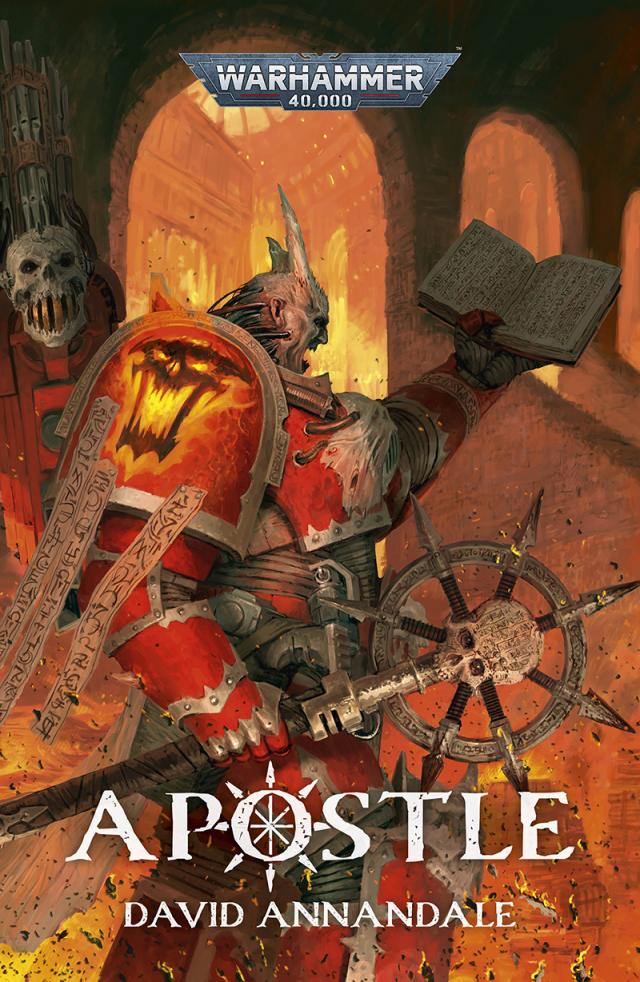


Many did not yet embrace the faith he had brought them. It embraced them, though. They listened to him, and because they did so willingly, his words netted their souls. For now, they revelled in the licence to feel resentment for their lot and to express it. Soon they would be willing to kill in its name. Some already were.
The tower of flame bellowed in exultation. Fire jetted from open burrows. Screams of agony made themselves heard briefly above the crackling roar. Not all the inhabitants of the parchment mound had left it before Cerastes had turned the hill into a beacon. They became Legitur’s first burnt offerings to the true gods. The congregation responded to the screams with renewed, ecstatic fervour.
Cerastes paused his sermons. He let the people feed on their passions for a while. He left them to bask in the blistering heat of the fire.
‘We stand before a great show of light,’ Orthaon remarked.
‘It is the means by which we shall cast even longer shadows, brother,’ said Cerastes. ‘Do you doubt its value?’
‘No, Dark Apostle. I seek to understand its full purpose.’
Cerastes nodded. ‘You are wondering why I should send out so bright a signal to Legitur’s Imperial rulers when their strength is yet so much greater than ours.’ He held up a hand before Orthaon could protest that he was not questioning Cerastes’ wisdom. ‘Our flame is a great one, but the depths of the Lower Glyphs are profound. For the masters in the Upper Glyphs, the depths are something to be ignored. I speak from experience. For much of my life on Legitur, I knew the Lower Glyphs existed, but only in the same way that I knew that the molten core of Legitur exists. The Upper Glyphs do not think about the Lower because they do not have to. The machinery of Imperial oppression of body and thought is pervasive in nature and massive in strength. But it can be broken. We are breaking it now.’ He paused and looked up towards the peak of the mountain of flame, hundreds of feet above them. ‘Our signal is invisible from the heights of the Upper Glyphs, brother. I believe, though, that it reaches high enough.’
‘High enough for what, Dark Apostle?’
‘To call some attention to us. To issue the right kind of invitation.’
It would be the best part of a day before Cerastes heard the growling of an engine in the near distance, and knew the invitation had been accepted.
He bared his sharpened teeth in anticipation and strode away from the burning mountain. His followers parted before him and Orthaon, opening a path towards the east.
The Taurox rumbled into view as Cerastes came to the edge of the crowd. The skull-and-‘I’ emblem of the Ecclesiarchy enforcers adorned its front. Legitur’s forces of order had arrived.
‘Disperse or die!’ a vox-caster commanded.
‘Kill no more than is necessary,’ Cerastes told Orthaon. ‘I want survivors.’
They charged directly at the Taurox. You did not expect us, Cerastes thought. Though the Taurox picked up speed to meet them, there was a delay, a delay of shock and incomprehension, before the enforcers inside reacted to the attack. The pintle-mounted storm bolter on the roof swung to follow Orthaon as he sprinted ahead of Cerastes and to the side. It fired a stream of shells a moment too late. Orthaon closed with the armoured carrier and leapt onto the roof. He slammed a krak grenade onto the gun, then took a step back, as steady on his feet as if he were a statue on the roof.
Cerastes stopped running a few dozen yards from the Taurox and fired his bolt pistol at the armaglass windows. He placed his shots with brutal precision, and the repeated explosions shattered the shielding. The shells struck home inside, killing the driver, and the Taurox slewed sideways before coming to a halt a few feet from Cerastes.
On the roof, the grenade went off, melting through the storm bolter and the roof.
Cerastes heard a muffled scream of pain inside the vehicle.
The side door crashed open. Eight enforcers and their commanding officer faced Cerastes. The sight of him froze them in the act of disembarking.
Orthaon jumped down from the roof and landed beside Cerastes, his bolter trained on the enforcers.
The faithful servants of the Adeptus Ministorum hesitated. Most of them held shock mauls as weapons – more than enough to put down the unruly, especially the weakened and starving in the furthest depths of the Lower Glyphs. They recognised the futility of the mauls against power armour. Perhaps one or more of them had encountered Imperial Space Marines in the past. Perhaps they only knew them as myths that somehow were real. Either way, their first sight of Cerastes and Orthaon told them that they had no chance.
But they also had their oaths of loyalty. The enforcer who led the squad grabbed the shotgun he carried on his back. Before he could bring it to bear, Cerastes lunged forward, grabbed the lip of his armour’s pauldron and yanked him out of the Taurox. He threw the man to the ground, hard enough to stun him. The enforcer pushed himself up to his hands and knees, shaking his head. Cerastes brought his crozius down, shattering helmet and skull.
All the while, Orthaon held his bolter steadily trained on the others.
‘Get out,’ Cerastes told them.
The enforcers climbed out of the Taurox, clearly watching the Word Bearers for a moment of inattention, a hint of weakness that could be exploited.
They didn’t understand, Cerastes thought. They were the weak ones. They were the ones about to be exploited.
But also set free.
Cerastes loomed over them. ‘Kneel,’ he commanded.
They hesitated. One raised her chin, ready for the shell that would kill, braced to die for her putrid corpse of an Emperor. They defied Cerastes, but they trembled too. He would use their terror to pry them open.
Cerastes spoke the Litany of Despair. He formed ancient, inhuman words, words that could not even be pronounced by the human tongue and throat without passing through training of a thousand agonies. The words swirled around the enforcers, gathering new sounds from the warp, gathering the hints of whispers and the taste of voices. The fog of Legitur rippled and wrinkled. Murmuring surrounded the enforcers. It clawed at their minds with the revelation of darkness beyond the veil.
‘You know what I must be,’ Cerastes said to them, ‘yet your faith demands that you deny it. You hear the voices sent by the true gods, yet you must not accept the evidence of your ears. There is no such thing as daemons. This is one of the great commandments of the Imperial Creed. Yet the whispers of daemons caress the backs of your necks.’ He bared his teeth at them, and the murmurs echoed his low growl. He took a single step towards the enforcers, towering over them. One kept staring at his horns, and that man now did kneel, unknowingly taking the decision that could not be revoked.
‘I am the proof of daemons,’ said Cerastes. ‘I am the voice of gods. Yet I was once a son of Legitur. I believed as you believe. I believed in lies. Now I converse with daemons, and call upon the blessings of the true gods.’
The murmurs gathered strength, becoming insistent, becoming a choir that responded to the rhythm of his words. The enforcers looked around, frightened, disoriented, their eyes wide as if in anticipation of seeing the whispers take on visible form.
When Cerastes spoke again, his voice yanked the enforcers’ attention forward.
‘Listen,’ he said. ‘Listen to the Word. Listen to the incantation of your liberation.’
The enforcers listened. They feared him. They feared for their souls. But they listened, damning themselves.
He would have to kill a few more of them in the days ahead to cow the others and force them down the path he was laying out before them. But he would see them walk it. Before he was done, they would hate the False Emperor and the lies that had imprisoned them.
And then there were the Abandoned. They listened to him eagerly, hungry for commands, hungry for tasks. He gave them what they craved. ‘You have begun our war without realising it,’ he told his growing army. ‘You have burrowed like termites into the texts of lies. You dug to survive, and for a semblance of shelter. Now dig with purpose, my faithful. Dig our tunnels. Dig our web of secret roads.’
They set to work as he had bade them. And when they were not digging, they returned to hear him speak, and to grow in strength and anger.
‘You must leave me now,’ Cerastes had told Wrack a few days after the first attack by the enforcers. ‘Go and do as I bid, and then return to me in triumph.’
Wrack obeyed. She left the gloom of the Lower Glyphs and returned to the sunlit realm again. Only weeks before, though truly a lifetime ago, she would have relished the chance to spend time even under the polluted skies of Legitur’s primary spaceport. Now she hated the light. It was a lie. True illumination came from the darkness, and from the roiling unmatter of the warp. She hated being cut off from Cerastes’ presence. When she beheld him, and heard his preaching, she felt the touch of the dark divine. Every moment of her existence became the experience of revelation, and an ongoing, transcendent emancipation from the mental, physical and spiritual bonds that had kept her shackled for her entire life until now.
At the same time, Cerastes had placed his trust in her. He had given her a mission. ‘You have learned well and quickly, acolyte,’ he had told her. ‘You know enough to carry some of the precepts of Lorgar forward. And you know Legitur and its people too. Go now. Do as I bid, and witness the glory of the Word take hold through your actions.’
The primary spaceport of Legitur spread itself like a blackened lesion over the face of the Upper Glyphs. Formed by scores of interlocked platforms, it occupied a sector just over the northern horizon from the Palace of Saint Evellad. Though its ugly, industrial visage did not blemish the view from the spires of Legitur’s masters, the sky in that region was stained brown. At night, the glow and flare of take-offs and landings created an energetic fire whose aesthetics made up for the daytime flaw.
Wrack took the serf grav-lifts to the Upper Glyphs, and then the magrail carrying thousands of vessel hands to the spaceport. The magrail cars approached the complex at the level of the landing pads, pouring their passengers into concourses that led to rapid embarkation paths.
She headed back down as soon as she could, to the lower levels of the spaceport’s maintenance sectors. Here, once more, there was no sky to behold. Here, the most miserable of the spaceport’s serfs toiled. In the dark, bitterness grew like fungi. Obedience to the Imperial Creed kept it in check. If to resent one’s lot in life was to engage in heresy, then one could do nothing but accept misery as what the God-Emperor had decreed.
Wrack had verged on heresy despite herself before encountering Cerastes. Now, freed, she did more than imagine the impossible. She witnessed its reality. And she had come to enact it too.
She made her way to the lowest of the cargo bays. Here, thousands laboured to transfer sacred texts into crates that would, in turn, be transported upward to the ships that took the exegeses and sermons off-world. Nothing suggested the holy nature of the work in the bay. The books were only heavy masses here, the source of endless labour in a dimly lit cavern. Catwalks criss-crossed the space, dividing the stacks of crates into inspection sectors. Shift supervisors walked along them, observing the work below.
Wrack ascended to the topmost level of catwalks. Moving through and with shadows came naturally to her now, and she kept away from the notice of the supervisors until she found the one she sought.
His name was Stavor. He had been a salvage captain, like her. They had sometimes been rivals for the same find, but had always respected each other’s skill. Three years back, Stavor had brought his ship alongside a factory vessel that had been cut in half by a meteor. The entire stern had disintegrated, but even in its reduced state, the wreck had been huge, and an ambitious target for Stavor’s modest tug.
He’d managed to secure the hull, and brought it all the way back to Legitur, reaching a high anchor point. Some of the wreck’s cargo was still in the holds, though, and it was volatile. The explosion had destroyed Stavor’s ship and two-thirds of his crew, and had rendered the ship-breaking platform he had been approaching unusable for the next eighteen months. Injured, financially ruined, his Right of Captainship revoked, Stavor had found what work he could in the sublevels of the spaceport.
Wrack had only seen him once since the accident. She recognised him now, but only just. He had aged rapidly. Always wiry, now he was gaunt, his skin sallow, hair lank, face pinched and harrowed by bitterness. His two bionic legs gave him a rolling gait. He had never replaced his left eye, and the lid hung low over the hollow socket.
She stopped him as he marched past her pool of shadows. ‘This is not a proper fate for a voidship captain,’ she said.
Stavor jerked to a halt. He peered at her. ‘Wrack?’ he said, uncertain and surprised.
‘It is. Neither of us is what we once were.’
‘I’m not,’ said Stavor. ‘That much is certain. You look…’ He hesitated, as if realising the word well did not apply. ‘Strong,’ he said at last.
Wrack grinned. ‘That’s right. I am. Stronger than I have ever been.’
‘Are you still captaining the Witness to Duty?’
‘No. I have a new calling. A better one. A truer one. That’s why I’m here.’
‘I don’t understand.’
Wrack took Stavor by the shoulder. She brought him to the catwalk’s railing. She gestured into the gloom echoing with the din of unceasing labour. ‘Why are you here?’ she asked. ‘What is the purpose of your toil?’
He grunted. ‘To eat. Why are you asking such foolish questions?’
‘You work so you can eat,’ said Wrack. ‘You eat, and so you live another day to work again. For what purpose? For whose ends? For what glory?’
Stavor yanked himself away from Wrack. ‘We don’t ask things like that down here. It’s not healthy.’
‘Because it leads to despair?’
‘Despair is heresy,’ Stavor muttered, voicing another lesson drummed into them from youth. He spoke in a monotone caked in venom.
‘It is heresy,’ Wrack agreed. ‘Because it makes you less useful to unworthy masters.’
Stavor’s one eye stared at her. ‘What are you saying?’
‘Nothing you don’t already know, and don’t already believe, even if you won’t admit it to yourself. I was the same. But I’m not afraid any longer. I’m not enslaved.’ She took Stavor’s arm again, this time in a grip he would not be able to break. ‘I came to show you what I now see,’ she said. ‘I came to free you.’
Stavor said nothing. He just nodded, very slightly. He was listening.
She followed Cerastes’ teachings. She used the words of the Dark Apostle, and began to tear the veil from Stavor’s eye.
Cardinal Mazarine walked the Garden of Discipline while he waited for his visitor. The garden occupied the central courtyard of the Palace of Saint Evellad the Unforgiving. Tall, groomed topiary walls divided the garden into a series of interconnected cloisters. Every rectangular formation held, at its heart, a statue of a saint standing over a circular pond. Stone benches lined the ponds. To sit by one of them, with the open sky above and the ten-foot hedges on all sides, was to feel a particular stillness and privacy, and perhaps hear a call to meditation.
Mazarine didn’t feel contemplative today.
He was in the north-east corner cloister when he heard the crunch of boots on the gravel path. He faced the entrance to the space, and Marshal Provallak of the enforcers appeared. Mazarine had expected Provallak to look worried. The fact that the marshal had requested they meet here, rather than in the throne room, suggested that Provallak didn’t want to raise any kind of alarm with his visit. The more informal the meeting appeared, the more likely it was that Mazarine would have to face a crisis. The thought irritated him. Dealing with crises should be Provallak’s responsibility.
Provallak was a squat, bullet-headed man with grey hair shaved to stubble. He had the rough-hewn features of an officer used to battering problems and people down with crude, brutal violence. Mazarine knew him to be a more subtle thinker than he seemed.
Provallak bowed and kissed Mazarine’s rings. ‘Cardinal,’ he said. ‘Thank you for seeing me.’
‘You have never given me any reason to doubt your judgement, marshal,’ Mazarine said, sounding more conciliatory than he felt. ‘If you feel it is necessary for us to meet, then I believe it must be.’
‘We have the garden to ourselves?’
‘We do.’
They strolled together down the gravel path that took them out of the cloister and across to the next one. They walked slowly, with Provallak keeping his head slightly lowered. Should anyone see them, it would look as if the marshal were seeking spiritual counsel from the cardinal. He had done so in the past, partly to ensure that if meetings such as this one were needed, they would not draw attention.
‘I apologise,’ Provallak said, as if reading Mazarine’s mind. ‘I didn’t want to create any impression of a crisis.’
Mazarine suppressed a sigh. I knew it. ‘Is there one?’
‘I’m not sure, cardinal. But I am concerned.’
‘Go on.’
‘There have been disquieting rumours coming from the Lower Glyphs.’
‘Where, precisely?’
‘Very far down. At the foundation level.’
Mazarine hadn’t given a moment’s thought to that region in as long as he could remember. It was so far away that its rumours might as well be coming from another system. ‘What sort of rumours?’ he asked.
‘Of unrest. I don’t have a lot of details. But I do have confirmation of a parchment fire. One of the mountains is aflame.’
Mazarine grunted, a worm of unease slithering through his gut. ‘It’s been centuries since one of those has occurred,’ he said.
‘Four hundred and thirty years, according to our archives,’ said Provallak.