Illustrated world of tol.., p.12
Illustrated World of Tolkien,
p.12
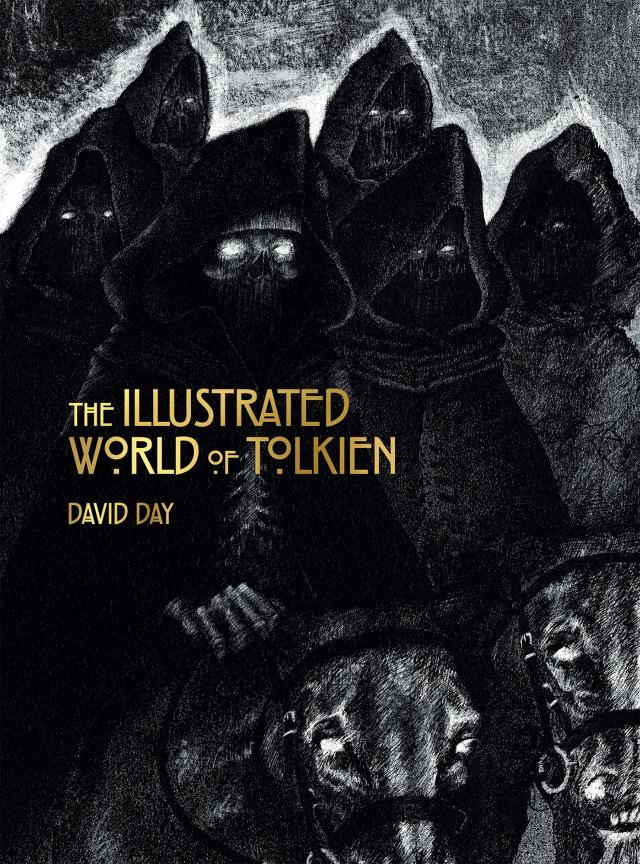


I wanted to show the waterfalls in all their massive and natural power, at the precise moment when the boat bearing Boromir’s body – tiny against the swell of the river – tilts to descend and disappear forever in the roar of the waters.
UMBAR AND CARTHAGE
Port city to the south of Gondor and of the mouth of the Anduin River. For a thousand years a colony of Númenor, then a base for the Black Númenóreans, and later part of the Gondorian empire. By the time of the War of the Ring, Umbar had long been in the hands of the marauding Corsairs.
Umbar plays a similar role in the history of Gondor to the port-city of Carthage in the history of Rome. A colony of the mighty sea power of Phoenicia for a thousand years, Carthage rose to be an independent and significant power in the wake of the destruction of the Phoenician island city-state of Tyre in 332 BC (here a counterpart for Númenor). Just as Carthage and Rome vied for control of the Mediterranean, Gondor vied with Carthage for control over the vast Bay of Belfalas. The Black Númenórean Lords of Umbar (whose war fleets were the terror of the seas and whose powerful mercenary armies were buttressed by divisions of war elephants) were a torment over many lands. The lords of Carthage (whose mighty war fleets were the terror of the seas and whose powerful mercenary armies were buttressed by war-elephants) were a torment over many lands.
In the Third Age, after centuries of rivalry, the Ship Kings of Gondor engaged in century-long wars (933–1050 TA) on sea and land, which resulted in the eventual conquest and subjugation of Umbar and its Southron Empire of Harad. This is similar to Rome’s century-long Punic Wars (256–146 BC) on sea and land, which resulted in the eventual conquest and subjugation of Carthage and its North African empire. The Black Númenórean rulers of Umbar were slain or scattered, and the city and port served as Gondor’s southern fortress controlling its vast Haradrim territories. The Carthaginians, too, were slain or sold into slavery, and its city and port served as Rome’s southern fortress controlling its vast North African territories.
Subsequently, Tolkien’s chronologies inform us that Umbar slipped from Gondor’s grasp after five centuries. In the year 1448 TA Gondorian rebels and lords among the Haradrim captured Umbar. These new lords became known as the Corsairs of Umbar, and their mighty pirate fleets once again terrorized the seas, harassing and attacking Gondor and its allies.
UMBAR
DAVID KEARNEY
THE CORSAIRS OF UMBAR
ALLAN CURLESS
SANCTUARIES CASTLES AND FORTRESSES
TIRION
LINDA GARLAND
THE FALL OF BARAD-DÛR
DAVID KEARNEY
CASTLES
To the Romans the stronghold or fortification was called a castrum. To the Anglo-Saxons it was a castel; while to the medieval English it was a castle. In history, myth and fiction, the castle, hill fort, citadel or walled town is a dramatic manifestation of a nation’s stern power and high romance. It is the centre of life and is the idealized world in a microcosm. It protects the seat of earthly power, the throne, it contains the symbol of heaven, the chapel, and it threatens with the symbol of hell, the dungeon.
The character of that enclosed world is determined by the master who builds and commands it. Outwardly it might be seen as a mandala or a maze: a saint’s paradise or a demon’s labyrinth. A place of peace and safety, or a hell on earth. Whether as a place to storm or a place to defend, the castle is the symbol of spiritual strength. The forces of light or darkness, good or evil, life and death are implicit in that struggle.
That the castle in all its metaphoric implications was understood by all who lived in the great ages of castles cannot be doubted. As Tolkien knew well enough, the oldest surviving morality play (pre-dating Everyman) is The Castle of Perseverance. Here, despite a siege army of the Deadly Sins and the Forces of Hell, Man was secure. The evil enemy for all its might cannot overwhelm the Castle. So long as he stays in it, he is safe, but if he is tempted to go outside, he may face eternal damnation. The meaning of the castle is direct and unmistakable, and it is an allegory as much psychological as moral.
In the writing of J R R Tolkien we have the most fully realized and extensive invented world of castle-kingdoms and fortified strongholds in modern fantasy fiction. Tolkien’s world of Middle-earth was created by an imagination fuelled by a massive knowledge of mythologies and histories of the castle-kingdoms of Europe. Although Tolkien himself denied any allegorical intention in his work, his theme is that most ancient struggle, never to be resolved, between the powers of good and evil.
In the wide lands of Middle-earth, the kingdoms of Elves, Dwarves and Men are at war with the dreadful forces of Sauron, the Dark Lord of Mordor. The centre and source of power in the mountain-ringed land of Mordor is the massive Barad-dûr, the Dark Tower of Sauron. From this tower Sauron commands his legions of Orcs, Uruks, Trolls and the damned spirits of barbarian men.
TOLKIEN THE ARCHITECT KIP RASMUSSEN
Tolkien was a master of visual design and even architecture. How did he contrive a city of seven levels, such as Minas Tirith? Or design a setting such as the caldera of an extinct volcano as was the Vale of Tumladen in which the city of Gondolin was built? How did he invent cities underground such as Menegroth, Nargothrond, Moria and Erebor? How did he conceive of the mighty Pillars of Argonath? This was a creator who was not just a master of literature, but of visual conception as well.
ON CASTLES AND HIGH WALLS IAN MILLER
Castles and high walls, places of refuge, never cease to intrigue me. Whether they be of stone, baked mud, palisades of timber, water-packed sand or mere metaphors and transports of the mind. Build them up, knock them down; the interest and fascination never goes away.
Castles, like Ents, are something I seem to draw a lot of. I often wonder if it’s the mere architecture and structural constraints of such places that interests me, or the stories that shape and define them. Given the often impossible perspective I use and the obtuse angles that defy the working constraints of even the most outrageous flying buttresses, I suspect it is the latter.
DOL GULDUR
IAN MILLER
THE DESTRUCTION OF MORDOR
ALLAN CURLESS
MINAS TIRITH
GRAHAM BENCE
MINAS TIRITH
The “Tower of the Guard” is the greatest surviving city and fortress of Gondor at the time of the War of the Ring. Originally known as Minas Anor, the “Tower of the Setting Sun”, it is a citadel built on a hill with seven levels, seven concentric walls and seven gates, each facing a different direction. It is mostly made out of white stone, except for the lowest wall, which is made of the same impervious black stone as Orthanc.
The Gondorian capital is comparable to the imaginary City of the Sun, a utopia devised in 1602 by the Renaissance friar and philosopher Tommaso Campanella (1568–1639): “The greater part of the city is built upon a high hill, which rises from an extensive plain, but several of its circles extend for some distance beyond the base of the hill, which is of such a size that the diameter of the city is upward of two miles, so that its circumference becomes about seven. […] It is divided into seven rings or huge circles named from the seven planets…” The City of the Sun, however, has only four principal gates, positioned at the compass points in the lowest wall – an arrangement that Tolkien considerably refined upon at Minas Tirith.
Both Minas Tirith and the City of the Sun look back to ancient mythological traditions: the ancient Sumerians believed that there were seven walls and seven gates to both heaven and hell, and the biblical paradise of Eden was surrounded by seven walls entered through seven gates. There are connections, too, with the ancient tradition of the Music of the Spheres and the divine order of the universe – a tradition that fascinated Tolkien deeply.
Ultimately in the War of the Ring, against this sea of darkness, one realm stands fast, the citadel and walled city of Minas Tirith, the White Tower of Gondor. It is here, before the seven ring walls of the White Tower, that the greatest battle would rage, and the tide of war would be turned against the Dark Lord.
However, it is only when the Dark Tower itself is toppled and entirely obliterated that the War of the Ring would be ended. Only then would the White Tower become the centre of a new world of peace and prosperity, a monument to all that is good and great in the world.
UTUMNO
IAN MILLER
UTUMNO
The mighty subterranean fortress of Melkor, the Black Enemy, beneath the Iron Mountains in the northern wastes of Middle-earth. Utumno means “hidden depths” in Quenya, while its Sindarin name is Udûn, meaning “dark pit”. It is in Utumno that Melkor gathers rebel Maiar, monstrous demons and other evil spirits about him and breeds the first Orcs in mockery of the Elves, and from which he wages war against the Valarian Powers of Arda before the first rising of the moon and the sun.
Utumno’s various names connect it to Tartarus in Greek mythology. In the Iliad Homer situates Tartarus below Hades (the Underworld) so deep and dark that one would not reach its bottom for a year. Rather than being a fortress for evil and chaos, however, it is conceived of their prison, into which Zeus, king of the gods, has thrown the Titans after he has defeated them in the Titanomachy, the primordial war between the Olympian gods and the rebel Titans.
In John Milton’s Paradise Lost Tartarus is the name given to the subterranean fortress of Satan and the fallen angels and is thus a direct counterpart to Utumno.
TULKAS IN UTUMNO
MAURO MAZZARA
MORIA
IAN MILLER
KHAZAD-DÛM
Khazad-dûm, or Dwarrowdelf, is the greatest and grandest of all the mansions and mines of the Dwarves in Middle-earth. Founded by Durin the Deathless, the first of the Seven Fathers of the Dwarves in the Ages of Stars, Khazad-dûm in the Misty Mountains encompasses the greatest mines in Middle-earth, famous for their rich seams of mithril, the “silver steel” that is worth ten times its weight in gold.
We can only speculate about the inspirations for this magnificent Dwarvish kingdom. We know for sure that the great three peaks above Khazad-dûm were inspired by a walking vacation in the Alps as a young man. The origins of the mines beneath are more doubtful. There are many legends of lost mines around the world, most notably King Solomon’s Mines, which supplied the biblical king with his fabulous wealth. On the more realistic side of things, Tolkien grew up not far from the Black Country in the Midlands, home to hundreds of coal pits (though coal is hardly comparable to the precious and beautiful mithril).
Whatever its origins, Khazad-dûm thrives until the year 1980 of the Third Age when the Dwarves delve too deep in search of mithril and an entombed Balrog is released within the halls of the Dwarves. So terrible was the Balrog’s strength and wrath that the Dwarves were driven from their kingdom. Thereafter, the abandoned realm is known by its Elvish name of Moria, the “Black Pit”.
THE WALLS OF KHAZAD-DÛM
SUE PORTER
BELEGOST
IAN MILLER
DWARVES OF BELEGOST AND ELVES OF MENEGROTH DAVID DAY
In the contrasting illustrations of Ian Miller’s Belegost and Linda Garland’s Thousand Caves of Menegroth, we see the essential difference between the fortress-building Dwarves and the sanctuary-seeking Elves.
Both races have wealthy and thriving subterranean kingdoms and both live under the existential threat from their fellow cave dwellers such as Dragons, Trolls and Orcs. However, their focus on life and their choice of defences are quite different.
Dwarves are hoarders, master forgers of weapons and stonemasons who believe their fortifications are essential to their survival and wealth. Elves are capable of similar feats with metal and stone, but depend primarily upon powerful spells of enchantment to guard their kingdom. Unlike the Dwarves, they make no displays of power or weapons of war, but spend their creative powers and arts on the imitation of nature, filling their realm with trees, birds and animals carved from stone, with their halls and chambers filled with fountains and lamps of crystal.
MENEGROTH
LINDA GARLAND
TOLKIEN AND US LINDA GARLAND
To be commissioned for A Tolkien Bestiary so early on in my career was very exciting, and to be in the company of fine, contemporary illustrators was an honour, if a little daunting. My problem was that as a “rookie” illustrator (I had only been with the agency for a few months) I was literally not up to speed and the schedule demanded my artworks be oil sketches rather than my favoured oil paintings.
I have always been an avid reader – rather eclectic in taste – but there are two books that have changed my life and inspired my work. The first being The White Goddess by Robert Graves – it’s what he leaves out and not what he puts in that is able to fire my imagination. The second is of course The Lord of the Rings by J R R Tolkien. This classic book of epic proportions has run through my life, and especially the life of my late husband Roger Garland, who produced over forty illustrations for the publishers of J R R Tolkien. Together, we opened our gallery in 1987 showing the permanent exhibition of Roger’s Tolkien illustrations alongside our other work and have met some lovely people along the way.
Looking back, Menegroth is my favourite of the artworks I produced for A Tolkien Bestiary. Back then, I enjoyed the challenge of conjuring up the strange and fantastical landscapes that set the scenes for Tolkien’s imaginary world, and Menegroth captures that interest.
I have always painted in oils and still work every day, although I have gone back to my old ways and take months and not days to produce a painting.
AGLAROND AND CHEDDAR GORGE
Meaning “Caves of Glory” in Sindarin (Grey Elvish), Aglarond is the name given to the spectacular caverns in the White Mountains, close to Helm’s Deep. Aglarond, as translated from the common tongue of Westron, is known as the “Glittering Caves”.
Initially a fortress built by the Númenóreans, the Glittering Caves became a refuge for the Rohirrim, and later, in the wake of the War of the Ring, a new colony of Durin’s Folk.
Tolkien acknowledged that the caves were inspired by the vast real-world caves of Cheddar Gorge in the Mendip Hills of Somerset, in southwestern England. One of the greatest “natural wonders” of Britain, this vast limestone gorge and cave complex is the site of some of the island’s earliest Paleolithic human remains. Aglarond and the Cheddar Gorge and Caves both appear to have been formed by underground rivers, and their vast galleries contain deep reflecting pools with remarkable stalactite and stalagmite formations. Tolkien was known to have visited Cheddar Gorge and its caves on at least two occasions: in 1916, while on his honeymoon, and again in 1940.
AGLAROND
MELVYN GRANT
DWINDLING POWER
The Sidhe were the remnant of the once mighty prehuman race of Irish immortals known as the Tuatha Dé Danann or the “People of the Goddess Danu”. The Sidhe (pronounced “Shee”) or the Aes Sidhe, meaning “People of the Hills”, were believed to be those immortals who withdrew from the mortal realm and most often hid themselves away inside “hollow hills” and ancient burial mounds. However, other Sidhe lived hidden away and trapped in time in enchanted woodlands and kingdoms beneath lakes and in river grottos.
Tolkien’s theme of the dwindling power of the immortal Elves upon the mortal lands of Middle-earth has much in common with the Aes Sidhe “People of the Hills”. With Tolkien’s Elves, we have kingdoms and cities that are comparable to many of those in the legends of the Sidhe hidden away in all manner of places. In the First Age the Sindar, Elves were found in the enchanted forest of Doriath and the glittering caverns of Menegroth. Noldor refuges were also hidden in the secret mountain passes of Gondolin, in precarious river gorges of Nargothrond, in the havens of Brithombar and Eglarest, and in the distant island refuge of Balar. The Second and Third Ages saw the establishment of the hidden realms of Lindon and the Grey Havens, the deep valley refuge of Imladris and the enchanted golden forest of Lothlórien.
Ultimately, Doriath does not survive into the Second Age. Menegroth is sacked and King Thingol is treacherously murdered by the Dwarves of Belegost over a dispute about the possession of a Silmaril. Melian abandons the kingdom, and, without the protection of her enchantment, Doriath is no longer protected against invasion by Orcs, Balrogs and Dragons. Total ruin ultimately comes in the wake of the War of Wrath when almost all of Beleriand is broken apart and swallowed up by the Western Sea. Like the Welsh Cantref y Gwaelod in Cardigan Bay or the Cornish Lyonesse near the Isles of Scilly, Doriath and Beleriand may be numbered among those “lost and drowned kingdoms” that abound in the legends of the Celtic fringes of the British Isles.
ATTACK AT THE FORD AT RIVENDELL
ALLAN CURLESS
HIDDEN VALLEYS
The steep hidden valley and Elven refuge of Master Elrond Half-Elven and his people. Considered the “Last Homely House East of the Sea”, for four thousand years Rivendell (known as Imladris in Sindarin) is a refuge of wisdom and great learning for all Elves and Men of goodwill.
Rivendell, as a place of learning, takes some of its inspiration from Tolkien’s own university city of Oxford, and, as a place of almost oracular wisdom and counsel, from ancient Delphi in Greece. Topographically, however, it seems to have been inspired – as shown in Tolkien’s sketches and watercolours of Rivendell – by the spectacular deep-cloven Lauterbrunnen Valley, which the 19-year-old author-to-be encountered while on a walking tour in the Swiss Alps.